
Applying delegation and authority in student projects creates structure, momentum, and accountability from the very beginning. When you understand who owns decisions, who executes each delegated task, and how authority flows across the group, collaboration becomes productive instead of chaotic. Delegation and authority replace uncertainty with direction, helping student teams perform with focus, speed, and confidence.
Many student projects struggle due to unclear ownership. Everyone participates, yet no one truly leads. Tasks get started without finishing. Decisions stall. Deadlines creep closer while accountability fades. Delegation and authority solve this problem by defining responsibility and decision power clearly.
When delegation and authority work together, student teams operate like professional project units. Work moves forward. Conflicts get resolved faster. Outcomes improve. This article shows you how to apply delegation and authority in academic settings using practical strategies, real student examples, and execution-focused guidance.
Key Takeaways
- Delegation and authority give student teams clarity, structure, and execution speed.
- Assigning authority alongside responsibility strengthens accountability and ownership.
- Understanding the difference between authority and leadership improves teamwork and decision-making.
Understanding Delegation and Authority in Team Settings
Student teams bring together diverse personalities, strengths, and expectations. Without structure, collaboration quickly becomes inefficient. Delegation and authority provide the framework that allows teams to function with intention instead of assumption.
Delegation defines responsibility. Authority defines decision rights. Together, they determine how work flows, how conflicts get resolved, and how outcomes get delivered. Understanding these fundamentals sets the foundation for every successful student project.
What Is Delegation and How Does It Affect Teamwork?
Delegation is the intentional assignment of tasks, ownership, and expected outcomes. In student projects, delegation answers critical operational questions. Who owns this work. Who decides if it meets the standard. Who adjusts when conditions change.
Without delegation, teamwork relies on informal agreement. Informal agreement creates confusion. Confusion slows progress. Clear delegation eliminates guesswork.
A well-defined delegated task includes scope, timeline, quality standards, and authority boundaries. When these elements stay visible, team members work independently while staying aligned. Productivity increases without constant coordination.
Delegation also improves trust. When responsibilities align with skills, students feel valued. Valued team members contribute more consistently. Trust grows. Collaboration strengthens.
The Difference Between Authority and Leadership
The difference between authority and leadership often gets blurred in student teams. Authority refers to decision rights within a defined scope. Leadership refers to influence, guidance, and motivation.
A student with authority controls approvals, priorities, and conflict resolution within their role. A student demonstrating leadership encourages participation, supports peers, and maintains momentum. Authority directs. Leadership inspires.
Both matter. Confusing authority with leadership leads to friction. Teams stall when leadership lacks authority. Teams disengage when authority lacks leadership. Clear distinction allows each role to function without conflict.
Strong student teams respect authority for decision-making while valuing leadership for culture and morale.
How Delegating Authority and Responsibility Benefits Group Projects
Delegating authority and responsibility together prevents bottlenecks. Responsibility without authority forces students to wait. Authority without responsibility weakens accountability.
When students receive both, ownership deepens. Decisions happen faster. Adjustments occur without delay. Teams adapt confidently when challenges arise.
Delegating authority and responsibility mirrors professional project environments. Students gain experience managing outcomes, not just tasks. This prepares them for workplaces built on authority and delegation rather than supervision.
Key Concepts: Delegated Task and Business Authority in Academia
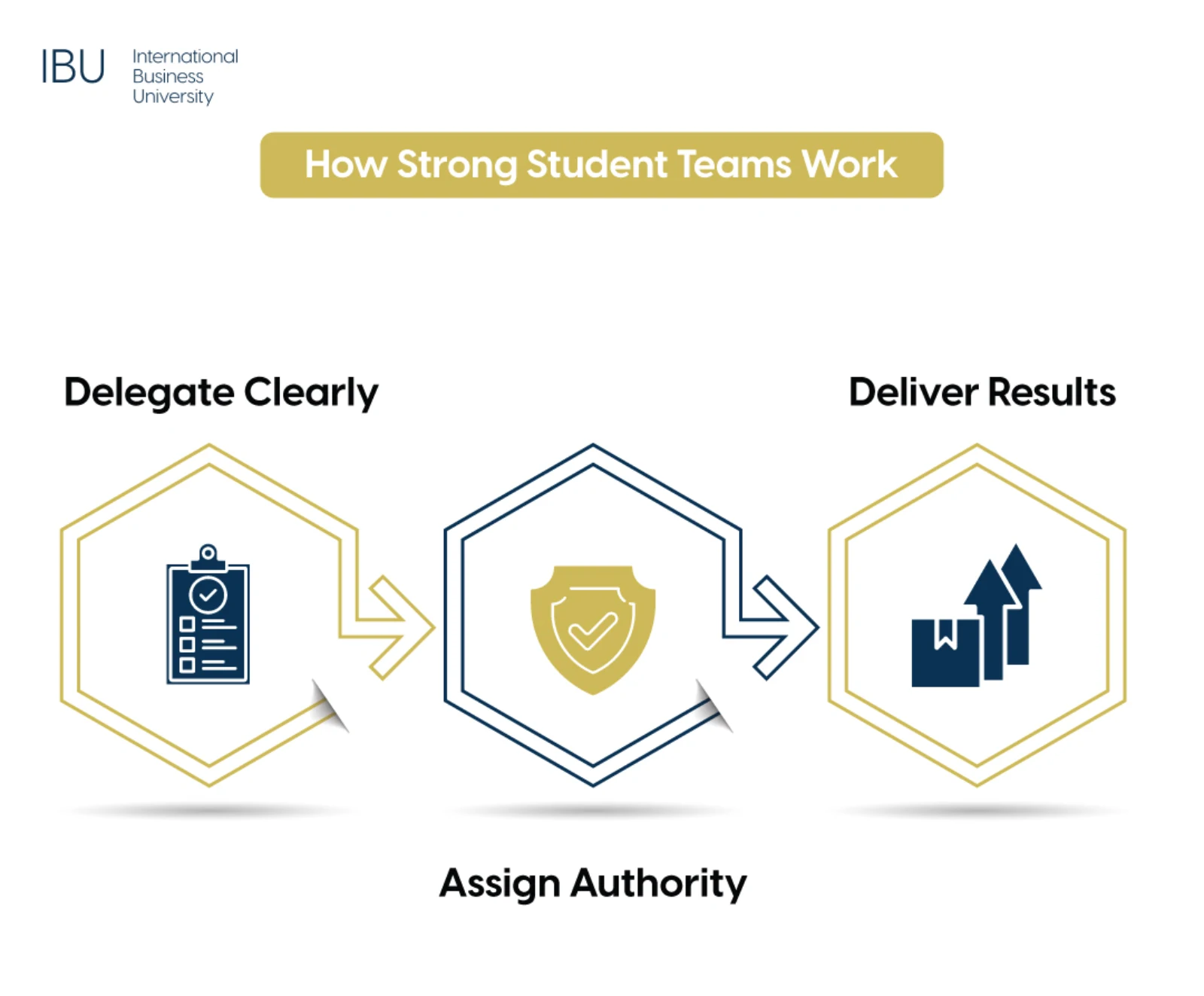
Delegation and authority in academia reflect the same principles used in organizations. Clear ownership. Defined decision power. Accountability aligned with outcomes.
Defining Delegated Tasks for Student Teams
A delegated task is not simply an assignment. It includes ownership, scope, deadline, authority limits, and success criteria. Many student teams assign tasks without defining these elements fully.
Incomplete delegation creates confusion later. Students may complete work that does not meet expectations. Others may hesitate to act due to unclear decision rights.
Clear delegated tasks eliminate these issues. Each student knows what they own, how quality gets evaluated, and when work reaches completion. This clarity improves time management and reduces last-minute stress.
Delegated tasks also support fairness. Visible ownership makes contribution measurable. Peer evaluation becomes more objective. Accountability strengthens naturally.
Examples of Authority and Leadership in Student Projects
Authority leadership examples appear in many student project roles. Project coordinators manage timelines and deliverables. Research leads approve sources and methodologies. Editors control content quality. Presentation leads decide structure and messaging.
Each role carries authority within a defined scope. These authority leadership examples prevent endless debate and stalled progress. Decisions move forward without consensus paralysis.
Leadership complements authority through encouragement, mediation, and motivation. Students without formal authority still contribute leadership by supporting peers and sustaining momentum.
How Authority Leadership Examples Motivate Effective Participation
Authority leadership examples motivate participation through clarity and predictability. Students know who decides and why. This transparency reduces passive behaviour and disengagement.
When authority feels fair and earned, trust grows. Students contribute ideas freely while respecting final decisions. Participation increases because expectations remain visible and consistent.
Authority applied responsibly strengthens confidence across the team. Authority applied inconsistently damages morale. Successful teams treat authority as coordination rather than control.
Strategies for Students to Delegate Authority and Responsibility
Delegation works only when it is intentional. Many student teams assign tasks casually, assuming coordination will happen naturally. In practice, this leads to confusion, uneven effort, and stalled progress. Effective delegation requires planning, clarity, and disciplined use of authority.
Students who learn how to delegate authority and responsibility develop coordination skills that mirror professional team environments. These strategies help convert group work into structured collaboration where expectations remain clear and outcomes improve.
Assigning Roles to Match Strengths and Interests
Role assignment sets the tone for the entire project. When roles align with strengths and interests, teams perform better with less friction. Skill-based delegation increases efficiency and engagement simultaneously.
Common student project roles include:
- Research lead responsible for sources, analysis structure, and credibility standards
- Project coordinator managing timelines, milestones, and follow-ups
- Content or writing lead ensuring clarity, flow, and consistency
- Presentation lead overseeing visuals, narrative structure, and delivery format
Assigning roles based on demonstrated ability builds confidence and trust. Students feel capable rather than pressured. Contribution becomes consistent instead of reactive.
Matching roles to strengths also reinforces business authority. Decision rights align with expertise. Teams spend less time debating choices and more time executing tasks effectively.
Setting Clear Expectations for Accountability
Accountability improves when expectations stay visible. Teams benefit from defining standards before work begins rather than correcting issues later.
Effective accountability structures include:
- Clear deliverables with defined completion criteria
- Agreed deadlines with interim checkpoints
- Ownership is assigned to specific individuals rather than groups
- A clear process for reviewing work and requesting revisions
Authority supports accountability by defining who evaluates progress and who addresses missed commitments. This removes personal tension from feedback and keeps discussions focused on outcomes.
When accountability remains visible, performance improves naturally. Students manage time more effectively. Quality increases without added pressure.
Communicating and Resolving Conflicts Using Authority
Conflict emerges when expectations differ or priorities collide. Authority provides a framework for resolution that prevents prolonged disagreement.
Effective use of authority in conflict situations involves:
- Listening to all perspectives before responding
- Restating the issue in neutral terms
- Explaining the decision logic clearly
- Acting decisively once input is gathered
Clear reasoning increases acceptance, even when opinions vary. Authority used with transparency preserves trust while keeping projects moving forward.
Respectful authority prevents tension from escalating. Teams maintain momentum rather than revisiting unresolved issues repeatedly.
Overcoming Challenges in Delegating Authority in Student Teams
Even well-organized teams face challenges. Authority and delegation introduce structure, yet human dynamics still require active management. Recognizing common obstacles allows teams to respond early instead of reacting under pressure.
This section addresses frequent challenges and practical ways students can manage them effectively.
Navigating Shared Decision-Making
Shared decision-making works well during idea generation and early planning. Execution requires defined authority to maintain progress.
Successful teams separate discussion from decision-making:
- Ideas are gathered collectively
- Options are evaluated openly
- Final decisions rest with the assigned authority
This structure preserves inclusion without slowing execution. Students practice decision-making models used in professional environments where consultation precedes action.
Clarity around decision ownership prevents frustration and repetition. Teams move forward with confidence rather than hesitation.
Addressing Unequal Participation and Authority Conflicts
Unequal participation often signals unclear delegation. Some students disengage when roles lack definition. Authority conflicts arise when responsibilities overlap or decision rights remain vague.
Teams should address these issues early by:
- Revisiting role definitions
- Clarifying ownership boundaries
- Reinforcing accountability expectations
- Reaffirming authority assignments
Authority exists to restore balance and protect morale. Addressing imbalance early prevents resentment and burnout.
Clear delegation reinforces fairness. Accountability restores trust. Teams regain alignment and momentum.
Learn to lead projects with structure and accountability
Build delegation, authority, and team coordination skills through a BCOM that prepares you to manage people, priorities, and outcomes with confidence
Practical Scenarios: Applying Delegation and Authority in Student Projects
Delegation and authority become meaningful when you see them in action. Student projects offer a controlled environment where roles, decisions, and accountability play out in real time. These scenarios show how clear authority paired with thoughtful delegation improves execution, reduces friction, and raises overall performance.
Each example reflects common academic project formats and highlights how small structural choices change outcomes dramatically.
Scenario One: Research-Heavy Group Assignment
Research-based projects often fail due to inconsistent sources, duplicated effort, and unclear direction. A four-person team avoids these issues by assigning one student as the research lead.
The research lead holds authority over source selection, research methodology, and content structure. This authority allows the lead to approve sources, reject weak references, and align findings with the project objective. Delegated tasks distribute data collection across the team, with each student responsible for specific subtopics.
This structure prevents conflicting research directions. Students avoid citing contradictory data or irrelevant material. Accountability stays visible because each delegated task has a defined owner and deadline. The research lead maintains quality control without completing every task personally.
The result is a cohesive analysis supported by credible sources. The team spends less time reconciling differences and more time refining insights.
Scenario Two: Presentation-Focused Capstone
Presentation-heavy projects often suffer from mixed messaging, inconsistent visuals, and last-minute changes. A team addresses this by appointing a presentation lead early.
The presentation lead holds authority over slide structure, visual consistency, and narrative flow. Other team members contribute content, examples, and supporting data. The lead reviews submissions and integrates them into a unified presentation.
This authority eliminates repeated revisions and prevents design debates close to deadlines. Decisions happen quickly. Expectations remain clear. Team members focus on content rather than formatting disputes.
Stress decreases because responsibility is visible. Confidence increases because the final presentation reflects a single voice rather than fragmented contributions. The team delivers a polished outcome that feels intentional rather than rushed.
Scenario Three: Long-Term Semester Project
Long-term projects introduce challenges related to momentum, coordination, and accountability over time. A project coordinator role solves these issues.
The coordinator holds authority over timelines, milestones, and progress tracking. This includes scheduling check-ins, monitoring deliverables, and addressing delays early. Delegation distributes workload evenly across phases, with clear task ownership at each stage.
Authority allows the coordinator to enforce deadlines without personal conflict. Decisions regarding scope changes or priority shifts happen promptly. The team avoids the common mid-semester slowdown.
Momentum stays steady across weeks. Accountability remains consistent. The project advances incrementally rather than relying on last-minute effort.
What These Scenarios Teach You
Across all three scenarios, the pattern stays consistent:
- Authority clarifies decisions
- Delegation defines ownership
- Accountability stays visible
- Quality improves without added stress
Students learn how authority supports coordination rather than control. Delegation empowers contribution rather than limiting it. These lessons mirror professional team dynamics and prepare students for environments where clarity drives results.
Academic Skills That Translate to Professional Authority
Delegation and authority practiced in student projects prepare you for environments where decisions carry weight and outcomes matter. Employers look beyond grades. They assess how you manage responsibility, how you work with others, and how you respond when clarity matters most. Academic projects provide a safe proving ground for these expectations.
When you apply authority and delegation effectively as a student, you build habits that transfer directly into professional roles. These habits shape how managers trust you, how teams rely on you, and how leadership opportunities appear earlier in your career.
Ownership and Accountability
Professional authority begins with ownership. Students who learn to take responsibility for outcomes demonstrate reliability under pressure. Ownership means completing a delegated task without reminders and addressing issues before they escalate.
Employers value individuals who treat assignments as commitments rather than suggestions. When you show accountability in academic teams, you signal readiness for roles where performance impacts results, timelines, and stakeholders.
Decision-Making Under Defined Authority
Clear authority trains you to make decisions within scope. In professional settings, authority often comes with boundaries. Knowing when to decide independently and when to escalate shows judgment.
Students who practice decision-making within assigned authority adapt faster in workplaces. They avoid hesitation and prevent delays. This skill strengthens confidence and earns trust from supervisors and peers alike.
Role-Based Collaboration
Delegation teaches you how roles function within a system. Professional teams rely on defined responsibilities rather than informal cooperation. Understanding how your role supports others improves collaboration.
Students experienced with role-based delegation integrate smoothly into structured teams. They respect boundaries, communicate clearly, and avoid stepping into areas without authority. This awareness reduces friction and improves execution quality.
Communication With Purpose
Authority requires clear communication. Students managing delegated responsibilities learn to share progress, flag risks, and request resources without overexplaining.
This skill transfers directly into professional environments where clarity saves time and prevents misunderstandings. Purposeful communication strengthens credibility and positions you as dependable rather than reactive.
Conflict Resolution Using Authority
Professional teams expect disagreements. Authority provides a framework for resolution. Students who practice addressing conflict through assigned authority develop composure and fairness.
Employers value individuals who resolve issues calmly and decisively. This skill supports leadership growth and reduces team disruption in high-pressure situations.
Time and Priority Management
Delegation trains you to manage priorities rather than tasks alone. Authority requires balancing timelines, dependencies, and expectations.
Students who develop this skill handle workload complexity more effectively after graduation. They plan proactively and deliver consistently without constant supervision.
Trust Building Through Consistency
Authority grows through consistency. Students who follow through on delegated responsibilities build trust quickly. Trust leads to increased responsibility.
In professional settings, consistent performance accelerates career growth. Teams rely on individuals who deliver predictably and uphold standards.
Independent Execution
Delegation teaches independence. Authority empowers execution. Students comfortable working autonomously transition smoothly into roles requiring self-direction.
Employers reward professionals who execute without constant oversight. This skill signals readiness for leadership paths and advanced responsibilities.
FAQ
How does delegation improve student project outcomes?
Delegation clarifies ownership and reduces confusion. Students focus on execution instead of coordination. Outcomes improve with less friction.
Can leadership exist without authority in student teams?
Leadership influences behaviour and morale. Authority controls decisions. Both contribute when aligned.
Why do authority conflicts arise in student projects?
Authority conflicts arise from unclear roles. Clear delegation prevents power struggles.
Nurture Effective Teamwork by Balancing Delegation and Authority
Strong student teams rely on balance. Delegation and authority provide structure without limiting collaboration. When you understand authority and delegation, teamwork becomes intentional instead of reactive.
Applying delegation and authority prepares you for environments built on accountability, execution, and leadership. These skills extend beyond coursework into careers shaped by responsibility and decision-making. Master delegation and authority now, and you position yourself as a contributor who delivers results, not excuses.
Apply delegation and authority in innovation-driven leadership
Strengthen your ability to lead teams, assign ownership, and scale ideas through an online MBA focused on technology innovation and entrepreneurship