
The challenges of online learning do not present the same way for a working professional pursuing an MBA as they do for a full-time campus student. Competing demands from career, family, and coursework create a different kind of pressure, and without a structured approach to managing them, even highly motivated students find their progress stalling mid-program. Understanding what each challenge looks like in practice is the first step toward managing it effectively.
Practical Strategies for Managing the Challenges of Online Learning
Students who perform well tend to plan further ahead, communicate more proactively with faculty, and protect their study time with more discipline than their peers.
The most effective online MBA students treat their academic schedule the same way they treat their professional commitments: with fixed blocks, measurable targets, and no tolerance for reactive planning. The following habits apply across all 10 challenges and form the foundation of a durable study system.
- Block study hours in your calendar and treat them as non-negotiable professional appointments
- Set SMART weekly goals, so progress stays visible when motivation dips
- Join a peer accountability group or virtual study session to recreate the social accountability of an in-person campus
- Communicate early and regularly with faculty to stay ahead of expectations rather than catching up to them
- Schedule deliberate breaks between study blocks: sustained output requires planned recovery, not just effort
- Prioritize sleep, exercise, and nutrition as part of your academic strategy, not as rewards for completing coursework
- Build digital fluency before the semester begins by learning your platform tools in advance rather than mid-assignment
Built for Working Professionals
IBU’s Online MBA programs are structured around flexible scheduling, live faculty access, and peer accountability from the first semester.
The 10 Challenges of Online Learning Every MBA Student Should Know
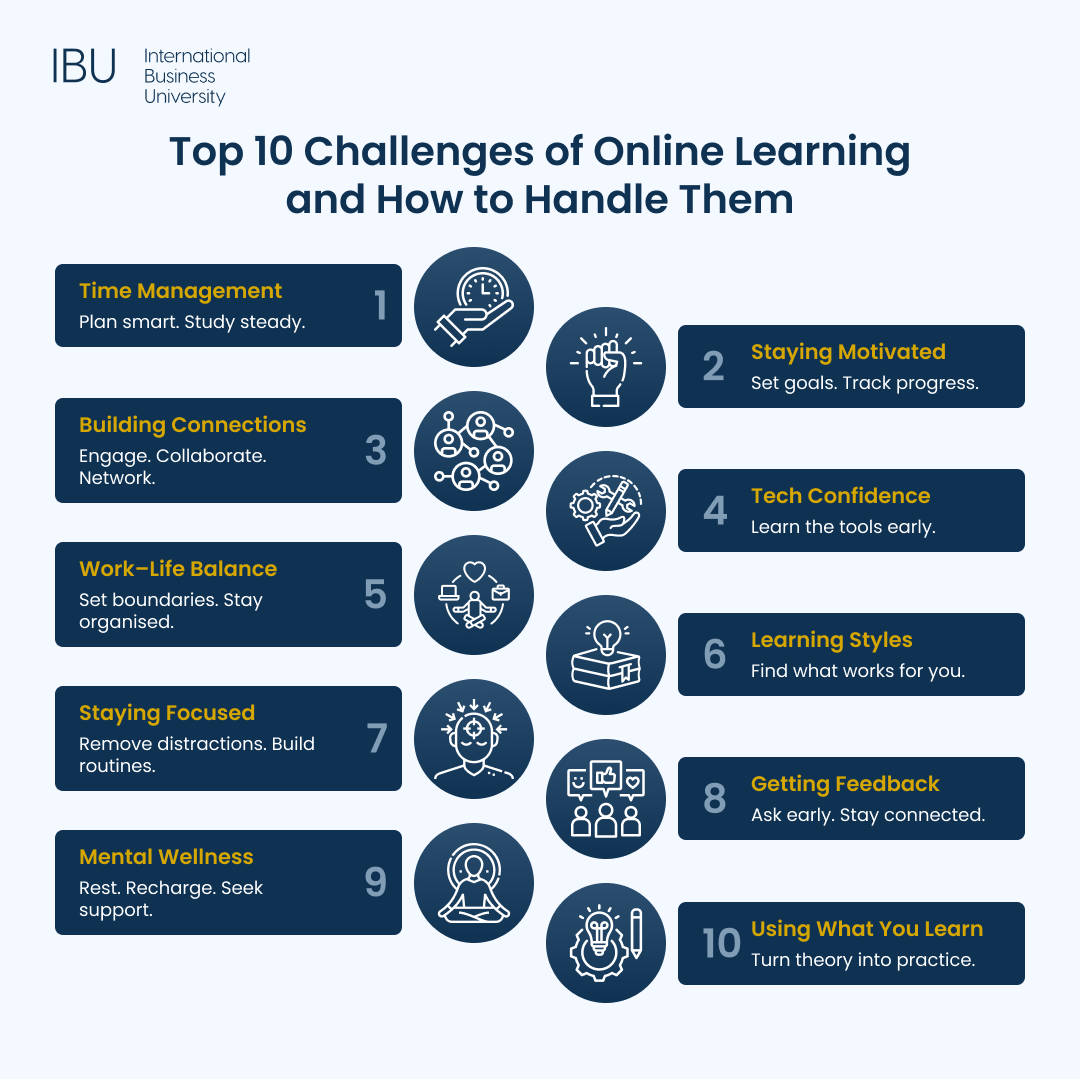
Every working professional who pursues an MBA online will encounter some version of the same 10 obstacles. How early you anticipate them and how deliberately you respond determines whether they slow your progress or sharpen your performance.
Challenge 1: Time Management
For MBA students managing careers, families, and coursework simultaneously, time is the scarcest resource in the program. The issue is rarely motivation. It is that professional obligations are reactive by nature, and academic deadlines do not flex to accommodate a demanding week at work.
Solution: Treat study time as a protected professional commitment rather than a discretionary activity. Build your weekly schedule around your study blocks. Use project management thinking: break assignments into components, assign each a time block, and review your plan each week to catch conflicts before they become crises.
Challenge 2: Staying Motivated
Without in-person classes, spontaneous conversations, and the physical environment of a campus, motivation in an online MBA must be internally generated and consistently maintained. For professionals who end a demanding workday before opening course materials, the default is disengagement.
Solution: Set goals at three levels: semester, month, and week. Visible progress against specific targets sustains momentum more reliably than general determination. Connecting your academic work directly to a concrete professional outcome (a promotion, a career transition, a business decision) keeps the degree anchored to a purpose that outlasts any single difficult week.
Challenge 3: Building Connections
One of the most significant challenges of online learning for MBA students is the absence of organic professional networking. In a physical program, relationships form through shared spaces, incidental conversations, and recurring proximity. Online, those relationships require deliberate effort to initiate and maintain.
Solution: Treat your cohort as a professional network from day one. Participate in every discussion forum, contribute to group projects with the same standard you apply to professional deliverables, and attend virtual events as you would a career conference. The professional relationships that emerge from a well-engaged online MBA are as durable as those built in person, but only for students who invest in them deliberately.
Challenge 4: Tech Confidence
Digital literacy gaps are among the less-discussed challenges for MBA students entering online programs, particularly for professionals who have been in the workforce for years without needing to master academic learning platforms, collaboration software, or virtual presentation tools.
Solution: Build your tech confidence before the semester starts. Most programs provide platform access during orientation. Spend that period learning your tools to the point where they are invisible during coursework. Technical friction mid-assignment is not just frustrating; it consumes the mental bandwidth you need for the actual learning.
Academic Support When You Need It
IBU students access 24/7 wellness resources, faculty mentorship, and flexible deadlines built into every Online MBA program.
Challenge 5: Work-Life Balance
Balancing professional responsibilities, academic expectations, and personal commitments is among the most consistently reported challenges of online learning for MBA students. The flexibility of online study can blur the boundary between work time, study time, and recovery time until all three compete for the same hours.
Solution: The solution is explicit boundaries rather than flexible intentions. Define your study hours, communicate them to your household and employer where relevant, and protect them with the same firmness you apply to client meetings. An online MBA demands more self-management than a campus program, not less. The schedule simply belongs to you.
Challenge 6: Learning Styles
Online learning platforms standardize delivery in ways that physical classrooms do not. Not every MBA student absorbs material the same way, and the format of an online program may not immediately align with how a particular student learns most effectively.
Solution: Identify your dominant learning mode early and adapt the platform to serve it. If you retain more from audio, play lectures at adjusted speed and record verbal summaries. If you are a visual processor, convert notes into diagrams before reviewing them. The platform is a tool; how you use it determines whether it supports or constrains your performance.
Challenge 7: Staying Focused
Home environments are filled with competing demands: professional notifications, family obligations, and the absence of the social pressure that a physical study space creates. Distraction in an online MBA is structural, not a reflection of commitment.
Solution: Designate a specific workspace and a specific study time, and use both consistently. The brain learns to associate environment and time with focused output when those conditions are repeated. Students who study across multiple environments at irregular times consistently report lower productivity than those who build and protect a single, predictable routine.
Challenge 8: Getting Feedback
In a physical classroom, feedback is immediate. Questions get answered in real time, and a professor’s response to a contribution calibrates your approach on the spot. Online learning delays this cycle, and without proactive management, students can spend weeks uncertain about whether their work meets the expected standard.
Solution: Ask early and specifically. Do not wait for a graded assignment to gauge your alignment with course expectations. Submit a partial draft for comment, attend office hours before a deadline, and use feedback from early assessments to recalibrate before the high-stakes work arrives. The students who perform best in online programs are not always the strongest writers. They are the most consistent communicators.
Challenge 9: Mental Wellness
The sustained pressure of managing a career, personal obligations, and an MBA simultaneously creates a mental load that does not announce itself until it becomes a problem. Fatigue, reduced motivation, and anxiety tend to peak mid-semester, precisely when academic demands are highest.
Solution: Build recovery into your schedule before you need it. At least one activity per week entirely disconnected from work and study is not optional: it is part of the system that makes consistent performance possible. Access available counseling and support services early if pressure builds rather than waiting until it has affected your coursework or your relationships.
Challenge 10: Using What You Learn
Translating MBA coursework into professional application is one of the least discussed but most important challenges of online learning. Students who treat theory as abstract content disconnected from their current role miss the compounding benefit of an MBA: the ability to apply each concept directly as it is learned.
Solution: Connect every major topic to a decision, project, or problem you are currently managing at work. A strategic framework applied to a team challenge, or a financial model used to evaluate a business case you are already handling, converts academic content into professional judgment. That conversion is where the lasting value of the degree is built.
MBA Program Challenges and Opportunities in Online Education
The next decade of business education is digital, and that shift creates both demands and advantages for working professionals. Flexible scheduling, asynchronous learning, and cross-border peer groups expand access to high-quality MBA education in ways that were not possible a generation ago.
The challenges of online learning and the opportunities it creates are not separate phenomena. Managing those demands well, keeping pace with coursework while staying effective at work, building professional connections remotely, and applying theory before it fades, develops exactly the judgment that Canadian employers expect from MBA graduates. The skills you build managing the format are often as valuable as the content itself.
Selecting a program that acknowledges both sides of that equation, one that provides rigorous academic content alongside practical support structures, is the decision that determines whether an online MBA produces the career outcomes you enrolled for.
What Getting Through the Challenges of Online Learning Actually Builds
The challenges of online learning are consistent across programs and student profiles, but they are not permanent obstacles. Every student who completes an online MBA has moved through each of these ten challenges and built a professional discipline in the process that extends well beyond the degree itself.
Understanding what makes online study difficult is the first step, and reviewing the advantages of online MBA programs in Canada gives the full picture of what working professionals gain alongside the demands they manage.
Key Takeaways

The challenges of online learning in an MBA are predictable, and students who prepare for them before the semester begins consistently outperform those who respond reactively mid-program.
Time management, sustained motivation, and building professional connections online are skills you develop by repeating them deliberately, not by wanting them strongly enough.
What you develop managing an online MBA alongside a career, keeping pace, applying theory before it fades, and communicating clearly under deadline pressure, is the same professional judgment that separates strong MBA graduates from average ones.
Take the Next Step
IBU’s Online MBA programs are designed for professionals who need flexibility, structure, and career-relevant learning without interrupting their income.
Frequently Asked Questions
How hard is an MBA online compared to an in-person program?
An online MBA requires the same academic rigor as an in-person program but demands stronger self-discipline, time management, and digital communication skills. Most students find the difficulty comes not from the coursework itself but from managing study alongside professional and personal obligations without the structure of a physical campus.
What are the biggest challenges for MBA students studying online?
The challenges for MBA students in an online program most consistently include time management, sustaining motivation without in-person interaction, building professional connections remotely, and applying theoretical content to active professional roles. Each is manageable with deliberate structure but rarely resolves without an intentional approach before the semester begins.
How do online MBA students stay motivated without a physical campus?
Motivation in an online MBA is sustained through structured schedules, peer accountability groups, and regular engagement with faculty through office hours and live sessions. Students who treat their study blocks as professional commitments and track weekly milestones report significantly higher engagement throughout the program.
Can you build a professional network through an online MBA?
An online MBA produces a strong professional network when the program includes structured group projects, virtual events, and industry-connected faculty. The network differs in format from an in-person program but is equally valuable when students engage deliberately with their cohort and alumni community from the start.
Is an online MBA respected by employers in Canada?
Canadian employers evaluate MBA credentials primarily by the accreditation and reputation of the institution rather than the delivery format. An online MBA from an accredited institution with strong career outcomes carries the same weight as an in-person equivalent when the program content and graduate results are comparable.