
Every hospital runs on two ladders. Clinicians climb one, from new nurse or resident to head of a department. The other ladder belongs to the people who run budgets, staffing, projects, and systems, and most students never hear it named.
That second ladder is where healthcare management careers live. You do not need a medical degree to climb it. You need business judgment, a working knowledge of how health systems are funded and regulated, and a credential that tells employers you can manage people and money in a setting where mistakes reach patients.
Below, we map the rungs of healthcare management careers: what the work involves, which roles MBA graduates step into, what the Government of Canada reports for pay, and how to test if an MBA in Healthcare Management fits your plans for 2027.
Key Takeaways
The short version, drawn from the sections below:
- Two ladders: Healthcare management careers sit beside clinical careers and reward business skill over medical training.
- Three paths: Most healthcare management careers for MBA graduates run through administration, project work, or digital health.
- Pay benchmark: Job Bank lists a Canada median of $55.29 an hour for clinical services managers.
- Credential first: IBU’s MBA in Healthcare Management runs 16 months across four semesters and 42 credits.
- Experience counts: Coordinator, analyst, and administrative roles before graduate school give the MBA something to build on.
- Fit test: The degree suits people who want to manage systems, budgets, and teams instead of patient care.
What Does a Career in Healthcare Management Involve? Running the System Around the Patient
Healthcare management is the business of keeping care delivery funded, staffed, compliant, and on schedule. A clinician decides how to treat a patient. A healthcare manager decides how many beds stay open on a Tuesday night, which supplier wins a contract, and how a new scheduling system rolls out without stalling the emergency department.
In practice, healthcare management careers look like management careers in any large organization, except that a bad call shows up in wait times and patient safety. Most roles combine four kinds of responsibility.
- Operations: Scheduling, patient flow, supply chains, and the daily problems that slow a unit down.
- Finance: Budgets, cost control, and funding requests in a system shaped by public funding.
- People: Hiring, coaching, and leading teams that mix clinical and non-clinical staff.
- Compliance: Privacy law, accreditation standards, and quality reporting that every department must meet.
THE SECOND LADDER NEEDS NO STETHOSCOPE
You can build healthcare management careers without clinical training. Employers hire for budgeting, operations, and people leadership, then expect you to learn the clinical setting quickly. A clinical background helps you learn faster, and it is optional.
The leadership side of these jobs has its own skill set, which we cover in our guide to leadership skills in healthcare. Here, the focus stays on healthcare management careers themselves and the credential that opens them.
Map Your Management Ladder
See the courses behind each career stage.
Healthcare Management Careers for MBA Graduates: Hospital Administration Careers and Two Other Ladders
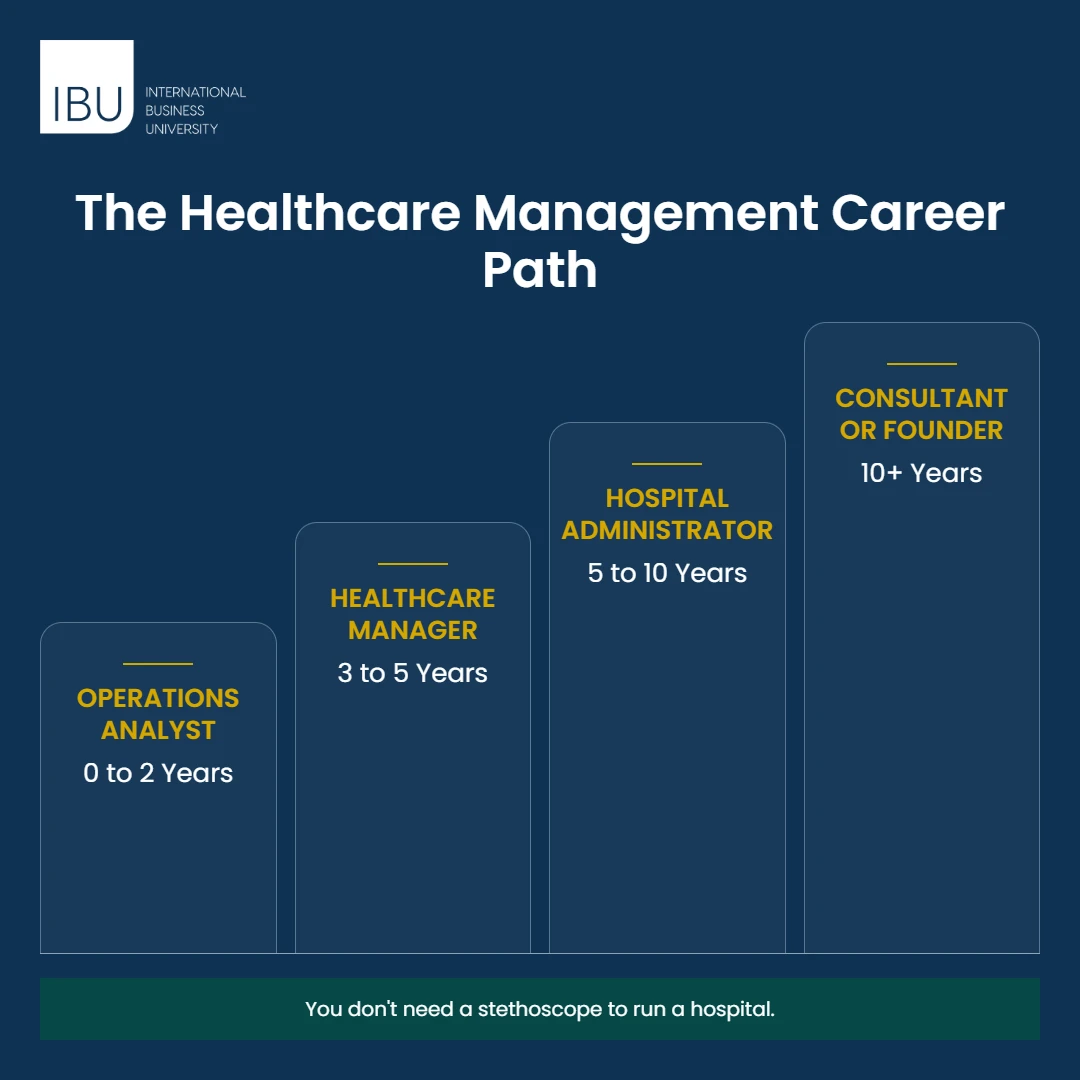
IBU’s own program page lays out the climb in stages. The table reproduces the career stages listed on the IBU MBA in Healthcare Management program page.
| Career stage | Example roles listed by IBU |
|---|---|
| 0 to 2 years (Early Career) | Healthcare Operations Analyst; Clinical Data Coordinator; Hospital Administrative Assistant |
| 3 to 5 years (Mid-Career) | Healthcare Manager; Policy Analyst; Director of Quality & Patient Experience |
| 5 to 10 years (Senior Level) | Chief Operating Officer (COO); Hospital Administrator; Vice President, Health Systems |
| 10+ years (Entrepreneurship or Consulting) | Founder of Healthcare Startups; Healthcare Management Consultant |
Those titles cluster into three MBA healthcare management career options. Each one uses the same business core, and each rewards a different strength.
Hospital Administration Careers Reward Operations and Finance Skills
Hospital administration careers are the most familiar rung of healthcare management careers. Administrators run departments, programs, or whole sites, and they answer for budgets, staffing levels, and service targets.
Promotion on this ladder tends to follow evidence: a unit that came in on budget or a wait list that shrank. Courses such as Managing Healthcare Organizations and Systems and Accounting and Financial Management for Healthcare, both part of IBU’s program, map directly onto that work and onto the healthcare management careers that follow it.
The Healthcare Project Manager Owns Change From Plan to Launch
Hospitals change constantly: a new patient record system, a renovated wing, a merged lab. A healthcare project manager owns that change, from scope and budget to the day staff start using the new process. Among healthcare management careers, this path suits people who like deadlines and cross-team coordination more than steady daily operations.
Healthcare project managers spend most of their week on four tasks:
- Scope: Agreeing with clinical and executive sponsors on what the project will and will not deliver.
- Budget: Tracking spend against approved funding and flagging overruns early.
- Stakeholders: Keeping physicians, nurses, IT, and finance aligned when their priorities conflict.
- Adoption: Training staff and checking that the change sticks after launch.
A PROJECT ENDS. A PROGRAM DOES NOT.
A healthcare project manager delivers a defined change by a set date, then hands it off. A hospital administrator runs the service that change lands in, every day after. Knowing which of the two you prefer saves years of drifting between ladders.
For certifications and a step-by-step route into this role, see our guide on how to become a healthcare project manager.
Digital Health and Data Leadership Puts You Between Clinicians and Vendors
Health systems buy a great deal of software, from scheduling platforms to virtual care tools. Digital health leaders decide what to buy, negotiate with vendors, and get clinicians to use it. They turn clinical needs into business requirements and business limits back into clinical terms.
Courses such as Information Technology and Digital Transformation give MBA students the vocabulary for these healthcare management careers. Expect more time on contracts, privacy rules, and staff adoption than on code.
How Much Do Graduates Earn? Healthcare Management Salary Canada Data From Job Bank
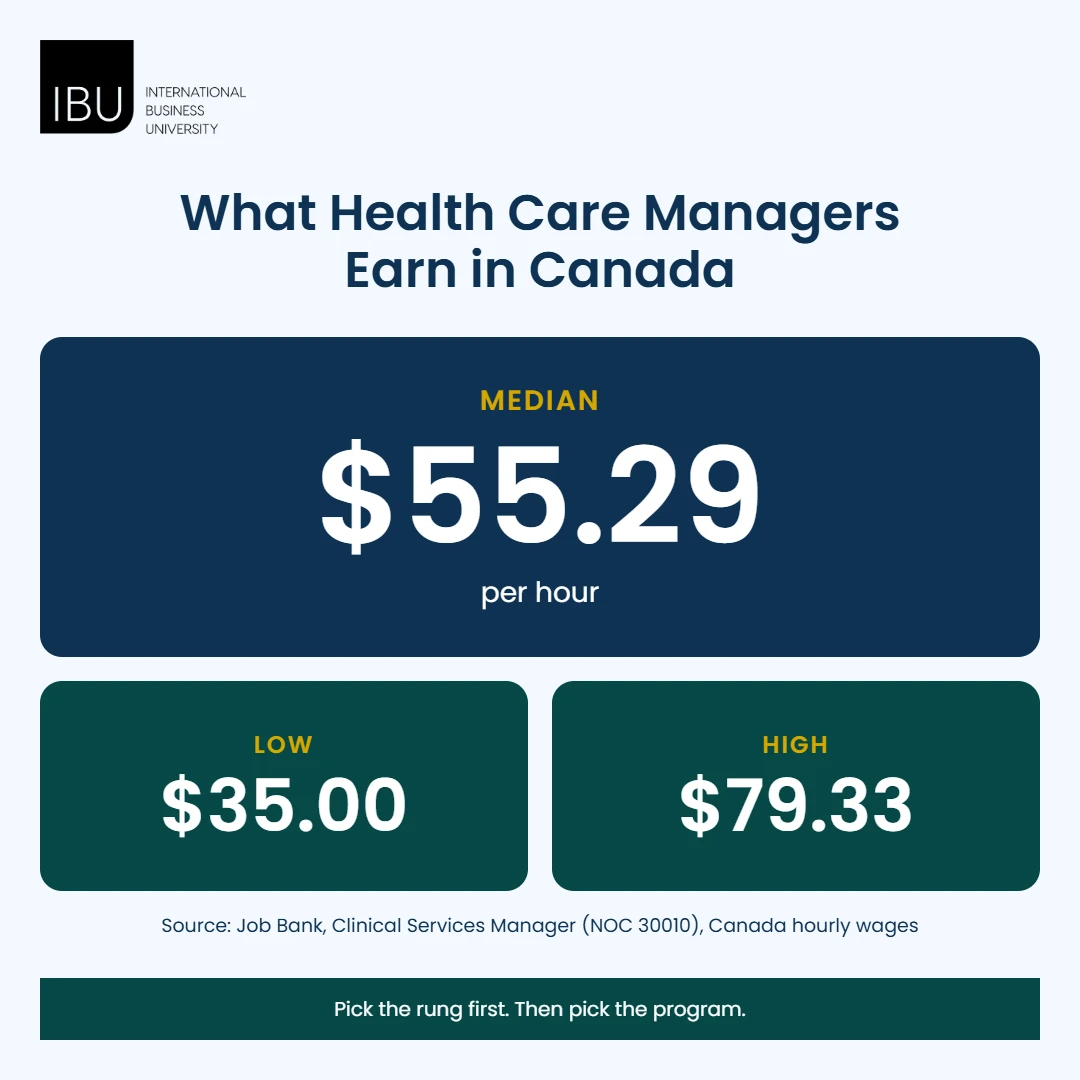
Pay is where many searches start, and healthcare management salary canada figures need careful reading. The Government of Canada’s Job Bank publishes wages for clinical services managers, an occupation it groups under NOC 30010, Managers in health care. According to Job Bank wage data for clinical services managers, the Canada-wide median hourly wage is $55.29, with a low of $35.00 and a high of $79.33, based on Statistics Canada’s Labour Force Survey for the 2023-2024 reference period.
Healthcare Management Salary Canada Figures by Province
Job Bank also breaks the same occupation down by province. The table shows a selection of hourly wages exactly as Job Bank reports them.
| Area | Low ($/hour) | Median ($/hour) | High ($/hour) |
|---|---|---|---|
| Canada | 35.00 | 55.29 | 79.33 |
| Ontario | 35.90 | 56.00 | 87.18 |
| British Columbia | 34.00 | 55.68 | 84.13 |
| Alberta | 37.00 | 54.95 | 75.00 |
| Quebec | 30.00 | 55.29 | 66.00 |
| Nova Scotia | 38.97 | 56.00 | 78.00 |
Ontario’s median of $56.00 an hour sits close to the national figure, and its high of $87.18 is the widest in the table. The gap between the low and high columns is the ladder in numbers.
READ THE WAGE TABLE CAREFULLY
Job Bank figures are hourly wages for an occupation, and they are not starting salaries for MBA graduates. They come from survey data for 2023-2024, so treat them as a benchmark for 2027 planning. Your own pay will depend on employer, region, and the rung you enter on.
Senior titles such as Hospital Administrator may be classified under different occupation codes, so use the NOC 30010 figures to set expectations for mid-ladder healthcare management careers, then check current postings for the role you want.
How to Become a Healthcare Manager or Healthcare Project Manager
Two things move you onto the management ladder: a business credential and experience inside a health setting. The strongest candidates for healthcare management careers can point to both.
Education Requirements: Step One in How to Become a Healthcare Manager
If you are researching how to become a healthcare manager, start with the degree question. Entry-level coordinator and analyst roles usually ask for a bachelor’s degree, and moving into management often means adding graduate business training such as an MBA. The IBU healthcare management MBA sets out its format and requirements on the program page:
- Admission: A recognized bachelor’s degree, plus recommendations, a statement of intent, and language proficiency.
- Length: 16 months over four semesters, totalling 42 credits.
- Specialization courses: Regulatory Environments, Ethics and CSR; Accounting and Financial Management for Healthcare; Operations and Quality Management for Healthcare.
- Capstone: A choice of a Consulting Project, Business Plan development, or a Major Research Paper.
- Intakes: January 6, May 5, and September 8, 2027.
For people who need to keep working full-time, IBU also offers an online MBA in Healthcare Management as a separate format option.
Plan Your Next Rung
Compare program courses with the roles you want.
Building Experience Before Graduate School
An MBA lands harder when you bring a few years of work to it. Any role near health operations counts toward healthcare management careers: a clinic front desk, a scheduling team, an insurer’s claims unit, or a health technology vendor. Three habits make that experience easier to use later.
- Keep numbers: Write down the budgets, patient volumes, and wait times you touched, so your résumé shows scale.
- Volunteer for projects: Ask to join any system rollout or process change, since project work transfers directly to management roles.
- Learn the rules: Read your employer’s privacy and quality policies, which management interviews often probe.
BRING A PROBLEM TO THE MBA
Students who arrive with a specific operational problem from their own workplace get more from case work and the capstone. A scheduling bottleneck or a stalled software rollout gives every course a test case.
Clinicians who move into management face their own set of hurdles, which we outline in leadership challenges in the healthcare industry.
Is an MBA the Right Fit? Test Your MBA Healthcare Management Career Options First
An MBA is a large commitment of time and money, so test your fit with healthcare management careers before you apply. Answer these four questions honestly:
- Systems over cases: You would rather fix why a clinic runs late than see the patients who wait.
- Comfort with numbers: You can read a budget and are willing to defend one in a meeting.
- Appetite for rules: Privacy law, accreditation, and public funding limits interest you more than they frustrate you.
- Time horizon: You are planning for the 3 to 10 year rungs on IBU’s list, beyond the first job.
If most answers point the same way, an MBA turns healthcare management careers from a vague interest into a sequence of roles you can plan for. Mixed answers are useful too: they suggest a year of operations experience first.
Test Your Fit Further
Ask admissions about intakes and requirements.
Frequently Asked Questions
Is an MBA in Healthcare Worth It?
The value depends on the rung you are aiming for. Job Bank reports a Canada median of $55.29 an hour for clinical services managers, and an MBA is one direct route into management roles at that level. The degree pays off most for people who plan healthcare management careers built around budgets, teams, or projects.
Is an MBA in Healthcare Management a Good Career Option?
For people drawn to the business side of health, it is a strong option because it opens three distinct ladders: administration, project management, and digital health leadership. Healthcare management careers also build skills that transfer to insurers, consultancies, and health technology firms. The fit depends on how much you enjoy budgets, rules, and people leadership.
What Is the Scope of MBA Healthcare Management Career Options?
The scope runs from analyst and coordinator roles early on to director, administrator, and executive roles later. IBU’s program page lists roles from Healthcare Operations Analyst early on through Vice President, Health Systems at the senior level. Hospitals, clinics, long-term care homes, public agencies, and health technology firms all hire for healthcare management careers.
How Do You Become a Healthcare Manager?
Most people combine a bachelor’s degree, a few years of operations experience in a health setting, and graduate business training such as an MBA. Coordinator, analyst, and project roles are common first rungs in healthcare management careers. From there, promotion follows evidence that you can run a budget, a team, or a change.
What Is Healthcare Management?
Healthcare management is the business side of health care: operations, finance, staffing, compliance, and change. Managers keep care delivery funded, staffed, and run to standard, while clinicians focus on treating patients. All healthcare management careers in this guide sit inside that field.
For a BBA Student, Is an MBA in Healthcare Management a Good Choice?
A BBA gives you the business base, and a healthcare MBA adds sector knowledge such as health regulation, healthcare finance, and quality management. Many BBA graduates get more from the degree after a year or two of work in a health setting, so the case work connects to something they have seen. IBU’s MBA in Healthcare Management asks for a recognized bachelor’s degree, among other requirements.
Choose Your Ladder Before You Choose Your Intake
Healthcare management careers sit on a second ladder beside clinical work, and they reward business skill applied under health-sector rules. Hospital administration, project management, and digital health leadership are the three main paths for MBA graduates. Job Bank’s median of $55.29 an hour for clinical services managers gives you a Canadian pay benchmark, with wide variation by province and rung. The route in combines a credential with experience, and the fit depends on your appetite for budgets, rules, and teams.
Your next step this week: pick one role from IBU’s career-stage table, find three current Canadian job postings for it, and list the skills they share. That list tells you which rung of healthcare management careers to aim for first and what to ask admissions before the January, May, or September 2027 intake.
Start Your Climb
Choose your 2027 intake and apply.