
Every day involves hundreds of decisions, from small ones like what to eat to consequential ones like which career path to pursue or how to handle conflict. The difference between a decision you stand behind and one you regret often comes down to a single variable: letting logical thinking lead rather than letting an emotional reaction take over.
As a student, this challenge is constant. Deadlines, social pressure, financial stress, and the weight of building your future push your brain toward what feels urgent rather than what makes long-term sense. You react instead of respond. You choose comfort over growth. You let feelings override facts.
The following sections explain the science behind logical thinking and emotional decision-making, what happens in your brain under stress, why facts and feelings both matter in high-stakes moments, and how to build decision-making and logical reasoning skills that hold up under pressure.
In business and leadership environments, logical thinking becomes a core professional skill. Managers, analysts, and entrepreneurs rely on structured reasoning to evaluate data, manage risk, and guide strategic decisions.
Key Takeaways:
- Logical thinking uses evidence, structure, and long-term consequences to guide decisions, while emotional reactions prioritize immediate relief and comfort over rational outcomes.
- Stress narrows your focus, amplifies feelings, and pushes you toward impulsive choices unless you intervene with deliberate strategies.
- Building decision-making skills through structured frameworks and self-awareness gives you control over outcomes in academics, careers, and relationships.
What Is Logical Thinking?
Logical thinking is the process of analyzing information, identifying patterns, weighing options, and arriving at conclusions based on evidence rather than impulse. It is structured and deliberate. It asks: What do the facts say? What are the consequences? What makes sense given the data?
When you use logical thinking, you separate what you know from what you feel. You consider multiple outcomes. You test assumptions. You do not jump to the first answer that reduces anxiety; you work through the problem in sequence.
Here is what that looks like in practice:
Scenario: You receive a low grade on a midterm.
Emotional reaction: “I am terrible at this subject. I should drop the class.”
Logical thinking: “This grade represents one assessment. I scored well on assignments. I can review what went wrong, adjust my study approach, meet with the professor, and improve on the final.”
Logical thinking does not ignore emotions. It acknowledges them, then moves past them to evaluate reality. It is a skill you build through practice, not a personality trait you are born with. The more you practice separating feelings from facts, the stronger your logical reasoning skills become.
Students who develop logical thinking early gain an advantage in academics, job searches, and career decisions. You make decisions grounded in strategy rather than panic. You build a reputation for sound judgment. You avoid the regret that comes from letting temporary feelings dictate permanent choices.
The brain’s prefrontal cortex handles logical thinking. It manages planning, reasoning, and evaluating consequences. When stress hits, the amygdala takes over. That is when logical thinking becomes harder. The goal is to train yourself to re-engage the prefrontal cortex even when your emotions are loud.
What Is Emotional Decision Making?
Emotional decision-making happens when feelings drive your choices. Fear, anger, excitement, sadness, relief, these emotions override analysis. You act to reduce discomfort, not to solve the problem.
Emotional decision-making is not always wrong. Your gut instinct can protect you. If you sense danger, your brain’s alarm system reacts fast, bypassing slow analytical processes. That response is useful in genuine emergencies.
The problem arises when emotional decision-making becomes your default mode in situations that require careful thought. You quit a project because it feels difficult. You avoid a conversation because confrontation creates anxiety. You choose a major based on family expectations rather than your actual strengths. You say yes when you mean no to avoid disappointing someone.
Here’s the pattern:
Trigger: Something uncomfortable happens (criticism, failure, uncertainty).
Feeling: You experience a strong emotion (shame, fear, frustration).
Reaction: You make a choice to eliminate the feeling as quickly as possible.
Outcome: The immediate discomfort fades, yet the underlying problem remains, and sometimes grows.
Emotional decision-making feels productive in the moment. You took action. You moved forward. Yet, if that action wasn’t grounded in facts, you’ve likely created new problems. You dropped a class you could have passed. You sent an angry email you can’t unsend. You committed to something you don’t have time for.
Students are especially vulnerable to emotional decision-making. You are navigating high stakes with limited experience, managing social comparison, financial pressure, academic demands, and identity formation simultaneously. The brain does not reach full executive function until the mid-20s, which makes impulse control and long-term planning harder than they will be later.
The key is recognizing when emotions are driving. Once you see it, you can pause and choose to engage rational thinking before you act. That pause is where logical decision-making operates.
Logical Thinking vs Emotional Reactions in Decisions
The tension between logical thinking and emotional reactions plays out constantly in student life. You are writing a paper due tomorrow but cannot focus. The emotional reaction is to watch videos to escape the anxiety. The logical response is to break the paper into small tasks, write for 20 minutes, take a break, and repeat.
You get into an argument with a roommate. The emotional reaction is to send a harsh message immediately. The logical response is to step away, let the emotion settle, and revisit the conversation when you can discuss the issue without attacking.
You are offered an internship that pays well, but the work does not align with your career goals. The emotional reaction is to take it because money feels urgent. The logical response is to weigh the opportunity cost; what else could you do with that time that builds relevant skills?
The difference is not that logic is good and emotion is bad. Both carry information. Emotions tell you what you care about, what threatens you, and what excites you. Logical thinking helps you interpret that information and decide what to do with it.
Here is a five-step framework for working through decisions under emotional pressure:
- Step 1: Notice the emotion. Name it. “I feel anxious about this decision.”
- Step 2: Ask what the emotion is protecting. “I’m afraid of failing. I’m worried about judgment.”
- Step 3: Separate the feeling from the facts. “What do I actually know? What evidence do I have?”
- Step 4: Evaluate options based on outcomes, not comfort. “Which choice serves my long-term goals?”
- Step 5: Decide and act. “I’ll choose the harder path because it builds the skills I need.”
This process does not disregard emotion; instead gives logic a seat at the table. Research published in Psychological Science found that people who integrate emotional awareness with analytical thinking make better decisions than those who rely solely on one approach. Emotional intelligence for students is not about suppressing feelings; it is about managing emotional reactions so they inform choices rather than dictate them.
How Stress and Decision Making Affect Students
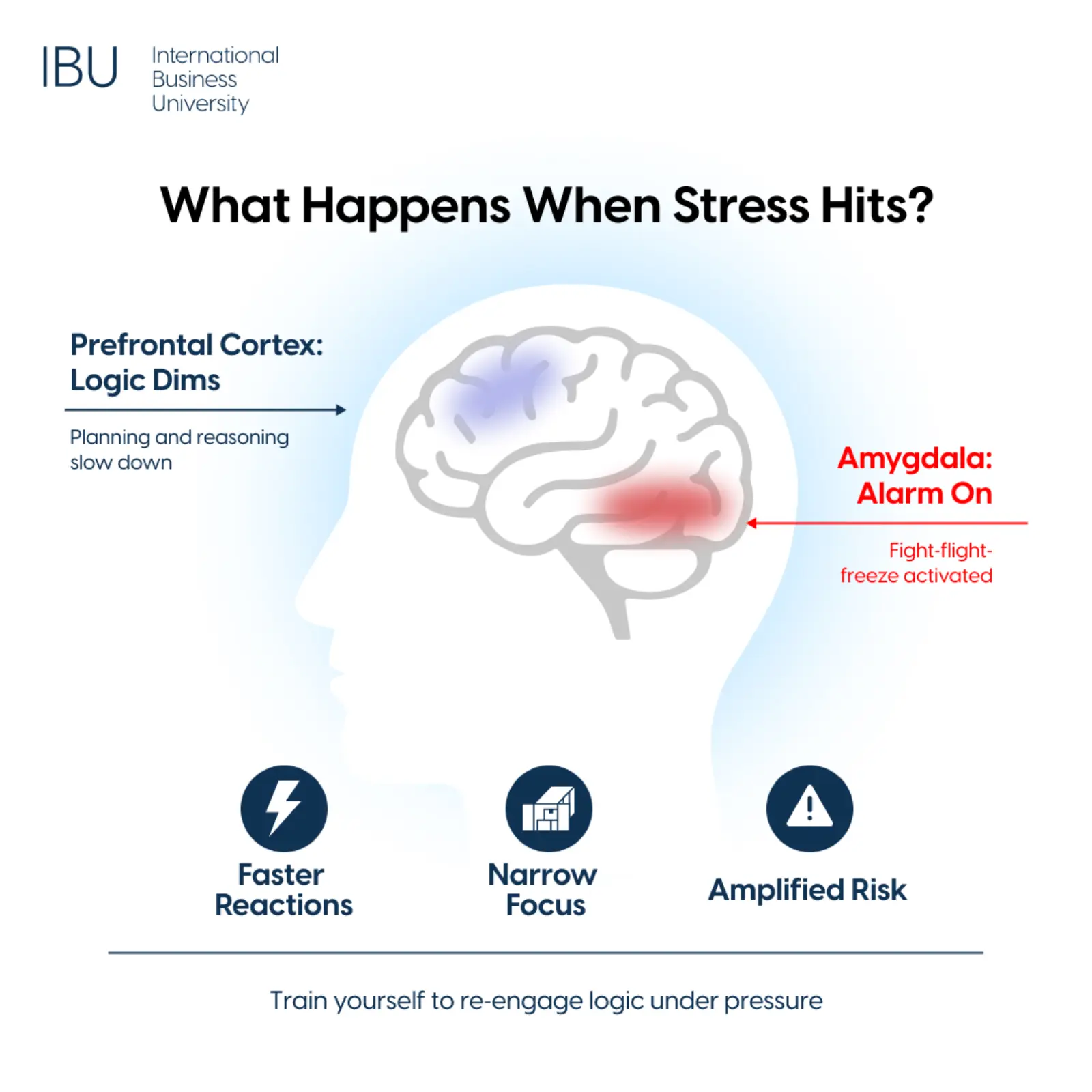
Stress changes how your brain processes decisions. Under pressure, deadlines, exams, financial worries, and relationship conflicts, your body enters a heightened state. Cortisol floods your system. Your heart rate increases. Your focus narrows.
This is your brain’s survival mechanism. In a genuine emergency, stress helps you react quickly. You do not need to analyze every option when you are in immediate danger. The problem is that your brain cannot always distinguish between a physical threat and a looming final exam. It treats both as threats. Stress and decision-making create a loop: stress narrows your thinking, which leads to poor decisions, which creates more stress.
Here is what happens neurologically:
- Amygdala activation: The amygdala activates.
This is your brain’s alarm center. It scans for threats and triggers the fight-flight-freeze response.
- Prefrontal cortex reduction: The prefrontal cortex dims.
This is where logical thinking, planning, and self-control operate. Under stress, blood flow shifts away from this area. You are primed to react, not think.
- Working memory reduction: Working memory shrinks.
Stress reduces your ability to hold and process information. You forget details, miss obvious solutions, and fixate on the first option that feels safe.
- Negative bias: Negative bias amplifies.
Your brain becomes hypervigilant to risk. You overestimate danger and underestimate your capacity to handle it.
Students experience this constantly. You are preparing for an exam, and every outcome feels catastrophic. You are deciding between job offers, and you freeze because both options seem risky. You are managing multiple deadlines and cannot prioritize because everything feels equally urgent.
The result is decisions that prioritize short-term relief over long-term benefit. You procrastinate to escape discomfort. You avoid difficult conversations. You choose paths that feel safe rather than paths that challenge you.
You can interrupt this cycle. Problem-solving under pressure improves when you recognize stress, name it, and deliberately re-engage your prefrontal cortex. Deep breathing, physical movement, and structured decision frameworks restore logical thinking even when emotions are running high.
When stress hits, pause. Take three deep breaths. Ask yourself: What is the actual threat here? What do I control? What is one small action I can take right now? This reset moves you from reactive to responsive.
Build the skills that define leaders.
• Turn insight into action. Lead with confidence.
• Make choices that drive real results.
Facts vs Feelings: Why People React Emotionally
Your brain processes feelings faster than facts. Emotions are immediate; they do not require analysis. Facts require effort. You have to gather information, interpret it, and weigh it against alternatives.
This speed difference explains why feelings often take over in decision-making. When you face a choice, your emotional system fires first. It tells you: this feels wrong, this feels scary, this feels exciting. Your logical system lags behind, trying to catch up with data and reasoning.
Here is a practical example: you are writing a cover letter for a job you want. You know the logical approach; research the company, highlight relevant skills, customize the content. But you feel intimidated. You doubt your qualifications. That feeling pushes you toward procrastination or copying a generic template. Neither serves you.
Facts vs feelings is not about eliminating emotion. It is about recognizing when feelings are accurate reflections of reality and when they are distortions caused by fear, bias, or past experience. People react emotionally for several consistent reasons:
Immediate relief feels easier than a delayed payoff
Choosing comfort now is easier than enduring short-term discomfort for long-term gain. This is why students avoid studying in favor of distraction. The relief is immediate. The consequences come later.
Emotions signal identity
Your feelings tell you who you are. “I am someone who values loyalty, so I stay in this toxic friendship.” “I am someone who avoids conflict, so I do not speak up.” When decisions threaten your self-concept, emotions intensify to protect it.
Past experiences shape current reactions
If failure felt humiliating before, your brain pushes you to avoid situations that could lead to failure again, even when the risk is worth taking. Your emotional system is protecting you based on outdated information.
Social pressure amplifies feelings
Fear of judgment can override logic, leading you to make choices that please others rather than choices aligned with your goals.
The antidote is awareness. When you notice a strong feeling influencing a decision, pause and ask:
- What am I feeling right now?
- Is this feeling giving me accurate information about the situation?
- What would I decide if I removed the emotion from the equation?
- What do the facts actually say?
This does not mean facts are always right and feelings are always wrong. Your gut instinct can pick up on patterns your conscious mind has not yet processed. The key is dialogue; let facts and feelings inform each other, then decide based on what serves your goals rather than what reduces your anxiety.
How Rational Thinking Helps You Make Better Choices
Rational thinking is the application of logic to decision-making. It’s structured, evidence-based, and outcome-focused. You gather data, evaluate options, consider consequences, and choose the path that best aligns with your goals. In business environments, leaders use the same approach to evaluate investments, analyze market data, and guide strategic choices. Programs such as business analytics and management education train students to apply logical thinking to complex decisions.
Rational thinking doesn’t remove uncertainty. It helps you navigate it. You can’t control every variable, yet you can control your process. When you approach decisions rationally, you reduce the influence of bias, emotion, and snap judgments.
Here’s how rational thinking improves outcomes:
1. You see beyond the immediate. Emotional decision-making prioritizes now. Rational thinking considers later. You ask: “What happens next? And after that? What does this choice look like in six months, a year, five years?”
2. You evaluate trade-offs. Every decision involves trade-offs. Rational thinking forces you to name them. “If I take this internship, I gain money but lose time to build my portfolio. Which matters more right now?”
3. You test assumptions. Emotional thinking accepts assumptions as truth. “I’m not good at math, so I can’t pursue this field.” Rational thinking challenges that. “What evidence do I have? Have I given myself enough practice? What would improve my skills?”
4. You reduce regret. Regret often stems from decisions made impulsively. When you use a rational process, you can defend your choice, even if the outcome isn’t what you hoped. You made the best decision with the information you had.
5. You build better judgment. Each time you practice rational thinking, you strengthen the neural pathways that support it. Decision-making becomes easier, faster, and more reliable.
Applied to a common student scenario, choosing a major:
Scenario: Choosing a major.
Emotional reaction: “I like this subject because it’s easy. I’ll major in this.”
Logical thinking: “What are my strengths? What careers interest me? What skills do those careers require? Which majors develop those skills? What does the job market look like? What do alumni from this program say about their outcomes?”
The rational approach takes longer and requires research. It leads to a choice you can commit to with confidence. Making better choices is not about being cold and calculating; it is about being intentional and reverse-engineering the steps toward your goals.
Thinking Before Reacting: Simple Student Strategies
The gap between stimulus and response, the pause, is where growth happens. Thinking before reacting is a skill you train. Here is how to build that gap:
1. Use the 10-10-10 rule.
Before making a decision, ask: How will I feel about this in 10 minutes? 10 months? 10 years? This shifts your perspective from immediate relief to long-term impact. It’s especially useful for emotionally charged decisions, ending a relationship, quitting a commitment, and sending a confrontational message.
2. Name the emotion.
Research shows that labeling an emotion reduces its intensity. When you feel anger, frustration, fear, anxiety, name it. “I’m feeling anxious about this presentation.” That simple act activates your prefrontal cortex and gives you distance from the feeling.
3. Write it out.
When you’re stuck in an emotional loop, externalize it. Write down the decision, the options, the pros, and the cons. Seeing your thoughts on paper (instead of swirling in your head) often reveals clarity you couldn’t access internally.
4. Sleep on it.
Your brain processes information during sleep. If you can delay a decision by even one night, you’ll often wake up with a clearer perspective. The emotion will have cooled. The logic will have settled.
5. Ask: “What would I tell a friend?”
You’re often more rational about other people’s problems than your own. When you’re stuck, imagine a friend came to you with the same decision. What would you advise? That distance can help you see what you already know.
6. Set a decision deadline.
Open-ended decisions create anxiety. Give yourself a concrete timeline. “I’ll decide by Friday.” This prevents rumination and forces you to move from analysis to action.
7. Limit your options.
Too many choices trigger decision paralysis. When faced with multiple paths, narrow it down to two. This simplifies the comparison and reduces overwhelm.
8. Check your body.
Stress shows up physically, tight chest, shallow breathing, clenched jaw. When you notice these signs, pause. Take five deep breaths. Go for a walk. Move your body. Physical regulation supports mental clarity.
9. Use “if-then” planning.
Anticipate emotional triggers and plan responses in advance. “If I feel overwhelmed during the exam, then I’ll pause, breathe deeply for 30 seconds, and refocus on one question at a time.” This pre-commitment reduces in-the-moment impulsivity.
10. Separate urgency from importance.
Not everything that feels urgent actually is. Emotional reactions make everything feel like an emergency. Ask: “Is this urgent, important, both, neither?” Then prioritize accordingly.
These strategies work because they interrupt the automatic pathway from stimulus to reaction. They re-engage your prefrontal cortex. They give logical thinking space to operate. The more you practice, the faster you’ll be able to access this pause, even under pressure.
Building Decision-Making and Logical Reasoning Skills
Decision-making and logical reasoning skills are not fixed traits. They are competencies built through deliberate practice. Students who make consistently strong decisions are not smarter; they follow a process. Here is how to build these skills:
1. Study decision frameworks.
Frameworks give you structure when your mind feels chaotic. Learn models like:
- Cost-benefit analysis: List the costs and benefits of each option. Assign rough weights. Compare.
- Decision matrix: Identify criteria that matter (salary, location, growth potential). Score each option against those criteria. Total the scores.
- Pre-mortem: Imagine the decision failed. Work backward to identify what could go wrong. Use that to adjust your approach.
- Opportunity cost: For each option, ask: “What am I giving up?” The real cost of a choice is what you sacrifice to make it.
Practice applying these frameworks to low-stakes decisions. The more familiar they become, the easier it is to use them when the stakes are high.
2. Reflect on past decisions.
Look back at the decisions you made in the past year. Which ones went well? Which ones didn’t? What was different in your process? What were you feeling at the time? What did you overlook?
This reflection builds pattern recognition. You start to see your tendencies, where you get emotional, where you rush, where you overthink. Awareness is the first step to change.
3. Seek feedback.
Ask people you trust how they perceive your decision-making process. Do you tend to avoid conflict? Do you overanalyze? Do you act impulsively? External perspectives reveal blind spots.
4. Practice with constraints.
Decision-making improves under constraints. Give yourself limits: “I’ll decide in the next 20 minutes” (instead of overthinking for days). Constraints force you to prioritize what matters and let go of what doesn’t.
5. Learn from people who decide well.
Identify someone in your life, a professor, mentor, or manager, who makes strong decisions. Watch their process. Ask questions. How do they gather information? How do they weigh options? What do they do when they’re uncertain?
6. Build domain knowledge.
Logical reasoning skills improve when you understand the context. If you’re deciding on a career path, study that industry. If you’re evaluating job offers, research compensation norms. Knowledge reduces uncertainty, which reduces emotional decision-making.
7. Challenge your assumptions.
Get in the habit of asking: “What am I assuming to be true here? What if I’m wrong?” This opens up alternative perspectives and prevents you from locking into a single narrative.
8. Tolerate discomfort.
Good decisions often feel uncomfortable in the short term. You’re saying no to something appealing. You’re choosing the harder path. You’re disappointing someone. Building decision-making skills means learning to sit with that discomfort without letting it override your judgment.
9. Track your decisions.
Keep a decision journal. Write down major choices, your reasoning, and the outcome. Over time, you’ll see patterns in what works and what doesn’t. You’ll develop a personal decision-making playbook.
10. Accept imperfection.
No decision will feel 100% certain. You’re working with incomplete information and future unknowns. Rational thinking doesn’t guarantee perfect outcomes. It gives you the best odds. Learn to make peace with good enough and move forward.
These practices compound. Each time you choose logic over impulse, you reinforce the habit. Each time you pause before reacting, you strengthen the neural pathway that supports self-control. Decision-making skills improve not because you get smarter, yet because you get more disciplined.
Emotional Intelligence for Students: Managing Emotional Reactions
Emotional intelligence is the ability to recognize, understand, and regulate emotions while navigating social and academic environments. It is not about suppressing feelings; it is about managing emotional reactions so they do not work against your goals.
Students with high emotional intelligence perform better academically, build stronger relationships, and handle stress more effectively. They do not avoid difficult conversations. They do not spiral when things go wrong. They feel the emotion, process it, and respond with intention.
Here’s how to develop emotional intelligence:
1. Build self-awareness.
You can’t manage what you don’t notice. Pay attention to your emotional patterns. What triggers anger? What makes you shut down? What situations make you anxious? The more aware you are, the faster you can intervene.
2. Practice self-regulation.
Self-regulation is the ability to manage your emotional state. When you feel anger rising, you don’t snap. When you feel anxious, you don’t avoid. You choose a response aligned with your values, not your impulses.
Techniques: deep breathing, progressive muscle relaxation, grounding exercises (name five things you see, four you hear, three you feel, two you smell, one you taste), physical movement, journaling.
3. Develop empathy.
Empathy is understanding what someone else is feeling and why. It doesn’t mean you agree with them. It means you can see their perspective. This skill reduces conflict, strengthens relationships, and improves collaboration.
Practice: When someone frustrates you, pause and ask, “What might they be dealing with that I don’t see? What’s driving their behavior?”
4. Improve social skills.
Emotional intelligence includes navigating relationships. This means communicating clearly, setting boundaries, resolving conflict, and building trust. Students who master this stand out in group projects, internships, and job interviews.
5. Cultivate optimism (without denial).
Optimism isn’t pretending everything is fine. It’s believing you can handle what comes. When setbacks happen, emotionally intelligent students ask: “What can I learn? What’s within my control? How do I move forward?”
Managing emotional reactions is especially critical in high-pressure environments; exams, job interviews, difficult feedback, social conflict. When emotions spike, the automatic response is to defend, avoid, or attack. Emotional intelligence gives you the pause to choose differently.
Emotional intelligence is built through practice. Each time you pause instead of reacting, you strengthen the skill. Each time you name an emotion instead of being consumed by it, you gain control. Each time you respond with empathy instead of defensiveness, you deepen your capacity to work with others under pressure.
FAQ
What’s the difference between logical thinking and emotional thinking?
Logical thinking uses evidence, analysis, and structured reasoning to evaluate options and make decisions based on long-term outcomes. Emotional thinking prioritizes feelings, immediate relief, and comfort over objective analysis. Logical thinking asks: What do the facts say? Emotional thinking asks: What feels right in this moment? Both carry information, but logical thinking produces more consistent, defensible decisions in complex situations.
How can I stop making emotional decisions when I’m stressed?
Start by recognizing when stress is affecting you; physical tension, racing thoughts, narrow focus. Once you notice it, pause. Take three deep breaths to activate your prefrontal cortex. Then use a structured decision framework: write down your options, list pros and cons, consider long-term consequences, and set a deadline for deciding. This process interrupts the emotional loop and re-engages rational thinking. With practice, you will access logical thinking faster, even under pressure.
Is emotional intelligence more important than logical thinking?
They are not in competition; they are complementary. Emotional intelligence helps you understand and manage your feelings and navigate relationships. Logical thinking helps you analyze information and make sound decisions. The strongest decision-makers integrate both: they acknowledge emotions through emotional intelligence, then evaluate options based on evidence and goals through logical thinking. Students who develop both skills consistently outperform those who rely on only one approach.
Applying Logical Decision-Making
Logical decision-making is not about removing emotion. It is about making choices you can stand behind, even when feelings run high. Your academic, social, and career decisions carry real consequences, and the quality of your process directly affects the quality of your outcomes.
Emotions provide information about what matters to you. Logical thinking ensures that information does not take over before you have evaluated the full picture. The goal is a balance where feelings inform and reasoning guides.
When you build decision-making and logical reasoning skills early, the advantages accumulate. You develop confidence in high-stakes moments. You earn trust from peers and mentors. You learn to think clearly under pressure and build a track record of choices you can explain and defend.
Start small. Pause before reacting. Apply a decision framework. Reflect on outcomes. Seek feedback. Challenge your assumptions. Over time, clear thinking becomes a habit rather than an effort, and better decisions follow consistently.
Make decisions that scale.
• Own every decision. Build real influence.
• Lead from day one.