An MBA can completely transform your career for the better – boosting your salary, expanding your professional network, and setting you up for leadership roles. But before you jump in, one of the biggest questions to answer is: How much does an MBA costs in Canada? Most importantly, is this degree worth it? What is the return on investment (ROI)? How much can you expect to earn after graduating? We answer all these questions – and more – below.
Key Takeaways:
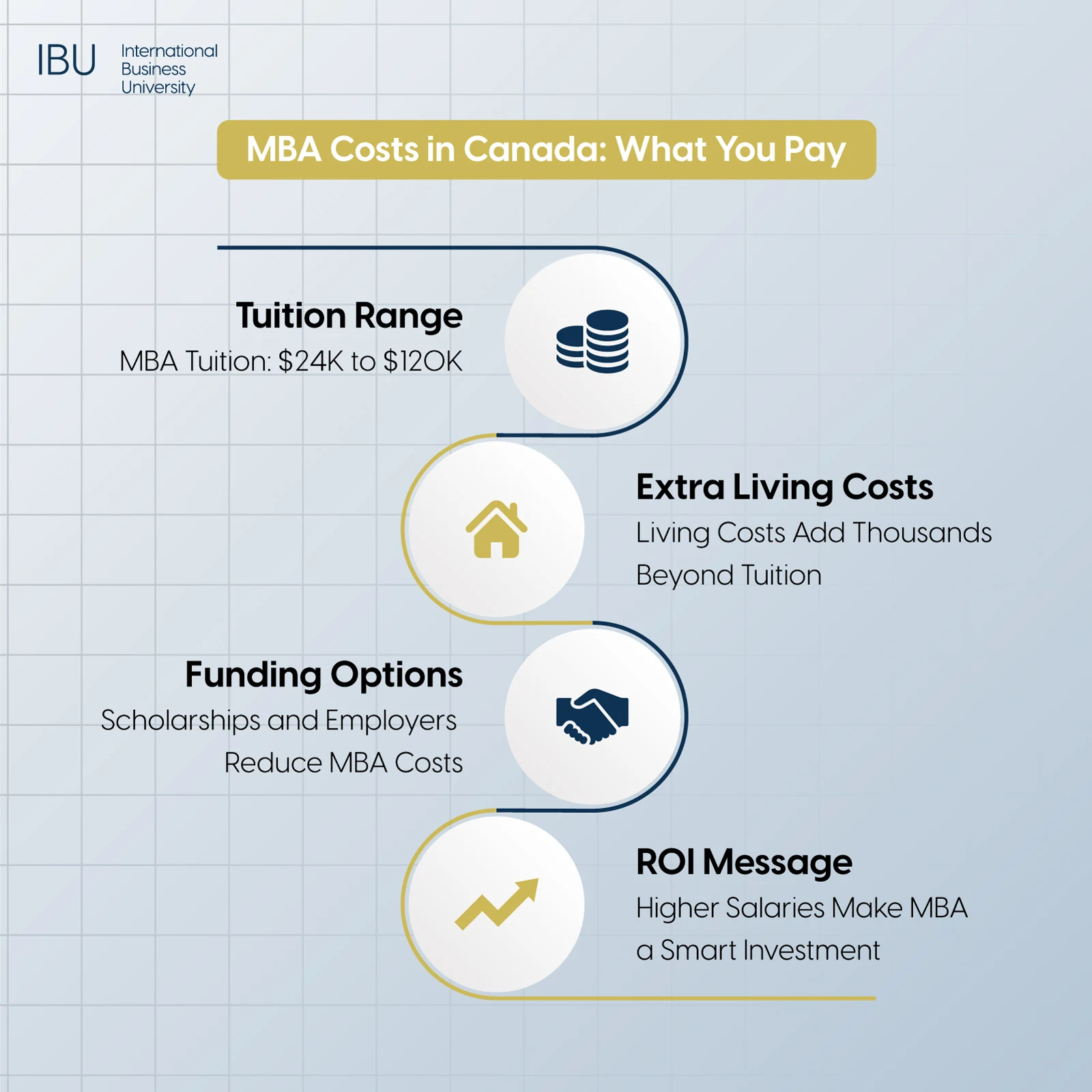
- MBA costs in Canada vary widely, but affordability exists. While top Canadian MBA programs can cost between $30,000 and $120,000, options like IBU offer a high-quality MBA at a significantly lower price point without compromising academic depth or career outcomes.
- Planning beyond tuition is essential for financial confidence. Books, housing, transportation, and networking expenses can substantially increase total MBA costs. Choosing programs that include books, offer flexible formats, and support working professionals helps control overall spending.
- The long-term return on investment remains strong. MBA graduates in Canada see meaningful salary growth, expanded leadership opportunities, and improved career mobility. With strategic funding, scholarships, and employer support, the MBA remains a practical investment with lasting financial and professional benefits.
How Much Does an MBA Cost in Canada?
When it comes to MBA costs in Canada, tuition varies widely based on the institution, specialization, and program format (full-time, part-time, executive, or online).
On average, here’s what MBA students in Canada can expect:
- Tuition for top Canadian MBA programs: $30,000 – $120,000
- Affordable MBA options (like the International Business University (IBU) in Toronto): $24,000 for domestic students and $36,000 for international students (includes book fees)
IBU believes in providing a quality MBA at an affordable price. Our MBA program includes 42 credits over four semesters in 16 months, meaning students can graduate faster while paying significantly less than traditional business schools.
But, of course, tuition isn’t the only expense – let’s talk about the MBA costs beyond the classroom.
Additional MBA Expenses: Books, Housing, and Living Costs
Other costs add up quickly when you’re studying, so it’s essential to budget effectively.
Here’s a rough breakdown of what MBA students in Canada might spend beyond tuition:
- Books & Study Materials: Expect to budget around $1,500 to $3,000 per year for textbooks and course materials. (At IBU, book fees are included in tuition – one less expense to worry about!)
- Housing & Accommodation: Toronto (where IBU is located): Rent for a one-bedroom apartment downtown averages $2,400 per month. More affordable options are available in the suburbs or with roommates.
- Food and Daily Expenses: Monthly grocery and dining costs will be around $300 – $600
- Public transportation: $150/month
- Hidden Costs (Networking, Conferences, Travel): Attending networking events, business conferences, and career fairs can enhance your job prospects but may incur costs of $500 to $1,500 annually.
Adding these costs up, a student completing an MBA in Canada could be looking at total expenses of $50,000 to $150,000 over two years, depending on location and lifestyle choices.
But don’t let that scare you! There are ways to cut costs and fund your MBA.
Plan your MBA investment with clarity and confidence
Review MBA costs, learn about the scholarships, and learn proven ways to graduate with minimal or zero debt while advancing your career goals.
MBA Degree Scholarships and Financial Aid
The best way to reduce the financial burden of your MBA is to secure scholarships and explore MBA financial aid options.
Some major funding opportunities include:
Merit-Based MBA Scholarships
Many universities, including IBU in Toronto, offer entrance scholarships based on academic excellence, leadership, and industry experience.
International Student Scholarships
Some schools provide grants specifically for international MBA students, reducing high tuition fees (IBU offers a tuition structure that is already lower than many other Canadian MBA programs!)
Need-Based Bursaries
Colleges and universities award MBA bursaries to students who demonstrate financial need – don’t forget to apply for these early.
External & Corporate Scholarships
Organizations like CIBC, TD, RBC, and other Canadian corporations offer business-specific scholarships. Check sites like ScholarshipsCanada.com for additional funding opportunities.
Employer Sponsorship and Alternative Funding Solutions
If you’re already working, one of the smartest ways to fund your MBA in Canada is through employer sponsorship.
Many companies offer full or partial tuition coverage for employees who pursue an MBA, especially if the degree benefits the company in return.
How to secure MBA funding from your employer:
- Show the ROI: Emphasize how your MBA will improve your skills and benefit the company.
- Negotiate part-time or flexible MBA study: IBU offers full-time on-campus and online MBA options, allowing you to continue working while earning your degree.
- Commit to staying with the company post-MBA: Many businesses require graduates to stay for a set time in exchange for sponsorship.
MBA Return on Investment: Is It Worth the Cost?
Now for the million-dollar question: Is paying for an MBA in Canada actually worth it?
Let’s look at the numbers:
- The average MBA salary in Canada is $80,000 per year or $41.03 per hour.
- Entry-level MBA salaries start at $60,936 per year.
- Experienced MBA grads earn up to $136,925 per year.
That’s a significant jump compared to business professionals without an MBA, making the MBA return on investment (ROI) clear. Over a lifetime, MBA grads earn hundreds of thousands of dollars more than non-MBA professionals in business and leadership roles.
Remember, MBAs lead to better salaries, and open doors for top management positions, executive roles, and entrepreneurship ventures.
So, if you’re looking to climb the corporate ladder, switch industries, start your own business, or get a salary boost, an MBA is one of the best investments you can make in yourself.
At IBU in Toronto, we offer a high-quality, affordable MBA designed for career-driven professionals who want to maximize their potential without overpaying for tuition.
Why IBU’s MBA?
- Affordable Tuition: Just $24,000 for domestic students & $36,000 for international students (including books!).
- Flexible Study Options: Full-time (on campus) and online learning available.
- Fast-Track Completion: Earn your MBA in as little as 16 months.
- Located in Downtown Toronto and Ottawa: Canada’s business hubs, full of networking opportunities.
FAQ
How much does an MBA cost in Canada?
MBA tuition in Canada ranges widely depending on the institution, program format, and specialization. Top business schools can charge between $30,000 and $120,000, while more affordable universities offer programs at lower price points. Choosing the right program depends on balancing cost, duration, and career outcomes.
Can employers help pay for an MBA in Canada?
Many employers offer partial or full tuition reimbursement for employees pursuing an MBA. Support is often tied to how the degree benefits the organization’s goals and leadership needs. Flexible or online MBA programs make employer sponsorship easier to manage.
Is an MBA worth the cost in Canada?
MBA graduates in Canada typically earn higher salaries and have access to more leadership opportunities than non-MBA professionals. The degree often pays for itself over time through increased earnings and career mobility. Long-term ROI depends on program cost, specialization, and career goals.
Make a Smart, High-Return Investment in Your Career
An MBA is more than a credential. It is a strategic investment in your earning potential, leadership trajectory, and long-term career flexibility. When you understand tuition MBA costs, plan for living expenses, and take advantage of scholarships or employer support, the return on investment becomes clear. Choosing an affordable, well-structured MBA program allows you to advance your career with confidence while keeping financial risk under control.
Turn your MBA into a long-term career advantage
Select from a career-aligned MBA in Technology, Innovation, and Entrepreneurship designed to build leadership, analytical, and innovation skills that employers value.