
If you think business education in Canada is simply sitting in lecture halls and memorizing economic theories, think again. Today’s best BCOM programs don’t teach you to follow trends. They train you to shape them.
In a country where global companies thrive, innovative startups bloom daily, and artificial intelligence is transforming work as we know it, choosing the right commerce degree in Canada is one of the most strategic moves you can make. And if you’re looking for a place where future-forward learning meets personal mentorship and global perspective, the International Business University (IBU) in Toronto should be at the top of your list.
Ultimately, your first step starts with the right education, it doesn’t matter if you’re aiming for corporate leadership, entrepreneurship, tech innovation, or something completely your own. Let’s explore what business education in Canada can really offer, and how the BCOM programs at IBU can take you there.
Key Takeaways:
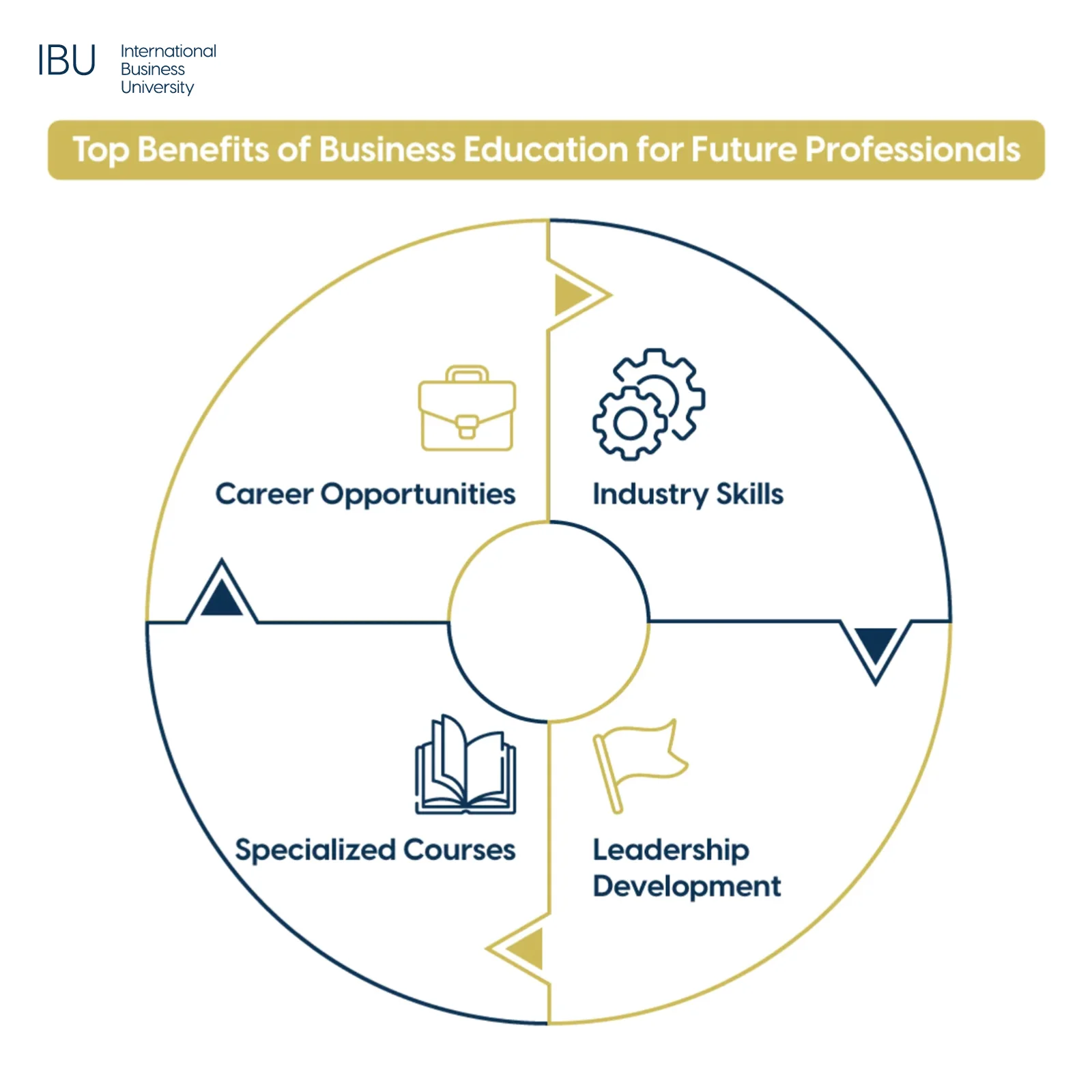
- Business education in Canada opens direct pathways to industry-ready skills, modern business education courses, and leading career roles.
- Students gain access to strong business education employment opportunities across finance, tech, digital marketing, operations, and entrepreneurship.
- The right BCOM program offers specialization, mentorship, and hands-on learning that builds long-term career confidence.
What is a Bachelor of Commerce Degree? | BCOM Guide
A Bachelor of Commerce degree offers far more than textbook theory. Think case studies, real-world projects, and industry collaboration. Modern business education in Canada is built to shape leaders, not followers.
The average annual salary for commerce graduates in Canada starts at around $66,000, and career options extend across hundreds of roles. Business education employment opportunities range from investment banking and digital marketing to analytics, logistics, and business technology.
You can also choose specializations such as:
Wondering about BCOM eligibility? If you’ve completed high school with a focus on math or business courses, you’re likely already in the running. Combine that with the chance to study in a globally recognized environment like IBU, where small class sizes and faculty mentoring power student success, and you’ve got a winning formula.
Thinking about learning remotely? Does distance learning have value? In Canada, absolutely, especially when it’s built into a practical, industry-aligned structure like IBU’s.
Don’t forget to budget your ambitions: BCOM tuition in Canada varies, but the return on investment is one of the best in the education space. What can you do with a commerce degree? The better question might be, what can’t you do?
Start Your Business Education Journey Today
Apply to a future-ready BCOM program built for real-world success.
How Does a BCOM Entrepreneur Degree Help You in Canada
With a rising cost of living and wages that no longer stretch like they used to, more Canadians are trading in the traditional 9-to-5 for the unpredictable (and often wildly rewarding) world of self-employment. In fact, over half of Canadians are now considering starting their own business. The entrepreneurial spirit is no passing trend; it’s a movement. And the clearest path to turning that spark into something scalable? Business education in Canada – specifically a Bachelor of Commerce with an entrepreneurial focus.
There are approximately 3.5 million entrepreneurs in Canada today. They’re building solutions, disrupting industries, and rewriting what success looks like. A commerce degree in Canada, especially one like IBU’s BCOM in Technology, Innovation, and Entrepreneurship, arms you with the real-world skills these leaders need: including business planning, marketing, operations, digital tools, and data-driven decision-making.
What does the Bachelor of Commerce mean in this context? It becomes your blueprint for launching and growing a business in unpredictable markets. BCOM programs in Canada are increasingly hands-on, involving mentorship from seasoned entrepreneurs, access to startup incubators, and case-based problem-solving rooted in the challenges Canadian founders face every day.
Your academic journey revolves around building the mindset that allows you to turn gaps in the market into business opportunities. Wondering ‘what can you do with a commerce degree?’. Start your own company. Scale it. Sell it. Or use it to innovate from within as an ‘intrapreneur’ inside major Canadian firms.
From understanding BCOM eligibility to evaluating BCOM tuition, every step you take toward business education in Canada puts you closer to bringing your entrepreneurial vision to life and joining the next generation of business innovators already remodelling this country.
How to Get a University Scholarship: Scholarship Guide
Scholarships lighten the financial load while opening various doors of opportunity. If you’re considering business education in Canada and looking for ways to make your commerce degree more affordable, understanding your scholarship options is paramount. At IBU, the goal is simple: recognize your ambition, reward your performance, and remove financial barriers.
Let’s start with IBU’s entrance scholarships. Designed to reward academic achievement, these are automatically considered based on your final high school grades. That’s right – no additional application is required. If you’ve maintained a consistent full-time schedule in secondary school and you’re entering university for the first time, you’re eligible. Score 95% or higher? You get $3,000 each for your first two semesters. Even averages of 80%–89.9% are rewarded with $1,000 per term. And if you keep your GPA at 4.0? The scholarships continue for up to 8 semesters.
Didn’t quite meet the criteria for merit-based funding? IBU has your back with general entrance scholarships. Canadian citizens or permanent residents still receive $750 for each of their first two semesters simply for enrolling full-time.
For international students seeking business education in Canada, IBU offers bursaries by region. For example, if you’re from Latin America, Southeast Asia, or the Caribbean, you could receive up to $18,000 in scholarships applied directly to your Bachelor of Commerce tuition in Canada.
Other options? Explore third-party scholarships through websites like ScholarshipsCanada.com. Tap into education savings plans. Use loyalty points through HigherEdPoints. And if you’ve been in foster care, ask IBU’s Enrolment Services about full tuition waivers for crown wards.
Business education in Canada should be an opportunity rather than an obstacle. With scholarships, funding, and flexible payment plans, you can focus on your BCOM goals instead of your bank account.
Because once you know what you can do with a commerce degree — the only limit you should face is your imagination.
Business Skills Every Business Student in Canada Needs
A diploma alone won’t cut it anymore. Employers hiring for jobs for commerce graduates aren’t just skimming your transcript, they want proof that you’re ready to hit the ground running. That’s why standout business education in Canada builds the practical, adaptable skills that move the needle in real-world business. Strong business education teaches:
- Communication: Witten, spoken, digital, and cross-team collaboration
- Analytical thinking: Making sense of data, KPIs, trends, and strategy
- Leadership: Managing teams, making decisions, and solving complex problems
- Flexibility and digital literacy: Important for business environments driven by technology
BCOM eligibility gets you in. Your skill set takes you further. And with the right environment, your degree pays dividends for years.
Communication is at the top of the list. Business students must master the art of presenting ideas clearly in person, over email, and in impromptu Zoom debates with tight-lipped CFOs. A solid commerce degree in Canada, like those at IBU, will push you to think fast, write well, and fine-tune your listening skills.
Analytical thinking is also non-negotiable. Ask any graduate: What can you do with a commerce degree? The answers are endless, but they all require data literacy. You need to make sense of complex numbers, trends, and KPIs even if you’re working in finance, marketing, or operations. Strengthening your critical thinking skills gives you a professional edge that can’t be overstated, and Canadian BCOM programs are built to teach it.
Then there’s leadership. Not everyone walks into business school a confident decision maker, and that’s okay. A quality business education in Canada develops leadership from day one, with interactive projects, team-based challenges, and mentoring from faculty who’ve led teams globally.
Flexibility and tech-savviness round out the must-haves. Especially if you’re exploring distance learning. (And yes, the answer to “does distance learning have value?” is a massive “yes”… when it’s designed to reflect today’s fast-moving business landscape, of course.)
BCOM eligibility might get you in the door. BCOM tuition pays for the ride. But it’s the business skills you take with you that ultimately determine where that degree will take you, and how far you’ll go.
Student Guide: Impact of Artificial Intelligence in Business
Artificial Intelligence is already deeply woven into the fabric of modern commerce. Business education in Canada is rapidly adapting to help students keep up with changes from predictive analytics in marketing to AI-powered chatbots in customer service. Why? Because the AI skills gap is one of the biggest challenges facing today’s workforce – and if you’re still a student, now is the moment to get ahead of it.
Nearly 78% of Canadian small and medium-sized businesses are actively seeking to adopt AI tools. Even more remarkable? 65% of them are encouraging their teams to explore and use those tools daily. Businesses already on board with AI report an average 31% boost in productivity – not to mention measurable improvements in customer experience, employee satisfaction, and overall work quality.
Here’s where things get interesting: 27% of entrepreneurs using AI report that they don’t even realize they’re using it. That tells you two things. One: AI is so embedded in modern business software that it’s working behind the scenes, and two: there’s a serious knowledge gap that students with relevant training can use to stand out.
So, how do you go from passive observer to AI-literate professional? If you’re in a Bachelor of Commerce program (or reviewing what BCOM eligibility looks like), choose one that integrates digital tools, business technology, and innovation. IBU, for example, offers specializations like Digital Marketing where AI integration is front and centre.
Business education in Canada is no longer only about economics and spreadsheets; it’s about understanding how emerging tech is flipping the entire ecosystem on its head. Want to be indispensable in your next role? Start learning how AI works while your classmates are still asking, “What even is machine learning?”
It’s invaluable tech knowledge… and it’s your competitive edge.
4 Must-Read Books for Business Students
Business education in Canada teaches you the fundamentals. However, if you want to run a company, start a movement, or pitch your way into the C-suite, you simply must crack open these modern page-turners. These books for business students are (and always will be) your go-to playbooks.
1. Leading Change – John Kotter
Change is hard, and most teams fail at it. This book walks you through the leadership blueprint that actually works – from building urgency to creating quick wins. Want to be more than a manager? Start here.
2. The Lean Startup – Eric Ries
Forget the myth of the perfect idea. Success is about testing fast and learning faster. If you’re launching a startup or even just running a class project, Ries’s “Build-Measure-Learn” loop will change how you innovate forever.
3. How to Win Friends & Influence People – Dale Carnegie
Being smart isn’t enough. You need people on your side. Carnegie’s timeless strategies for connection, empathy, and influence are must-haves in every BCOM student’s toolkit. This book makes you unforgettable in boardrooms and beyond.
4. The 7 Habits of Highly Effective People – Stephen R. Covey
Covey teaches you how to take control of your time, relationships, and results – and these habits will serve you long after exams are over.
Business education in Canada is your foundation. But these books? They sharpen your edge.
Now’s the time to stop planning for the future and finally start building it! Business education in Canada gives you a world-class foundation, and IBU takes it a step further. With small class sizes (max 30 students), direct access to real-world business leaders, an industry-crafted curriculum, and 100% post-grad work placement within three months, IBU’s Bachelor of Commerce programs are designed for action.
Choose from in-demand specializations like Digital Sales & Marketing, Technology Management, Financial Analytics and more. BCOM eligibility is straightforward. BCOM tuition delivers measurable ROI. And the sooner you start, the sooner you’ll see what you can do with a commerce degree: in real time, in real businesses, and in a world that’s hungry for new leadership.
FAQ
What makes business education in Canada valuable?
Business education in Canada blends theory, applied learning, and industry collaboration, preparing students for modern business challenges. Graduates gain access to strong business education employment opportunities across sectors like finance, marketing, supply chain, and tech. The combination of specialization options and real-world experience makes Canadian BCOM programs globally competitive.
Do business education courses cover practical skills?
Yes, modern business education courses include hands-on case studies, analytics, digital tools, presentations, team projects, and industry-based assignments. These experiences help students build confidence in real-world situations. Programs like IBU’s BCOM emphasize practical career skills from the first semester.
What career opportunities open up after studying business education?
Graduates can explore careers in management, analytics, tech, consulting, marketing, finance, operations, entrepreneurship, and more. Thanks to strong business education employment opportunities, students often secure jobs within months of graduating. BCOM degrees are valued across industries due to their versatility.
Conclusion: Take the Next Step Toward Your Business Future
Business education in Canada gives you a foundation that’s practical, global, and future-ready. With the right BCOM program, you gain the skills, confidence, and career pathways needed in today’s rapidly changing economy. Even if you want leadership roles, entrepreneurial opportunities, or cutting-edge digital careers, business education prepares you for all of it. Your future is full of possibility, and now is the time to start building it.
Ready to Build Your Future in Business?
Connect with IBU’s admissions team for guidance and next steps..