
Adaptability at work means adjusting plans, communication style, or priorities when new information arrives, without losing momentum or team confidence. It is not the same as simply tolerating change. It is the active skill of responding to it faster and more effectively than the people around you.
Managers consistently name adaptability as one of the top traits they look for when promoting someone into a leadership role, because the roles above entry level rarely follow a fixed script. Budgets shift, teams reorganize, and priorities change mid-project. The professionals who handle that shift smoothly become the ones trusted with more responsibility.
Key Takeaways
Here is what determines if adaptability shows up as a strength on someone’s record.

Adaptability is a learnable skill, not a fixed personality trait, and it can be developed through deliberate practice and proper business education.
Canadian employers test for adaptability directly in interviews, often through behavioral questions about handling unexpected change.
BCOM and MBA programs build adaptability through project-based learning, where shifting requirements and ambiguous problems mirror actual workplace conditions.
Why Adaptability Decides Career Trajectories More Than Most Skills
Technical skills get someone hired. Adaptability determines how far they go after that. A professional who can only perform well when conditions match their training becomes a liability the moment conditions shift, which happens constantly in any growing organization.
Leaders who evaluate promotion candidates look for evidence that a person can hold a role together during a reorganization, a budget cut, or a sudden shift in strategy. This is why adaptability appears so often in performance reviews and promotion criteria, even when the job description never explicitly names it.
What Adaptability Means in a Canadian Business Context
In a Canadian workplace, adaptability often shows up around bilingual communication needs, regional market differences, and rapid shifts driven by regulatory change or economic conditions. A manager in Toronto adjusting a strategy built for a different provincial market, or a team absorbing a sudden supply chain disruption, is practicing workplace adaptability in a very concrete way.
This context matters because adaptability in the workplace is not an abstract virtue. It is demonstrated through specific, observable decisions: reallocating a budget mid-quarter, restructuring a team after a departure, or revising a customer strategy after new data contradicts the original plan.
Build Adaptability Through Business Learning
Practice problem-solving, teamwork, and decision-making from year one.
The Core Adaptability at Work Skills BCOM and MBA Graduates Are Tested On
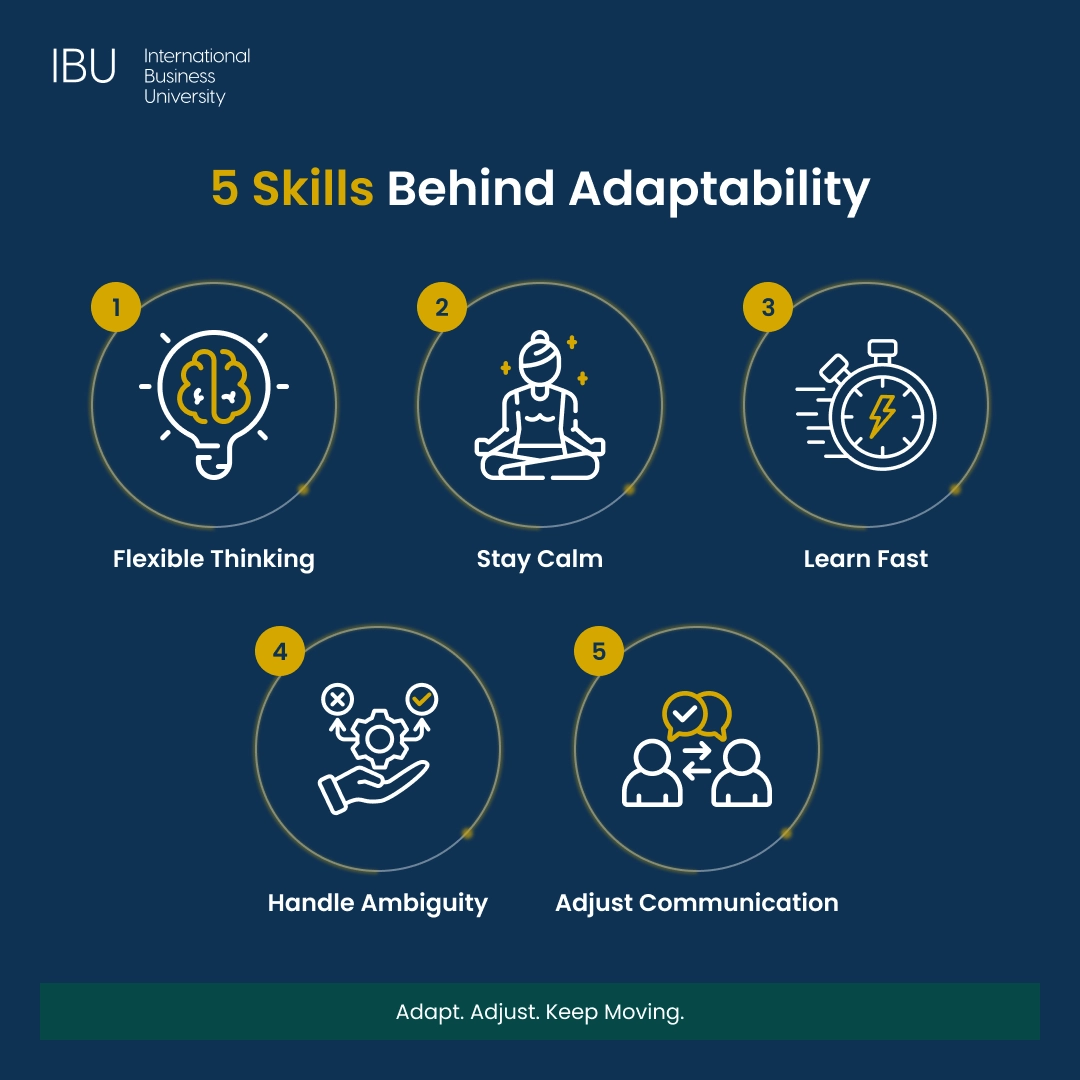
Employers and business schools break adaptability skills into a few concrete sub-skills that can be trained and assessed directly.
- Cognitive flexibility: Switching between different types of thinking or problem-solving approaches as a situation demands. A student might move from structured quantitative analysis to open-ended stakeholder discussion within the same meeting, or abandon an initial framework once new information shows it no longer fits the problem.
- Emotional regulation under pressure: Staying effective when a plan changes unexpectedly. This shows up when a client narrows a project’s scope midway through, moves a deadline forward, or rejects a recommendation the team had already built momentum around.
- Rapid learning: Picking up new tools, processes, or information quickly enough to stay useful. Consulting and analyst work regularly requires learning an unfamiliar industry’s terminology, a client’s internal systems, or a new software platform within the first days of an engagement, not over a full semester.
- Comfort with ambiguity: Making a reasonable decision without waiting for complete information. This means forming a working recommendation from partial data, stating the assumptions behind it plainly, and being willing to revise it once more information arrives, instead of stalling until every input is confirmed.
- Communication recalibration: Adjusting tone and detail level for different audiences as circumstances change. The same finding gets explained differently to a technical team debating implementation than to an executive sponsor deciding whether to fund the next phase.
Business programs assess these skills through group projects with shifting requirements, live case studies, and scenario-based exercises rather than through a single test, because adaptability only becomes visible once someone is put under actual pressure.
Strengthen Adaptability for Leadership Roles
Build the judgment to lead through changing business conditions.
What an Applied Group Project That Tests Adaptability Looks Like
The clearest way business programs build this skill is by putting students in a group project and then deliberately changing the assignment partway through.
A team is usually given a brief with a fixed goal, a defined budget, and a set of stakeholders to satisfy. Midway through the project, the instructor introduces a disruption: a stakeholder changes a requirement, a budget line is cut, or a key piece of data the team relied on turns out to be wrong. The team cannot restart. It has to revise its plan, reassign roles if needed, and still deliver against the original deadline. Instructors then grade not only the final output but how the team handled the pivot: whether it reworked its approach quickly or lost time arguing about whose fault the change was.
That structure exists because a group that has never had its plan disrupted in a low-stakes setting tends to freeze the first time it happens on the job. Practicing the pivot, not just the plan, is what carries over into a workplace where priorities shift without warning, and it is also what gives graduates a specific, detailed story to tell in an interview instead of a vague claim about being flexible.
How This Skill Connects to a BCOM or MBA at IBU
Programs built around this kind of project-based learning give students repeated, structured practice at absorbing a disruption and still delivering a result, which is the exact behavior employers are screening for when they ask a candidate to describe handling unexpected change. Graduates who have been through several rounds of this pivot-under-pressure exercise tend to describe workplace disruption differently than peers who have not: as an expected part of the job rather than an emergency that derails it.
Adaptability Examples That Canadian Employers Reference in Interviews
Interviewers rarely ask “are you adaptable?” directly. Instead, they ask candidates to describe a specific situation where a plan changed and how they responded.
- A project scope changed midway through, and the candidate had to reprioritize deliverables without missing the deadline.
- A key team member left unexpectedly, and the candidate absorbed part of the workload while training a replacement.
- A client changed requirements late in a project, and the candidate revised the approach without damaging the relationship.
- A new system replaced a familiar tool, and the candidate became proficient quickly enough to keep the team on schedule.
- A budget was cut mid-quarter, and the candidate had to cut scope on a project without cutting the parts the client cared about most.
Candidates who can describe a specific outcome, not just the fact that change happened, stand out because the story shows adaptability at work produced a result, not just survival.
How IBU Programs Build Adaptability Into BCOM and MBA Learning
IBU’s business programs use project-based learning specifically because it forces students to adjust their approach as new constraints appear mid-project, the same condition they will face on the job. Group assignments introduce shifting requirements, and case studies are drawn from live business situations rather than static textbook examples.
This mirrors the broader set of management skills every BCOM and MBA graduate needs and the wider list of business skills for aspiring leaders, where adaptability consistently ranks as a foundational trait employers expect graduates to demonstrate from their first role.
Frequently Asked Questions
How do you demonstrate adaptability in a job interview?
Describe a specific situation where a plan or requirement changed, then explain the exact action taken and the result. Interviewers are listening for a concrete decision, not a general statement about being flexible. A strong answer includes what changed, what you did differently, and what outcome followed.
Is adaptability a skill you can learn or is it a personality trait?
Adaptability has a temperament component, but the behaviors that make it visible at work- cognitive flexibility, rapid learning, and comfort with ambiguity- can all be developed through practice. Structured business education that includes ambiguous, evolving projects accelerates this development. Most people become measurably more adaptable with deliberate exposure to changing conditions.
What is the difference between adaptability and resilience in a leadership context?
Resilience is the ability to recover from setbacks and keep functioning after difficulty. Adaptability is the ability to change approach before or during a disruption, not just recover from it afterward. Strong leaders typically need both, but adaptability at work is the more proactive of the two.
How does an MBA help you become more adaptable as a professional?
An MBA exposes students to varied case studies, cross-functional projects, and diverse working styles within a short period, compressing years of workplace variability into a structured learning environment. This repeated exposure to changing constraints builds the cognitive flexibility that adaptability requires. Graduates often report handling workplace disruption with more confidence after this kind of applied training.
Practicing Adaptability at Work Before the Next Disruption Arrives
Adaptability at work is built through repetition, not through a single moment of crisis. Start by tracking how you currently respond when a plan changes without warning, and note if your first instinct is to resist the shift or to reassess quickly. Seek out projects with genuine ambiguity rather than avoiding them, since comfort with unclear situations only grows through direct exposure. The professionals who reach leadership roles fastest are usually the ones who treated every disruption as practice for the next one.
Prepare for the Workplace That Keeps Changing
Apply to IBU and build business skills employers value.