

Strong management skills are built well before a first leadership role, not during it, which is exactly what IBU’s BCOM in Business Management program is designed to build. Employers promoting someone into management, or hiring a new graduate directly into one, expect a working level of coaching, stakeholder management, and communication skills already in place.
A business degree covers financial statements, marketing frameworks, and operations theory. Very little of that coursework, on its own, prepares a graduate for the first difficult conversation with a direct report.
The Management Skills Gap Nobody Warns You About Before Your First Role
The gap shows up in the space between knowing management theory and applying it under pressure.
- Theory vs practice: Coursework covers leadership models and organizational behavior, but rarely simulates a live team conflict or an underperforming employee.
- First 90 days: Most new managers report their first significant management challenge arrives inside the first three months, before formal training catches up.
- Confidence gap: Many new managers describe knowing what good leadership looks like without feeling equipped to practice it in the moment.
That gap between knowledge and applied practice is exactly what a structured management skills curriculum is meant to close.
Why This Gap Persists Across Business Programs
Most undergraduate business programs teach management as a subject rather than a practiced skill. Students read case studies about other people’s leadership decisions instead of making their own inside a supervised setting.
Graduate programs assume more workplace exposure, but do not always build structured practice into the curriculum either. The result is a graduate who can define delegation correctly on an exam and still hesitate the first time delegation actually matters.
Why Technical Ability Gets You Hired but Interpersonal Skills Decide What Happens Next
Technical skill and management skill serve different purposes at different career stages.
- Hiring stage: Technical ability, financial modeling, marketing analysis, or operations knowledge gets a graduate through the interview and into the role.
- Promotion stage: Interpersonal skill, not technical depth, determines who gets considered for the next promotion into people leadership, which is the same pattern behind why revenue roles increasingly expect graduates comfortable on both the marketing and sales side.
- Retention stage: Managers who communicate poorly see higher turnover on their teams regardless of how strong their technical judgment is.
Canadian employers increasingly separate these two skill sets when evaluating internal candidates for management roles.
Where This Shows Up in Performance Reviews
Performance reviews for early career managers frequently flag communication and coaching before they flag technical gaps. A manager who misses a deadline is treated as a process problem, while a manager who mishandles a team conflict is treated as a leadership problem.
That distinction is why business programs increasingly separate management skills training from technical coursework rather than assuming one produces the other.
The Leadership Skills Canadian Employers Say New Managers Are Missing Most
Canadian employers aren’t frustrated with new managers’ technical skills, they’re frustrated with the people side. Across industries, the same gaps keep coming up.
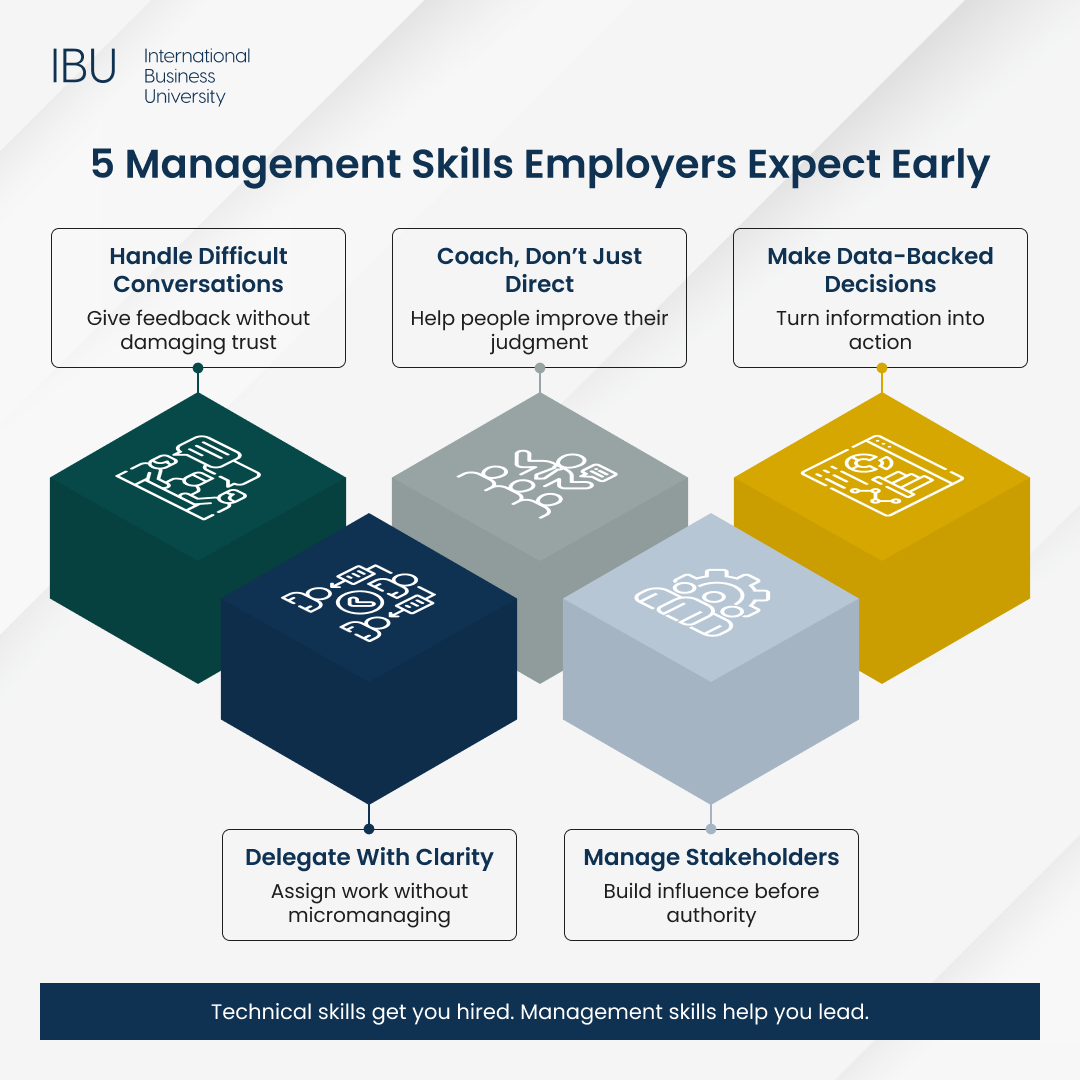
And for most new managers, these aren’t knowledge gaps, they’re experience gaps that no classroom fully prepares you for.
- Difficult conversations: Giving direct, constructive feedback without damaging the working relationship.
- Delegation: Assigning meaningful work instead of either micromanaging or disappearing entirely, the core of the delegation skills most new managers are never taught.
- Prioritization under pressure: Deciding what a team should focus on when everything feels urgent at once.
- Managing former peers: Leading people who were colleagues before the promotion, without losing their respect or overcorrecting into authority.
- Remote and hybrid coordination: Building trust and giving feedback across a team that is not in the same room every day requires deliberate effort most graduates have not practiced.
- Cross-generational leadership: Managing a team that spans several career stages and expectations at once adds another layer most first-time managers have not encountered.
Each of these gaps is trainable, but only if a program treats it as a skill to practice rather than a topic to read about.
Why These Specific Gaps Persist
Most of these skills involve interpersonal risk, the possibility of an awkward conversation or a strained relationship, which makes people avoid practicing them until they have no choice.
A structured program creates that practice in a lower-stakes setting, before a graduate has to learn the same lesson in front of their own team.
Build Management Skills Before You Need Them on the Job
IBU builds coaching, delegation, and stakeholder management directly into every BCOM and MBA program.
Coaching and Mentoring as a Management Skill, Not Just a Senior Responsibility
Coaching is often treated as something a manager grows into after several years, rather than a skill new managers need immediately.
- Early expectation: Even first-time managers are expected to run one-on-ones and give development feedback within their first quarter.
- Coaching vs directing: Coaching asks questions that help someone reach their own answer, while directing simply hands them the answer.
- Mentoring outward: Mentoring often extends beyond direct reports to peers or junior staff outside the reporting line.
Employers increasingly expect this skill from managers within their first year, not their fifth.
How Coaching Differs From Managing Performance
Performance management evaluates work against a set standard. Coaching builds the judgment needed to meet that standard without direct instruction each time.
New managers who confuse the two tend to either over-direct their team or avoid development conversations altogether.
Stakeholder Management Skills: How to Build Influence Before You Have Authority
Stakeholder management becomes necessary well before a graduate holds formal authority over the people involved.
- Cross-functional influence: Getting cooperation from other departments who do not report to you requires a different approach than directing a team.
- Reading priorities: Understanding what a stakeholder actually needs, not just what they say in a meeting, shapes how a request should be framed.
- Managing upward: Communicating constraints and risks to a manager’s own manager is a distinct skill from managing a direct report.
Graduates who practice this skill before their first management role adjust faster once they hold formal authority.
Where Stakeholder Skills Get Tested First
Group projects, internships, and cross-department assignments are usually the first place a student practices influence without authority. Business programs that build structured stakeholder exercises into coursework give students a head start most peers do not get.
Employers ask about group project conflict in interviews for exactly this reason. The scenario tests the same influence skill directly.
Decisions Backed by Data: The Management Skill That Separates Good From Great
Interpreting a dashboard is different from deciding what action the numbers justify.
- Interpretation vs action: A manager who can read a dashboard but cannot translate it into a decision has only half the skill.
- Speed under uncertainty: Most management decisions get made with incomplete data, which means judgment still matters alongside the numbers.
- Communicating the decision: Explaining the reasoning behind a data-backed call is what builds team trust in future decisions.
Canadian employers increasingly test this skill directly in case interviews for management track roles.
Why This Skill Is Hard to Teach in a Lecture
Reading about analytical decision-making and practicing it under time pressure are different experiences entirely. Case-based coursework that forces a decision within a deadline builds the skill more directly than a lecture on frameworks.
Programs that pair analytics coursework with applied case work close this gap faster than programs that keep the two separate.
Reading the Room Before Making the Call
Data rarely tells a manager the full context behind a number, a seasonal dip, a one-time client issue, a staffing gap. Strong managers pair the data with what they already know about the team and the business before deciding.
Graduates who skip this step tend to make technically correct decisions that miss the practical reality of the situation.
Practice Management Decisions Before You Make Them on the Job
IBU pairs case-based decision practice with core BCOM and MBA coursework.
Communication Skills for Managers: Why This Is Different From General Communication Skills
General communication skills and management communication skills overlap, but they are not identical.
- Audience shift: A manager communicates the same message differently to a direct report, a peer, and a senior executive, often within the same day.
- Stakes attached: Management communication usually carries consequences- a missed deadline, a budget change, a role change- that general communication rarely does.
- Written record: Manager communication is more often written and reviewable later, which changes how carefully it needs to be constructed.
That difference is why communication training built specifically for management differs from general presentation or writing skills training.
The Skills Most Programs Skip
Writing a performance review, delivering bad news to a team, and negotiating a deadline extension with a client rarely appear in general communication coursework. These are management-specific scenarios that require dedicated practice.
A program that includes these scenarios directly gives graduates a rehearsed starting point instead of a first attempt on the job.
Managing a Team Through Change Without Formal Training
Organizational change, a reorg, a new system rollout, a leadership transition, tests management skills that rarely appear in a typical business course, and this is where the broader skill of workplace adaptability gets tested most directly, which is exactly the gap a specialization built around leading technology change is meant to close.
- Uncertainty management: Teams look to their manager for stability even when the manager has as many unanswered questions as they do.
- Message consistency: Repeating the same message accurately across multiple conversations prevents rumors from filling the gap.
- Timing judgment: Deciding when to share incomplete information versus waiting for full clarity is itself a management skill.
Few graduates encounter this scenario before their first management role, which makes it one of the highest-risk gaps in a new manager’s skill set.
Why Change Management Belongs in Business Coursework
Change management is usually taught as an organizational theory topic rather than a people leadership skill. Students learn frameworks for change models without practicing the harder task of communicating change to an anxious team.
Coursework that pairs change theory with a simulated communication exercise builds the skill employers actually test for during a transition.
How Canadian Employers Test Management Skills in Interviews
Interview formats for management track roles increasingly test these skills directly rather than asking about them in the abstract.
- Behavioural questions: Interviewers ask for a specific example of a difficult conversation or a delegation decision, not a general philosophy.
- Case-based prompts: Some employers present a short management scenario and ask the candidate to walk through their decision on the spot.
- Peer and panel interviews: Management candidates are increasingly interviewed by future peers, not only by the hiring manager, to test team fit.
Preparing for these formats requires the same practiced skill the role itself demands, not a rehearsed definition.
What Strong Answers Have in Common
Strong answers describe a specific situation, the action taken, and the outcome, rather than a general statement about leadership style. Interviewers consistently rate specific examples higher than broad claims about being a natural leader.
Graduates who have practiced these scenarios in a program setting can draw on a concrete example instead of improvising one during the interview.
Building a Management Skills Timeline From BCOM Through Your First Role
Management skill development follows a rough sequence across a business education and into a first leadership role.
- Years one and two: Foundational coursework introduces leadership theory and organizational behavior concepts.
- Final year and capstone: Applied projects require students to lead a team through a deliverable, often for the first time.
- Graduate study: MBA coursework adds higher-stakes scenarios, including managing former peers and leading through organizational change.
- First 12 months on the job: New managers apply the same skills under full workplace pressure for the first time.
Programs that map this timeline explicitly give graduates a clearer sense of what to expect at each stage.
How IBU Programs Build Management Skills Into Every BCOM and MBA Stream
IBU treats management skills as a required competency across programs rather than an elective add-on.
- Embedded coursework: Coaching, delegation, and stakeholder management appear inside core courses rather than as a single standalone unit.
- Applied practice: Students work through simulated management scenarios, including difficult conversations and cross-functional negotiation.
- Mentorship access: Working professionals mentor students through management situations drawn from their own careers.
Graduates leave with a management skill set they have already practiced, not one they are encountering for the first time on the job.
How This Differs Across BCOM and MBA Levels
BCOM students build foundational management skills alongside their core business coursework, preparing them for a first supervisory role. MBA students extend the same skills into higher-stakes scenarios, including managing former peers and leading through organizational change.
Both paths share the same core framework, adjusted for the level of authority a graduate is likely to step into first.
Key Takeaways

Trainable gap: the gap between management theory and applied practice is what causes most new manager struggles, and it can be closed before the first role.
Interpersonal skill decides promotion: technical ability gets a graduate hired, but interpersonal skill determines who advances into management.
Coaching starts early: employers expect coaching and development conversations within a new manager’s first year, not after several years of experience.
Influence before authority: stakeholder management skill needs to exist before a graduate holds formal authority over the people involved.
Applied practice matters: IBU builds coaching, stakeholder management, and data-backed decision practice directly into BCOM and MBA coursework.
Frequently Asked Questions
Do I need to know how to code to work with data engineering tools?
Basic coding knowledge in Python or SQL is necessary for most data engineering roles. Tools like Apache Airflow, Spark, and AWS Glue all involve writing or reading code at some level. That said, MBA-level programs at IBU, such as the MBA in Technology, Innovation, and Entrepreneurship, focus on helping students understand and work alongside technical teams without needing to build infrastructure themselves.
Which data engineering tools are most in demand for AI jobs right now?
Apache Spark, Kafka, Snowflake, and Airflow consistently appear at the top of data engineering job postings. Cloud-specific tools like AWS Glue and Azure Data Factory are also heavily requested by organizations migrating to cloud-first AI architectures. Familiarity with at least one data processing tool, one streaming tool, and one storage platform covers the most common requirements across roles in data engineering for AI.
How is coaching different from managing performance?
Performance management evaluates work against a set standard, while coaching builds the judgment to meet that standard independently. New managers often need both skills within their first quarter.
Do BCOM and MBA programs teach management skills differently?
BCOM coursework builds foundational management skills for a first supervisory role. MBA coursework extends the same framework into higher-stakes situations, including managing former peers.
Why do interpersonal skills matter more than technical skills for promotion?
Technical ability gets a candidate into a role, but promotion into management depends on how well someone leads people. Employers consistently rate communication and coaching above technical depth for management track roles.
How does IBU build management skills into its BCOM and MBA programs?
IBU embeds coaching, delegation, and stakeholder management practice directly into core coursework rather than treating it as a separate elective. Students also work with mentors who bring management scenarios from their own careers into the classroom.
When should a business student start building management skills?
Foundational management skills should start developing well before a first leadership role, ideally in the early years of a business degree. Waiting until a promotion forces the issue puts new managers at a disadvantage.
Do employers test management skills in interviews?
Many Canadian employers now use behavioural and case-based interview formats specifically to test coaching, delegation, and stakeholder management skills. General statements about leadership style rank lower than specific examples.
What is the difference between managing former peers and managing a new team?
Managing former peers requires rebuilding the working relationship on new terms without losing their respect. Leading a new team starts without that history, which carries a different but equally demanding set of challenges.
How does hybrid work change management skill requirements?
Hybrid teams need more deliberate coaching and feedback since informal check-ins happen less often. Managers who rely only on in-person cues tend to miss problems until they are harder to fix.
Building Management Skills Before the Title Requires Them
Management skills separate graduates who advance quickly from graduates who stall after their first promotion. Waiting until a title requires these skills puts a new manager, and their team, at a disadvantage during the exact period when trust is hardest to rebuild.
Programs that build coaching, stakeholder management, and communication into coursework directly give graduates a practiced starting point instead of a first attempt on the job.
Canadian employers increasingly evaluate management potential earlier in a candidate’s career, which means the practice built during a degree carries more weight than it once did.
Graduates entering their first management role with this practice already in place tend to build team trust faster and avoid the early missteps that follow untrained managers into their second and third years.
See How IBU Builds Management Skills Into Your Degree
Speak with an admissions advisor about the management skills framework inside IBU’s BCOM and MBA programs.