
Automation engineers in Canada now spend more time working with AI-driven control systems than with the fixed mechanical automation the role once centered on entirely. Employers hiring for this position increasingly expect candidates to work across software, data, and traditional industrial systems at once.
In addition, automation engineer roles are at moderate risk of labor shortage nationally. That shortage risk reflects a skills gap as much as a hiring volume problem, since fewer available candidates combine industrial systems knowledge with applied AI training.
What an Automation Engineer Actually Does in a Canadian Industrial Setting
Ask two automation engineers at different Canadian plants to describe a typical week and the answers will vary by industry, by equipment age, and by how far along a facility is in its technology upgrade cycle. What stays consistent is the scope: the role rarely sits inside a single system or reporting line. Engineers move between the floor-level machinery generating data, the software layer processing it, and the cross-functional teams deciding what to do with the output.
- Control system design: Building and maintaining the systems that run manufacturing lines and industrial processes.
- AI integration: Applying machine learning models to predictive maintenance, quality control, and process optimization.
- Cross-team coordination: Working between operations, IT, and plant management to implement system changes without halting production.
Most Canadian employers now expect candidates to understand both the mechanical and data sides of this work.
How the Role Differs From Traditional Industrial Engineering
The distinction matters most when candidates are choosing coursework, not when they are already on the job. Traditional industrial engineering built its toolkit around process efficiency, time-motion analysis, statistical process control, and lean manufacturing principles.
Those methods still apply, but they now run alongside AI-driven systems that generate more data, flag issues faster, and adjust processes without waiting for a manual update. The engineer who understands only one of these layers is working with half the picture.
Traditional industrial engineering roles focused on process efficiency using established mechanical and statistical methods. Automation engineering now layers AI-driven analysis on top of those methods, changing both the tools and the pace of the work.
Engineers who trained only in the traditional discipline often need additional coursework to work confidently with these newer systems.
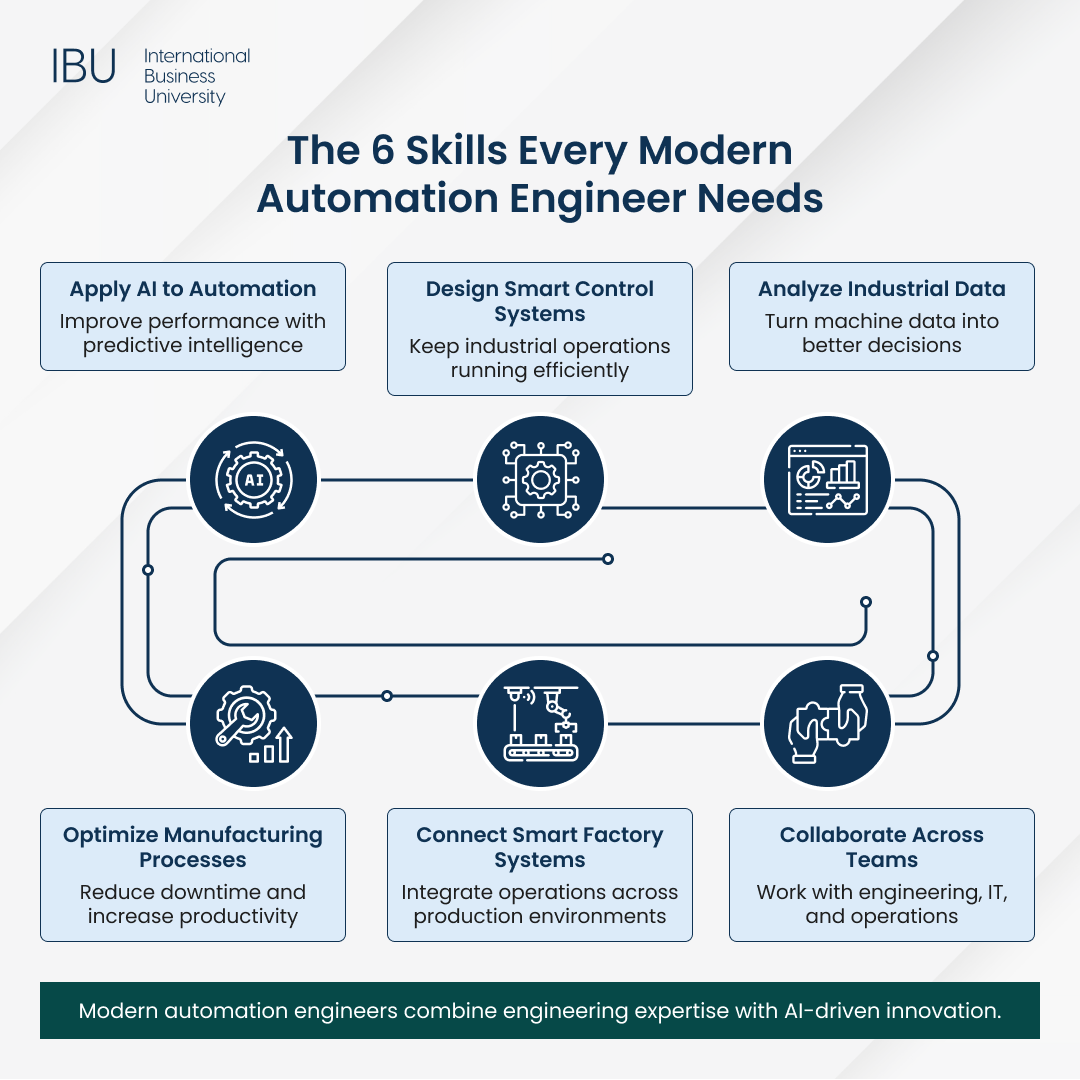
The 6 Skills Every Modern Automation Engineer Needs
Automation engineering has expanded well beyond keeping machinery running. Six specific skills now separate engineers who can only maintain existing systems from engineers who can actually modernize them.
- Apply AI to automation: Improve performance with predictive intelligence instead of relying on fixed, rule-based control alone.
- Design smart control systems: Keep industrial operations running efficiently as control systems take on more automated decision-making.
- Analyze industrial data: Turn machine data into better decisions rather than letting raw sensor output go unused.
- Optimize manufacturing processes: Reduce downtime and increase productivity by acting on what the data and control systems reveal.
- Connect smart factory systems: Integrate operations across production environments so equipment, software, and teams work from the same information.
- Collaborate across teams: Work with engineering, IT, and operations, since modern automation projects rarely stay inside one department.
Why These Six Skills Work as a Set, Not a Checklist
Each skill feeds the next rather than standing alone. Applying AI to automation only pays off once an engineer can design the control systems that act on it, analyze the data those systems produce, and then work across departments to actually implement the change.
Modern automation engineers combine engineering expertise with AI-powered innovation, not one or the other in isolation.
What Is Industrial Automation and How the Field Has Changed Since AI Entered the Factory Floor
For most of its history, industrial automation was a problem of programming precision. You defined every condition, wrote every rule, and the system executed exactly what it was told, which meant every change in the process required a change in the code. That model worked reliably but scaled poorly as factory environments grew more complex and the cost of unplanned downtime grew harder to absorb.
- Before AI integration: Automation relied on fixed programming and rule-based control systems that required manual updates for any process change.
- After AI integration: Systems now adjust automatically using predictive models, reducing manual reprogramming and catching issues before they cause downtime.
- Skill implication: Engineers need working fluency in both the mechanical control layer and the AI models running on top of it.
That shift is why industrial automation increasingly overlaps with applied AI training rather than staying a purely mechanical discipline.
The Sectors Hiring Automation Engineers Hardest Right Now
Not all sectors are at the same point in this transition, and the gap between early adopters and slower-moving industries has created uneven hiring pressure across the Canadian economy. The sectors investing most aggressively in automation upgrades right now are the ones where legacy equipment failures carry the highest operational cost, and where AI-driven monitoring is generating the clearest return on investment.
- Manufacturing: Plants upgrading legacy equipment with AI-driven monitoring and predictive maintenance systems.
- Energy and utilities: Grid and facility operators applying automation to manage capacity and reduce downtime.
- Logistics and warehousing: Distribution centers automating sorting, inventory tracking, and routing decisions.
Candidates who understand the specific regulatory and safety requirements within one of these sectors often move through hiring processes faster than generalists.
What a Typical Project Looks Like
A common automation project involves connecting sensor data from production equipment to a predictive model that flags maintenance needs before a breakdown occurs. The engineer builds both the data pipeline and works with plant staff to act on the model’s output.
That blend of technical build work and cross-team coordination is what distinguishes automation engineering from a purely data science role.
What an MSc in Applied AI Builds That General Engineering Degrees Do Not
The gap is not in foundational engineering knowledge; most candidates coming out of general engineering programs understand control systems and mechanical principles well enough. What general degrees rarely build is the layer on top: the applied machine learning coursework, the industrial data infrastructure training, and the hands-on project work that connects AI models to the factory floor systems they are meant to run on.
That gap is what employers keep encountering when they screen recent graduates.
- Applied machine learning: Coursework focused on building and deploying models for predictive maintenance and process optimization, not just theory.
- Industrial data systems: Training on the data infrastructure that connects factory floor equipment to AI models.
- Applied capstone: Requires students to complete an automation project mirroring the systems Canadian manufacturers actually use.
Graduates leave with a concrete automation project to reference in interviews, not just theoretical coursework.
A Common Misconception About This Career Path
Many students assume this path overlaps closely with robotics engineering, but the two disciplines diverge significantly in practice. Robotics engineering focuses on physical machine design and movement, while automation engineering focuses on the control and data systems that run industrial processes.
Candidates who understand this distinction early can target the right coursework instead of building skills for the wrong specialty.
Skills That Transfer Between the Two Disciplines
Some skills carry over between robotics and automation engineering, including control system fundamentals and applied programming. Where the two paths diverge is in the depth of mechanical design training versus data systems and AI model deployment training.
Candidates unsure which path fits can compare how drawn they are to building physical systems against how drawn they are to the data and control layer running on top of them.
Prepare for Industrial AI Roles Before You Graduate
Learn how IBU’s MSc in Applied Artificial Intelligence builds automation skills into coursework directly.
How IBU Students Step Into Automation Roles Before They Graduate
The program structure builds industry exposure directly into the degree rather than leaving it to internships alone.
IBU’s blog on artificial intelligence and industrial innovation covers several of the same systems students work with directly during the applied capstone.
Students also work with mentors from Canadian manufacturing and industrial technology companies throughout the program.
What Employers Screen For in Interviews
Interviews for automation engineering roles increasingly include a walkthrough of a past project involving both a control system and a data or AI component. Candidates who can describe how they connected these two layers stand out from candidates who can only speak to one side of the work.
That gap is one reason a completed capstone project carries genuine weight during the hiring process for recent graduates.
Key Takeaways

AI is now core to the role: automation engineers spend significant time on AI-driven systems, not only fixed mechanical automation.
Demand reflects a skills gap: Job Bank rates this role at moderate shortage risk nationally, driven partly by a lack of candidates with combined industrial and AI training.
Sector focus helps: candidates targeting manufacturing, energy, or logistics specifically move through hiring processes faster than generalists.
Applied training matters: IBU’s capstone structure gives graduates a concrete automation project to reference directly in interviews.
Frequently Asked Questions
What does an automation engineer do differently now compared to five years ago?
The role now includes significant work with AI-driven predictive maintenance and process optimization, not just fixed mechanical control systems as it once did. Engineers need working fluency in both layers to stay competitive in the current Canadian job market.
Is automation engineering the same as robotics engineering?
The two disciplines diverge significantly in practice. Robotics engineering focuses on physical machine design and movement, while automation engineering focuses on the control and data systems that run industrial processes.
Which sectors in Canada hire the most automation engineers?
Manufacturing, energy and utilities, and logistics and warehousing show the strongest current demand. Each sector is actively upgrading legacy systems with AI-driven monitoring and control.
Do I need a robotics or mechanical engineering degree to become an automation engineer?
A mechanical or industrial engineering background helps, but is not strictly required with the right applied AI training. An MSc in Applied AI with an industrial automation focus can build the needed skills directly.
How does IBU prepare students for automation engineering roles?
IBU’s MSc in Applied Artificial Intelligence pairs machine learning coursework with industrial data systems training and an applied capstone project. Students also work with mentors from Canadian manufacturing and industrial technology companies.
What skills transfer between robotics engineering and automation engineering?
Control system fundamentals and applied programming carry over between both disciplines. The paths diverge in the depth of mechanical design training compared to data systems and AI model deployment training.
Where the Automation Engineer Role Is Headed
Automation engineering now rewards candidates who combine traditional industrial systems knowledge with applied AI training, not one or the other on its own. Graduates who pair that combination with a concrete automation project enter the job market with direct evidence of the skills Canadian manufacturers are hiring for.
Build the AI and Automation Skills Canadian Manufacturers Need
IBU’s MSc in Applied Artificial Intelligence prepares graduates for automation and industrial innovation roles.