
A business analyst career path starts with translating business problems into requirements that a technical or operational team can act on. Most guides describe this progression in idealized terms, skipping the plateau most analysts hit after the first promotion and the specific skills that determine who moves past it.
A BCOM in Business Management builds the analytical and communication foundation this career depends on more directly than most people realize before actually entering the field. This article covers the progression stage by stage, including the parts most guides leave out.
Key Takeaways
Four points summarize what determines success on the business analyst career path.

Progression rewards judgment, not just documentation: analysts who advise on decisions advance faster than analysts who only document processes.
A BCOM builds the right foundation early: process analysis and stakeholder communication training close a gap many technical candidates address only after starting the job.
Three skills drive advancement: stakeholder influence, business context fluency, and executive communication determine how quickly analysts move up.
Strategy and consulting are realistic pivots: a portfolio of strategic recommendations and client-facing experience position analysts for this transition.
What Business Analysts Actually Do at Each Stage of the Career Path
The daily work changes substantially as an analyst moves from entry level toward senior responsibility. Understanding this shift early helps candidates set realistic expectations for their first few years.
- Entry level: Documenting current processes and gathering requirements under close supervision from a senior analyst or manager.
- Mid level: Leading requirements gathering independently and translating business needs into specifications a technical team can build from.
- Senior level: Advising on strategic decisions and mentoring junior analysts, often bridging business and technical leadership directly.
Analysts who plateau at the entry level typically continue documenting rather than advising, since documentation alone rarely demonstrates the judgment needed for promotion.
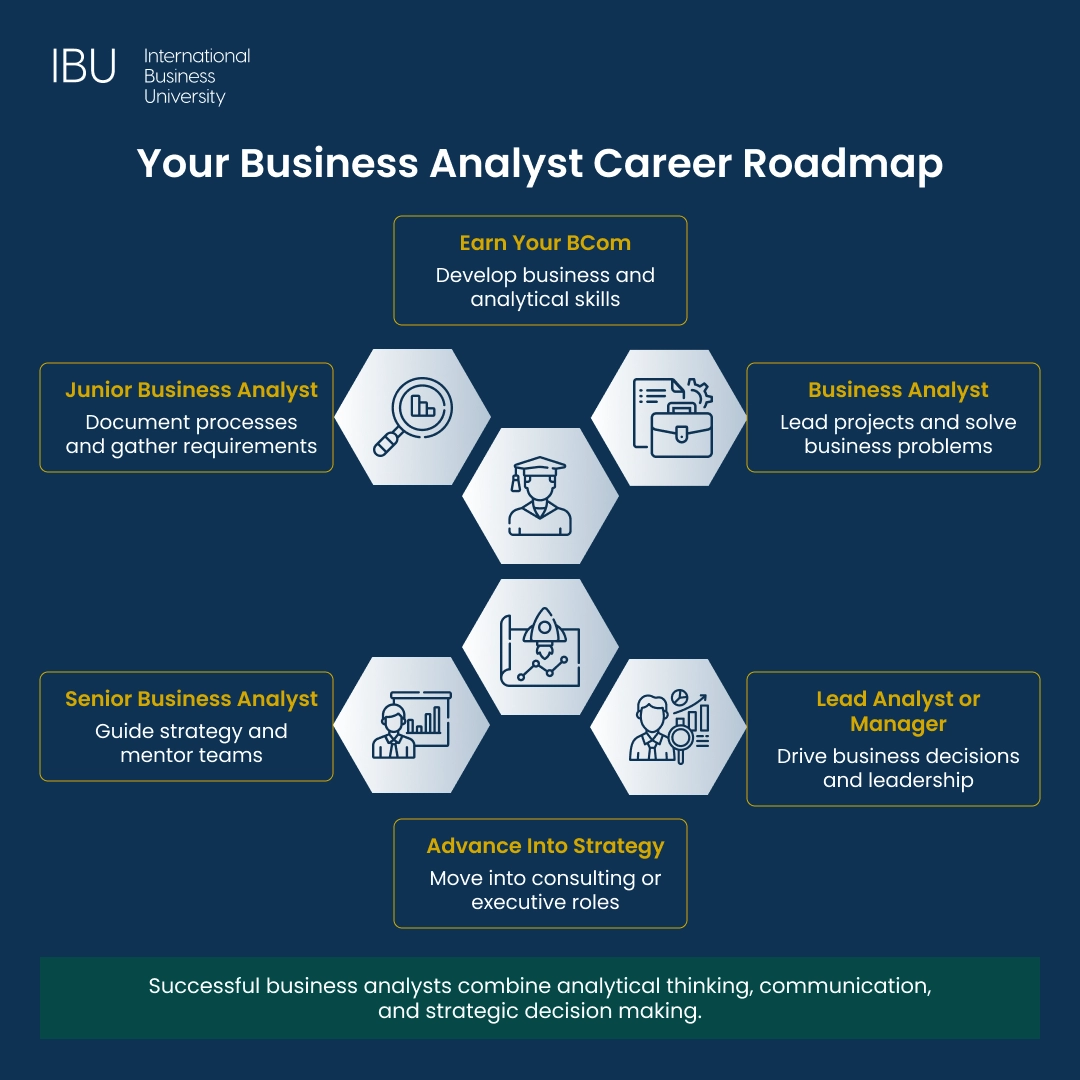
Business Analyst Career Path: The Four Stages From Entry Level to Senior
The path generally moves through four identifiable stages, though pace varies significantly based on demonstrated impact rather than tenure alone. Each stage requires a distinct skill emphasis beyond the one before it.
- Junior business analyst: Focuses on requirements documentation and process mapping under direct supervision.
- Business analyst: Owns a project or process area independently, presenting findings directly to stakeholders.
- Senior business analyst: Leads cross-functional initiatives and advises on strategic direction, not just process detail.
- Lead analyst or manager: Oversees a team of analysts and represents the analyst function in executive-level discussions.
Movement between stages depends heavily on a candidate’s ability to communicate findings persuasively and clearly, not just on analytical accuracy alone.
Build the Foundation for a Business Analyst Career
IBU’s BCOM in Business Management develops the analytical and communication skills this career path depends on.
Why a BCOM in Business Management Is the Strongest Starting Foundation
Many entry-level business analysts come from technical or accounting backgrounds without formal training in stakeholder communication or process analysis. A BCOM in Business Management builds both directly, closing a gap technical candidates often address only after starting the job.
- Process analysis coursework: Trains students to map and evaluate business processes, the core activity of an entry-level analyst role.
- Stakeholder communication training: Builds the presentation and negotiation skills that separate analysts who advise from analysts who only document.
- Applied project work: Gives students practice translating a business problem into a structured recommendation before entering the workforce.
Candidates entering with this foundation typically progress through the early stages faster than peers building these skills for the first time on the job.
The Skills That Determine How Fast You Move Up the Business Analyst Career Path
Technical proficiency with data and documentation tools gets a candidate into the role, but a distinct set of skills determines how quickly they advance beyond it.
- Stakeholder influence: Getting buy-in from people who do not report to the analyst, often across multiple departments with competing priorities.
- Business context fluency: Understanding how a specific recommendation affects revenue, cost, or risk, not only if it is technically sound.
- Executive communication: Summarizing complex findings into a format senior stakeholders can act on quickly.
Analysts who invest in these three areas early tend to reach senior roles years faster than analysts who focus solely on technical tool proficiency.
Business Analyst Salary: What Each Career Stage Pays in Canada
Compensation varies by industry, region, and specific responsibility, though a general pattern holds across most Canadian markets. Analysts who move quickly into advisory responsibilities typically see compensation grow faster than analysts who remain in a documentation-focused role.
- Junior and entry level: Compensation reflects a supervised, documentation-focused role with limited independent authority.
- Mid level: Pay increases align with independent ownership of a process area or project.
- Senior and lead roles: Compensation reflects strategic advisory responsibility and, in some cases, direct people management.
Candidates should research current compensation benchmarks for their specific city and industry rather than relying on national averages alone.
How to Pivot From a Business Analyst Career Path Into Strategy or Consulting
Many experienced analysts eventually move into strategy or consulting roles rather than continuing along the traditional analyst ladder, where the path from analyst to partner follows its own defined structure. This pivot rewards a specific combination of experience most analysts can build deliberately.
- Build a portfolio of strategic recommendations: Documenting instances where an analysis directly influenced a business decision, not just a process change.
- Develop client-facing experience: Seeking opportunities to present directly to external stakeholders or senior leadership.
Formalizing this pivot often involves pursuing IBU’s MBA in Finance and Management Analytics, which builds the strategic and quantitative skill set consulting and strategy roles specifically screen for.
Analysts who make this pivot successfully typically start positioning for it several years before actually making the move.
What IBU BCOM Graduates Do in Their First Business Analyst Role
Graduates entering their first analyst role typically apply the same process mapping and stakeholder communication skills built during their applied coursework. The transition tends to be smoother than for candidates without this specific preparation.
IBU’s guide on how to become a business analyst and its companion piece on powerful business skills for aspiring leaders cover related entry strategies in more depth.
Frequently Asked Questions
What is a typical business analyst career path in Canada?
Most analysts progress from junior analyst to business analyst, then senior business analyst, and eventually lead analyst or manager. Progression speed depends on demonstrated strategic judgment rather than tenure alone.
Is a BCOM in Business Management a good foundation for a business analyst career?
The degree builds process analysis and stakeholder communication skills directly relevant to entry-level analyst work. Candidates with this foundation often progress through early career stages faster than peers without it.
What business analyst salary can I expect at each career stage in Canada?
Entry-level compensation reflects a supervised, documentation-focused role, while senior compensation reflects strategic advisory responsibility. Specific figures vary significantly by industry, region, and individual negotiation.
How is a data analyst career path different from a business analyst career path?
Data analysts focus more heavily on technical data manipulation and statistical analysis. Business analysts focus more on translating business needs into requirements and advising on strategic decisions.
How can I move from a business analyst role into strategy or consulting?
Building a portfolio of strategic recommendations and seeking client-facing presentation experience both support this pivot. An MBA in financial and management analytics can formalize the quantitative and strategic skills these roles require.
Moving Up the Business Analyst Career Path Deliberately
The business analyst career path rewards candidates who build stakeholder influence and business judgment early on, not only technical documentation skill. Graduates who enter with this foundation already in place, and who deliberately pursue strategic experience, tend to progress through the stages most guides gloss over.
Position Yourself for Faster Career Advancement
Learn how IBU’s BCOM in Business Management builds the skills that accelerate business analyst career progression.