

Communication determines how leadership shows up long before titles appear. Every conversation signals competence, intent, and credibility. Communication 101 focuses on clarity, responsibility, and direction rather than volume or personality. When you speak with purpose, people understand you faster, trust you sooner, and follow you more willingly.
Strong leaders communicate with intention. They do not rely on charisma alone. They structure ideas, read the room, and guide conversations toward outcomes. Communication 101 gives you the foundation to do exactly that.
Key Takeaways
- Purpose-driven communication strengthens leadership presence and decision-making.
- Clear structure and intentional delivery reduce friction in teams and organizations.
- Communication 101 supports career growth by improving influence, trust, and alignment.
The Fundamentals of Communication 101 for Effective Interaction
Communication 101 begins with discipline rather than personality. Effective interaction depends on how well intent, message, and interpretation align in real time. Leaders who master these fundamentals communicate clearly even when the stakes rise, timelines tighten, and emotions surface. This discipline turns communication from a soft skill into an operational advantage.
Strong communication reduces friction before it appears. It creates shared understanding, accelerates execution, and limits the need for correction. These fundamentals form the backbone of leadership presence in every setting.
Clarity Before Expression
Leadership communication starts internally. Clear thinking produces clear speech because ideas already have shape before they reach the room. When leaders organize thoughts in advance, teams receive direction instead of fragments. Clarity saves time, reduces follow-up, and prevents rework.
Clarity also protects credibility. When messages wander, confidence erodes. When messages stay focused, authority strengthens.
Workplace scenario:
A project manager outlines priorities without a clear structure. Each team member hears something different. Deadlines slip due to misalignment. The next meeting becomes a clarification session that could have been avoided through clearer framing the first time.
Intentional Word Choice
Words define authority more than tone alone. Leaders choose language that signals ownership, direction, and accountability. Purposeful wording avoids excess explanation while preserving meaning. Precision helps teams act without hesitation.
Intentional language also removes ambiguity. When expectations sound firm and clear, execution improves.
Workplace scenario:
A manager says, “We should probably try to improve this.” The team pauses, unsure who owns the task. Another manager says, “We will improve this by adjusting the process this week.” Action follows immediately because direction feels clear.
Active Listening
Leadership communication includes listening as a strategic function. Leaders who listen actively gather context, identify risks early, and strengthen trust across teams. Listening improves response quality because decisions rest on full information rather than assumptions.
Active listening also signals respect. People contribute more openly when they feel heard.
Workplace scenario:
During a team conflict, a leader listens without interrupting. Underlying concerns surface that had remained unspoken. Resolution becomes possible because individuals feel acknowledged rather than dismissed.
Emotional Awareness
Emotion shapes how messages land regardless of content. Leaders regulate tone to maintain credibility under pressure. Emotional awareness helps leaders choose timing and phrasing carefully, especially during difficult conversations.
Calm delivery reinforces authority. Reactive delivery weakens it.
Workplace scenario:
A supervisor delivers feedback while visibly frustrated. The message gets lost as defensiveness rises. Another supervisor waits, delivers feedback calmly, and sees immediate improvement because the message lands clearly.
Nonverbal Alignment
Body language reinforces spoken intent. Leaders align posture, eye contact, and gestures with words to maintain consistency. Alignment builds trust because people sense coherence between message and presence.
Mixed signals create doubt even when words sound confident.
Workplace scenario:
A leader announces confidence in a plan while avoiding eye contact and shifting posture. The team senses uncertainty and questions direction despite verbal assurance.
Feedback Awareness
Feedback shows how communication lands in real time. Leaders observe reactions, adjust delivery, and refine approach continuously. This adaptability improves long-term effectiveness and strengthens relationships.
Feedback completes the communication loop. Without it, growth stalls.
How Communication 101 Helps You Speak with Purpose
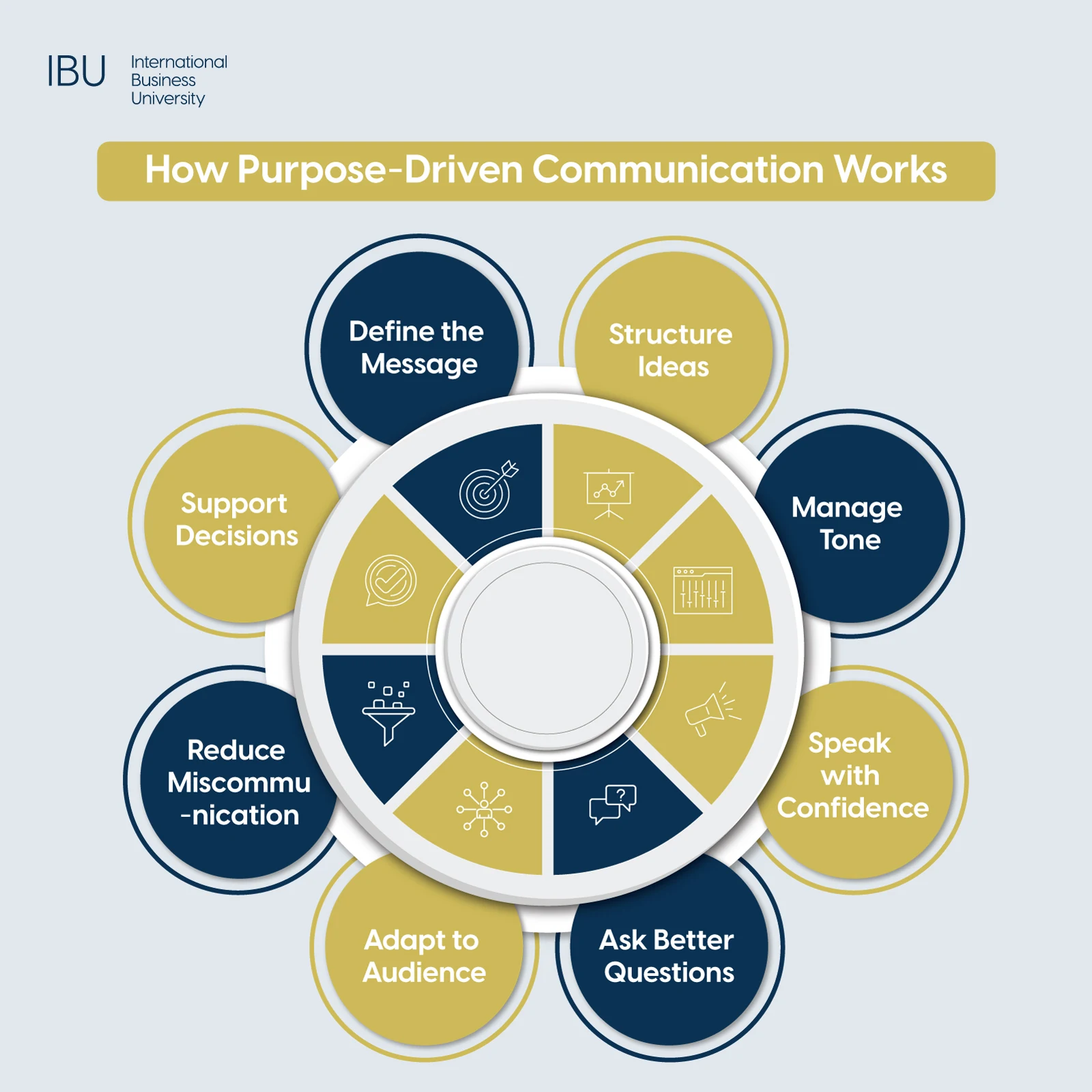
Purpose turns conversation into leadership leverage. Communication 101 trains you to speak with intention rather than impulse, changing how people interpret your presence. When words follow a clear objective, conversations move forward instead of looping. Leaders who speak with purpose reduce friction, accelerate alignment, and earn trust faster.
Speaking with purpose also shifts responsibility. You stop reacting to moments and start shaping them deliberately. This shift changes how colleagues listen, how teams respond, and how decisions form around you.
Defining Your Message
Leaders clarify their message before speaking. Knowing the outcome you want keeps communication focused and controlled. Clear objectives prevent unnecessary detours that dilute impact. When the message stays tight, attention stays with you.
In practice, this means identifying one primary point per conversation. Supporting details exist to reinforce that point, not compete with it. This discipline sharpens authority and improves confidence.
Structuring Thoughts Logically
Logical structure allows listeners to follow without strain. Leaders sequence ideas so one point leads naturally into the next. This flow improves comprehension and retention during meetings, presentations, and one-to-one discussions.
Structure also signals preparation. When ideas arrive in order, people trust your thinking. Alignment grows because understanding arrives faster.
Managing Tone and Pace
Tone determines how messages feel. Calm, steady delivery communicates control and confidence even during tension. Leaders adjust pacing based on context, slowing down for complex ideas and tightening delivery for decisions.
Pace influences credibility. Rushed speech introduces doubt. Measured delivery reinforces authority and clarity.
Speaking with Confidence
Confidence grows from preparation and clarity rather than volume. Purpose-driven speech reduces hesitation because direction feels certain. Clear messaging reinforces leadership presence without force.
Consistency builds reputation. When delivery remains steady across situations, people trust your judgment. Confidence becomes associated with reliability.
Asking Better Questions
Leadership communication includes inquiry alongside instruction. Strong questions guide discussions toward insight and resolution. They uncover assumptions, risks, and opportunities that statements alone miss.
Asking thoughtful questions also signals engagement. It shows respect for input and awareness of complexity. Decision quality improves when inquiry shapes conversation.
Adapting to Your Audience
Purposeful leaders adjust communication based on who is listening. Language, examples, and emphasis shift depending on audience needs. Communication 101 prioritizes relevance over repetition.
Adaptability strengthens connection. When people feel understood, alignment follows naturally. Flexibility increases influence without weakening clarity.
Reducing Miscommunication
Miscommunication often begins with unclear framing. Leaders who speak with purpose anticipate interpretation rather than assume understanding. Providing context reduces confusion and limits incorrect assumptions.
Clear framing protects momentum. Fewer corrections mean faster execution. Teams stay focused rather than retracing steps.
Supporting Decision-Making
Clear communication drives better decisions. Leaders frame options with purpose, outlining implications, constraints, and priorities. This clarity helps teams evaluate choices efficiently.
Purpose guides outcomes. When communication directly supports decision-making, progress accelerates. Confidence in direction strengthens execution.
Communication 101 in High-Stakes Leadership Moments
High-stakes moments reveal communication skill faster than routine conversations. Communication 101 becomes most visible when pressure increases, emotions rise, and outcomes carry consequences. Leaders who communicate clearly in these moments protect trust, maintain authority, and guide teams through uncertainty. Purpose-driven communication keeps momentum intact when conditions feel unstable.
IBU Learning Outcome Alignment:
- Executive communication under pressure
- Ethical leadership and accountability
- Conflict management and organizational change
Communicating During Disagreement Without Creating Division
Disagreement tests leadership composure. Purposeful communicators separate ideas from identity and frame discussion around outcomes rather than positions. Clear structure keeps disagreement productive rather than personal.
Case scenario:
Two department leads disagree on budget allocation during a leadership meeting. One reframes the discussion around shared priorities and impact. Alignment follows without escalation or defensiveness.
Leading Difficult Conversations with Clarity and Restraint
Difficult conversations demand preparation and emotional discipline. Communication 101 emphasizes clarity, timing, and respectful tone. Leaders who prepare key points reduce confusion and defensiveness.
Case scenario:
A manager addresses performance concerns with an employee using clear expectations and calm delivery. Improvement follows because the message feels constructive rather than confrontational.
Holding Authority While Remaining Approachable
Authority does not require dominance. Leaders communicate expectations firmly while remaining open to dialogue. This balance strengthens respect and trust at the same time.
Case scenario:
A team lead sets firm deadlines while inviting questions and clarification. The team responds with confidence and commitment rather than hesitation.
Speaking with Confidence When Answers Are Not Final
Leadership often requires communication before certainty exists. Purposeful leaders acknowledge unknowns while explaining next steps clearly. Transparency preserves credibility during ambiguity.
Case scenario:
During a system outage, a leader explains what is known, what remains uncertain, and how the team will respond. Anxiety decreases because direction remains clear.
Managing Emotional Pressure Without Losing Message Control
Pressure amplifies emotion. Communication 101 trains leaders to regulate delivery while staying focused on outcomes. Emotional discipline protects message clarity during tense moments.
Case scenario:
A senior leader receives unexpected criticism in a meeting and responds calmly, redirecting discussion toward objectives without defensiveness.
Aligning Stakeholders During Organizational Change
Change communication requires clarity and consistency. Leaders who explain rationale, impact, and direction reduce uncertainty and resistance. Alignment depends on repetition and transparency.
Case scenario:
During a restructuring announcement, leadership communicates purpose, timeline, and support resources clearly. Engagement remains steady despite change.
Build leadership communication that earns trust
Develop structured thinking, confident speaking, and decision-focused communication through hands-on business education
Practicing Communication 101 to Enhance Daily Conversations
Leadership communication improves through daily application rather than occasional performance. Communication 101 turns routine interactions into practice opportunities that build consistency over time. Small adjustments, repeated often, compound into noticeable authority. The strongest communicators do not switch skills on for presentations only; they apply discipline in everyday moments.
Every conversation becomes a chance to refine clarity, tone, and presence. Daily habits shape leadership reputation more powerfully than isolated high-visibility moments. Consistency earns trust.
Preparing Before Speaking
Leaders prepare even for informal conversations. A brief pause helps clarify intent, desired outcome, and key point. This preparation prevents messages from drifting mid-conversation and reduces the need for correction later.
Preparation also stabilizes delivery. When you know your point, hesitation fades and confidence increases. Even a few seconds of mental organization sharpens impact.
Choosing Timing Wisely
Timing influences receptivity as much as content. Leaders read context, energy levels, and priorities before speaking. Choosing the right moment increases impact and reduces resistance.
Good timing shows awareness. It communicates respect for workflow, pressure, and attention. Messages delivered at the right time land with less friction.
Staying Present
Presence strengthens connection. Focused attention improves listening quality and response accuracy. Distraction weakens leadership credibility quickly because people sense divided attention immediately.
Being present signals respect. It communicates that the conversation matters. People respond more openly when they feel fully heard.
Managing Interruptions
Interruptions test composure and control. Leaders handle them calmly without losing direction. Purposeful responses acknowledge the interruption while guiding conversation back on track.
Control during interruptions reinforces authority. Composure under pressure builds confidence in leadership capability. People trust leaders who remain steady when conversations fragment.
Clarifying When Needed
Clarification prevents assumptions from spreading unchecked. Leaders ask for confirmation when messages feel unclear or incomplete. This habit reduces conflict, rework, and misalignment.
Clear understanding supports smoother execution. When expectations align early, teams move faster and with greater confidence. Alignment improves outcomes across projects.
Practicing Brevity
Brevity strengthens messages by respecting attention spans and cognitive load. Leaders communicate what matters without excess explanation. Purpose guides conciseness.
Clear endings improve recall. People remember messages that land cleanly rather than trailing off. Brevity protects authority by avoiding overexplanation.
Observing Reactions
Reactions provide immediate feedback. Leaders watch body language, tone shifts, and engagement levels closely. These signals reveal how messages are received.
Awareness enables adjustment in real time. Communication becomes adaptive rather than rigid. Strong leaders read reactions as carefully as they deliver content.
Reflecting After Conversations
Reflection builds skill over time. Leaders review conversations mentally, noting what worked, what missed, and what could improve. This reflection sharpens judgment and refines style.
Growth follows awareness. Consistent reflection strengthens long-term effectiveness and maturity. Improvement accelerates when learning becomes habitual.
Measuring Growth and Mastery in Communication 101
Communication mastery develops through evaluation, feedback, and reflection. Communication 101 treats improvement as a measurable process rather than intuition. Leaders who track progress communicate with increasing clarity, confidence, and consistency over time.
IBU Learning Outcome Alignment:
- Reflective leadership development
- Continuous improvement and self-assessment
- Strategic communication evaluation
Signals That Communication Is Earning Trust
Trust appears through behavior rather than words. Teams ask fewer clarification questions, act decisively, and share concerns openly. These signals indicate communication effectiveness.
Case scenario:
A project team executes decisions quickly after meetings with minimal follow-up because expectations feel clear.
Using Feedback to Improve Communication Effectiveness
Feedback reveals blind spots. Leaders invite input on clarity, tone, and delivery. Adjustments based on feedback strengthen long-term impact.
Case scenario:
A leader requests post-meeting feedback and revises presentation structure based on team responses.
Tracking Communication Growth Across Roles
Leadership communication evolves with responsibility. What works at one level changes at another. Tracking growth helps leaders adapt language and framing.
Case scenario:
A professional moving into management shifts from task-focused updates to outcome-focused messaging.
Self-Reflection Practices Used by Strong Leaders
Reflection strengthens awareness. Leaders review conversations mentally, noting effectiveness and gaps. Consistent reflection sharpens judgment.
Case scenario:
After a challenging meeting, a leader reflects on pacing and clarity, improving the next interaction.
Measuring Impact Through Outcomes, Not Intent
Intent does not equal impact. Leaders evaluate communication based on outcomes such as alignment, execution speed, and morale. Results matter more than delivery effort.
Case scenario:
A leader measures communication success by project momentum rather than message delivery alone.
Building Consistency Across Communication Channels
Consistency across meetings, emails, and presentations reinforces trust. Communication 101 emphasizes alignment across formats to prevent mixed signals.
Case scenario:
A leader delivers the same core message across written updates and team discussions.
Establishing Personal Communication Benchmarks
Leaders set personal standards for clarity, tone, and structure. Benchmarks guide continuous improvement and accountability.
Case scenario:
A leader commits to clear agendas and defined conclusions in every meeting.
Recognizing When Communication Becomes a Leadership Advantage
Mastery becomes visible when communication accelerates decisions and reduces friction. Leaders notice smoother collaboration and stronger influence across teams.
Case scenario:
A leader gains cross-department support quickly due to clear, trusted communication.
Becoming a Thoughtful Communicator through Communication 101
Thoughtful communication signals leadership maturity because it prioritizes impact over expression. Communication 101 trains leaders to take responsibility for how messages land, not simply how they are delivered. Words shape momentum, influence trust, and guide decisions long after a conversation ends. Leaders who understand this speak with intent rather than impulse.
Thoughtful leaders pause before responding because speed does not equal clarity. They assess context, audience expectations, and desired outcomes before choosing language. This pause sharpens judgment, steadies tone, and improves precision. Emotional reactions give way to deliberate responses that move conversations forward.
Communication 101 also emphasizes internal discipline before external delivery. Leaders learn to clarify their objective before entering a discussion. They consider what must be understood, decided, or resolved. This preparation reduces ambiguity and strengthens credibility.
Key traits of thoughtful communicators include:
- Clear intent before speaking
- Awareness of emotional and situational context
- Respect for differing perspectives
- Willingness to adjust delivery without diluting the message
Thoughtful communication builds trust steadily through consistency. Teams feel heard rather than directed. Psychological safety increases because responses feel measured and fair. Leadership influence strengthens as predictability replaces volatility.
Communication 101 and Leadership Development at IBU
IBU treats communication as a core leadership capability that shapes authority, influence, and decision-making. Programs emphasize structure, clarity, and strategic intent across spoken and written communication. Students learn to organize ideas logically, present confidently, and engage in purposeful dialogue within complex environments. These competencies mirror real workplace expectations.
At the undergraduate level, communication development begins through active practice. Students participate in presentations, case discussions, team projects, and applied problem-solving. They learn to explain reasoning clearly, defend positions with evidence, and listen with intent. Communication 101 supports early leadership readiness by building confidence alongside discipline.
Graduate programs extend this foundation into executive-level communication. MBA students refine how they frame decisions, align stakeholders, and manage dialogue under pressure. Messaging becomes more deliberate, audience-aware, and outcome-driven. Communication shifts from a functional skill to a leadership lever that guides strategy and execution.
Across programs, communication training reinforces accountability. Students learn that clarity reduces friction and alignment accelerates results. This approach prepares graduates to lead conversations that shape teams, decisions, and organizational direction.
FAQ
What does Communication 101 mean in leadership
Communication 101 refers to foundational principles that guide effective leadership interaction. It emphasizes clarity, intent, and listening. These principles support influence and trust. Leadership presence grows through consistent application.
Can communication skills change career trajectory
Communication shapes how leaders are perceived. Clear communicators gain trust faster. Influence increases with clarity. Career growth often follows strong communication.
Why do capable professionals struggle with communication
Many focus on content rather than delivery. Lack of structure creates confusion. Emotional pressure affects tone. Communication 101 addresses these gaps.
Why Communication 101 Matters in Personal and Professional Life
Communication shapes leadership at every level because it determines how intent becomes action. Communication 101 equips you to express ideas clearly, manage conversations responsibly, and guide outcomes with purpose. Purpose-driven communication reduces friction by limiting confusion and misalignment before they grow. Trust builds when people experience clarity consistently.
In personal settings, Communication 101 strengthens relationships by improving listening and reducing misunderstanding. In professional settings, it supports collaboration, decision-making, and leadership credibility. When words align with intent, leadership presence becomes unmistakable and sustainable.
Lead conversations that shape outcomes
Strengthen executive communication, strategic thinking, and leadership presence through advanced business education