

Data analytics in healthcare is the systematic collection, processing, and interpretation of clinical and operational data to improve patient outcomes, reduce cost, and guide organizational decisions. It operates under constraints unlike any other industry. Regulatory oversight, clinical risk, and infrastructure complexity shape every decision from system design to deployment. This article examines the six factors influencing how healthcare analytics initiatives are planned, governed, and delivered today, with a focus on execution discipline rather than technology alone.
Technical Infrastructure Requirements
Healthcare project outcomes rise and fall on infrastructure decisions made early, often before visible progress begins. Infrastructure in healthcare does more than support analytics workloads. It safeguards patient trust, clinical continuity, and regulatory standing. Systems must function under constant demand while meeting strict privacy, security, and audit requirements. Unlike commercial environments, infrastructure failures in healthcare affect real-time care delivery, not just reporting timelines.
Project managers act as stewards of infrastructure risk. They coordinate decisions that determine system availability, data integrity, and scalability under clinical load. Infrastructure planning accounts for peak usage during emergencies, system redundancy for failover, and long-term maintainability. Once deployed, architectural weaknesses remain difficult and costly to correct. Early discipline prevents downstream exposure.
Cloud Migration for Healthcare Analytics
Cloud migration in healthcare unfolds through carefully sequenced phases rather than broad transitions. Patient data remains subject to jurisdictional residency rules, sector-specific privacy laws, and organizational governance frameworks. Project managers coordinate migrations that preserve continuous access for clinicians while validating security controls at every step.
Unlike other industries, downtime tolerance approaches zero.
Migration strategies often rely on hybrid environments where on-premise systems run alongside cloud platforms for extended periods. Parallel operation supports validation, comparison testing, and risk mitigation. Rollback plans remain mandatory in case performance or compliance thresholds fall short. Cloud adoption succeeds only when regulators, clinicians, and IT leaders share confidence in system stability.
Post-migration audits confirm encryption effectiveness, access permissions, data lineage, and performance benchmarks. Compliance documentation becomes as critical as technical success. Cloud migration in healthcare progresses through assurance rather than acceleration.
High-Performance Computing Needs
Healthcare analytics workloads extend far beyond dashboards and summaries. Imaging analysis, genomic sequencing, clinical simulation, and population modeling demand substantial computational power under tight latency constraints. These workloads increase unpredictably during outbreaks, research initiatives, or policy shifts. Project managers incorporate this variability into capacity planning.
High-performance computing decisions balance reliability against cost control. Under-provisioning delays analytics output and limits clinical usefulness. Over-provisioning strains capital approval processes and long-term operating budgets. Project managers collaborate with data scientists and infrastructure teams to forecast demand based on clinical use cases, not technical estimates alone.
Performance certification becomes part of project acceptance criteria. Systems undergo stress testing under simulated peak loads. Analytics value depends on timely results, not theoretical capability.
Data Lake Architecture Design
Healthcare data lakes serve as the backbone for analytics initiatives across care delivery, operations, and research. They aggregate electronic health records, imaging data, lab results, operational metrics, and external datasets such as public health data. Architecture must handle diverse formats while enforcing strict governance.
Project managers ensure architectural decisions reflect clinical workflows and compliance requirements from the outset. Access control, data segmentation, and audit trails remain foundational design elements. Poor architecture introduces data quality issues that ripple through analytics pipelines, eroding confidence and decision accuracy.
Strong data lake design supports scalability without sacrificing control. It enables analytics expansion while maintaining traceability. Architecture choices influence reporting reliability and regulatory posture long after the project closes.
Streaming Data Processing Pipelines
Streaming data pipelines power real-time patient monitoring, alert systems, and operational dashboards. These systems ingest continuous data from bedside devices, wearables, and monitoring platforms. Low latency, accuracy, and fault tolerance remain non-negotiable.
Project managers oversee complex integrations across hardware, middleware, and analytics engines. Validation focuses on event ordering, completeness, and alert precision. Even minor sequencing errors may produce misleading clinical signals. Deployment proceeds through shadow environments where outputs are monitored without affecting care decisions.
Failures in streaming systems carry immediate consequences. Disciplined execution protects patient safety while enabling responsiveness.
Scalable Machine Learning Operations
Machine learning in healthcare operates under continuous change. Clinical patterns evolve, treatment protocols shift, and population characteristics change. Infrastructure must support retraining, monitoring, and validation across model lifecycles.
Project managers coordinate governance that tracks model inputs, outputs, and performance over time. Version control ensures traceability when models inform clinical decisions. Explainability remains mandatory, especially when analytics influence diagnosis or treatment pathways.
Scalability ensures models remain effective across growing data volumes and diverse patient populations. Governance prevents drift and unverified deployment. Machine learning success depends on operational discipline rather than experimentation alone.
Build leadership skills for complex healthcare systems
Healthcare analytics projects demand strong decision-making, governance awareness, and cross-functional leadership.
6 Factors Shaping Data Analytics in Healthcare Today
Data analytics in healthcare develops under overlapping pressures from regulation, clinical demand, and technical advancement. These forces shape scope definition, stakeholder alignment, and delivery expectations. Project managers who understand these dynamics anticipate constraints early and design execution strategies accordingly.
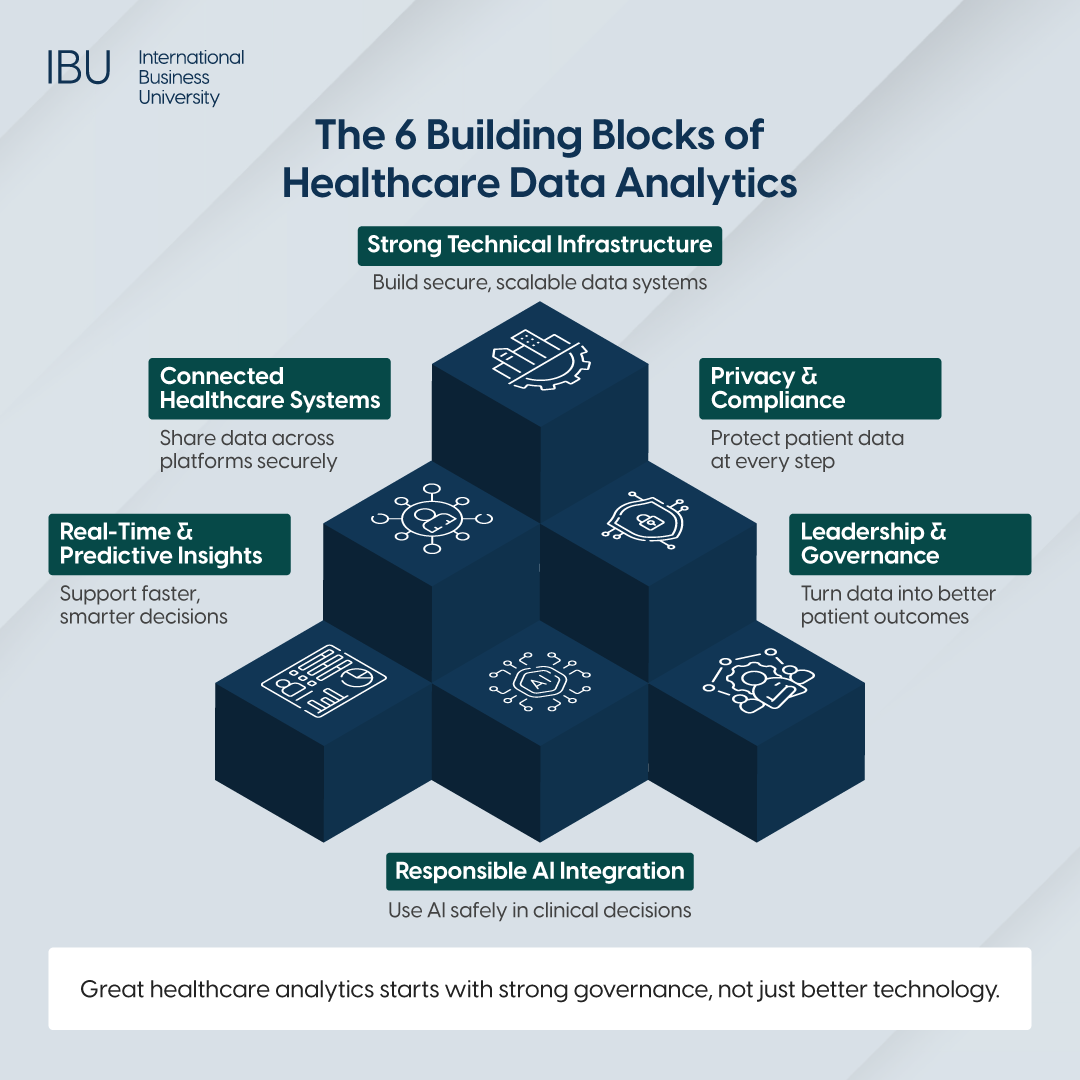
1. AI Integration and Clinical-Grade Analytics
AI integration in healthcare requires validation against clinical performance benchmarks, not technical accuracy alone. Models must demonstrate reliability across patient populations, care settings, and usage conditions. Project managers coordinate structured testing protocols involving clinicians, data scientists, compliance officers, and governance committees.
Deployment follows approval checkpoints tied to safety and interpretability. Explainability supports clinician trust and regulatory acceptance. AI initiatives succeed only when governance maturity matches technical capability.
2. Data Interoperability Standards Evolution
Healthcare systems depend on interoperability standards to exchange data across platforms and organizations. Analytics projects rely on consistent interpretation of standards such as HL7 and FHIR. Project managers oversee interface mapping, transformation rules, and validation testing.
Interoperability failures lead to incomplete analytics and operational blind spots. Standard adherence reduces reconciliation effort and error propagation. Vendor coordination becomes a continuous project responsibility rather than a one-time task.
3. Privacy Regulations and Compliance Pressures
Privacy regulations govern every stage of healthcare analytics. Consent management, data minimization, retention limits, and access logging shape project execution. Compliance checkpoints appear throughout the project lifecycle.
Project managers collaborate closely with legal and compliance teams to maintain alignment. Documentation supports audit readiness and regulatory reporting. Non-compliance halts progress regardless of technical readiness.
4. Real-Time and Predictive Analytics Adoption
Predictive analytics supports staffing optimization, capacity forecasting, and patient risk identification, the exact skill set covered in predictive analytics in healthcare. Project managers manage expectations around accuracy and applicability. Models support decision-making rather than automated action.
Deployment includes clinician training and feedback mechanisms. Interpretation frameworks ensure analytics inform judgment rather than replace it. Trust grows through consistent performance and transparency.
5. Integration of Social Determinants Data
Healthcare analytics increasingly integrates non-clinical data related to housing, income, education, and environment. These datasets enrich population health insights while increasing governance complexity. Project managers oversee ethical use frameworks and transparency requirements.
Integration expands analytics beyond institutional boundaries. Governance ensures appropriate application and safeguards trust. Social data strengthens long-term planning and intervention design.
6. Personalized Medicine and Precision Analytics
Precision analytics tailors treatment decisions using genomic, behavioural, and clinical data. Projects manage sensitive datasets and advanced modeling workflows. Coordination across research, clinical, and IT teams increases complexity.
Project managers enforce governance that protects patient trust while enabling innovation. Precision analytics advances cautiously under structured oversight and validation.
Why Data Analytics in Healthcare Needs Stricter Governance Controls
Healthcare analytics operates on data that is clinically sensitive, legally protected, and operationally consequential in ways that standard enterprise analytics does not encounter. The regulatory environment, patient safety exposure, and ethical obligations create governance requirements that exceed what most commercial frameworks provide.
As Peter Drucker observed in The Effective Executive: “What gets measured gets managed.” In healthcare analytics, the inverse also applies: what is governed poorly gets misused, and the consequences fall on patients rather than balance sheets.
The primary reasons healthcare analytics requires stricter governance controls than standard environments:
- Patient data is federally and provincially regulated. In Canada, PIPEDA and provincial health information legislation such as Ontario’s PHIPA impose specific requirements for consent, access, breach notification, and data retention. Non-compliance carries legal liability, not only operational disruption.
- Clinical decisions follow from analytics outputs. When analytics informs a diagnosis, treatment path, or risk score, errors propagate into care delivery. In commercial analytics, a flawed model produces a poor business decision. In healthcare, it can produce patient harm.
- Audit trails must satisfy regulatory review. Health Canada and provincial regulators require traceability of data lineage, model inputs, and decision pathways. Standard analytics platforms rarely provide the documentation depth required for healthcare audits.
- Model drift carries patient safety risk. When machine learning models trained on historical clinical data begin performing outside validated parameters, the consequences extend beyond reporting inaccuracy. Governance frameworks must include continuous monitoring, revalidation thresholds, and controlled rollback procedures.
- Access controls must reflect clinical roles. Generic role-based access is insufficient in healthcare environments where data sensitivity varies by patient, department, and care episode. Governance structures must enforce granular, context-aware access that aligns with clinical need rather than organizational hierarchy alone.
For professionals building careers in this space, the MBA in Digital Health and Data Analytics and the MSc in Applied AI Data Engineering both address governance frameworks as core curriculum components, not supplementary context.
Future Outlook for Healthcare Analytics
Healthcare analytics continues evolving through emerging technologies that test existing project management models. Adoption requires a balance between experimentation and accountability. Long-term success depends on structured planning rather than rapid adoption.
Quantum Computing Applications
Quantum computing offers potential acceleration in drug discovery and system modeling. Healthcare applications remain exploratory. Projects focus on feasibility studies and research partnerships.
Risk assessment remains central. Adoption timelines progress conservatively. Governance frameworks guide exploration.
Edge Analytics for Wearables
Wearable devices generate continuous patient data streams. Edge analytics processes data closer to the source, reducing latency and bandwidth strain. Project managers oversee device validation and integration.
Edge deployment improves responsiveness while increasing governance complexity. Security extends beyond centralized infrastructure.
Blockchain for Data Provenance
Blockchain strengthens traceability, consent tracking, and audit transparency. Healthcare projects evaluate scalability and governance suitability carefully. Adoption remains selective.
Provenance tracking supports trust across data-sharing ecosystems. Governance determines feasibility.
Digital Twin Patient Models
Digital twins simulate patient responses across treatment scenarios. Projects require advanced modeling, integration, and validation. Clinical oversight remains mandatory.
Use cases expand gradually. Acceptance depends on accuracy and interpretability.
Global Health Data Collaboration
Cross-border analytics improves disease surveillance and coordinated response. Projects navigate jurisdictional data rules and governance complexity. Collaboration expands insight while increasing oversight requirements.
Project managers define access, responsibility, and accountability clearly. Structure enables scale without sacrificing compliance.
Governance Models That Determine Analytics Success
Healthcare analytics depends on governance as much as technology. Clear governance structures define authority, accountability, and risk tolerance across every phase of an analytics initiative.
- Defined approval authority: Clear ownership determines who approves data access, model deployment, and system changes. This structure prevents delays caused by overlapping responsibilities.
- Clinical oversight integration: Governance models include clinical leadership to validate analytics relevance and safety. Clinical input ensures insights align with care standards.
- Privacy and compliance enforcement: Data governance frameworks enforce consent management, access controls, and retention policies. These controls protect regulatory standing and patient trust.
- Change control discipline: Formal change management prevents unauthorized model updates or data source changes. Discipline preserves analytics reliability over time.
- Audit readiness and traceability: Governance ensures documentation supports audits and regulatory review. Traceability reduces exposure during external assessments.
- Escalation pathways for risk: Defined escalation processes allow rapid response to data quality issues or compliance concerns. Speed with structure reduces operational disruption.
What Analytics Capabilities Healthcare Leaders Prioritize
Analytics changes how decisions are made inside healthcare organizations. Leadership readiness determines if insights improve outcomes or create confusion. The following capabilities are most consistently prioritized by healthcare executives and department heads building analytics competency:
- Analytics literacy at the executive level: Leaders must understand what analytics can and cannot show. Literacy prevents overreliance on models without context.
- Governance oversight of analytics systems: Leaders prioritize understanding data lineage, model validation processes, and compliance audit requirements before authorizing deployment.
- Real-time data interpretation: Executives managing high-volume care environments prioritize real-time analytics in healthcare settings, including patient flow dashboards, capacity monitoring, and clinical alert systems.
- Interpretation before action: Decision-makers evaluate insights alongside clinical judgment and operational realities. Analytics supports decisions rather than replacing expertise.
- Confidence in data sources: Trust grows when leaders understand how data is collected, validated, and governed. Confidence improves adoption.
- Responsible use of predictive insights: Leaders apply predictive analytics in healthcare cautiously, especially in patient-facing decisions. Oversight protects ethical standards.
- Alignment between strategy and analytics outputs: Analytics initiatives align with organizational priorities. Insights drive strategy when goals remain clear.
- Ongoing leadership education: Continuous learning keeps leaders current with analytics capabilities and limitations. Education sustains long-term value.
Professionals building toward leadership roles in healthcare analytics benefit from dedicated program pathways. The data analyst in healthcare career guide outlines how formal education, governance exposure, and clinical domain knowledge combine to build sector-specific analytical leadership.
Key Takeaways

Healthcare analytics success depends on early infrastructure, governance, and compliance decisions that are difficult to correct later.
Project managers play a central role in balancing clinical safety, regulatory accountability, and technical performance across analytics initiatives.
Advanced analytics delivers value only when execution prioritizes reliability, transparency, and leadership readiness over speed.
Frequently Asked Questions
What is data analytics in healthcare?
Data analytics in healthcare is the collection, processing, and interpretation of clinical and operational data to improve patient outcomes, reduce costs, and support organizational decisions. It includes descriptive reporting, predictive modeling, real-time monitoring, and prescriptive analytics across care delivery and health system management.
Why does data analytics in healthcare need stricter governance controls?
Data analytics in healthcare operates on legally protected patient information subject to federal and provincial regulations, including PIPEDA and PHIPA. Analytics outputs directly influence clinical decisions, creating patient safety exposure when models fail or data is misapplied. Governance controls ensure traceability, access integrity, regulatory compliance, and model validation across the full analytics lifecycle.
What are the key factors for successful healthcare analytics adoption?
Successful healthcare analytics adoption depends on infrastructure readiness, regulatory compliance, interoperability with existing clinical systems, clinician engagement, and governance frameworks that cover data access, model validation, and audit readiness. Leadership literacy and change management capacity determine if technical capability translates into operational value.
How is predictive analytics used in healthcare?
Predictive analytics in healthcare is applied to patient risk stratification, readmission forecasting, staffing optimization, capacity planning, and early deterioration detection. Models are trained on historical clinical data and validated against defined performance thresholds before deployment. Clinician oversight remains active throughout use, and models are monitored for drift against evolving patient populations.
What is the future of data analytics in healthcare?
The future of data analytics in healthcare includes real-time edge analytics for wearable monitoring, quantum computing for genomic and drug discovery applications, digital twin patient modeling, and expanded cross-border health data collaboration. Governance frameworks, not technology alone, will determine how quickly and safely these capabilities move from research into clinical practice.
What breaks when healthcare teams rely on standard analytics tools?
Standard analytics tools fail in healthcare environments due to regulatory gaps in consent and audit trail management, interoperability failures with HL7 and FHIR standards, data quality degradation across heterogeneous clinical data sources, clinician adoption failures when tools interrupt care workflows, and alert fatigue from systems tuned to business rather than clinical thresholds.
Strategic Roadmap for Analytics Success
Data analytics in healthcare success depends on structured execution anchored in governance, infrastructure readiness, and clinical alignment. Projects align technical capability with regulatory accountability from inception. Discipline prevents rework and trust erosion.
Organizations that invest in robust project management frameworks build analytics capabilities that scale responsibly. Reliability builds confidence across stakeholders. Confidence sustains impact across systems.