

Starting a business in Canada takes more than an idea. It takes financial discipline, strategic clarity, and the ability to build and lead a team through uncertain conditions. A BCOM entrepreneur degree gives you the structured foundation to develop those capabilities before you take on the risk of launching a venture. Programs in this field cover financial management, market analysis, operations, and business strategy, with a curriculum built around the specific demands of building companies from the ground up, not just managing existing ones.
What Is an Entrepreneurship Degree and What Does It Cover?
If you’re the kind of person who’s more “build my own brand” than “climb the corporate ladder”, an entrepreneurship degree might be your launchpad. Unlike a general business degree (which often gears you up for roles within established companies) or IBU’s BCOM in International Management and Technology, which prepares graduates for global, technology-driven leadership roles, this qualification is laser-focused on giving you the mindset, tools, and strategic chops to start, run, and scale your own venture. Many students progressing from this pathway eventually consider an MBA in Technology Innovation and Entrepreneurship or a master’s degree in entrepreneurship and innovation to deepen their expertise.
While a Bachelor of Business Administration (BBA) covers functional management across marketing, finance, and HR, a BCOM in entrepreneurship goes further by embedding venture-creation methodology, startup financing structures, and innovation-focused project work that directly mirrors the founder experience.
Courses typically cover business development, financial planning, marketing and sales, and more. As entrepreneurship becomes a leading career path, students often ask, “Is an entrepreneurship degree worth it?” and the hands-on structure of modern programs continues to show strong value.
As entrepreneurship becomes a leading career path in Canada, students often ask if an entrepreneurship degree is worth the investment. The structure of modern programs continues to show strong returns, particularly for graduates who combine academic learning with practical exposure and professional networks. Many students progressing from this pathway continue into an MBA in Technology, Innovation and Entrepreneurship to deepen their expertise in venture-scale leadership.
Is a Business Degree Worth It in Canada for Entrepreneurs?
For most aspiring founders, yes. A structured business education reduces the knowledge gaps that cause early-stage companies to fail, particularly in financial management, legal structure, and market positioning. Canada’s entrepreneurial ecosystem is large and growing: the Government of Canada’s Key Small Business Statistics report that small businesses account for 98.2% of all employer businesses in the country, employing nearly 10.7 million Canadians. That scale signals both opportunity and competition.
As Reid Hoffman, co-founder of LinkedIn and author of The Start-up of You, observed: “The biggest risk is not taking any risk.” For Canadian entrepreneurs, the follow-through to that principle is preparation. An entrepreneur’s degree provides the analytical tools and risk frameworks that turn that philosophy into an executable strategy.
A BCOM in entrepreneurship is worth it when it delivers three things: applicable technical knowledge, access to networks and mentors, and structured exposure to real business problems before capital is at risk. Programs that combine these elements produce graduates who are better positioned to secure funding, build teams, and sustain operations through the volatile early stages of a business.
For context on the financial returns that business education can generate, see how much business graduates make in Canada and what factors most influence earning potential across programs and specializations.
How Does a BCOM Program Prepare You for Entrepreneurship in Canada?
Canada’s small business sector employs more than 10.7 million people across the country, according to the Government of Canada SME Statistics. With government support for small businesses and a growing startup ecosystem, the conditions for launching a venture are strong. A BCOM in entrepreneurship gives you the tools to take advantage of that environment with discipline, not just ambition.
A BCOM in entrepreneurship delivers a practical toolkit across five core areas:
- Business operations: Core mechanics of how companies function across structure, management, and scale.
- Financial management: Cash flow analysis, funding structures, and financial modeling for early-stage and growing ventures.
- Strategic decision-making: Data-informed frameworks for evaluating risk, entering markets, and allocating resources.
- Network access: Connections to investors, mentors, and industry professionals built through program activities and institutional relationships.
- Applied experience: Business plans, pitch competitions, and problem-solving projects that mirror real founder decisions. This combination also opens doors across different BCOM in Business Management pathway options for students who want broader coverage alongside their entrepreneurship focus.
These experiences also prepare you for innovation and entrepreneurship degree jobs across the startup ecosystem, if you launch your own company, join an early-stage venture, or work in a corporate innovation unit.
Go Further in Innovation and Entrepreneurship
Build leadership, innovation, and venture-building skills with IBU’s graduate program.
Challenges and Opportunities of Being an Entrepreneur in Canada
Starting and running a business comes with both risks and rewards. Let’s take a closer look at the challenges and opportunities of being an entrepreneur in Canada.
Challenges of Being an Entrepreneur
The most common challenges of being an entrepreneur include:
- Financial Risk: Funding a startup can be expensive, and not all businesses turn a profit right away. Many entrepreneurs struggle with securing loans or finding investors.
- Uncertain Market Conditions: Consumer preferences change, and economic shifts can impact your business. Adapting quickly is crucial.
- Competition: With so many businesses in Canada, standing out can be a challenge, especially in saturated markets.
- Time and Workload: Being an entrepreneur isn’t a 9-to-5 job. It requires long hours and dedication, especially in the early stages.
Opportunities of Being an Entrepreneur
The opportunities to look forward to as an entrepreneur are as follows:
- Growing Market for Entrepreneurs: With millions of entrepreneurs in Canada, there’s a thriving ecosystem of support, mentorship, and networking opportunities.
- Government Support: Canada offers grants, funding programs, and tax incentives to help small businesses succeed.
- Independence and Flexibility: As an entrepreneur, you control your schedule, decisions, and business direction.
- Job Creation: Small and medium-sized businesses in Canada employ more than half of the total workforce, contributing significantly to the economy.
How to Become an Entrepreneur in Canada and Steps You Need to Take
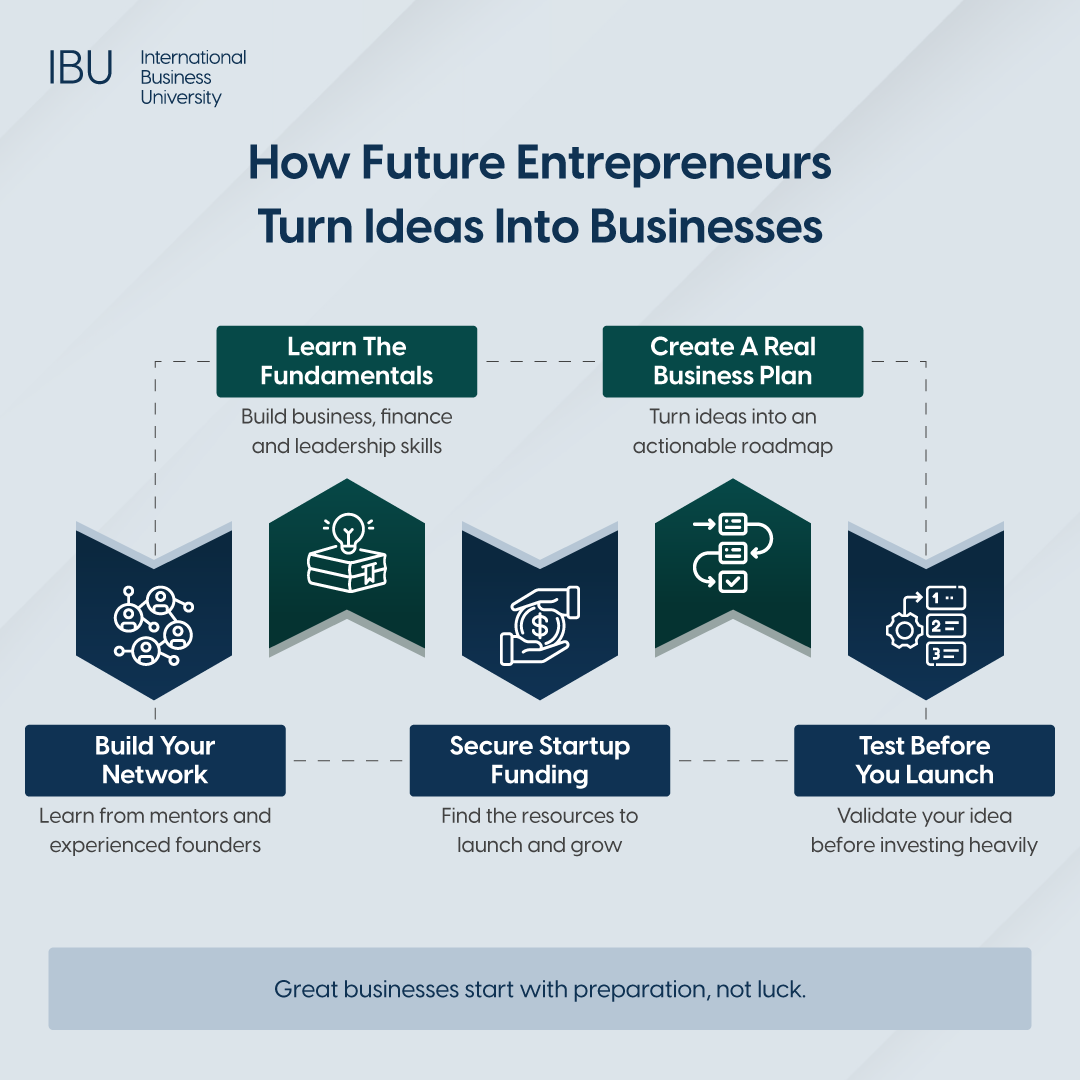
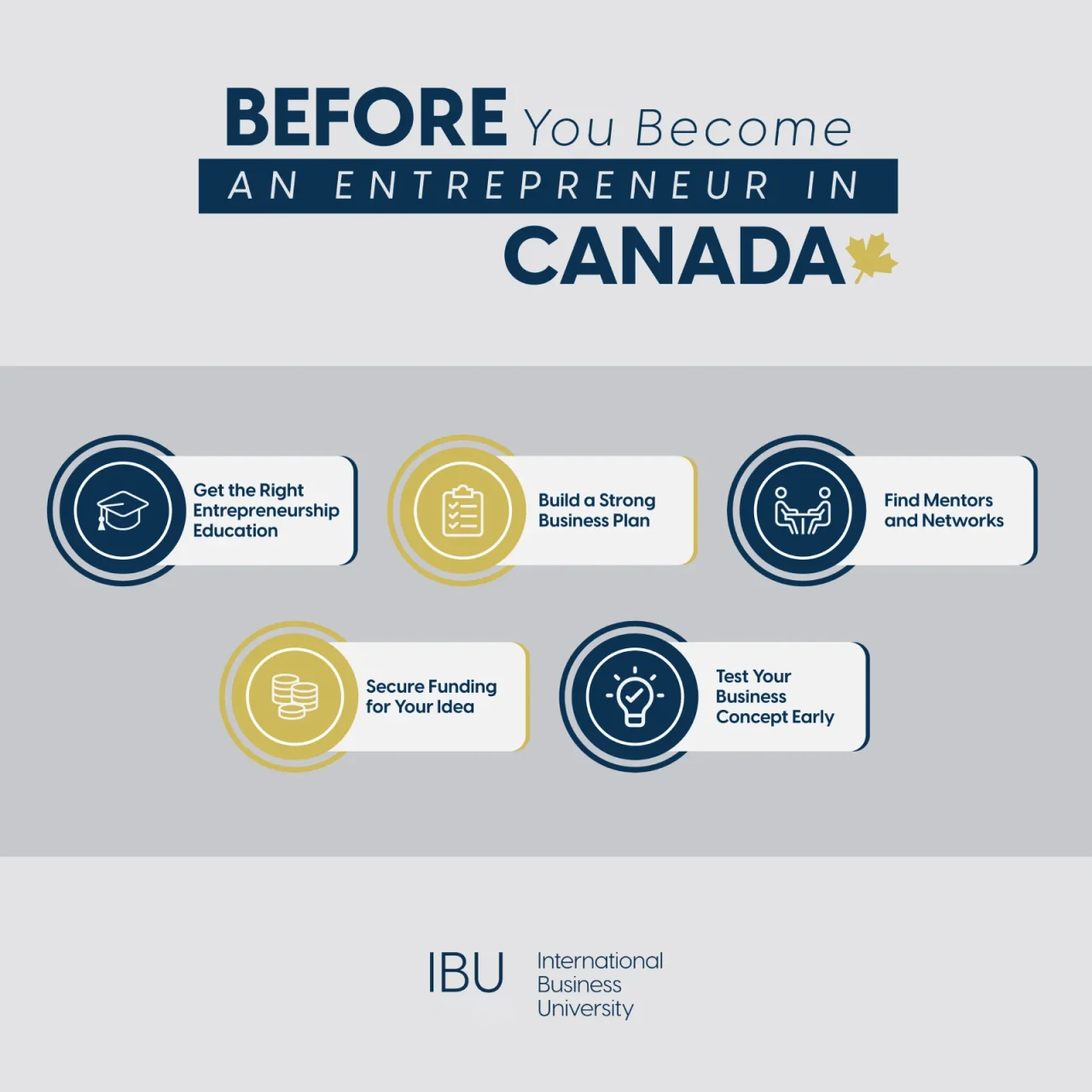
Building a business in Canada requires preparation across several dimensions. The following steps address the most common knowledge and readiness gaps that hold early-stage founders back.
1. Get the Right Education
A BCOM entrepreneur degree provides a structured foundation in strategy, finance, and operations. Many students continue toward a master’s degree in entrepreneurship or an MBA in Technology, Innovation and Entrepreneurship at the graduate level to build advanced venture leadership skills.
2. Develop a Business Plan
A business plan converts an idea into a testable strategy. It defines your target market, competitive positioning, revenue model, cost structure, and funding requirements. Without one, a business idea remains a concept without a path to execution.
3. Network and Find Mentors
Access to experienced operators and investors shortens the learning curve significantly. Mentors who have founded or scaled companies in Canada provide context that no curriculum fully replicates. Most BCOM entrepreneurship programs build structured networking access into the curriculum.
4. Secure Funding
Startup capital comes from multiple sources: personal savings, business loans, government grants, angel investment, and venture capital. Understanding which funding type fits your stage and business model is a core competency taught through an entrepreneurship degree program. Canada’s financing landscape includes both federal programs and provincial support mechanisms.
5. Test Your Idea Before Full Launch
Validating your offering at a small scale before committing full resources reduces the risk of investing in a product or service the market does not want. Minimum viable product testing, pilot programs, and structured customer discovery are methodologies covered in the BCOM entrepreneurship curriculum.
If you’re ready to start your entrepreneurial path, consider enrolling in a BCOM program that prioritizes practical learning, hands-on projects, and industry connections – like the one at the International Business University in Toronto. Contact us today for details.
What Jobs Can You Get With an Entrepreneurship Degree?
An entrepreneurship degree prepares graduates for a wide range of roles across the startup ecosystem, corporate innovation, and independent venture creation. The following career paths are most common among BCOM entrepreneurship graduates in Canada:
- Business founder or co-founder: The most direct application of the degree. Graduates launch product or service companies using the financial, operational, and strategic frameworks built during the program.
- Startup strategist or operations lead: Early-stage companies need people who can manage multiple business functions simultaneously. Entrepreneurship graduates are trained for this generalist-strategic role.
- Innovation consultant: Organizations hire entrepreneurship-trained professionals to develop new product lines, assess market opportunities, and build internal innovation programs.
- Business development manager: Roles focused on partnerships, market expansion, and revenue growth that draw directly on the sales, strategy, and negotiation skills built in the program.
- Venture analyst or associate: Investment firms and accelerators hire entrepreneurship graduates to evaluate business plans, support portfolio companies, and conduct market research.
- Small business manager: Operating an existing business, including family businesses or franchise operations, requires the same financial, operational, and team management skills taught in a BCOM entrepreneurship program.
For salary context across these roles, see how much business graduates make in Canada, which covers compensation benchmarks across program types and specializations.
Key Takeaways

A BCOM entrepreneurship degree equips you with strategy, finance, and leadership fundamentals needed for long-term business success.
This path prepares you for the practical demands of entrepreneurship while opening doors to high-value entrepreneurship-related jobs in Canada.
You can advance further through a master’s degree in entrepreneurship and innovation, including IBU’s MBA in Technology Innovation and Entrepreneurship, if you want deeper specialization.
Frequently Asked Questions
What is an entrepreneur degree and what does it cover?
An entrepreneur degree is an academic program focused on venture creation, startup operations, financial planning, and market strategy. It covers business development, financial modeling, marketing, legal business structures, and risk management. Programs typically include hands-on projects such as business plans and pitch presentations. The curriculum is built for students who intend to start or scale companies rather than work within established corporate hierarchies.
Is a BCOM entrepreneur degree worth it in Canada?
A BCOM entrepreneur degree is worth it in Canada because it provides structured preparation for launching and managing a business in a competitive market. Canada’s small business sector accounts for 98.2% of all employer businesses and employs over 10.7 million people, creating both opportunity and market pressure. The degree provides technical knowledge, network access, and applied experience that reduce the trial-and-error cost of early entrepreneurship.
What jobs can you get with an entrepreneurship degree?
An entrepreneurship degree opens pathways to roles including business founder, startup strategist, innovation consultant, business development manager, venture analyst, and small business manager. Graduates work across early-stage companies, accelerators, corporate innovation units, and independent ventures. The degree’s combination of financial, strategic, and operational training supports both self-employment and employment in growth-focused organizations.
What is the difference between a BCOM and a general business degree for entrepreneurs?
A BCOM in entrepreneurship focuses specifically on venture creation, startup financing, innovation strategy, and early-stage operational management. A general business degree covers broader corporate functions such as HR, accounting, and management within established organizations. The entrepreneurship BCOM prioritizes founder-relevant skills, including opportunity assessment, pitch development, risk management, and building companies from the ground up. A BBA covers similar general management territory but typically without the venture-specific curriculum depth.
Can a BCOM in entrepreneurship lead to an MBA?
Yes. A BCOM in entrepreneurship is a common academic pathway into MBA programs, including IBU’s MBA in Technology, Innovation and Entrepreneurship. Graduate programs build on the analytical and strategic foundation of the undergraduate degree, adding advanced leadership, global business strategy, and innovation management. This pathway strengthens competitiveness for senior roles in venture-backed companies, corporate innovation units, and independent entrepreneurship.
How long does a BCOM entrepreneur degree take in Canada?
A BCOM entrepreneur degree in Canada typically takes four years of full-time study. Some institutions offer accelerated formats or co-op structures that extend the timeline in exchange for integrated work experience. Graduate programs, such as an MBA in entrepreneurship or a master’s in innovation add one to two years after the undergraduate degree. Total program length depends on the institution, course load, and if work placement is included.
Building Your Path as a Future Entrepreneur
Your path forward starts with preparation and the right academic foundation. A BCOM entrepreneur degree gives you the practical tools and strategic frameworks to build real businesses and pursue meaningful opportunities across Canada. Surround yourself with mentors, networks, and learning experiences that accelerate your progress. With commitment and the right guidance, you can transform your ambition into a business that thrives.
Build Your Business Idea With IBU
Develop the finance, strategy, and leadership skills to start strong.