

A bachelor’s degree can open doors, but if you’re aiming for leadership roles, industry influence, or even building your own company, you need more. That’s where a Master of Business Administration (MBA) gives you the edge.
So, what is an MBA degree in practice? And how does it change your career outlook? This article breaks down the meaning, benefits, requirements, and opportunities connected to one of the most respected graduate business qualifications.
Key Takeaways

An MBA expands beyond a business degree, building the leadership judgment, strategic thinking, and decision-making skills senior roles actually require.
Graduates unlock higher salaries, global opportunities, and career pathways that extend into entrepreneurship, finance, marketing, and technology, where the information systems specialization specifically trains graduates for the business side of that path.
Programs such as IBU’s Online MBA in Ontario make the degree flexible, affordable, and built around the skills employers are actually hiring for.
What Is a Master of Business Administration Degree?
An MBA is widely recognized as the advanced benchmark in business education. It’s built for professionals who already have some business grounding and want to move into higher-stakes management and strategy work. While an undergraduate business degree in Canada provides foundational knowledge, an MBA develops the ability to analyze, strategize, and manage high-stakes decisions with confidence.
The versatility of an MBA is unmatched, especially compared with a Bachelor of Commerce degree, which builds toward an earlier career stage. If the goal is running a global team, launching a startup, or moving into finance, the coursework maps directly onto that path.
At International Business University (IBU) in Toronto, MBA programs emphasize applied learning, industry-aligned skills, and direct mentorship, so graduates step into their first post-MBA role already knowing how to operate.
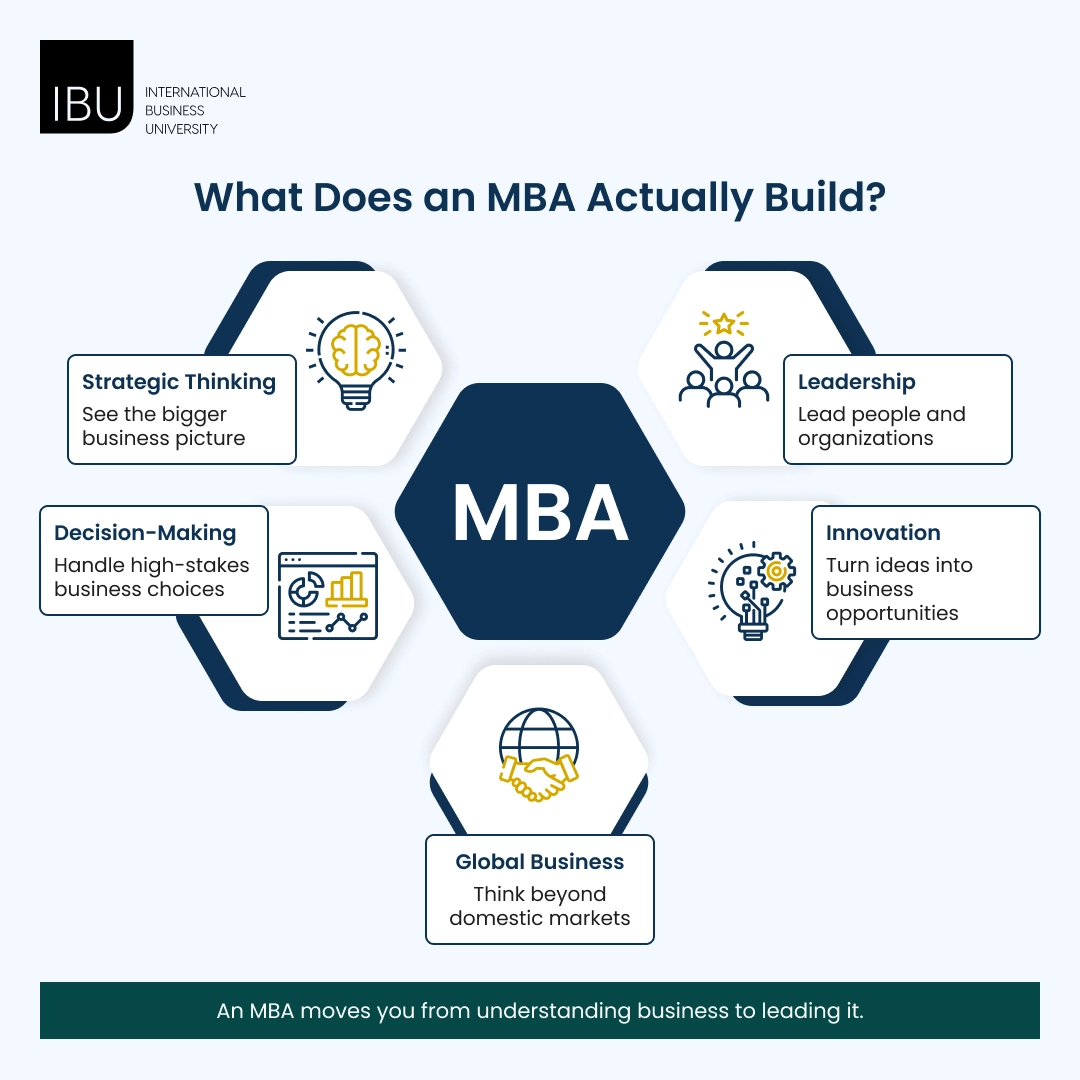
Ready to move from business basics to advanced leadership?
Flexible MBA formats and what is an MBA degree stands for, with specializations for future executives and entrepreneurs. Bursaries available.
What Types of MBA Programs Are Available?
Not every MBA looks the same, which means you can choose a format that fits your goals and career stage. Each option develops strong leadership skills but differs in structure and intensity.
Full-Time MBA
For students who can step away from full-time work, a full-time MBA compresses the degree into a shorter, more intensive timeline. It’s especially attractive for career switchers or recent graduates who want to fast-track their entry into leadership.
Online MBA
The MBA is the most popular online graduate degree worldwide. For professionals who need flexibility, online MBA programs in Ontario allow you to balance learning with work. IBU’s 16-month online MBA includes asynchronous classes, virtual collaboration, and optional in-person networking, delivering advantages many students overlook.
Executive MBA (EMBA)
Experienced professionals aiming for senior executive positions often choose an EMBA. This program emphasizes strategy, executive decision-making, and leadership under complex conditions.
At IBU, MBA students can specialize in areas such as:
- Technology, Innovation & Entrepreneurship
- Global Business Management
- Financial & Management Analytics
- General Stream MBA
- Information Systems Management
Each track connects academic knowledge with industry application, ensuring graduates leave with both expertise and practical skills.
What Are the Benefits of an MBA?
The value of an MBA extends far beyond a diploma. Graduates consistently report career acceleration, better earnings, and improved leadership confidence. The degree also builds adaptability, preparing professionals to lead in industries that are constantly changing.
- Career Acceleration & Higher Salaries: Young master’s graduates show that business management consulting is the single most common job among business administration and management grads, held by 9.0% of men and 9.3% of women a few years after finishing the degree.
- Expanded Network & Industry Connections: Cohorts, professors, and alumni create a professional network that can influence opportunities for years.
- Entrepreneurial Edge: Nearly 1 in 10 MBA graduates launch businesses. An MBA supplies financial, operational, and risk management skills necessary to succeed.
- Leadership Development: Courses in MBA emphasize managing teams, driving innovation, and handling high-pressure decisions.
- Global Perspective: With a Global Business Management MBA, graduates understand international markets and strategies.
What Is Required for an MBA Degree?
Many students ask what is required for an MBA degree, and what MBA qualification standards most schools expect from applicants. Admission criteria vary across schools, but common requirements include:
- A recognized undergraduate degree (often a business degree in Canada or equivalent).
- Professional work experience, usually 2–3 years minimum.
- Strong academic performance and, in some cases, GMAT/GRE scores.
- Letters of recommendation and a personal statement.
At IBU, the application process emphasizes professional experience, academic readiness, and motivation for graduate study. The goal is to make sure incoming students can handle graduate-level coursework and apply it on the job right away.
Exciting Career Paths for MBA Graduates
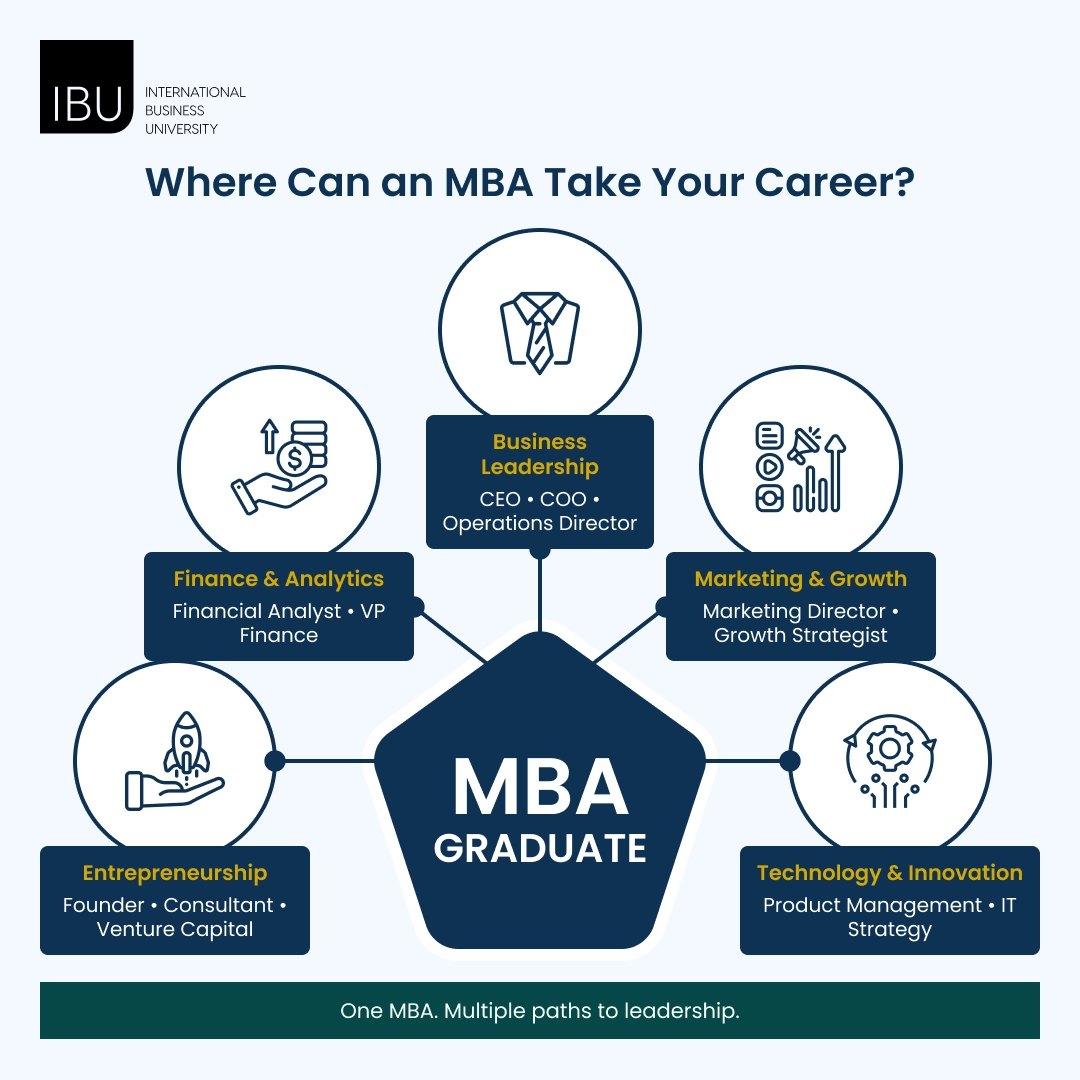
Graduates often ask, what is an MBA degree good for? The answer is simple: it expands your career opportunities across industries and gives you the skill set to step into leadership roles with confidence. An MBA doesn’t limit you to one track; instead, it opens multiple doors, from corporate boardrooms to entrepreneurial ventures. Let’s look at the most common and rewarding pathways.
Business Leadership & Corporate Management
An MBA degree is one of the most direct routes to senior corporate leadership. The program builds strategic thinking, people management, and decision-making skills required to operate at the highest levels. Graduates often move into roles such as:
- Chief Executive Officer (CEO) or Chief Operating Officer (COO): Guiding company-wide direction, strategy, and growth.
- Business Unit Manager: leads teams, owns the budget, and is accountable for hitting performance targets.
- Operations Director: redesigns workflows to cut waste and protect margins.
With these roles, the MBA becomes more than a credential; it’s proof of your readiness to lead complex organizations.
Finance & Analytics
Students with a numbers-driven mindset often ask what is required for an MBA degree if they want to move into finance. Programs with a Financial & Management Analytics specialization provide the tools to evaluate investments, manage risks, and interpret market data. Typical positions include:
- Investment Banker: Structuring mergers, acquisitions, and capital raises.
- Financial Analyst: Forecasting risks, evaluating markets, and turning the numbers into a recommendation leadership can act on.
- Vice President of Finance: Overseeing organizational planning and long-term financial growth.
This pathway is highly rewarding for those who want to influence big financial decisions and shape corporate strategy.
Marketing & Digital Strategy
In a world where brand presence determines market success, an MBA sharpens your ability to design growth-focused strategies. Graduates can excel as:
- Marketing Director: Overseeing campaigns that strengthen brand equity.
- Growth Strategist: Identifying market opportunities and implementing expansion plans.
- Digital Transformation Lead: Guiding organizations through tech-driven customer engagement.
Marketing-focused MBA graduates play a critical role in building competitive advantage, especially in industries experiencing rapid digital change.
Entrepreneurship & Startups
For many, an MBA is about independence. It builds the financial, strategic, and leadership skills needed to launch and grow a venture, not just manage someone else’s. Graduates often move into roles such as:
- Startup Founder: Turning innovative ideas into viable companies.
- Business Consultant: Helping organizations solve operational, marketing, or financial challenges.
- Venture Capitalist: Funding high-potential startups while guiding them to scalability.
Resources like Can I Do an MBA and CFA Together? Highlight how combining advanced qualifications can further strengthen entrepreneurial outcomes.
Technology & Innovation
As industries evolve, MBAs focused on Technology, Innovation & Entrepreneurship create leaders who can translate between business strategy and technical execution. Graduates step into:
- Product Management: Managing product lifecycles from development to launch.
- IT Strategy & Transformation: Aligning technology projects with broader business objectives.
- Tech Startup Leadership: Building and scaling ventures that combine business strategy with hands-on technology execution.
This specialization is especially powerful in markets like Toronto, where fintech, health tech, and AI-driven companies are expanding rapidly.
Thinking about your career after graduation?
From entrepreneurship to corporate leadership, IBU’s MBA prepares you for diverse opportunities.
The IBU MBA Experience: Study in the Heart of Toronto
Toronto is Canada’s business hub, home to major corporations and a thriving technology sector. Studying at IBU places you in the middle of these opportunities.
Program highlights include:
- One of the most cost-effective MBAs in Canada.
- 16-month program length for faster results.
- Post-graduation work permit (PGWP) eligibility.
- Flexibility to work while studying.
- Industry networking and collaboration.
Students considering online learning can also explore IBU’s Online MBA vs. Regular MBA guide for advice on format choice.
Is an MBA Right for You?
Choosing to pursue an MBA is a strategic decision; it is usually the first question: what is an MBA degree worth, answered honestly, since it involves financial investment, time, and personal commitment. Yet for professionals aiming for leadership, entrepreneurship, or specialized expertise, the return is often substantial.
Ask yourself:
- Do you want to move into senior leadership roles quickly?
- Are you looking to launch a business with confidence?
- Do you want to strengthen your global career options?
If the answer is yes, then an MBA is one of the most effective ways to achieve these goals. Articles such as Can You Get an MBA Right After Undergrad? can help students assess timing and readiness.
Frequently Asked Questions
What does MBA stand for?
MBA stands for Master of Business Administration, the graduate-level business qualification most schools use to signal advanced training in leadership, strategy, and finance. That MBA meaning has stayed consistent since the degree originated at Harvard in 1908.
Is an MBA degree worth it?
For most professionals aiming at senior roles, yes. Graduates typically see higher starting salaries and faster promotion timelines than peers with only an undergraduate degree, though the return depends on program cost and career goals.
What courses are included in an MBA program?
Core courses usually cover finance, marketing, operations, accounting, and strategy, with electives in areas like entrepreneurship or digital transformation. IBU structures its MBA around specialization tracks rather than a single fixed course list.
What MBA qualification do you need to apply?
Most programs require a recognized undergraduate degree, two to three years of professional work experience, and in some cases GMAT or GRE scores plus letters of recommendation.
How long does it take to complete an MBA degree?
Full-time programs typically take about two years, while accelerated and online formats can run 12 to 18 months. IBU’s online MBA is designed as a 16-month program.
What is the difference between an MBA and a regular master's degree?
An MBA is a generalist business degree covering finance, marketing, and leadership broadly, while other master’s degrees usually go deep on one specific topic, such as data analytics or public health.
Exploring What Is an MBA Degree and Driving Career Growth
An MBA is a graduate-level business degree built for people who already have some work experience. It picks up where an undergraduate program leaves off, and for most people, it opens doors that are genuinely harder to reach without one. More senior roles, better compensation, or a real path to running something yourself.
IBU in Toronto offers both on-campus and online MBA programs in Ontario, so you can choose the format that fits around your job. If you’re seriously considering a graduate business degree, IBU is worth a close look.
Take the next step toward leadership.
IBU’s MBA: The Smart Choice for your career growth. Apply today and access bursaries up to $10,000.