
Most students prepare for convocation by confirming their seat, buying a guest ticket, and borrowing a robe.
That prepares you for the ceremony. It does not prepare you for what convocation is actually most useful for: the professional transition that happens in the month before graduation and the weeks immediately after.
The graduates who treat convocation as a transition milestone, not just a photo opportunity, use it to update their professional profiles, activate their networks, and move into the job market with visible momentum rather than starting from scratch after the celebrations end.
Key Takeaways
- Start 30 days before the ceremony: effective resume updates, LinkedIn announcements, and reference confirmations should be prioritized well before the event.
- A LinkedIn graduation post is a career signal: a specific professional announcement triggers recruiter visibility and produces responses by naming a clear career direction.
- Administer before you celebrate: manage transcript requests, degree completion letters, and alumni portal access early to meet strict timing requirements.
- Five strategic conversations outperform twenty generic ones: priority contacts at convocation include faculty, senior alumni, and employer representatives.
- The 48-hour follow-up window matters: messages sent within two days of convocation conversations are much more likely to receive an answer than those sent later.
- The week after graduation is the highest-leverage job search period: you should use this time actively to maximize your professional opportunities.
How to Prepare for Convocation: The 30-Day Checklist
The most productive convocation preparation happens in the month before the ceremony. The tasks below are organized by category. Complete them in order so that administrative steps are done before you shift focus to networking and career positioning.
Step 1: Update Your Resume and LinkedIn Profile
Your degree is complete. Both your resume and LinkedIn profile need to reflect this now, not after the ceremony.
- Change your LinkedIn education entry from “Expected [year]” to the actual degree title and graduation date.
- Add your specialization, any honours or distinctions, and the correct graduation year.
- Rewrite your LinkedIn summary to describe where you are headed professionally, not where you have been.
- Replace your profile photo with a professional-quality image, whether in business attire or graduation regalia.
- Mirror these updates on your resume: updated degree listing, specialization, and a revised professional summary.
Recruiters actively search for recent graduates in the weeks surrounding convocation. An out-of-date profile means you are invisible during the period when you are most likely to be found.
Step 2: Post a LinkedIn Graduation Announcement
A graduation post on LinkedIn is a visibility mechanism, not a personal milestone announcement. When you articulate your degree and career direction publicly, the platform surfaces your profile to people in your network with relevant opportunities.
A post that performs well includes:
- The degree and institution: named specifically
- The specialization and any notable projects or distinctions
- A specific statement about the role type or industry you are targeting
- A direct, low-friction invitation: “I’m open to connecting with anyone working in [field].”
Generic graduation announcements produce minimal responses. Specific ones, for example: “I completed my BCOM in Business Management at IBU with a focus on operations and analytics, and I’m targeting project coordinator and business analyst roles in the GTA,” draw replies from people positioned to help.
Step 3: Identify Who You Want to Connect With at the Event
Review the graduation program and institutional communications before the event. Identify three to five specific people you want to speak with at the ceremony.
Priority contacts to identify:
- Faculty members relevant to your career direction whom you have not yet spoken with directly
- Department heads or program directors attending the event
- Employer representatives or corporate sponsors present at the ceremony
- Alumni guests who work in your target industry
Walking into the event with names and a brief note about what you want to say to each person converts a social occasion into a structured networking activity.
Step 4: Refresh Your References
Convocation is the right time to contact the faculty members who can serve as professional references. Send each one a brief email in the two weeks before the ceremony.
The email should cover three points:
- A brief thank-you for their support during the program
- An update on your career direction and the types of roles you are pursuing
- A direct request to confirm they are still comfortable being listed as a reference
This refreshes the relationship, reminds them of your work and goals, and guarantees they are not caught off guard by a reference call months later.
What to Do Before Graduation: The Administrative Checklist
Several steps in the convocation preparation process have timing dependencies that most graduates underestimate. The tasks below should be completed before the ceremony, not after. Leaving them until after graduation means completing them while managing post-ceremony obligations, which reduces follow-through rates.
- Request official transcripts before your graduation date. They need to be ready to accompany job applications immediately after the ceremony. Processing times at most registrar offices run one to two weeks.
- Obtain your degree completion letter from the registrar. Many employers request this document before the official parchment is issued, which can take several months after the ceremony.
- Download and archive coursework, projects, and case studies. These documents often become inaccessible once your student account is closed after graduation.
- Convert your student account to alumni status. Many institutions close student portal access immediately after graduation unless you take a specific step to convert to alumni status. Career services, job boards, and alumni networks are typically accessible only through alumni accounts.
- Set up Google Alerts for your target companies and industries. This guarantees you are monitoring relevant news from your first day in the job market.
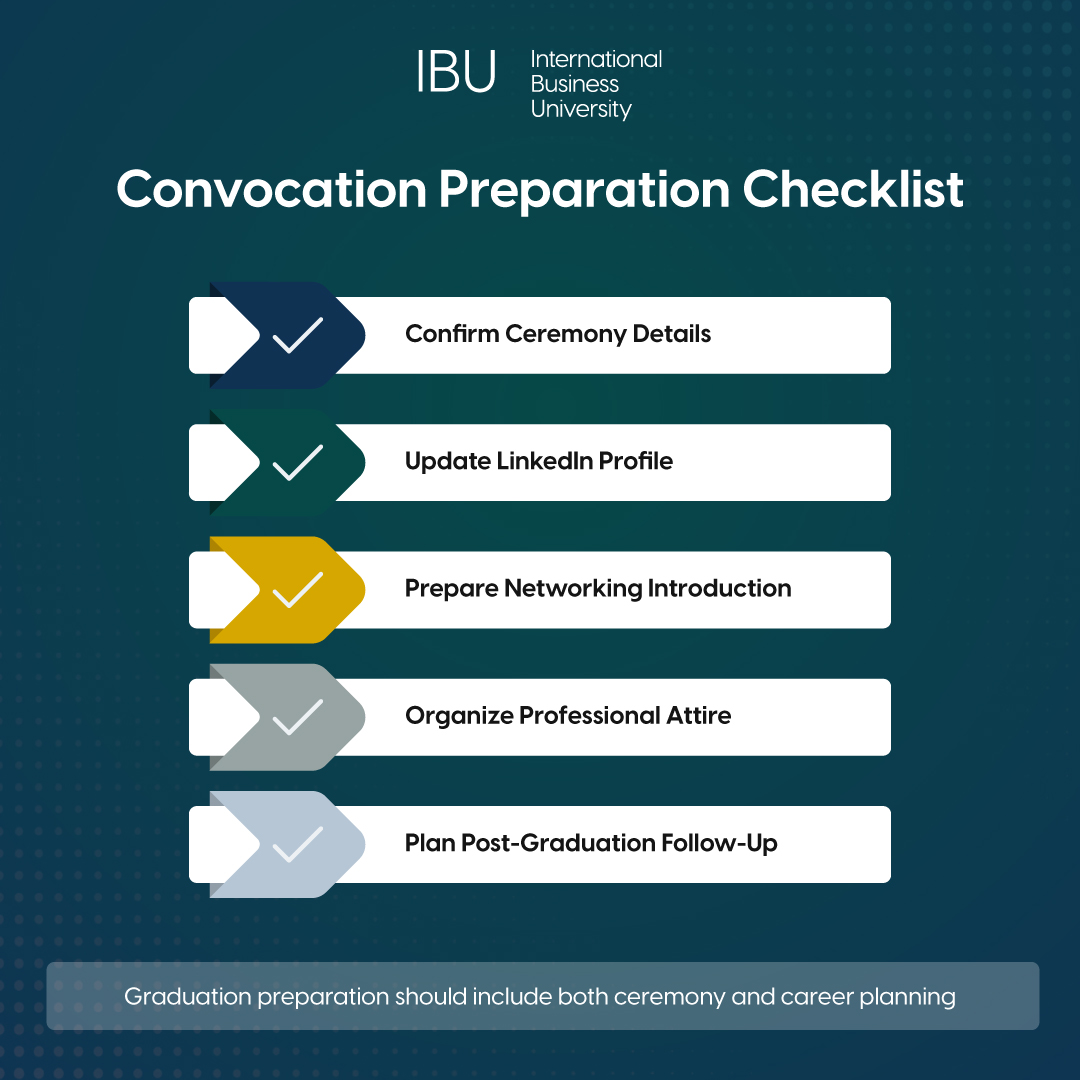
Ceremony Day: How to Use Convocation for Career Networking
Convocation ceremonies have three distinct windows: the pre-ceremony reception, the formal graduation, and the post-ceremony celebration. The reception and post-ceremony period are where networking occurs. Knowing how to use each window before you arrive makes the difference between an efficient 20 minutes of professional contact and a missed opportunity.
Before the Ceremony: The Pre-Ceremony Reception
Arrive at least 20 minutes before the scheduled start time. Faculty and institutional leadership are typically visible during the pre-ceremony period before the formal processional begins.
Use this window to:
- Approach faculty members you identified in advance and deliver a brief, prepared thank-you
- Locate employer representatives or alumni guests before the formal event begins and identify where they will be after the ceremony
- Confirm which of your target contacts are present so you can prioritize your time during the post-ceremony period
Do not attempt extended professional conversations at this stage. The pre-ceremony window is for establishing visibility, not for substantive networking. Save the longer conversations for after the ceremony.
After the Ceremony: The Post-Ceremony Reception
The post-ceremony reception is the highest-value networking window at any convocation event. Most graduates are occupied with family. The graduates who take 15 to 20 minutes to make deliberate professional contact before the family celebrations begin consistently report more lasting professional value from those conversations than from any career event attended during school.
How to move through the room effectively:
- Introduce yourself to faculty members beyond those you know well, referencing your program and career direction specifically
- Approach employer representatives or institutional guests who are attending independently of a specific graduate’s family group. Those are the individuals available for professional conversations.
- Keep each conversation to three to five minutes. The goal is a connection and a follow-up point of contact, not a full informational interview.
- End each conversation by asking for a LinkedIn connection or a business card, and stating you will follow up.
The Week After Convocation: What the Graduates Who Get Hired Fast All Do
The seven days after convocation are the highest-leverage job search period available to a new graduate. Recruiters who attended or followed your institution’s graduation events are actively evaluating candidates during this window. Most graduates use this week to decompress. The ones who land first-year roles quickly do not.
Within 48 Hours: Send Follow-Up Messages
For every significant professional conversation at convocation, send a follow-up LinkedIn connection request and a brief personalized message within two days.
Each message should include three elements:
- A specific reference to the conversation: name the topic or context, not just the event.
- A brief statement of appreciation
- A proposed next step: a follow-up question, a request for a short call, or an expression of continued interest in their work or organization.
Messages sent within 48 hours of an in-person conversation are responded to at a significantly higher rate than those sent a week later. After a week, context fades and the message reads as an afterthought.
Days 1 to 7: Apply Actively
Begin submitting job applications within the first week after graduation. Recruiters tracking recent graduates from your institution are most active during this window.
In the first seven days after convocation:
- Apply to a minimum of five targeted roles. Quality of application matters more than volume.
- Activate any job alerts set up in the pre-ceremony checklist step and review new postings daily.
- Respond to all LinkedIn messages or emails from recruiters within 24 hours.
Days 7 to 30: Schedule Three Informational Interviews
Use your convocation connections and existing network to book three informational interviews in the month following graduation.
How to request an informational interview:
- Identify the contact: someone working in a role or organization relevant to your target.
- Send a brief, specific message: reference the connection point (convocation, mutual contact, their published work), state your direction clearly, and ask for 20 minutes.
- Prepare three to four targeted questions: about the role, the industry, or the path they took.
- Follow up with a thank-you and keep the relationship active: share a relevant article, mention an update on your search.
Informational interviews produce referrals at a rate that cold applications do not. One well-executed conversation with a relevant contact can produce a warm introduction to a hiring manager within weeks.
Graduate With Skills Employers Can See
At IBU, career preparation goes beyond the classroom through applied learning, digital credentials, career pathways, and professional support.
Frequently Asked Questions
How far in advance should I prepare for convocation?
Start at least 30 days before the ceremony. The most important preparation- updating LinkedIn and your resume, identifying who you want to connect with, confirming your references, and completing any administrative steps like transcript requests- is best done with time to spare rather than in the days immediately before the event.
The career preparation that follows convocation- follow-up messages, active job applications, informational interview scheduling- should begin within 48 hours of the ceremony and continue with intensity for the following four to six weeks.
Is it appropriate to talk about job searching at convocation?
Yes, in the right context and framing. Mentioning your career direction is entirely appropriate in professional conversations at convocation; it gives the other person the context they need to know if they can help. What is not appropriate is leading with a direct request for a job referral in the first conversation.
The framing that works: share where you are headed, not what you need. ‘I’m targeting business analyst roles in the GTA’ is a statement of direction. ‘Do you know anyone hiring?’ is a request that puts the other person in an uncomfortable position before any relationship exists.
What should I do if I have not started my job search before convocation?
Start immediately. Convocation creates a natural urgency that is useful; use it. Update your LinkedIn profile and resume the day after the ceremony. Send follow-up messages from any convocation connections within two days. Identify three informational interview contacts and reach out in the first week.
The graduates who land first-year roles fastest are not always the ones with the strongest academic records. They are the ones who started their job search actively and early, treated every professional interaction as an opportunity, and followed through consistently on the connections they made.
Convocation Is a Starting Line, Not a Finish Line
Knowing how to prepare for convocation properly means treating the ceremony as the beginning of your professional transition, not the conclusion of your academic one.
The graduates who update their profiles, identify their priority contacts, follow up within 48 hours, and apply actively in the weeks that follow move into the job market with momentum. Those who start the job search six weeks after the celebrations end start from a standstill.
The difference between those two starting positions compounds quickly in the first year after graduation.
Start Building Career-Ready Skills at IBU
IBU’s business programs combine applied learning, small classes, and professional development to help students prepare for life after graduation.