
Picture a marketing manager who pastes last quarter’s sales figures into a chatbot and asks why revenue dipped. Within a minute she has a confident explanation, a tidy chart, and one problem: the tool has invented a product line her company never sold.
That gap between a fast answer and a correct one is where AI skills for business leaders now sit. Hiring managers have stopped asking candidates if they have used ChatGPT. They ask what you did the last time the output was wrong, who checked it, and what you changed before it reached a client.
The pattern behind those questions is simple: AI writes the first draft, and a leader makes the final call. Below are the five AI skills for business leaders that employers expect heading into 2027, how business schools teach them, and how to decide between an MSc in Applied AI and an MBA as the place to build them.
Key Takeaways

Baseline, not bonus: Canadian AI use by businesses tripled in two years, so fluency is now assumed.
Five core skills: Evidence checking, prompting, tool governance, team collaboration, and responsible use define the 2027 skill set.
Final call stays human: Employers want AI skills for business leaders that include judgment, beyond tool familiarity.
Applied study works best: Business schools build these skills through capstones, case work, and projects with actual data.
Degree choice follows role: An MSc in Applied AI fits builders, and an MBA fits leaders managing adoption.
Start with one workflow: Pick one weekly task, run it with AI, and document every correction you make.
AI Fluency 2027: Why Employers Now Treat It as a Baseline
Two years ago, listing an AI tool on a resume made a candidate stand out. Heading into 2027, the absence of AI fluency is what stands out, and employers read it as a gap in how a person works. For managers, AI skills for business leaders now count as part of general competence, alongside budgeting and communication.
What the Canadian Numbers Show
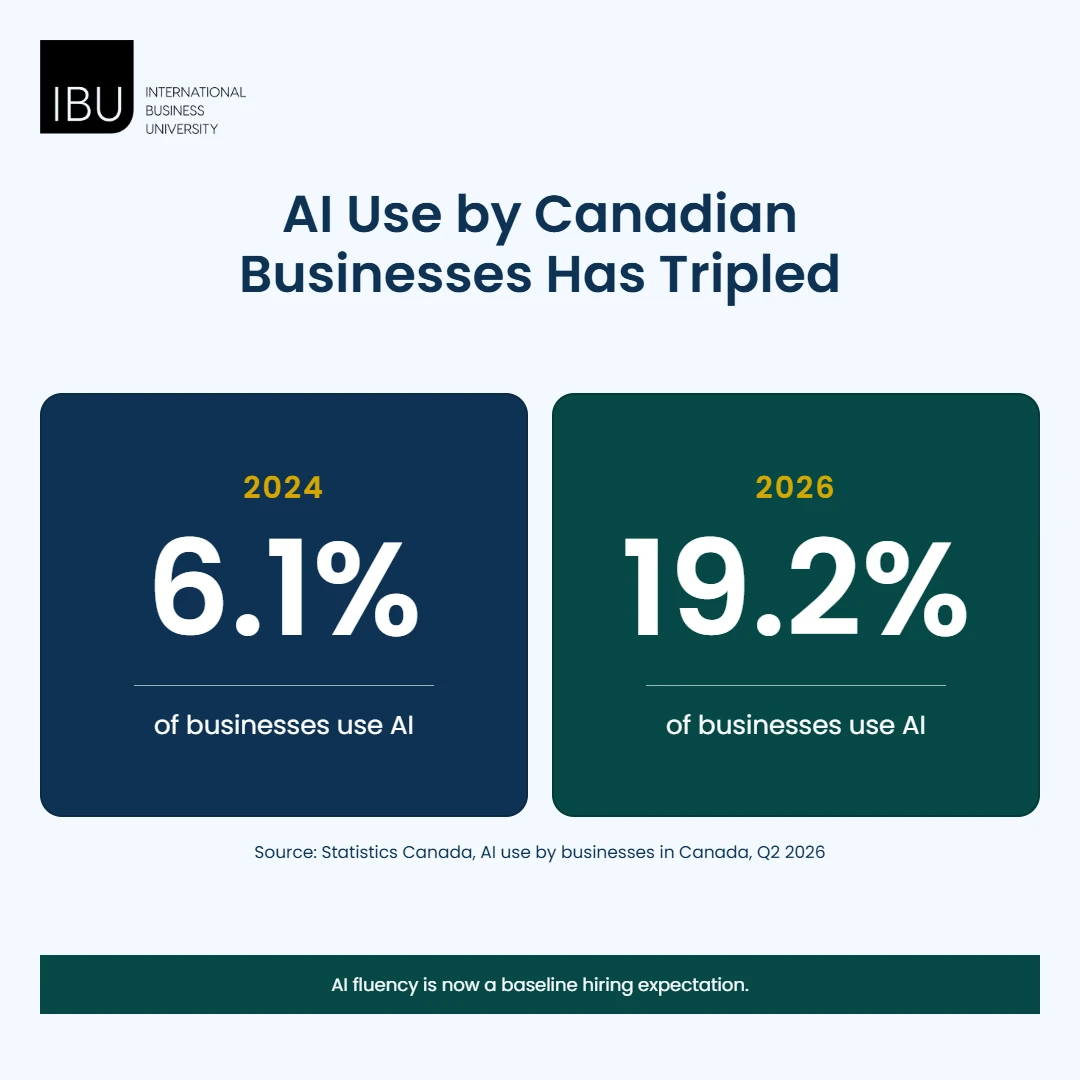
Statistics Canada tracks how many businesses use artificial intelligence in business operations. In its analysis of AI use by businesses in Canada for the second quarter of 2026, 19.2 percent of businesses reported using AI to produce goods or deliver services over the previous 12 months, triple the 6.1 percent reported in the second quarter of 2024. Data analytics was the most common application, cited by 36.6 percent of AI-using businesses, and 44.4 percent of AI-using businesses changed their training or staffing practices because of AI.
Read those figures from a hiring manager’s side of the desk. When more than two in five companies using AI have already changed how they train or staff, new hires are expected to arrive with the basics in place. Business coverage in outlets such as Bloomberg and Forbes, along with LinkedIn’s own workforce commentary, describes the same move from experiment to expectation. The Canadian data is the version you can verify, and it points to one conclusion: AI skills for business leaders have become a hiring baseline.
AI WRITES THE FIRST DRAFT ONLY
Treat every AI output as a draft from a fast junior colleague who has never met your client. It can be well written and still be wrong on facts, numbers, or context. The person who signs off owns the result, so the review step is the part of AI skills for business leaders that employers pay for.
What AI Fluency 2027 Looks Like at Work
AI fluency 2027 is less about knowing every tool and more about using a few of them well inside ordinary work. In practice, employers look for four visible behaviours that sit underneath all AI skills for business leaders.
- Task selection: You can say which parts of your job suit AI support and which parts need a person.
- Output checking: You test summaries, numbers, and claims against the source before you share them.
- Clear instructions: You brief an AI tool the way you would brief a new analyst, with context, limits, and a format.
- Open documentation: You tell your manager and team where AI was used and what you changed.
None of these behaviours require a programming background. They do require practice, and they are the foundation for the five AI skills for business leaders covered in the next section.
Apply AI to Industry
Sixteen months of applied AI study in Toronto
5 AI Skills for Business Leaders to Build in 2027
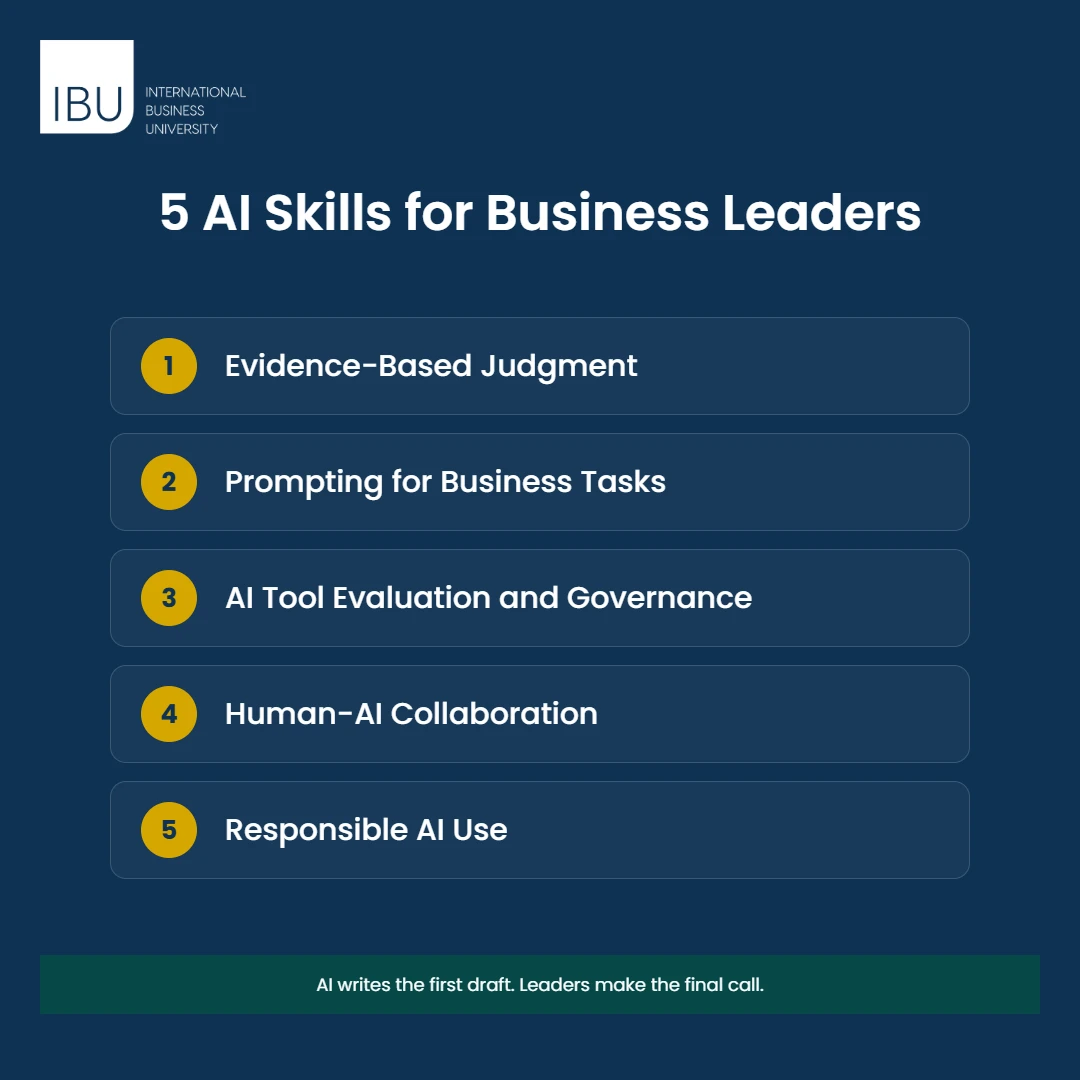
The five AI skills for business leaders below appear again and again in how employers describe the roles they are filling. The table gives the short version, and each H3 that follows explains what the skill looks like and how to practise it.
| Skill | What employers look for | How to practise it |
|---|---|---|
| Evidence-based judgment | Questions data and AI summaries before acting on them | Trace one AI-generated figure back to its source each week |
| Prompting for business tasks | Writes clear briefs that produce usable first drafts | Keep a library of prompts that worked and why |
| Tool evaluation and governance | Compares tools on cost, privacy, and fit before buying | Score two competing tools against the same task |
| Human-AI collaboration | Redesigns team workflows so people and tools each do their part | Map one team process and mark where AI helps |
| Responsible AI use | Spots bias, privacy risk, and disclosure issues early | Review one AI output for fairness before it ships |
1. Evidence-Based Judgment: Question the Numbers Before You Act
The most common use of AI in Canadian businesses is data analytics, which means the most common AI risk is a confident wrong number. Evidence-based judgment is the habit of asking where a figure came from, what it leaves out, and what would change your mind. Among all AI skills for business leaders, it is the one that protects every other skill. Leaders who do this well ask three questions of any AI-generated analysis. What data went in? What assumptions did the tool make? What would a second source say?
What to practise: Each week, take one number from an AI summary and trace it to the original spreadsheet, report, or system before you repeat it.
2. Prompt Engineering and Generative AI for Business Tasks
Prompt engineering sounds technical, but in a business setting it is closer to good delegation. Generative AI for business works when the instruction includes the audience, the purpose, the constraints, and the format you need. A vague prompt returns a vague draft, and the time saved on writing gets spent on rewriting.
Strong prompts for business tasks usually contain four parts.
- Role and audience: Tell the tool who it is writing for, such as a client CFO or a new hire.
- Source material: Paste or attach the facts it must use, and tell it not to add others.
- Limits: Set length, tone, and anything it must not claim or promise.
- Output format: Ask for a table, a bulleted list, or a one-page memo so the result is ready to review.
Building a shared prompt library that improves over time is one of the most visible AI skills for business leaders, because it turns personal productivity into team productivity.
WRITE PROMPTS LIKE A MANAGER'S BRIEF
If a new analyst could not do the task from your instruction, an AI tool cannot either. Name the audience, supply the facts, set the limits, and ask for a format. Prompt writing is the most teachable of the AI skills for business leaders.
3. AI Tool Evaluation and Governance
Every software vendor now sells an AI feature, and someone has to decide which ones a company adopts. Tool evaluation, one of the less visible AI skills for business leaders, means comparing options against a business need rather than a demo. Governance is the set of rules that follows: who can use the tool, with what data, and who reviews the results. Managers with this skill ask practical questions first. Where is our data stored, and is it used to train the vendor’s model? What does the tool cost at full team scale? How will we know in three months if it worked? These questions sit at the centre of artificial intelligence in business decisions, and they belong to managers as much as to IT.
What to practise: Pick one task, run it through two competing tools, and score each on accuracy, time saved, cost, and data handling.
4. Human-AI Collaboration in Teams
Adding an AI tool to a team changes who does what. A report that once took an analyst two days might now take two hours, which shifts that analyst’s time toward checking, interpreting, and presenting. Leaders who plan for that shift get the gain, while leaders who ignore it get confused roles and duplicated work. Good human-AI collaboration starts with mapping a workflow step by step and marking which steps the tool handles, which a person handles, and where a person must review the tool’s work. Among AI skills for business leaders, this one leans hardest on communication, because people adopt tools faster when they understand why the work is changing and what stays theirs.
What to practise: Map one recurring team process on a single page and mark each step as AI-led, person-led, or person-reviewed.
5. Ethical and Responsible AI Use
AI tools can repeat bias found in their training data, expose private information, or produce content that misleads customers. Responsible use means spotting those risks before they reach the public. It covers fairness, client privacy, honest disclosure, and copyright. Employers want leaders who raise these questions early, in planning meetings, instead of after a complaint. Responsible use is also where AI skills for business leaders connect most directly with company reputation, since one careless output can undo years of trust.
What to practise: Before an AI-assisted document goes to a client, ask one colleague to read it only for fairness, privacy, and accuracy.
How Business Schools Are Teaching Artificial Intelligence in Business
Business schools have moved away from treating AI as a single elective. The stronger approach builds AI into core courses, then asks students to apply it to a business problem with actual constraints. Lectures explain the concepts, but the AI skills for business leaders listed above mostly develop through applied work that someone else reviews.
Across graduate programs, three teaching methods do most of the work.
- Applied projects: Students use AI tools on a defined business problem and defend their method as well as their answer.
- Case analysis: Classes study how companies adopted, misused, or governed AI, and what leaders decided at each point.
- Capstones: A final project asks students to scope, build or plan, and present an AI solution to an audience that pushes back.
At International Business University, the MSc in Applied AI follows this sequence over four terms. Students begin with courses such as Fundamentals of Artificial Intelligence, Machine Learning and Deep Learning, and Data Science and Data Mining Techniques, then move to applied courses such as Applications of Artificial Intelligence in Services. Every MSc student takes Artificial Intelligence and Cybersecurity and Applied Research Methods, and the program ends with a six-credit capstone project. Classes are capped at 35, so faculty can review how each student applies AI skills for business leaders rather than only the final slide.
IBU’s earlier guide on the impact of artificial intelligence in business covers common applications such as predictive analytics and chatbots. This guide focuses instead on the AI skills for business leaders that sit on top of those applications, because knowing what a tool does is different from deciding when a team should trust it.
Build the Data Foundation
Data engineering courses alongside core AI study
Building AI Skills for Business Graduates Through an MSc in Applied AI or an MBA
Graduate study is not the only way to build AI skills for business graduates and working professionals, but it is the most direct route for people who want a credential, a faculty-reviewed portfolio, and protected time to practise. Both degrees build AI skills for business leaders, but they build different parts of them. The harder question is which degree fits the role you want next.
The comparison below uses only details listed on IBU’s live program pages for the Toronto programs.
| Feature | MSc in Applied AI | General Stream MBA |
|---|---|---|
| Length | 4 terms, 16 months, 42 credits | 4 terms, 16 months, 42 credits |
| Delivery | In person, Toronto | On campus, Toronto |
| Core focus | AI, machine learning, data science, and applied AI in services | Finance, analytics, leadership, marketing, and digital transformation |
| AI and data courses | Specialization courses in industrial innovation or data engineering, plus AI and cybersecurity | Business Analytics; Information Technology and Digital Transformation; Technology Trends and Applications (elective) |
| Final term | Capstone project in the chosen specialization | Consulting project, business plan, or major research paper |
| Best fit | Professionals who want to build and apply AI systems | Professionals who want to lead teams and adopt AI as one part of strategy |
When an MSc in Applied AI Makes Sense
An MSc in Applied AI suits technology professionals, analysts, engineers, and data specialists who want to work hands-on with AI systems. IBU offers two specializations. The MSc in Applied AI with an Industrial Innovation specialization includes courses such as Industrial Automation, Manufacturing Innovation, and Sustainability, and Robotics for Service Innovation, and lists pathways including Industrial Innovation Specialist and Operations Consultant. The Data Engineering specialization of the MSc in Applied AI adds Data Engineering and Architecture and Engineering for Data Analysis, with pathways such as Data Engineer and AI Solutions Architect. Graduates of either specialization bring the technical side of AI skills for business leaders to a team.
For a closer look at one of those pathways, IBU’s article on why AI fluency has become the entry requirement for operations consultants covers how the role is changing. Readers drawn to the data side can start with what data engineering is and why AI teams need it. Both posts go deeper on a single role, while this guide stays at the level of skills that apply across roles.
MATCH THE DEGREE TO THE ROLE
Choose the program by the work you want to do in three years, not by which degree sounds more current. If you want to build and test AI systems, look at the MSc. If you want to lead the people using AI, look at the MBA. Both routes build AI skills for business leaders, at different depths.
When an MBA With AI Exposure Makes Sense
An MBA suits managers, career changers, and professionals aiming for roles where AI is one input among many. IBU’s General Stream MBA in Toronto includes Business Analytics and Information Technology and Digital Transformation in the first year, a required course in Regulatory Environments, Ethics and CSR, and an elective in Technology Trends and Applications. Those courses map closely to the governance, collaboration, and responsible-use AI skills for business leaders listed above.
MBA candidates still need hands-on AI fluency 2027 habits, because a leader who cannot judge an AI output cannot govern one. The difference is depth. An MBA graduate should be able to evaluate and oversee AI work, while an MSc graduate should be able to build and test it. Both sets of AI skills for business leaders are in demand, and they are often found on the same project team.
Preparing for an AI-Ready Business Career in the Next 12 Months
A degree takes time, but employers notice AI habits immediately. The steps below build AI skills for business leaders for people already in a role and for recent graduates, and they produce evidence you can show an interviewer.
A 90-Day Plan to Build AI Skills for Business Leaders on the Job
Ninety days is long enough to build a habit and short enough to stay focused. Treat each month as one stage.
- Month one, pick a workflow: Choose one weekly task, such as a status report or a market scan, and run it with an AI tool each week.
- Month two, document corrections: Keep a simple log of what the tool got wrong and what you changed before the work went out.
- Month three, share the method: Show your team the prompts, the checks, and the time saved, and invite them to use the same approach.
At the end of the 90 days, you have a story for your next interview that shows four of the five AI skills for business leaders at once: judgment, prompting, collaboration, and responsible use. The same log is useful evidence to reference in an IBU graduate application.
Where AI Skills for Business Graduates Start
Recent graduates often have more AI tool experience than their managers but less experience judging business consequences. The fastest way to build AI skills for business graduates is to pair tool use with a business question: what decision will this analysis support, and who will act on it?
IBU’s Future Talent Institute studied the skills Ontario employers identified as most needed, and those findings shaped the IBU Signal, a living profile of demonstrated capability. Its Leadership Profile includes Critical Thinking, Communication, and Collaboration, which match closely with how employers describe AI skills for business leaders. A graduate who can show evidence of those capabilities on AI-assisted projects has something more useful than a certificate of tool training.
Lead With Business Depth
Frequently Asked Questions
What AI skills for business leaders do employers want in 2027?
Employers most often look for five AI skills for business leaders: evidence-based judgment, prompting for business tasks, tool evaluation and governance, human-AI collaboration, and responsible AI use. Together they show that a person can use AI to produce a first draft and still make a sound final call. Tool knowledge matters less than the ability to check, explain, and take ownership of AI output.
How is artificial intelligence used in business?
Businesses use AI for data analytics, text analysis, customer chatbots, forecasting, marketing content, and process automation. Statistics Canada found that data analytics was the most common application among Canadian businesses using AI in 2026. In each case, a person still has to check the output before it reaches a customer.
What is artificial intelligence in business?
Artificial intelligence in business is the use of software that learns from data to support tasks that once needed human judgment, such as summarizing documents, predicting demand, or answering customer questions. It ranges from simple chatbots to custom machine learning models. Its business value depends on AI skills for business leaders: choosing, checking, and governing those tools well.
How can artificial intelligence help businesses?
AI can shorten routine work, surface patterns in large data sets, and give teams a fast first draft of reports, code, or customer replies. Generative AI for business is especially useful for drafting and summarizing, provided a person reviews the output. The gains hold only when managers apply AI skills for business leaders, such as workflow redesign and clear review rules.
Is an MSc in Applied AI worth it?
An MSc in Applied AI is worth considering if you want to build, test, and apply AI systems as a core part of your job. IBU’s program runs four terms over 16 months in Toronto and ends with a capstone project in industrial innovation or data engineering. Compare the MSc in Applied AI course list with the roles you are targeting before you apply.
Should I get a Masters in Artificial Intelligence or an MBA?
Choose a masters in AI if you want technical depth and plan to work directly on AI systems. Choose an MBA if you want to lead teams, manage strategy, and oversee how AI fits into a business. Both paths build AI skills for business leaders, so many professionals decide by asking which role they want in three years.
Generative AI for Business Is the Easy Part, and Judgment Is What Gets You Hired
Canadian businesses tripled their AI use in two years, so AI fluency 2027 is now a starting point rather than an advantage. The five AI skills for business leaders that matter most are judgment, prompting, governance, collaboration, and responsible use. Business schools build AI skills for business leaders best through applied projects and capstones that someone reviews. The right degree depends on the work you want next: building AI systems or leading the people who use them. Every one of those skills rests on the same principle: AI writes the first draft, and a person makes the final call.
The simplest way to start building AI skills for business leaders is small. This week, choose one task you repeat every Friday, run it with an AI tool, and write down every correction you make before the work leaves your desk.
Start Your 2027 Application
Choose a January, May, or September intake