
Delegation separates busy managers from effective leaders. When everything flows through you, decisions slow, teams disengage, and growth plateaus. When responsibility spreads with intention, execution accelerates and leadership capacity expands. That shift begins with understanding the 7 levels of delegation.
Most leaders know delegation matters. Fewer leaders know how delegation evolves. Delegation is not binary. It exists on a spectrum that reflects trust, skill, accountability, and maturity. The seven levels of delegation provide a practical framework for deciding how much control to retain and how much authority to transfer at any moment.
This guide breaks down the levels of the delegation model, shows how leaders apply each level in real work environments, and explains how mastering these levels transforms performance, engagement, and ROI. If you want clarity on how to delegate tasks without losing quality, this framework delivers it.
Key Takeaways
- The 7 levels of delegation help leaders scale responsibility without sacrificing control
- Delegation maturity increases execution speed, confidence, and accountability
- Mastery of delegation builds leaders at every level of the organization
Why Leaders Need to Understand These Levels
Delegation mistakes rarely come from bad intentions. They come from a mismatched authority. Leaders either hold too tightly or release too quickly. Both patterns create friction.
Without a clear model, delegation becomes emotional. Trust feels personal. Control feels protective. The levels of the delegation model remove emotion and replace it with structure. Leaders choose the appropriate level based on task complexity, risk, and readiness.
Teams benefit from this clarity. Expectations stay consistent. Decision rights remain visible. Feedback feels constructive rather than corrective.
Delegation also affects business outcomes. Faster decisions improve conversion. Clear ownership improves follow-through. Empowered teams reduce bottlenecks. Leadership gains time for strategy and growth.
Breakdown of Each Level of Delegation
The seven levels of delegation represent increasing degrees of autonomy. Each level fits specific situations. Strong leaders move fluidly between levels rather than locking into one style.
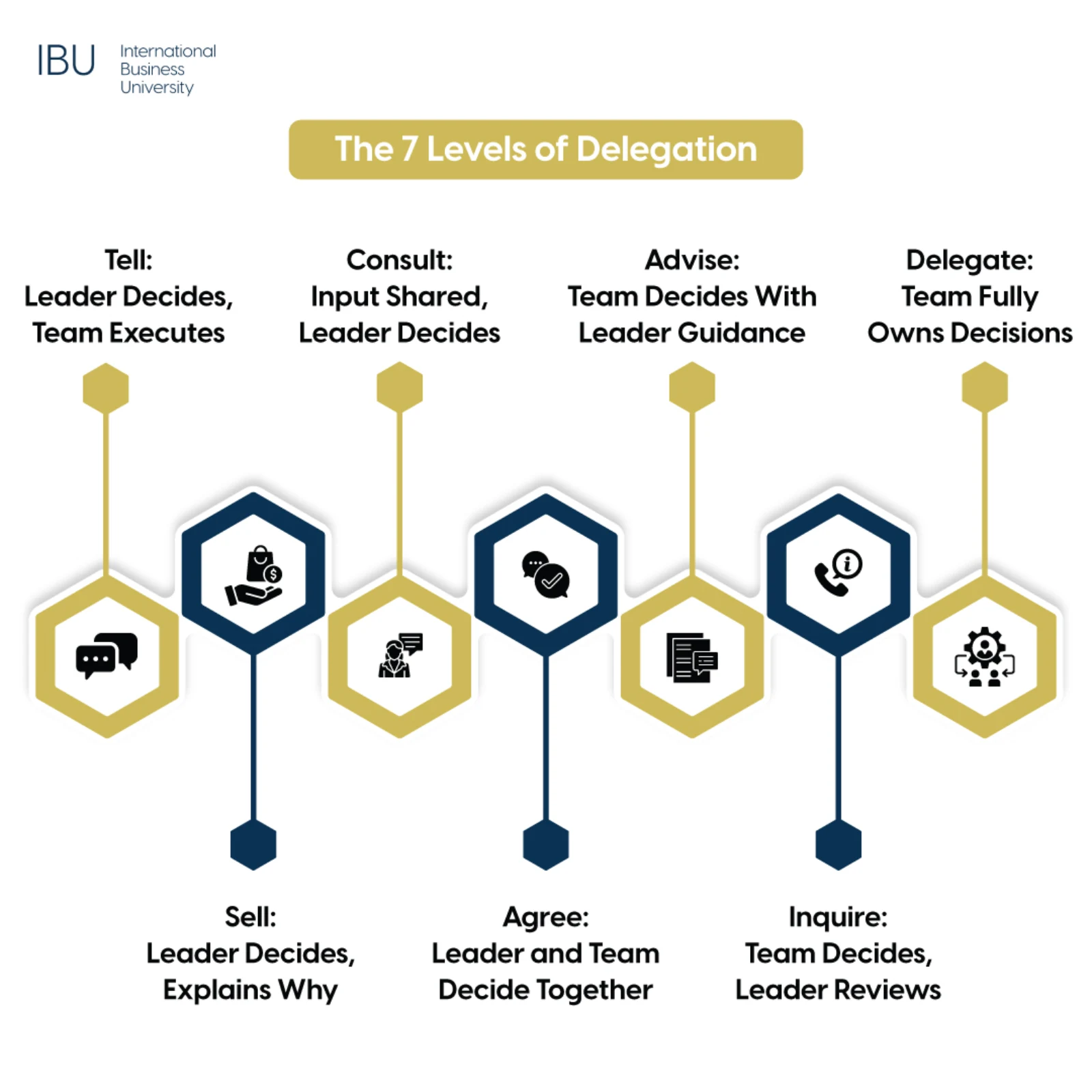
Level 1: Tell – Leader Makes Decision and Instructs
At this level, the leader decides and directs execution. The team follows instructions precisely.
This level works during emergencies, compliance situations, safety issues, and early training phases. Risk remains high. Time remains limited. Experience remains low.
Example: A system outage requires immediate action. The leader assigns tasks directly and monitors completion.
This level protects outcomes when stakes demand speed and certainty.
Level 2: Sell – Leader Decides and Persuades
Here, the leader decides and explains the reasoning. Team members understand context even though authority stays centralized.
This level supports buy-in and learning. Teams gain insight into decision logic while execution remains controlled.
Example: A department adopts a new workflow. The leader explains why the change matters and how it supports performance goals.
Selling decisions build trust while preserving accountability.
Level 3: Consult – Leader Seeks Input Before Deciding
Consultation introduces shared thinking. The leader gathers feedback, ideas, and concerns before making the final call.
This level increases engagement and improves decision quality. Diverse perspectives surface risks and opportunities early.
Example: A marketing director consults the team before finalizing campaign messaging. Input informs direction. Authority remains with leadership.
Consultation balances control with collaboration.
Level 4: Agree – Leader and Team Reach Consensus
At this level, decisions emerge through discussion and alignment. Authority becomes shared.
Consensus works best with experienced teams, clear goals, and low urgency. Commitment strengthens because everyone participates.
Example: A product roadmap planning session where leaders and contributors agree on priorities together.
Consensus builds ownership when time allows dialogue.
Level 5: Advise – Leader Offers Advice, Final Decision by Team
Authority shifts noticeably at this stage. The team decides. The leader offers guidance without control.
This level supports leadership development. Teams practice judgment while leaders provide perspective.
Example: A team chooses which vendor to engage. The leader shares experience and risks. The team makes the final call.
Advice replaces instruction. Trust deepens.
Level 6: Inquire – Team Decides, Leader Reviews
Teams operate independently. Leaders review outcomes and ask questions rather than directing action.
This level works when competence remains high and stakes remain manageable. Leaders stay informed without interfering.
Example: A project team selects tools and workflows. The leader reviews progress during checkpoints.
Inquiry supports autonomy with accountability.
Level 7: Delegate – Team Fully Autonomous
Full delegation represents maturity. Teams own decisions, execution, and results.
Leaders step back. Oversight focuses on outcomes rather than process.
Example: A department manages its operations independently while aligning with organizational goals.
This level frees leaders to focus on strategy, partnerships, and growth.
Applying the 7 Levels of Delegation in Real-World Scenarios
Delegation levels shift across functions and situations. Sales teams may operate at Level 6 for prospecting while using Level 2 for pricing decisions. Operations teams may run Level 7 workflows while using Level 1 during safety incidents.
Delegation also changes over time. New hires start with Level 1 or Level 2. As skills grow, leaders progress upward. Delegated tasks expand in scope and authority.
Strong leaders diagnose readiness continually. They adjust levels based on results rather than assumptions.
Build leadership skills that scale with responsibility
Learn how delegation mastery supports confident leadership growth
How to Implement the 7 Levels of Delegation in Your Team
Understanding the framework matters. Applying it consistently delivers results.
Assessing Team Members’ Skills and Willingness
Delegation begins with assessment. Leaders evaluate competence, confidence, and motivation.
Skills determine capacity. Willingness determines readiness. Both influence which delegation level fits best.
A capable team member lacking confidence may succeed at Level 3 before advancing. A confident performer with limited experience may start at Level 2.
Assessment prevents misalignment and frustration.
Communicating Delegation Choices Clearly
Transparency builds trust. Leaders explain why a specific level applies. Teams understand expectations and authority boundaries.
Clear communication removes ambiguity. Decision rights feel intentional rather than arbitrary.
Leaders who explain delegation choices strengthen engagement and accountability.
Adjusting Delegation Levels Over Time
Delegation remains dynamic. Performance informs progression.
When results improve, autonomy expands. When outcomes decline, leaders temporarily step down a level to support learning.
Adjustment reflects coaching rather than punishment. Teams recognize growth opportunities rather than control.
This flexibility sustains momentum.
Benefits of Mastering the 7 Levels of Delegation
Mastery of the 7 levels of delegation changes how leadership, teams, and organizations perform. Delegation stops being a way to offload work and becomes a system for scaling judgment, ownership, and results.
- Faster execution through proximity to decisions: Decisions move closer to the work itself. Teams act without waiting for approvals, which reduces delays and eliminates bottlenecks. Execution speed improves as accountability becomes clearer at every level.
- Expanded leadership capacity and focus: Leaders reclaim time previously spent on execution. Attention shifts toward strategy, innovation, performance planning, and people development. Burnout declines as responsibility is distributed more evenly.
- Stronger team engagement and confidence: Delegation signals trust. Teams feel valued when authority aligns with responsibility. Confidence grows through ownership, and skill development accelerates through real decision-making.
- Development of future leaders through delegated tasks: Delegated tasks evolve from simple workload distribution into leadership training. Team members practice judgment, accountability, and prioritization. Capability compounds over time rather than resetting with each new challenge.
- Consistent performance through repeatable systems: Organizations scale through clear delegation structures rather than individual effort. Systems replace heroics. Results remain stable as teams grow and complexity increases.
- Healthier culture built on clarity and trust: Expectations remain visible. Authority feels intentional. Teams collaborate with confidence rather than hesitation. Culture strengthens through shared responsibility and aligned decision-making.
Mastering delegation at this level creates leverage. Leaders gain capacity. Teams gain ownership. Organizations gain momentum that sustains growth over time.
FAQ
What makes the 7 levels of delegation different from basic delegation?
The 7 levels of delegation provide a structured spectrum that reflects leadership maturity rather than a single handoff of tasks. Each level defines how authority, decision-making, and accountability shift based on context. This structure helps leaders match delegation style to real business conditions.
How do leaders choose the right level?
Leaders assess risk, team readiness, and the potential impact of the decision. Skill level, confidence, and urgency influence how much authority transfers. The goal involves maintaining momentum while protecting outcomes.
Can teams operate at multiple levels simultaneously?
Yes, teams often function across several levels at the same time. Different tasks require different degrees of oversight and autonomy. This flexibility allows leaders to adapt delegation to changing priorities and capabilities.
Mastering Delegation Levels to Unlock Team Potential and Leadership Growth
Leadership growth depends on trust structured through clarity. Delegation without structure creates risk. Structure without trust creates stagnation.
The 7 levels of delegation offer a practical roadmap for balancing control and autonomy. Leaders choose intentionally. Teams grow steadily. Performance compounds.
When leaders apply the seven levels of delegation consistently, delegation stops feeling risky. It becomes a leadership advantage.
Daily habits shape outcomes. Delegation mastery remains one of the most powerful habits available to modern leaders.
Master delegation as a core leadership capability
Develop the judgment, accountability, and decision-making depth required to lead at every level through a flexible, leadership-focused MBA