

Operations consultant roles in Canada now list AI fluency as a baseline requirement, not a differentiator between otherwise similar candidates. Firms evaluating process optimization and efficiency work expect candidates to apply AI-driven analysis alongside traditional operations frameworks.
That shift has moved faster than most business programs have adjusted their coursework. Candidates trained only in classical operations methods increasingly compete against peers who can pair that training with applied AI skill.
What an Operations Consultant Actually Does Inside a Canadian Organization
Operations consulting is one of those roles that sounds straightforward until someone asks you to explain it at a dinner table. The word “operations” is broad enough to mean almost anything, and “consulting” adds another layer of ambiguity. What the role actually comes down to is a specific kind of problem-solving: finding where an organization is bleeding time, money, or effort, building a clear analysis of why it is happening, and then doing the harder work of getting the client to actually change.
The role centers on identifying inefficiency and building a case for change, backed by analysis a client can act on.
- Process mapping: Documenting how work currently moves through an organization to find bottlenecks and redundant steps.
- Efficiency analysis: Quantifying the cost of inefficiency and modeling the impact of proposed changes.
- Change implementation: Working with client teams to put recommendations into practice, not just deliver a report.
AI tools now support each of these stages, from pattern detection in process data to modeling the outcome of a proposed change before it happens.
How AI Changed This Training Compared to Just a Few Years Ago
The operations consulting skill set looked meaningfully different five years ago. Manual process mapping, weeks of data collection, and spreadsheet-heavy modeling were the standard, and the consultants who were best at those tasks had a genuine edge. That edge has shifted.
The arrival of AI tools in this space did not eliminate the need for operations expertise, but it did fundamentally change which parts of the job require human judgment and which parts now run faster through automated analysis. Operations consulting once relied heavily on manual process mapping and spreadsheet-based modeling.
AI tools now handle pattern detection across large operational datasets far faster than manual review. This is shifting the consultant’s role toward interpreting and acting on those patterns. Consultants who cannot work with these tools directly increasingly find themselves dependent on a technical teammate for work that used to sit entirely within their own skill set.
A Concrete Example of the Shift
It is one thing to say AI has changed how operations consulting works. It is another to see what that change actually looks like inside a project timeline. The difference between a manual process review and an AI-supported one is not marginal. It is the kind of shift that changes what clients expect, what firms can price, and how long a competitor without these tools can realistically stay in the market.
A process review that once took a consulting team several weeks of manual data collection and spreadsheet analysis can now run through an AI-supported workflow in a fraction of the time. The consultant’s role shifts from doing the manual analysis to validating the model’s output and building the client recommendation around it.
Firms that have not adopted this workflow increasingly struggle to compete on both price and delivery speed against firms that have.
The Core Operations Skills Not Every Candidate Brings
Technical training in operations is not rare. What is rare is a candidate who combines that technical foundation with the ability to interpret results quickly, communicate them clearly, and actually move a client organization toward adopting a recommendation. Hiring managers in this space have seen enough candidates who can run an analysis but cannot explain what it means to someone who did not build it. That gap is where most applications fall short.
A recurring gap shows up between what operations training programs teach and what firms actually need.
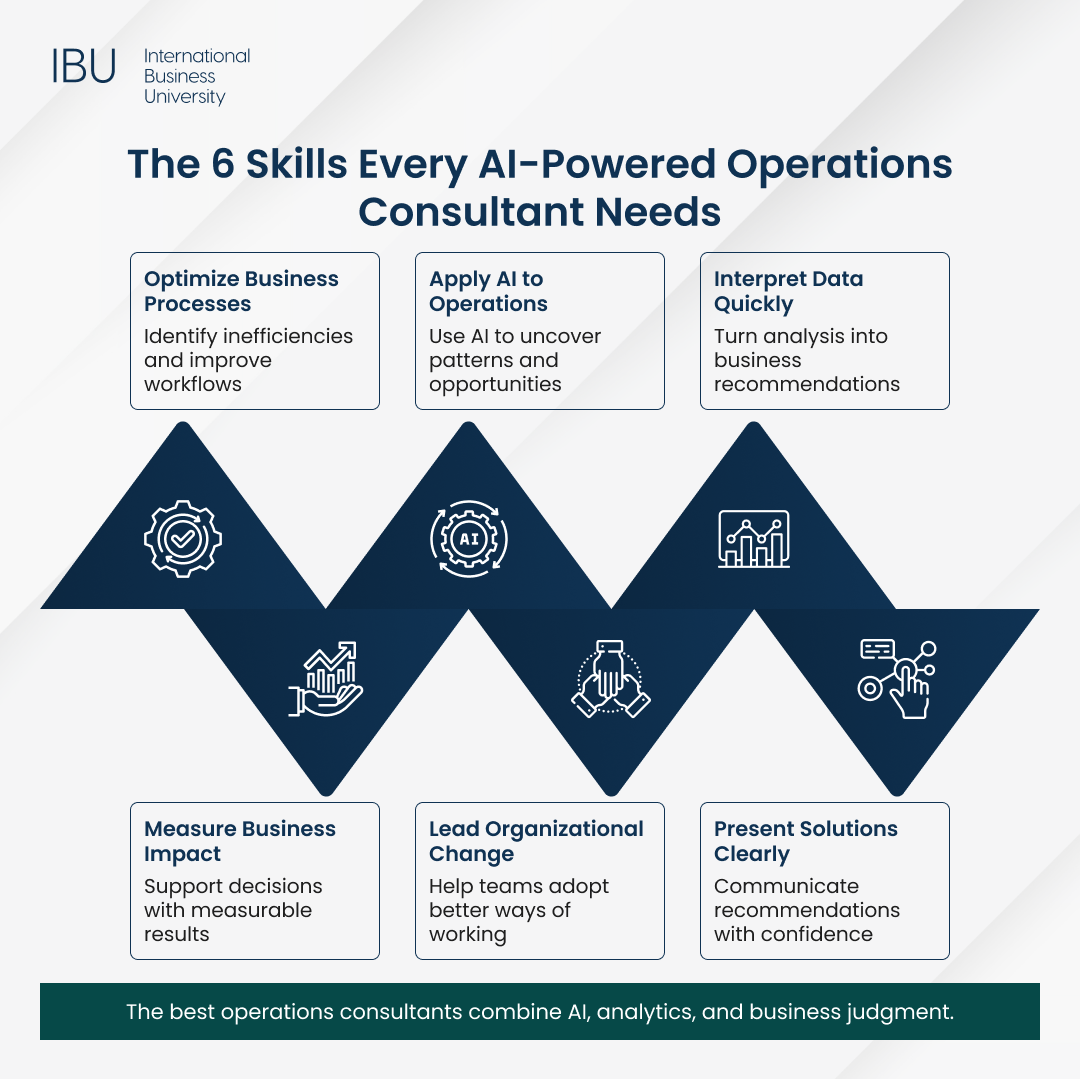
Candidates who can demonstrate all three, not just the technical piece, move through hiring processes faster.
How This Differs From General Management Consulting
Candidates sometimes target management consulting broadly without fully understanding how different the day-to-day work looks depending on which track they are actually pursuing. Operations consulting is not a softer or simpler version of strategy consulting. It is a distinct discipline with its own analytical demands, its own tools, and its own expectations around technical fluency.
Conflating the two leads candidates to build the wrong skill set for the role they actually want. General management consulting spans strategy, organizational design, and operations broadly, while operations consulting concentrates specifically on process efficiency and execution. The AI fluency expectation applies most directly to this narrower operations focus, where large volumes of process data make automated analysis practical.
Candidates targeting operations consulting specifically benefit from building deeper AI and process skills rather than spreading effort across the broader management consulting skill set.
Why AI in Operations Consulting Is No Longer Optional
There was a window, not long ago, where AI fluency in operations consulting was a differentiator. That window has largely closed. What was once an advantage has become a baseline expectation, and candidates or firms that treat it as optional are not competing on equal footing anymore. Client firms increasingly expect AI-supported analysis as a standard baseline part of a consulting engagement, not an add-on service.
- Client expectations shifted: Firms now assume a consultant will use AI tools for process analysis, similar to how spreadsheet fluency became standard decades ago.
- Competitive positioning: Consulting firms that cannot offer AI-supported analysis increasingly lose engagements to firms that can.
- Speed of delivery: AI-supported analysis compresses the timeline for a full process review, which clients now expect as the norm.
Consultants who built AI fluency into their skill set early are positioned ahead of this shift rather than catching up to it.
How an MSc in Applied AI Builds Operations Consulting Readiness
Understanding AI concepts is not the same as being able to apply them inside a real consulting engagement. Employers in this space are not hiring for theoretical awareness. They are hiring for people who have already worked through an AI-supported process project, produced a result, and can speak to what the model revealed and what they did with it.
IBU’s program is built specifically around that distinction. The program pairs core AI training with applied operations coursework built around Canadian industrial and business contexts.
- Applied machine learning: Coursework focused on building and interpreting models for process optimization, not just theory.
- Operations analytics: Training on the data systems and reporting tools operations consulting firms use directly.
- Applied capstone: Requires students to complete a process optimization project for a live business scenario.
Graduates leave with a concrete optimization project to reference in interviews, backed by quantified results.
Prepare for Operations Consulting Before You Graduate
Learn how IBU’s MSc in Applied Artificial Intelligence builds process optimization skills into coursework directly.
How to Position Yourself for Operations Consulting Roles in Canada
A strong academic background in operations or AI will get a candidate’s resume read. What actually moves a candidate through the hiring process is evidence that the training translated into something real.
Employers in this space have become skilled at distinguishing between candidates who studied the work and candidates who have done a version of it, even in an academic setting. That distinction shows up early in most screening conversations. Candidates entering this field benefit from a specific combination of evidence beyond a general operations background.
- A completed AI-supported project: A documented example of using AI tools to analyze and improve an actual or simulated process.
- Quantified results: Specific figures, cost saved, time reduced, error rate improved, carry more weight than general descriptions of involvement.
- Client-facing experience: Any experience presenting findings to a group and defending a recommendation under questioning.
Candidates who arrive with even one of these signals stand out clearly from applicants who list operations interest alone on a resume.
Where Employers Are Concentrating Hiring
Consulting firms serving manufacturing, logistics, and financial services clients show the strongest current demand for AI-fluent operations consultants. These sectors carry large, data-rich processes where AI-supported analysis delivers the clearest and fastest return.
Candidates targeting one of these sectors specifically can shape a portfolio project to match, strengthening their position over generalist applicants.
Key Takeaways

AI fluency is now baseline: operations consulting firms expect AI-supported analysis as standard practice, not a specialized add-on.
Three skills matter together: process optimization, data interpretation, and change management fluency combined move candidates through hiring faster than any one skill alone.
Speed changed client expectations: AI-supported analysis compresses review timelines, and clients now expect that pace as the norm.
Applied training matters: IBU’s capstone structure gives graduates a concrete, quantified optimization project to bring into interviews.
Frequently Asked Questions
Do operations consultants need to know how to build AI models themselves?
Working fluency with AI tools matters more than the ability to build models from scratch for most roles. Consultants need to interpret and act on model output, not necessarily engineer the underlying system.
What skills do Canadian operations consulting firms look for most?
Firms consistently look for process optimization skills, data interpretation under time pressure, and change management fluency. Candidates who demonstrate all three together stand out from candidates with only technical skill.
How has AI changed the pace of operations consulting work?
AI tools now handle pattern detection across large operational datasets much faster than manual review. This has compressed typical project timelines and shifted client expectations toward faster delivery.
Is an MSc in Applied AI a good fit for someone targeting operations consulting?
The specialization pairs applied AI training with operations analytics coursework built around current business contexts. Graduates complete a process optimization capstone project directly relevant to consulting work.
What makes a strong operations consulting portfolio for new graduates?
A completed AI-supported project with quantified results carries more weight than a general description of operations coursework. Client-facing experience presenting and defending a recommendation strengthens a portfolio further.
Which sectors hire the most AI-fluent operations consultants in Canada?
Manufacturing, logistics, and financial services show the strongest current demand due to their large, data-rich processes. Consulting firms serving these sectors increasingly require AI-supported analysis as part of a standard engagement.
Where Operations Consulting Is Headed Next
Operations consulting now rewards candidates who combine classical process improvement training with applied AI fluency, not one skill set alone. Graduates who pair that combination with a quantified optimization project enter the job market with direct evidence of the skills Canadian firms are hiring for.
Build AI Fluency Into Your Operations Consulting Skill Set
IBU’s MSc in Applied Artificial Intelligence prepares graduates for process optimization and operations consulting roles.