
Large class sizes affect how students learn, how often they engage, and how much support they receive. Most students who have sat in a 200-person lecture know that something feels different compared to a seminar of 20. That difference is not just a feeling; it has direct consequences for how well students retain information and how prepared they are after graduation. This article covers seven specific problems with large class sizes and explains why they matter.
Key Takeaways
- Student engagement drops as class size increases: Fewer students participate in discussions, ask questions, or feel personally accountable in large lecture environments.
- Lack of individual attention compounds over time: Students who fall behind in large classes often stay behind because there is no structure that catches or corrects the gap early.
- Class size is a structural choice, not a coincidence: Institutions that keep class sizes small make a deliberate decision that affects every part of the student learning experience.
Why Class Size Matters More Than Students Realize
The class size impact on learning is more significant than many students consider when choosing a university. Prospective students compare programs, campuses, and reputations. Few ask how many students will be in each class and what that number means for their experience. By the time they notice the gap between what they expected and what they are getting, they are already enrolled.
Large lecture disadvantages show up early in a student’s first semester. A student sitting in row 20 of a 300-person auditorium has no interaction with the instructor. They take notes, hope the content sticks, and submit assignments that receive standardized feedback. This pattern repeats for months, sometimes for an entire degree. The disadvantages of large class sizes are not abstract; they are daily academic experiences that affect outcomes.
Research from CEPR’s analysis of university class size and performance found that increasing class size from 56 to 89 students decreases marks by 9% of the observed variation within a given student. For top-performing students, the effect was nearly four times larger. Large class sizes do not affect all students equally; they disproportionately penalize those with the most academic potential.
7 Problems with Large Class Sizes and How to Fix Them
The problems with large class sizes fall into predictable patterns. They appear across different institutions, different programs, and different subject areas. Understanding each one helps students make better decisions about where and how they study.
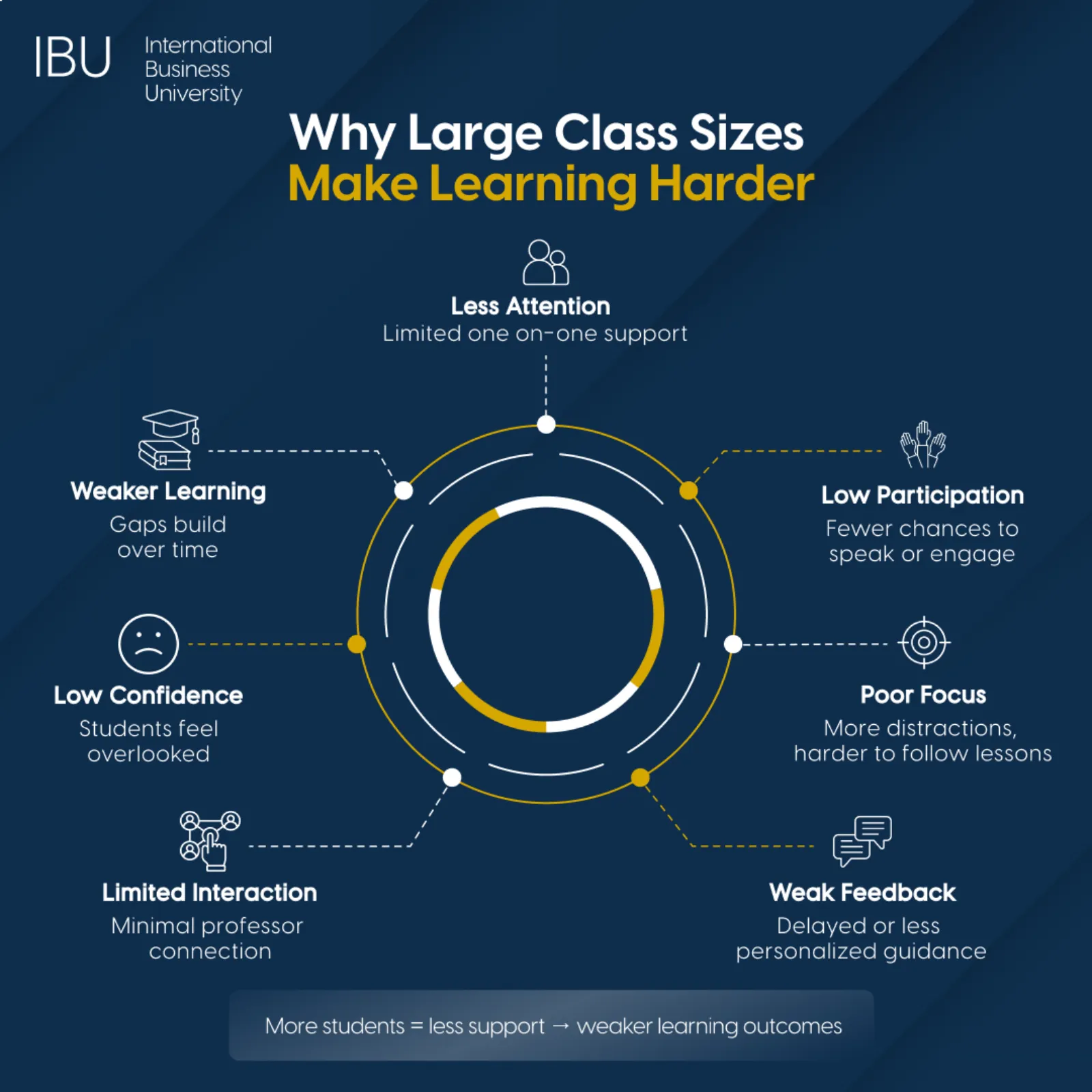
These core problems emerge when class sizes get too large. Students receive less attention, participate less, lose focus more easily, and get weaker, less personal feedback. Over time, this lowers confidence and leads to poorer learning outcomes.
1. Limited Individual Attention from Professors
Limited individual attention is the top problem with large class sizes. When one professor teaches 150 students, each student receives almost none. The fix is structural: choose a program with small class sizes by default.
Instructors in small classes can address confusion during the lesson itself. Students do not have to wait until office hours to get help. That immediate responsiveness is what closes knowledge gaps before they compound.
2. Lower Student Participation in Large Classes
Student engagement in large classes consistently falls below what smaller settings produce. Most students in a 200-person lecture never speak during the entire semester. The fix is to study in an environment where participation is built into every class.
Small seminars make silence visible, which changes the dynamic completely. Students who contribute regularly build professional communication habits faster. That habit carries directly into the workplace.
3. Difficulty Staying Focused During Lectures
Large lecture halls produce constant distraction from noise and late arrivals. A study found that 15 out of 25 students in overcrowded classrooms reported poor concentration. The fix is a smaller, quieter setting where the class itself reduces distraction.
Fewer students means fewer disruptions at every point in a session. Students at the front and back of a small room hear and see equally well. Focus improves not because students try harder, but because the room allows it.
4. Less Personalized Feedback on Assignments
Large class sizes force professors to mark work quickly and generically. A rubric applied to 150 papers rarely explains what a specific student should improve. The fix is a class small enough that instructors can address individual reasoning.
Specific feedback tells a student why their argument failed, not just that it did. That specificity is what develops writing and analytical skills over a full degree. Generic feedback repeated each semester produces slower improvement.
5. Reduced Interaction with Professors
In large classes, most students never have a direct conversation with their professor. They miss mentorship, career guidance, and professional introductions that faculty relationships produce. The fix is choosing a program where faculty know students by name.
Small class environments make those relationships a natural part of the course. Students do not have to seek out faculty; the contact happens within regular sessions. Those connections often influence references, opportunities, and career direction.
6. Lower Confidence in Classroom Discussions
Students who never speak in a large class do not build speaking confidence. Asking a question in front of 200 peers requires a level of confidence few students start with. The fix is regular, low-stakes participation in a small group setting.
Each seminar contribution builds on the one before it. Students who speak weekly across a semester arrive at graduation with a different baseline. That confidence transfers directly into job interviews and professional communication.
7. A Less Effective Overall Learning Experience
Each problem above reduces learning when it appears alone. Together, they create a degree experience where students pass without developing to their full potential. The fix is an institution that treats class size as an academic decision, not an operational one.
Institutions like IBU keep class sizes small by structure, not circumstance. Students in IBU’s BCOM in Business Management and MBA programs experience the opposite of every problem listed here. That difference starts from the first week and compounds across the full program.
Study in Smaller Classes
IBU keeps class sizes small, so every student gets attention.
A 2024 study published in the Bulletin of Economic Research (Carro & Gallardo, 2024) found that a significant class size reduction produced a positive effect of 0.11 standard deviations on overall student performance. The researchers noted this represents a lower-bound estimate of the true effect. Class size reduction consistently improves outcomes when implemented at scale.
How Smaller Classes Help Solve These Problems
Smaller classes address the disadvantages of large class sizes by changing the structure, not just the content. When fewer students share a room with one instructor, every dynamic shifts. Attention, feedback, participation, and confidence all improve because the environment makes them possible.
- Individual attention returns: Professors in small classes can track each student’s progress and adjust how they teach in response to what they observe.
- Participation becomes normal: Students in small seminars contribute regularly because the group size makes silence visible rather than invisible.
- Focus improves: Fewer people in a room means fewer distractions; students can follow content without competing against ambient noise.
- Feedback gets specific: Instructors with smaller marking loads can address the reasoning behind a student’s work, not just its surface correctness.
- Faculty relationships form: Professors who teach small groups know their students by name, which opens the door to mentorship and professional support.
- Confidence builds: Students who speak regularly in seminars develop communication skills that passive lecture attendance cannot produce.
IBU’s BCOM in Business Management and MBA programs are structured with small class sizes as a deliberate feature of the academic experience. Students engage directly with faculty across every course, not just in office hours. That access shapes the quality of feedback, the depth of discussion, and the professional readiness students carry into their careers.
Get the Attention You Deserve
IBU’s program structure puts students first from day one.
Frequently Asked Questions
What is considered a large class size at university?
Most researchers and educators consider a university class large when it exceeds 40 to 50 students per instructor. Introductory courses at major research universities can reach 200 to 500 students, which removes almost all possibility of individual interaction. At IBU, class sizes are kept small enough that faculty can address each student individually within regular course sessions, which is the standard that distinguishes a learning environment from a content-delivery one.
Do large class sizes affect all students equally?
No, and the research shows that high-performing students are often the most negatively affected. Students who would benefit most from academic challenge, deep feedback, and faculty mentorship are the ones most constrained by large class environments. Students from less supported backgrounds also experience greater disadvantage in large classes because they have fewer external resources to compensate for the lack of individual attention in classroom settings.
Can teaching assistants compensate for the problems caused by large class sizes?
Teaching assistants can provide some supplementary support, but they do not resolve the core problems of large class sizes. TAs are generally not subject experts at the faculty level and are not positioned to provide the mentorship, career guidance, or deep academic feedback that faculty relationships produce. The student engagement and confidence benefits associated with small class learning come specifically from regular interaction with the actual instructor, not from supplementary support delivered outside of the main class.
Class Size Is a Decision That Follows You Through Your Degree
Every problem with large class sizes described in this article is a structural one, not an individual failing. Students in large lecture environments are not less capable; they are working in conditions that limit how much they can develop, participate, and be seen. Choosing an institution that keeps class sizes genuinely small, like IBU, is one of the most direct ways to improve the quality of your academic experience from the first week of your program.