

Choosing the best MBA in Canada is harder than running a search and sorting by ranking score.
Rankings aggregate information in ways that are useful for comparing research-intensive universities, but are poor at capturing what actually determines if an MBA program delivers value for a specific student with a specific career goal.
Understanding what you are actually buying, and what the ranking does not tell you, is the starting point for any serious MBA decision.
Key Takeaways
- Rankings measure prestige, not fit: The highest-ranked program is not automatically the best for your career target, specialization match and format matter more for most candidates, whether that means a global business focus or a different concentration entirely.
- Accreditation is non-negotiable: Before evaluating any other factor, confirm the credential is recognized by your target employers and industry licensing bodies.
- Cohort size shapes the daily experience: Smaller cohorts produce more direct faculty engagement, stronger peer relationships, and often better individualized career support.
- Toronto location creates real career advantage: Access to Canada’s largest concentration of employers across financial services, technology, and healthcare is a tangible benefit for MBA students based in the city.
- Talk to recent graduates before you decide: No rankings data replaces a direct conversation with someone who completed the program and can tell you honestly what it produced for their career.
Why MBA Rankings in Canada Are Useful and Where They Mislead You
Rankings are useful for one thing: identifying which schools have the most institutional prestige, research output, and brand recognition in corporate recruiting contexts. If your goal is to enter a major bank’s analyst program or join a top-tier consulting firm through their campus recruiting stream, prestige matters and rankings are a reasonable proxy for it.
For the majority of MBA candidates in Canada, working professionals seeking to advance within their industry, shift into a leadership role, or change sectors, rankings are much less predictive of outcomes. The program that produces the best result for a healthcare administrator moving into management is not the same as the one that produces the best result for a recent graduate targeting investment banking.
What Rankings Do Not Capture
- The quality of teaching for practitioners versus researchers
- Cohort size and how much individual attention and mentorship you receive
- The composition of the cohort and the professional backgrounds your classmates bring
- Career support quality for non-Big-4, non-consulting outcomes
- How does the program fit your schedule if you are working while studying
- Even if the specializations offered match your actual career direction
The Five Factors That Separate the Best MBA in Canada From the Rest
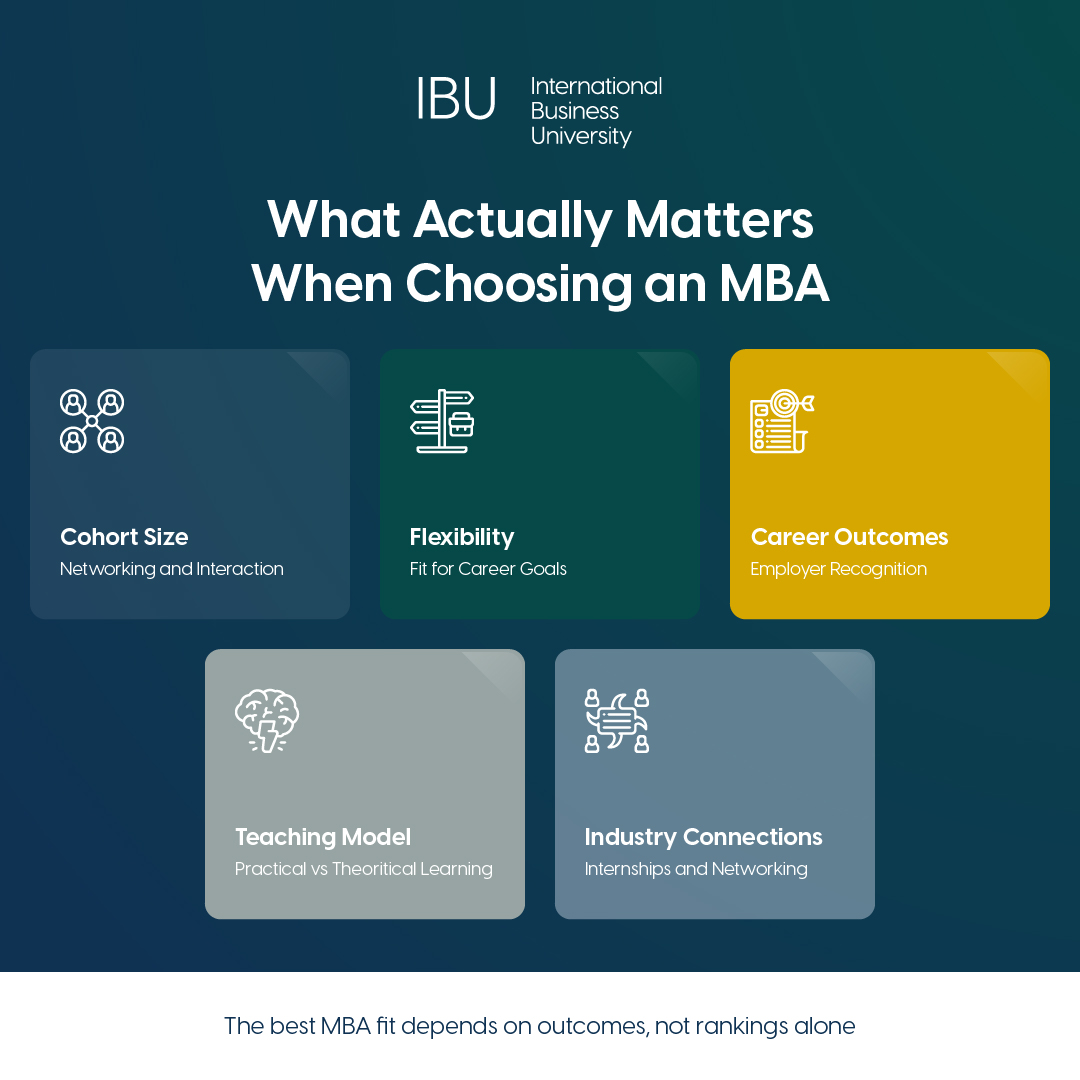
After the brand recognition question is addressed, five factors consistently predict if an MBA program delivers value for a specific candidate.
1. Accreditation and Credential Recognition
Accreditation is the non-negotiable baseline. Programs accredited by recognized bodies, including domestic recognition by the province’s degree-granting authority and international recognition through bodies such as AACSB, AMBA, or EQUIS, carry credentials that employers and licensing bodies will accept. Programs without proper accreditation create risk for the student, regardless of how they market themselves.
2. Specialization Match
The best MBA in Canada for you is the one whose specializations align most closely with your career target. A program with a strong healthcare management track is a better choice for a healthcare professional than a higher-ranked generalist program that treats healthcare as an elective cluster. Specificity in specialization produces better career outcomes than prestige in a generalist track for most candidates outside elite corporate recruiting.
3. Teaching Model and Cohort Interaction
Case-based learning, applied projects, and peer cohort interaction produce qualitatively different outcomes from lecture-based programs. Smaller cohorts allow more direct faculty engagement, more individualized feedback, and tighter professional relationships that continue beyond graduation. This is a factor that rankings almost never capture.
4. Flexibility and Format
An MBA that requires you to pause your career for two years is a different product from one you can complete while continuing to work. Online and hybrid formats have matured significantly in the post-2020 environment. The best MBA for a working professional is not necessarily the highest-ranked full-time program; it is the program that delivers the credential and the learning without requiring you to sacrifice income and career momentum to complete it.
5. Career Support Quality
Career services quality varies enormously across MBA programs. The most relevant question is not how many employers come to campus for the generalist full-time program; it is what support exists specifically for candidates with your background and career goals. Ask directly: What is the placement rate for graduates in my target industry? Who are the alumni I can speak with? What does the career team actually do for online or part-time students?

Compare IBU MBA Programs
IBU offers MBA specializations in healthcare, finance, global business, and technology.
What Toronto MBA Programs Offer That Other Canadian Cities Do Not
Toronto’s MBA market is distinct from other Canadian cities in two important ways: the density of employers and the range of industries accessible within the metro area.
Students completing MBA programs in Toronto have direct access to Canada’s largest concentration of financial services employers, technology companies, professional services firms, and healthcare networks, all within commuting distance and all actively hiring MBA graduates. The networking opportunity created by simply being in Toronto while completing an MBA is a real, measurable advantage over programs in smaller markets.
IBU’s campuses in downtown Toronto and Ottawa put students at the center of both Canada’s financial hub and its government and policy hub, two career environments where MBA credentials carry direct value.
How Cohort Size and Teaching Model Change Your MBA Experience
Large cohort programs, 200 to 400 students per intake, produce strong alumni networks over time but often deliver a less personalized learning experience during the program. Faculty interaction is limited, feedback is generalized, and the peer relationship dynamic is more competitive than collaborative.
Smaller cohort programs create a fundamentally different learning environment. Faculty know students by name. Feedback on presentations, case analyze, and projects is specific and developmental. The professional relationships formed in a small cohort are stronger at graduation and tend to be more actively maintained afterward.
For candidates evaluating MBA programs, cohort size is one of the most important and least discussed differentiators. A cohort of 30 produces a different experience, and often better career outcomes for non-prestige-track candidates, than a cohort of 300.
What Canadian Employers Say When They See Different Toronto MBA Programs
Canadian employers outside the prestige-hiring firms that recruit exclusively from a short target school list evaluate MBA graduates on three dimensions: what they know, what they can do, and if they can communicate clearly in a professional context.
The credential matters for getting past the initial screening in organizations that use degree level as a filter. The specialization determines which roles the candidate is considered for. The interview determines if they get an offer.
In this context, the gap between a top-ranked program and a well-accredited applied-learning program is smaller than rankings suggest for most hiring decisions. The candidate who graduates from a smaller Toronto program with strong applied project experience, a clear specialization, and practiced communication skills is competitive for most management and leadership roles in the Canadian market.
How to Shortlist the Right MBA Program for Your Specific Goals
Narrowing the field from every MBA program in Canada to the three or four that are genuinely worth a serious evaluation requires answering four questions honestly.
- What is my specific career goal, and which MBA format and specialization most directly supports it?
- Can I complete this program without pausing my career and income, or do I need a format that accommodates working while studying?
- Is this program accredited by a body that my target employers will recognize?
- Have I spoken directly with recent graduates of this program about their experience and outcomes?
The answers to these questions narrow the list quickly. The best MBA in Canada is not a universal answer; it is a specific answer for your situation.
Frequently Asked Questions
What is the typical cost of an MBA in Canada?
Annual MBA tuition in Canada ranges from approximately $16,000 CAD at more affordable institutions to $64,000 CAD or more at top-ranked business schools. Total program costs, including books, technology, and living expenses, can range from under $40,000 to over $130,000, depending on program length and location.
IBU’s MBA programs are designed to deliver strong career outcomes at a cost that allows students to complete the degree without creating the debt burden that limits career optionality after graduation.
Is an online MBA from a Canadian university respected by employers?
Yes, provided the credential is from an accredited institution, and the program is taught at the same academic standard as the on-campus version. Canadian employers have increasingly accepted online MBA credentials as equivalent to on-campus programs, particularly as the quality of online delivery has improved significantly, and the credential itself remains the same regardless of format.
The most important question is not online versus on-campus; it is if the institution is accredited, the program is rigorous, and the specialization matches the employer’s expectations for the role being considered.
How long does it take to complete an MBA in Canada?
Full-time on-campus MBA programs in Canada typically take 12 to 24 months to complete. Part-time and online programs designed for working professionals can range from 16 months to three years, depending on the course load. IBU’s MBA can be completed in as little as 16 months, making it one of the fastest completion pathways among accredited Canadian programs.
The MBA Decision That Matches Your Actual Goals
The best MBA in Canada is the one that matches your career direction, fits your life, carries a credential your target employers recognize, and surrounds you with peers and faculty who make the learning experience genuinely useful.
Rankings are a starting point for narrowing the field. Your actual priorities, format, specialization, cost, cohort, and career support are the criteria that determine the final choice.

Study business in Canada’s largest economic hub
Toronto gives MBA students direct access to employers across finance, healthcare, technology, and consulting.