
Reasoning skills determine how you evaluate information, form judgments, and act under uncertainty. Strong reasoning skills support better academic performance, sharper business decisions, and clearer communication in high-stakes situations. This guide explains how to strengthen reasoning skills through structured thinking methods, disciplined analysis, memory strategies, and applied problem-solving frameworks used by high performers.
Key Takeaways
- Reasoning skills improve through structured practice that trains logic, analysis, and judgment together.
- Critical, analytical, inductive, and abstract reasoning skills reinforce one another when applied consistently.
- Practical frameworks and daily routines develop higher order reasoning skills that scale across careers.
Simple Methods for Strengthening Your Reasoning Skills
Strengthening reasoning skills begins with understanding how different reasoning types function together. Logical reasoning skills ensure clarity and internal consistency. Inductive reasoning skills help identify trends and probabilities. Abstract reasoning skills support conceptual thinking beyond surface facts. When practiced intentionally, these methods create a reliable mental system for evaluating information and making sound decisions.
Understanding Deductive Reasoning Basics
Deductive reasoning applies general principles to specific situations. When premises are accurate and logic is sound, conclusions follow with certainty. This form of reasoning appears in law, finance, compliance, and policy development.
Deductive reasoning strengthens discipline in thinking. It forces clarity around definitions, conditions, and boundaries. Professionals who rely on deductive reasoning reduce ambiguity and prevent conclusions driven by emotion, habit, or assumption. Over time, this approach builds confidence in decision defensibility.
Building Inductive Reasoning Through Patterns
Inductive reasoning skills focus on recognizing patterns across observations and experiences. Instead of certainty, inductive reasoning produces likelihood-based conclusions. Market analysis, customer behaviour tracking, and performance forecasting depend on this approach.
To strengthen inductive reasoning, review outcomes regularly, compare historical data, and document recurring trends. This habit sharpens analytical and reasoning skills by training the mind to move from isolated facts to informed projections without overgeneralization.
Mastering Abductive Reasoning for Hypotheses
Abductive reasoning involves forming the most plausible explanation when information remains incomplete. This approach dominates diagnostics, investigations, and complex troubleshooting. Clinical reasoning skills rely heavily on abductive thinking combined with validation.
Practicing abductive reasoning improves adaptability. It encourages hypothesis testing rather than premature certainty. Leaders using abductive reasoning respond effectively in uncertain conditions while remaining open to revision as new evidence appears.
Daily Exercises to Sharpen Logical Thinking
Logical reasoning skills are strengthened through repetition. Daily exercises such as syllogisms, rule-based puzzles, and structured debates train consistency in thinking. Short reasoning drills reinforce accuracy under time constraints.
Fifteen focused minutes daily produce cumulative improvement. Over time, logic becomes automatic rather than forced, supporting faster and clearer decisions.
Avoiding Common Cognitive Biases
Cognitive biases distort reasoning by prioritizing comfort over accuracy. Confirmation bias reinforces existing beliefs. Availability bias exaggerates recent experiences. Anchoring bias fixes attention on initial information.
Recognizing bias patterns strengthens critical reasoning skills by slowing judgment and redirecting attention toward evidence rather than instinct. Bias awareness protects decision quality in leadership and analytical roles.
Build leadership through structured thinking
Strong reasoning skills shape confident leaders who communicate clearly and decide responsibly. A business education grounded in analytical thinking prepares you to apply reasoning in real-world settings.
Techniques for Critical Analysis
Critical analysis strengthens reasoning by training you to evaluate information actively rather than absorb it passively. This skillset supports higher-order reasoning skills by enforcing structure, discipline, and evidence validation at every stage of thinking. Critical analysis reduces reactive judgment and replaces it with intentional evaluation across academic, professional, and leadership contexts.
Breaking Down Arguments Step-by-Step
Effective analysis starts by isolating the core claim. Once the conclusion is clear, supporting evidence must be listed explicitly, followed by any assumptions required for the claim to stand. This method prevents ideas from blending together and reduces emotional interpretation.
Breaking arguments into defined components improves clarity in writing, presentations, and professional persuasion tasks, such as how to write a cover letter that relies on logic, relevance, and alignment rather than exaggeration or vague claims.
Evaluating Evidence and Sources
Evidence quality directly shapes decision quality. Reliable sources demonstrate clear authorship, transparent methodology, and contextual relevance. Strong evaluation practices prioritize accuracy, consistency, and applicability over volume or popularity.
This discipline strengthens analytical reasoning skills by training you to assess credibility, detect weak support, and separate opinion from substantiated information. Professionals skilled in evidence evaluation reduce exposure to flawed conclusions and unsupported claims.
Questioning Assumptions Effectively
Assumptions influence decisions without drawing attention. Identifying them reveals hidden risks and structural weaknesses in reasoning. Asking why an assumption exists forces examination of its origin and validity.
This practice strengthens critical reasoning skills, examples used in negotiations, strategy development, and policy evaluation by exposing unsupported beliefs before they shape outcomes.
Using the Socratic Method for Self-Inquiry
The Socratic method relies on structured questioning to test understanding and consistency. Each question builds on the previous one, leading to refined clarity rather than fast answers. This approach trains patience and intellectual discipline.
Self-inquiry strengthens reflective reasoning by encouraging you to validate claims through logic and evidence instead of confidence alone. Over time, this method reduces overconfidence and improves judgment reliability.
Practicing Counterargument Development
Counterargument development requires you to analyze opposing positions with equal seriousness. This exercise forces perspective expansion and exposes weaknesses in original reasoning.
Leaders who practice counterarguments strengthen analytical and reasoning skills by anticipating objections, improving persuasion quality, and presenting balanced conclusions grounded in evidence.
Analyzing Real-World Case Studies
Case studies connect reasoning theory to applied decision-making. Reviewing real outcomes, decision paths, and consequences trains judgment within realistic constraints.
This method reinforces analytical reasoning skills by showing how reasoning performs under pressure, incomplete data, and competing priorities.
Memory and Recall Strategies
Reasoning relies on accurate recall under time constraints. Memory strategies strengthen reasoning by reducing cognitive load and improving retrieval efficiency. When information becomes easier to access, mental resources shift toward evaluation and judgment rather than recall effort.
Mnemonic Devices for Complex Ideas
Mnemonics convert dense information into structured memory cues. Acronyms, imagery, and association techniques support long-term retention of frameworks and processes.
This approach strengthens abstract reasoning skills by linking concepts into organized mental systems rather than isolated facts.
Spaced Repetition for Retention
Spaced repetition reinforces memory through timed review intervals. Revisiting information just before forgetting strengthens long-term recall and understanding.
Students and professionals using spaced repetition demonstrate improved performance during high-pressure tasks that require quick access to information.
Mind Mapping for Connections
Mind mapping visualizes relationships between concepts using spatial organization. This method strengthens visual-spatial reasoning skills by showing how ideas connect within a system.
Mind maps support strategic planning, synthesis, and complex problem analysis by revealing structure that linear notes often miss.
Active Recall Practice Routines
Active recall requires retrieving information without prompts. Self-testing exposes knowledge gaps and strengthens neural pathways through effortful retrieval.
This method strengthens analytical and reasoning skills by reinforcing understanding rather than recognition.
Associating Concepts with Visuals
Visual associations anchor abstract concepts through diagrams, symbols, and models. Visual encoding improves comprehension speed and retention accuracy.
This technique reduces mental fatigue and supports consistent application across problem-solving scenarios.
Problem-Solving Frameworks
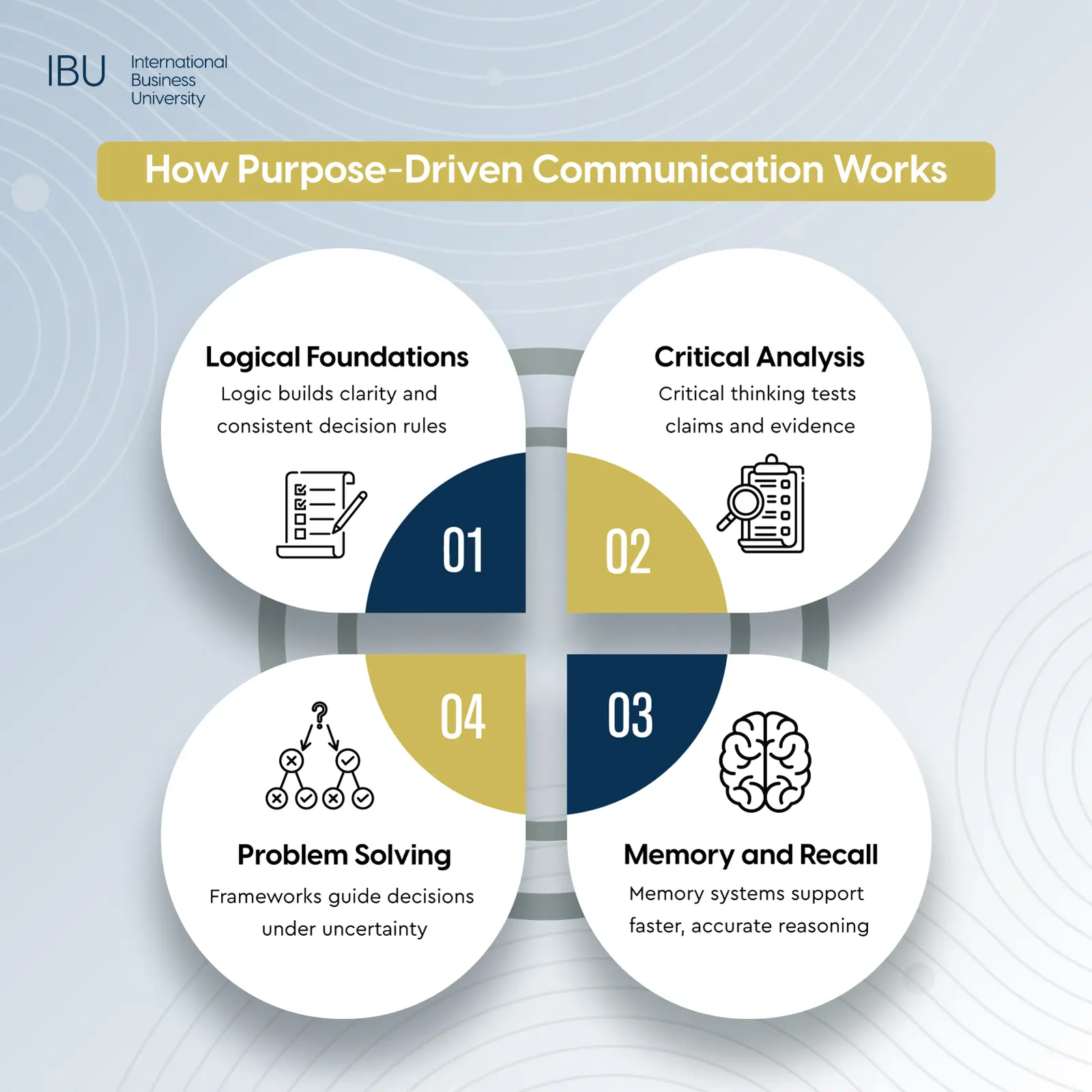
Problem-solving frameworks introduce structure during complex decisions. They guide reasoning through defined steps, reducing overload and improving outcome consistency. Frameworks convert uncertainty into manageable analysis.
Applying the Scientific Method Daily
The scientific method promotes observation, hypothesis formulation, testing, and evaluation. Applying it daily builds disciplined reasoning habits across routine decisions.
This approach strengthens clinical reasoning skills by encouraging evidence-based validation before conclusions are accepted.
Root Cause Analysis Techniques
Root cause analysis identifies underlying issues rather than surface symptoms. Mapping cause chains reveals where failures originate and how they propagate.
This method strengthens reasoning discipline by demanding accountability and preventing repetitive errors.
SWOT Analysis for Decisions
SWOT analysis evaluates strengths, weaknesses, opportunities, and threats within a defined context. This framework supports balanced evaluation across internal and external factors.
Strategic reasoning improves when decisions consider multiple dimensions rather than isolated variables.
Decision Trees for Logical Choices
Decision trees visualize options, consequences, and probabilities in a structured format. This clarity improves foresight and risk evaluation.
Decision trees strengthen logical reasoning skills by making trade-offs explicit and measurable.
Lateral Thinking Puzzles
Lateral thinking puzzles challenge fixed patterns and promote flexible reasoning. These exercises encourage reframing problems rather than forcing linear solutions.
Regular practice expands abstract reasoning skills by increasing adaptability under unfamiliar conditions.
Scenario Planning Exercises
Scenario planning prepares you for multiple plausible futures. This method strengthens strategic thinking by exploring consequences across varying assumptions.
Scenario planning develops higher-order reasoning skills essential for leadership, risk management, and long-term planning.
Lead with insight through advanced analysis
Advanced reasoning skills drive data-informed decisions and strategic leadership. Graduate education strengthens analytical depth across complex business environments.
Tools and Resources for Practice
Tools and resources strengthen reasoning skills when used with intention and structure. The value comes from consistency, reflection, and choosing resources that challenge thinking rather than entertain passively. Each category below supports a different dimension of reasoning development, from logic construction to reflective judgment.
Logic Puzzle Books and Apps
Logic puzzle books and apps train sequencing, deduction, and constraint-based thinking. These tools require you to follow rules, identify relationships, and reach conclusions without guesswork. Cross-number puzzles, grid logic problems, and syllogism exercises sharpen logical reasoning skills by reinforcing step-by-step analysis.
Daily practice produces measurable improvement when puzzles increase gradually in complexity. The goal involves accuracy and process awareness rather than speed. Tracking errors and reviewing reasoning paths strengthens analytical and reasoning skills over time.
Online Reasoning Courses
Online reasoning courses provide structured progression across logical, analytical, and abstract reasoning skills. High-quality courses introduce concepts, apply them through guided exercises, and reinforce learning through feedback. This format supports deliberate practice rather than fragmented exposure.
Courses focused on critical reasoning skills often include argument evaluation, assumption testing, and case-based analysis. These elements strengthen higher-order reasoning skills by teaching how to transfer concepts across different contexts rather than memorizing techniques.
Debate Clubs and Forums
Debate clubs and discussion forums strengthen evidence-based reasoning through active engagement. Participants must articulate positions clearly, respond to challenges, and adjust reasoning when evidence shifts. This process reinforces discipline in thinking and communication.
Debate environments sharpen critical reasoning skills, such as identifying weak claims, recognizing unsupported assertions, and structuring persuasive arguments. Regular participation improves confidence in reasoning under scrutiny and time pressure.
Brain Training Games Reviewed
Brain training games vary widely in effectiveness. Tools focused on reaction speed or memorization offer limited reasoning value. Games designed around logic chains, pattern discovery, and rule-based problem solving provide stronger cognitive returns.
Effective reasoning-focused games challenge abstract reasoning skills and inductive reasoning skills by requiring players to infer rules from limited information. Progress tracking and increasing difficulty levels support sustained development rather than short-term engagement.
Reading Philosophy Classics
Reading philosophy strengthens disciplined thinking by exposing you to structured arguments, formal logic, and conceptual analysis. Texts in logic, ethics, and epistemology train the mind to follow reasoning across extended arguments without shortcuts.
Philosophical reading improves analytical reasoning skills by demanding attention to definitions, premises, and conclusions. Annotating arguments and summarizing positions further strengthens comprehension and evaluation skills.
Journaling Reasoning Processes
Journaling reasoning processes transforms thinking into a visible record. Writing decisions, assumptions, and outcomes clarify how conclusions were reached. This practice strengthens metacognition, which improves future judgment.
Regular journaling supports critical reasoning skills by revealing patterns in decision-making, including bias and incomplete analysis. Over time, this habit refines reasoning quality and supports continuous improvement.
FAQ
What does it mean to define reasoning skills?
To define reasoning skills means identifying the cognitive processes used to evaluate information and reach conclusions. These include logical, analytical, inductive, and abstract reasoning abilities. They support decision-making across academic and professional contexts. Strong reasoning improves judgment consistency.
How can someone improve their reasoning skills consistently?
Learning how to improve reasoning skills requires structured practice and reflection. Daily exercises, framework application, and bias awareness support steady improvement. Consistency outweighs intensity. Progress becomes visible through clearer decisions.
Why are reasoning skills valuable beyond academics?
Reasoning skills apply across leadership, communication, and problem-solving roles. They support tasks such as how to write a cover letter that persuades logically. Employers value reasoning because it reduces risk. These skills remain relevant throughout a career.
Mastering Reasoning for Lifelong Success
Mastering reasoning skills requires sustained practice and self-awareness. Logical reasoning skills provide structure. Inductive reasoning skills support insight. Analytical reasoning skills guide judgment in uncertainty. Together, these capabilities form a reliable framework for decision-making, leadership, and professional growth that strengthens reasoning skills across a lifetime.