
Project management in healthcare operates under conditions that do not exist in most industries. Every decision intersects with patient safety, regulatory oversight, and continuous clinical operations. Timelines move more slowly, accountability runs deeper, and consequences carry real human impact. These differences demand a distinct approach to healthcare project management that balances structure, caution, and coordination at every stage.
Key Takeaways
- Project management in healthcare prioritizes patient safety and regulatory compliance above speed.
- Healthcare project managers coordinate complex teams across clinical, technical, and administrative roles.
- Successful healthcare projects rely on specialized tools, disciplined change control, and realistic timelines.
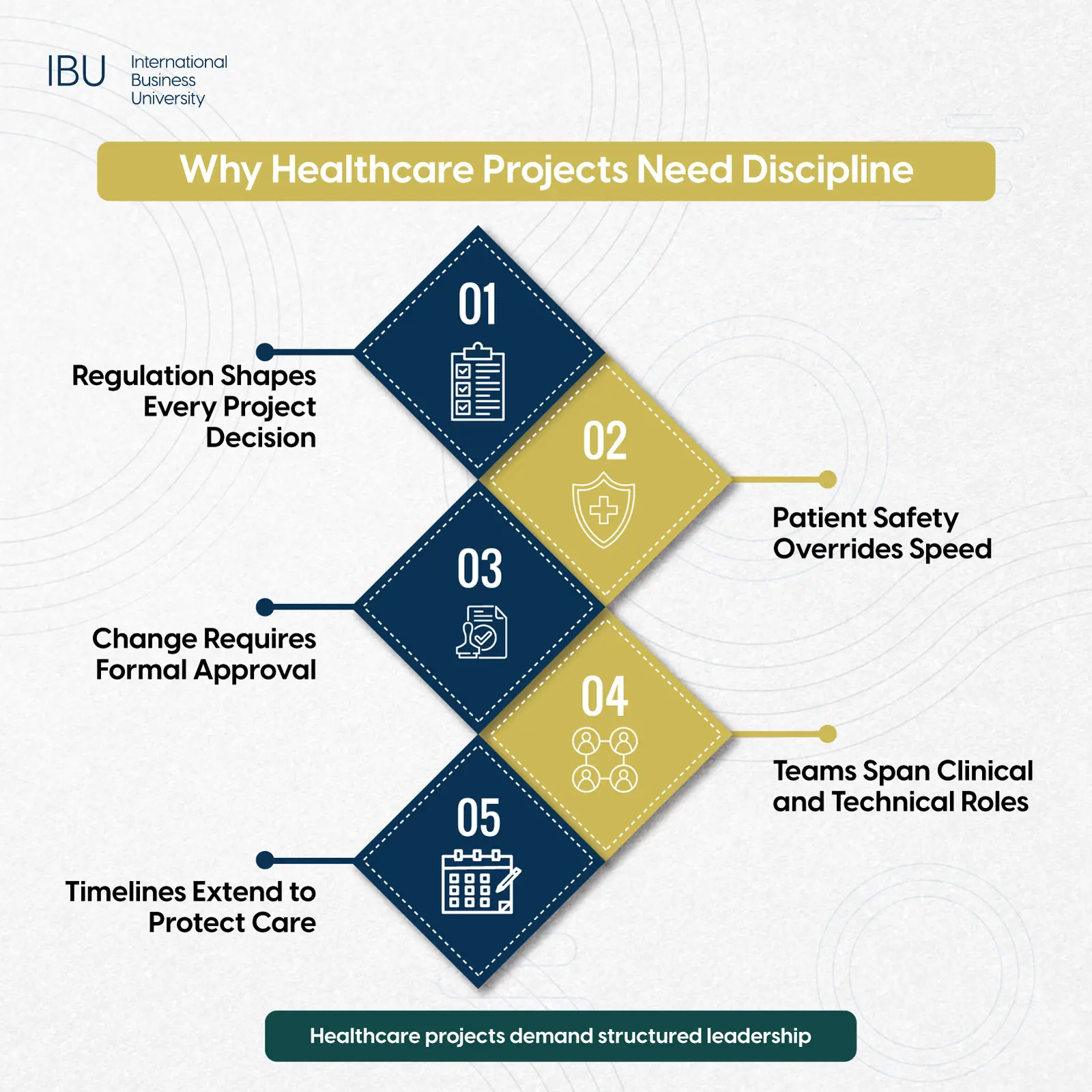
5 Ways Project Management in Healthcare Is Different
Project management in healthcare functions inside a tightly controlled environment shaped by regulation, ethics, and uninterrupted clinical operations. These constraints affect every phase of a project, from early planning through post-implementation review. Unlike commercial projects, success depends on alignment with governance structures as much as delivery outcomes. Understanding these differences prepares you to manage complexity while protecting care delivery.
Healthcare project management rewards caution, documentation discipline, and stakeholder alignment. Speed matters less than safety, traceability, and readiness. Each difference below reflects structural realities that reshape how projects move forward.
1. Strict Regulatory Compliance Requirements
Project management in healthcare operates under overlapping regulatory frameworks that vary by jurisdiction and service type. These include privacy legislation, clinical safety standards, accreditation requirements, and reporting obligations tied to funding and licensure. Project plans must align with these rules before execution begins.
Regulatory review often determines project pacing. Approvals may gate entry into design, testing, deployment, or training phases. Documentation standards influence vendor selection, system configuration, and staff onboarding. Every milestone must withstand audit review, often long after project closure. This environment rewards precision, version control, and disciplined documentation rather than rapid iteration.
Healthcare project managers spend significant time coordinating with compliance teams to confirm alignment. Regulatory readiness becomes a parallel workstream, not a final checkpoint.
2. Patient Safety as Top Priority
Patient safety overrides scope, cost, and schedule decisions in healthcare project management. Projects introducing new systems, processes, facilities, or equipment must demonstrate no negative impact on patient outcomes. Risk assessments prioritize clinical exposure rather than operational convenience.
Healthcare project managers work closely with clinicians to evaluate downstream effects. Workflow changes undergo simulation and testing before adoption. Even small adjustments receive scrutiny when they intersect with medication handling, diagnostics, or care delivery. This priority reshapes how success is defined.
A project delivered on time holds little value if it introduces clinical risk. Safety metrics influence go-live decisions, rollout pacing, and training depth. Patient safety remains the non-negotiable benchmark.
3. Highly Regulated Change Management
Change management in the healthcare industry follows structured approval pathways designed to protect patients and staff. Clinical governance committees, ethics boards, risk management teams, and regulators often review proposed changes. Each layer introduces oversight and time.
Project management in healthcare requires formal change logs, documented impact assessments, and staged rollouts. Deviations from approved plans require authorization before execution. Informal changes that might be tolerated in other industries carry serious consequences here.
This structure limits flexibility while increasing predictability. Healthcare project managers must anticipate review cycles and build them into schedules. Change becomes deliberate rather than reactive.
4. Multidisciplinary Team Coordination
Healthcare projects involve a wide range of professional groups, each with distinct priorities and responsibilities. Clinicians focus on patient outcomes. Administrators manage capacity and compliance. IT teams handle systems and security. Finance teams monitor budgets and funding rules. Vendors introduce external dependencies.
Coordination requires shared language, structured communication, and clearly defined accountability. Healthcare project managers act as translators between disciplines, aligning expectations without diluting professional standards. Facilitation skills matter as much as technical planning.
Meetings, documentation, and decision forums must accommodate diverse perspectives. Alignment occurs through structure, not assumption.
5. Extended Implementation Timelines
Healthcare projects often span longer timelines due to regulatory approval, clinical validation, training requirements, and phased deployment. Parallel clinical operations restrict how quickly systems and workflows can change. Implementation occurs gradually to protect continuity of care.
Extended timelines reduce risk while increasing planning complexity. Project managers must maintain momentum across long execution windows without exhausting stakeholders. Milestones reflect readiness rather than urgency.
Project management in healthcare values sequencing and patience. Timelines protect staff, patients, and systems from disruption.
Specialized Tools and Methodologies
Healthcare project management relies on tools and methodologies adapted to clinical, regulatory, and operational realities. Generic project tools often require customization to meet governance and safety needs.
Healthcare-Specific PM Software
Healthcare project managers use platforms designed for compliance tracking, audit readiness, and documentation control. These tools support role-based access, secure data handling, and detailed change history. They reduce manual oversight while strengthening traceability.
Software selection prioritizes data protection, approval workflows, and reporting capability. Integration with clinical systems influences adoption decisions. Usability matters when staff balance project tasks with patient care.
Clinical Project Management Platforms
Clinical platforms support research initiatives, system implementations, and care pathway redesigns. They manage approvals, patient data workflows, protocol documentation, and compliance reporting. These platforms align project execution with clinical governance requirements.
Healthcare project management benefits from tools that reflect clinical realities rather than forcing workarounds. Alignment reduces friction and improves adoption.
Gantt Charts for Regulatory Milestones
Traditional Gantt charts remain useful in healthcare when adapted to represent regulatory checkpoints. Milestones often track approvals, audits, training completion, validation, and certification stages rather than deliverables alone.
These charts help stakeholders visualize dependencies tied to compliance. They support expectation management by highlighting where delays may occur. Visibility reinforces realism.
Risk Registers for Patient Safety
Risk registers in healthcare extend beyond financial and scheduling concerns. They capture patient safety risks, workflow disruption, data exposure, and compliance failure. Each risk includes mitigation strategies approved by clinical leadership.
Project management in healthcare treats risk registers as active tools reviewed throughout execution. Risk ownership remains explicit. Escalation paths stay clear.
Agile vs. Waterfall in Healthcare
Healthcare projects rarely follow pure Agile approaches due to documentation and safety requirements. Waterfall models support predictability, traceability, and approval control. Agile techniques offer flexibility within defined boundaries.
Healthcare project managers often adapt Agile practices for internal development tasks while maintaining structured governance for patient-facing components. Balance replaces ideology.
Hybrid Methodology Approaches
Hybrid methodologies combine structured planning with controlled iteration. Waterfall governs compliance-heavy phases. Agile supports development and testing where appropriate. This structure balances adaptability with accountability.
Hybrid approaches dominate modern healthcare project management because they reflect real constraints. Flexibility exists where risk allows. Structure governs where safety demands certainty.
Lead complex healthcare projects with confidence
Project management in healthcare demands regulatory awareness, patient safety focus, and disciplined execution. Advanced healthcare management training prepares you to guide initiatives that operate under real clinical and operational pressure.
Budgeting and Resource Challenges
Budgeting in healthcare projects operates under constraints that rarely exist in commercial environments. Funding arrives from predefined sources tied to reimbursement models, public budgets, grants, and long approval chains. Project scope must align with these realities from the outset. Flexibility remains limited once approvals lock in.
Healthcare project management requires financial planning that balances precision with adaptability. Budgets must anticipate delays, regulatory review cycles, staffing variability, and emergency interruptions. Financial discipline protects projects from stalling when conditions shift.
Reimbursement Constraint Impacts
Reimbursement structures influence nearly every project decision in healthcare. Funding often ties directly to service categories, patient outcomes, compliance milestones, and reporting requirements. Project managers must design scope and timelines that fit within approved reimbursement frameworks rather than ideal execution scenarios.
These constraints shape vendor selection, staffing models, and technology choices. Changes to scope require financial revalidation through governance committees. Limited budget elasticity places pressure on upfront planning accuracy. Strong healthcare project managers understand reimbursement mechanics well enough to forecast constraint points early.
Capital Equipment Approval Cycles
Projects involving medical equipment face layered approval processes that extend timelines significantly. Clinical justification evaluates patient impact and safety. Technical review assesses compatibility with existing systems. Financial analysis confirms lifecycle cost and maintenance burden.
These approval cycles affect procurement schedules, staffing readiness, and training plans. Delays often cascade into dependent workstreams. Effective project management in healthcare anticipates these cycles during planning rather than reacting mid-execution. Early alignment with finance and clinical leadership reduces downstream disruption.
Staff Scheduling Around Shifts
Healthcare staffing operates around patient care priorities rather than project convenience. Clinicians work rotating shifts that include nights, weekends, and on-call responsibilities. Project activities must fit within these constraints.
Training sessions, workflow testing, and stakeholder meetings require flexible scheduling models. Healthcare project managers coordinate across departments to avoid coverage gaps. Engagement plans often include multiple sessions, recorded materials, and phased participation to ensure inclusion without disrupting care delivery.
24/7 Operational Continuity
Hospitals, clinics, and care facilities operate continuously. Projects must introduce change without stopping services. System upgrades, facility renovations, and process changes require careful sequencing.
Cutovers occur during low-risk windows identified by clinical leadership. Testing runs parallel to live operations. Resource allocation prioritizes patient-facing roles during peak demand periods. This continuous operation model demands meticulous coordination and contingency planning.
Emergency Preparedness Integration
Healthcare environments face unpredictable disruptions such as outbreaks, surges, equipment failures, and public health emergencies. These events override project schedules immediately. Planned work pauses without warning.
Healthcare project management incorporates contingency planning from the start. Schedules include buffer periods. Contracts allow for suspension clauses. Communication plans account for rapid reprioritization. Flexibility exists within structured boundaries to protect both patient care and project viability.
Career Implications for Healthcare Project Managers
Project management careers in healthcare demand a broader skill set than technical certification alone. Professionals must understand clinical workflows, regulatory language, governance structures, and institutional culture. This complexity raises responsibility levels while strengthening long-term career stability.
Healthcare project managers gain experience operating under pressure where decisions affect patient safety and service continuity. This exposure builds credibility across leadership teams. As a result, career paths often extend into senior operational leadership, clinical transformation roles, digital health initiatives, and enterprise change management.
Experience managing multidisciplinary teams strengthens influence across departments. Risk assessment skills sharpen judgment. Stakeholder alignment abilities improve decision outcomes. These competencies translate across healthcare systems, public agencies, and regulated industries.
Project management in the healthcare industry rewards professionals who combine structure with situational awareness. Discipline supports execution. Empathy supports trust. Systems thinking supports scale. Together, these capabilities position healthcare project managers as strategic leaders rather than task coordinators.
FAQ
What makes project management in healthcare more complex than other industries?
Healthcare projects affect patient outcomes directly. Regulatory oversight, clinical governance, and operational continuity add layers of complexity. Decisions require broader approval. Risk tolerance remains lower.
What skills does a healthcare project manager need most?
Strong communication, regulatory awareness, and risk assessment skills matter greatly. Healthcare project managers also need patience and coordination ability. Technical planning skills support these core competencies.
Are project management careers in healthcare growing?
Demand continues to rise as healthcare systems modernize. Digital health initiatives, infrastructure upgrades, and care redesign projects expand opportunities. Specialized expertise increases long-term career value.
Mastering Healthcare Project Management Success
Project management in healthcare succeeds when structure supports care rather than disrupts it. Regulatory discipline, patient safety focus, and multidisciplinary coordination define effective execution. Healthcare project managers who respect these realities deliver outcomes that endure. Mastery comes from aligning planning discipline with the human responsibility at the center of healthcare.
Build data-driven leadership in modern healthcare
Healthcare project managers increasingly rely on analytics, digital systems, and performance data to guide decisions. Specialized education in health data and digital operations strengthens your ability to lead transformation initiatives responsibly.