
Management consultants work with organizations to solve operational, strategic, or organizational problems that internal teams either lack the time or the outside perspective to solve alone. The work is project-based, often demanding, and consistently ranks among the most competitive career paths for BCOM and MBA graduates in Canada.
The appeal is straightforward: fast exposure to multiple industries, direct access to senior leadership, and a career path with clearly defined promotion stages. The demands are equally direct: long hours, constant travel or client-site work, and pressure to deliver credible recommendations quickly with incomplete information.
Key Takeaways
Here is what defines the management consulting career path in Canada.

Management consultants diagnose business problems and deliver specific recommendations, often working across multiple industries within a single year.
The career path runs from analyst to partner, with promotion timelines that are faster and more organized than most corporate roles.
BCOM and MBA graduates are the primary hiring pool for consulting firms, which test heavily for case-solving and methodical problem-solving skills.
What a Management Consultant Actually Does Versus What Most People Think
The popular image of a management consultant is someone who parachutes into a company, produces a slide deck, and leaves. The reality is closer to practical problem-solving under a deadline. A typical engagement starts with defining the problem clearly, since clients often misdiagnose their own issue, then gathering data through interviews and analysis, and finally building a recommendation that the client’s team can realistically implement.
Much of the actual work is unglamorous: building financial models, conducting stakeholder interviews, and revising a recommendation multiple times before it reaches a client’s leadership team. The value consultants provide is less about expertise the client lacks entirely and more about focused time, methodical thinking, and an outside perspective the internal team cannot access on its own.
The Management Consultant Career Path From Analyst to Partner in Canada
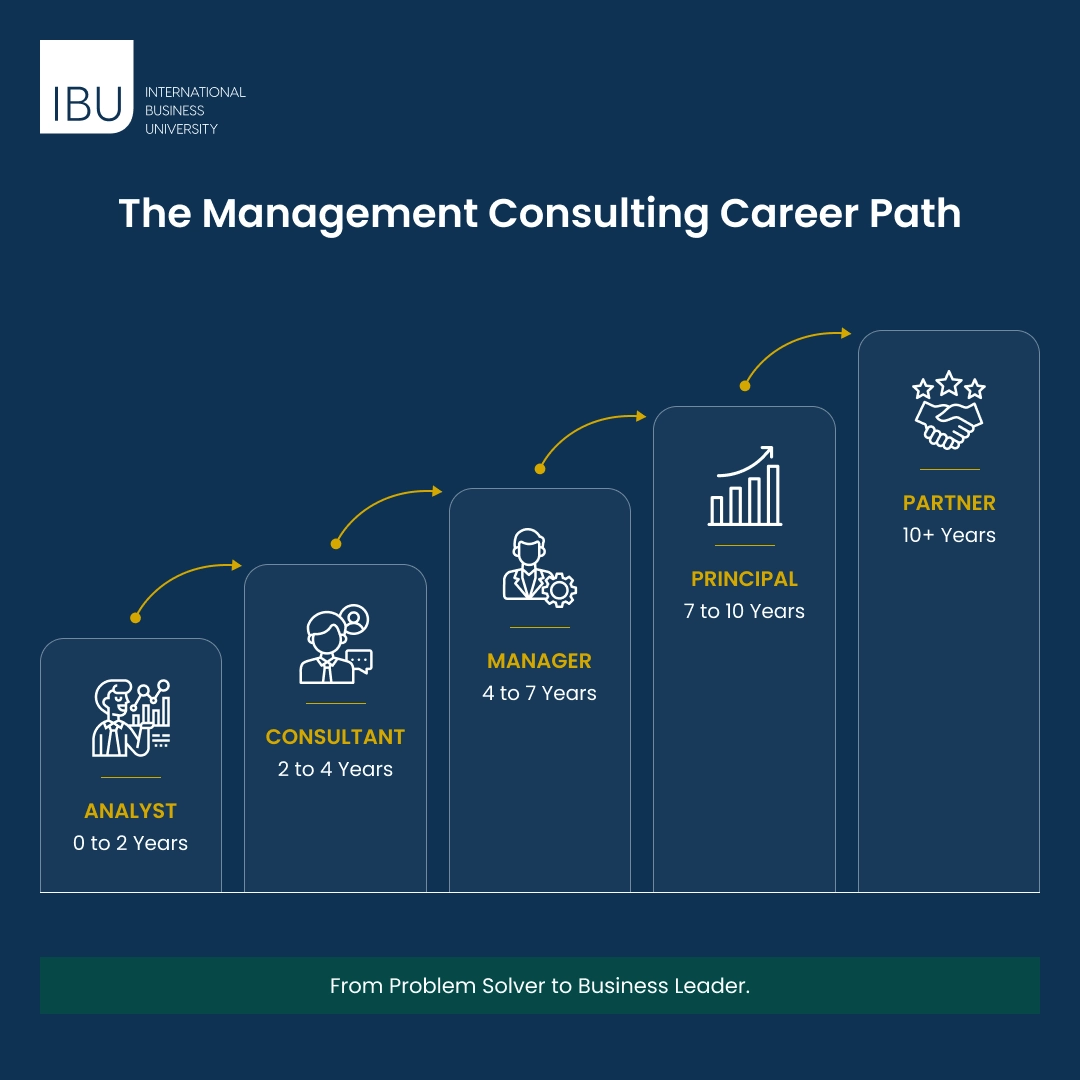
Consulting firms operating in Canada, from global strategy practices to the advisory arms of the professional services networks, move people from entry level to partner on a defined schedule with formal checkpoints at each stage. This differs from most corporate functions, where advancement timing is negotiated case by case rather than built into the structure itself.
- Analyst or Associate (0 to 2 years): Builds financial models, structures market research, and prepares the analysis that senior team members present to clients. Most firms hire directly from undergraduate business programs or bring in MBA graduates at a slightly higher associate band. Work at this stage is closely reviewed, with a manager or senior consultant checking outputs before they reach a client.
- Consultant (2 to 4 years): Takes ownership of a discrete workstream within a larger engagement and begins presenting findings directly to client stakeholders rather than only to internal team leads. This is typically the first stage where a person’s individual judgment, not just their analytical output, is formally assessed.
- Senior Consultant or Manager (4 to 7 years): Leads case teams day-to-day, manages the client relationship between formal steering meetings, and starts contributing to proposal development for new work. Performance at this level is measured on both delivery quality and the ability to develop junior staff.
- Principal or Director (7 to 10 years): Splits time across selling new engagements and overseeing delivery on several accounts at once. The role shifts from analyzing and shaping which problems the firm takes on and how a portfolio of client relationships is managed.
- Partner (10 or more years): Holds ultimate accountability for a portfolio of client relationships and contributes to firm-level strategy, including which markets or service lines the firm invests in next. At most firms, partnership also comes with a financial stake in firm performance.
This “up or out” progression is one of the defining features of consulting careers, and it rewards early, visible performance more directly than many other business career paths.
Why BCOM and MBA Graduates Are the Primary Consulting Hire Profile
Consulting firms hire heavily from BCOM and MBA programs because both degrees build the exact skills consulting requires: systematic problem-solving, financial literacy, and comfort presenting recommendations to senior stakeholders under time pressure.
BCOM graduates typically enter at the analyst level, while MBA graduates often enter directly at the consultant or senior consultant level, reflecting the additional strategic and leadership training an MBA provides. This is one reason consulting recruiting remains tightly connected to BCOM in Business Management programs and MBA cohorts specifically, rather than being open broadly across all degree types.
Build Consulting Skills From the Start
Develop business analysis, communication, and problem-solving skills.
Management Consultant Skills That Firms Test For in Case Interviews
Consulting firms use case interviews specifically because they reveal how a candidate thinks under pressure, not just what they know.
- Methodical problem breakdown: Splitting a broad, ambiguous problem into clear, testable components.
- Quantitative reasoning: Performing accurate calculations quickly, often without a calculator.
- Business judgment: Recognizing which factors actually matter to a client’s bottom line.
- Communication clarity: Presenting a recommendation clearly and defending it under questioning.
Candidates who practice case interviews extensively before applying consistently outperform equally qualified candidates who rely on academic performance alone, since the format rewards a specific, learnable format. Graduates who prefer building a single product over advising many clients often compare this path against how to become a product manager, since both careers draw on similar organized problem-solving skills.
Management Consultant Salary: What Each Level Pays in Canada
Management consulting compensation rises steeply relative to other business career paths, particularly at the transition from analyst to consultant and again from manager to principal. Total compensation typically includes a base salary plus a performance bonus, and the bonus component grows significantly at senior levels. Here is how pay generally breaks down by level in the Canadian market.
- Analyst (entry level): Base salary makes up nearly all of total compensation at this stage, with a small annual bonus tied mostly to firm performance rather than individual results.
- Consultant: Base salary increases and the bonus grows to a larger share of pay, usually reflecting a mix of project performance and individual contribution.
- Senior consultant or engagement manager: Compensation shifts further toward bonus, which starts to depend on client outcomes and the size of the engagements a person leads.
- Manager: Base salary plateaus relative to earlier jumps, while the bonus becomes tied to business development responsibilities, not just project delivery.
- Principal or partner: Compensation is heavily bonus-weighted at this level, often linked directly to the revenue an individual brings into the firm rather than a fixed salary band.
Compensation also varies by a wide margin depending on firm size and specialization, with large global strategy firms typically paying at the higher end of the market compared to boutique or regional consulting firms. Candidates evaluating offers should weigh total compensation alongside the specific industry exposure and promotion timeline each firm offers, since these factors affect long-term earning potential as much as starting salary.
- Large global strategy firms: Typically pay at the top of the market and offer the fastest formal promotion timelines, but often expect broader travel and longer hours in exchange.
- Boutique consulting firms: Usually pay somewhat below the largest global firms, but can offer deeper specialization in a specific industry or service line earlier in a career.
- Regional consulting firms: Generally pay the least of the three categories, though they can offer more predictable hours and a shorter path to client-facing responsibility.
- Industry exposure: The specific sectors a firm serves, such as financial services, healthcare, or the public sector, shape which skills a consultant builds and which future roles those skills open.
- Promotion timeline: Firms differ in how quickly they move consultants from one level to the next, which affects how fast compensation actually grows regardless of the firm’s starting salary.
Frequently Asked Questions
Do you need an MBA to become a management consultant in Canada?
Many consultants enter directly from a BCOM or equivalent undergraduate business degree at the analyst level. An MBA typically allows entry at a more senior level and can accelerate the path into strategy-focused roles. The degree requirement depends on the firm and the entry point being targeted.
What is the management consultant salary at each level in Canada?
Compensation increases substantially at each career stage, with the largest jumps occurring at the analyst-to-consultant and manager-to-principal transitions. Total compensation includes both base salary and performance-based bonuses that grow with seniority. Exact figures vary significantly by firm size, city, and specialization.
Is a BCOM enough to get into management consulting or is an MBA required?
A BCOM is enough for entry-level analyst positions at most consulting firms. An MBA becomes more relevant for candidates targeting mid-career entry or roles with immediate client-facing responsibility. Many successful consultants complete an MBA after a few years of analyst-level experience rather than before starting.
What is the difference between a management consultant and a business analyst?
A management consultant typically works across multiple client organizations on defined, time-limited engagements focused on strategic or operational problems. A business analyst usually works within a single organization on ongoing projects, often with a narrower technical or process focus. The consulting role generally involves broader industry exposure and more direct executive interaction.
Preparing for a Consulting Career Before You Apply
Breaking into management consulting requires more preparation than a strong resume alone. Start practicing case interviews well before recruiting season begins, since this specific skill rarely develops naturally through coursework. Build a track record of leadership in group projects or extracurriculars that demonstrates the same thinking consulting firms test for directly. The candidates who succeed in consulting recruiting are consistently the ones who treated case preparation as a skill to build deliberately, not a formality to complete quickly.
Start Your Path Toward Consulting
Apply to IBU and build the business foundation consulting careers require.