
Most students pick a business major the way they pick a phone plan: from the name on the label. The name tells you very little about what you will actually do on a Tuesday afternoon in third year.
IBU’s three BCOM specializations share one foundation and then split, like a road that forks. Each branch leads somewhere different: teams and operations, digital sales and marketing, or global business and technology.
This guide walks the fork with you, comparing the BCOM specializations course by course and role by role, using only what the program pages say.
Key Takeaways
Here is what a side-by-side read of the BCOM specializations shows.

Same length: All three BCOM specializations run 32 months across 8 semesters and 120 credits.
Shared start: Level One courses are nearly identical, so your first year builds the same business foundation.
Upper-level split: The clearest differences appear in Levels Three and Four, where each major adds its own courses.
Different job lists: Each program page names its own career titles, from Operations Manager to E-commerce Manager to IT Consultant.
Three 2027 intakes: Every specialization lists start dates of January 6, May 5, and September 8, 2027.
IBU’s Three BCOM Specializations Share One Foundation Before They Split
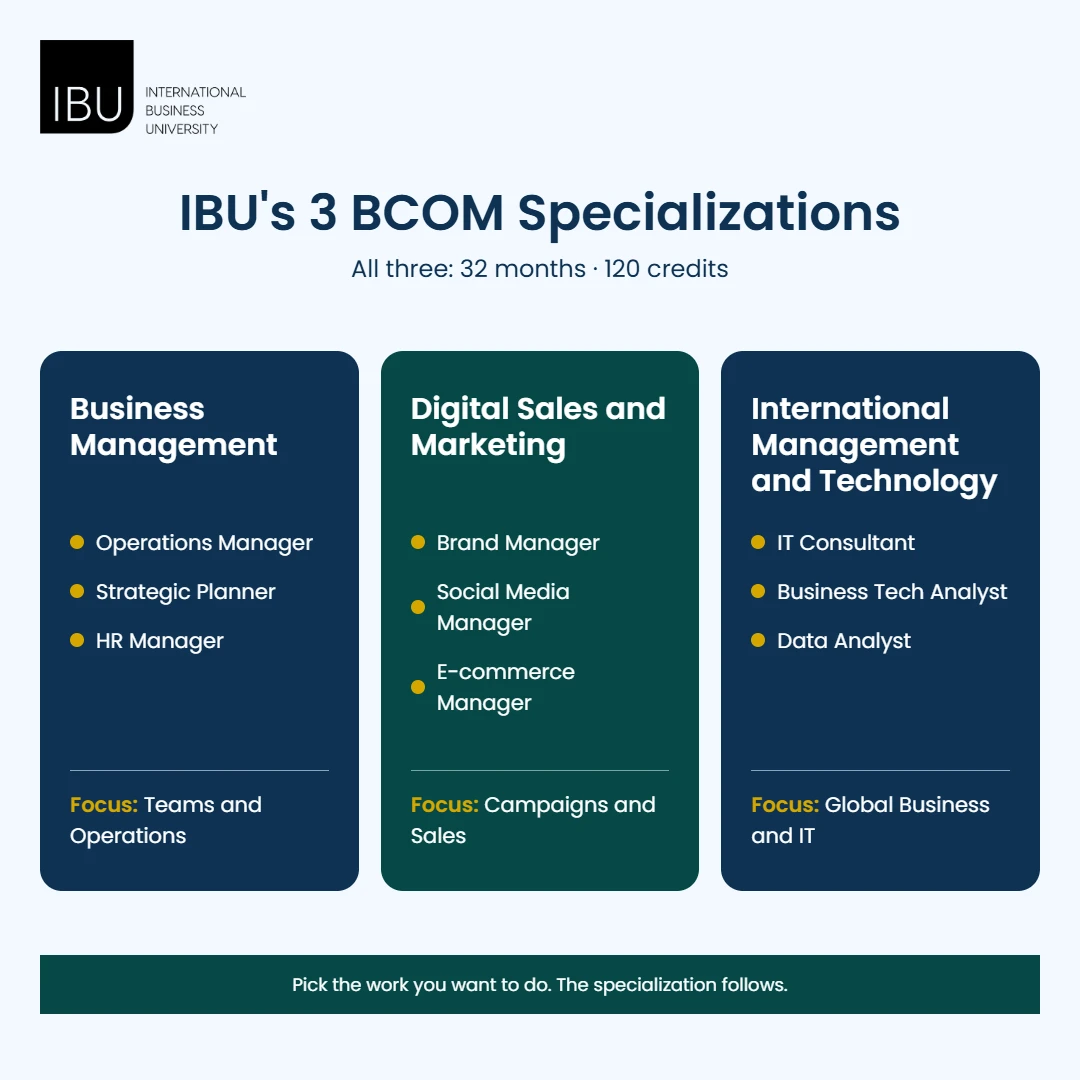
Every Bachelor of Commerce at IBU runs 32 months over 8 semesters and totals 120 credits. The three BCOM specializations are the BCOM in Business Management, the BCOM in Digital Sales and Marketing Management, and the BCOM in International Management and Technology.
In Level One, all three BCOM specializations list Introduction to Business, Introduction to Accounting, Applied Economics, Organizational Behaviour, and Introduction to Financial Analysis. Later levels share courses too, such as Project Management, Data Analytics for Business, and Global Strategy.
YEAR ONE IS NOT THE FORK
Your first two semesters look almost the same in all three majors. The only Level One difference: International Management and Technology lists Global Trends and World Politics instead of Contemporary World History. The fork comes from Level Two onward.
The Three BCOM Specializations Side by Side
The table below puts the main facts from each program page in one view.
| Feature | Business Management | Digital Sales and Marketing Management | International Management and Technology |
|---|---|---|---|
| Length and credits | 32 months, 8 semesters, 120 credits | 32 months, 8 semesters, 120 credits | 32 months, 8 semesters, 120 credits |
| Main focus | Leadership, strategy, operations, and analytics | Digital campaigns, sales, consumer behaviour, and marketing analytics | Global business, cross-cultural leadership, and technology |
| Signature upper-level courses | Organizational Design, Leadership Skills, Corporate Strategy | Digital Marketing 2, Marketing Analytics, Planning a Digital Marketing Campaign | Advanced International Finance, Information Technology Management, User Experience Design |
| Sample career titles | Operations Manager, Strategic Planner, Human Resources Manager | Brand Manager, Social Media Manager, E-commerce Manager | IT Consultant, Business Technology Analyst, Data Analyst |
The BCOM in Business Management Builds Leaders for Teams and Operations
The BCOM in Business Management is the broadest of the three BCOM specializations. Its program page frames it around leadership, strategy, operations, and analytics, for students who want to lead teams, improve how a business runs, or advise on strategy.
What You Study in the BCOM in Business Management
After the shared first year, this major adds courses focused on how organizations are run and led. Highlights by level include:
- Level Two: Strategic Management, Management Accounting, Human Resource Management, and Entrepreneurship and Innovation Business Planning.
- Level Three: Organizational Design, Leadership Skills, Special Topics in CSR, and Research for Business 2.
- Level Four: Corporate Strategy, Business Trends, Leading in Diverse Contexts, and a Capstone Course.
Students also complete a team-based business plan project guided by faculty and industry mentors. For eligible domestic students, the program page lists a hybrid option to attend classes live online or in person.
Where Business Management Graduates Work
The ten career titles here span many functions, including Management Advisor, Strategic Planner, Financial Analyst, Project Manager, Human Resources Manager, Operations Manager, and Entrepreneur or Startup Founder. For a wider view of how commerce skills carry across fields, read our guide to Bachelor of Commerce skills and career pathways.
Lead Teams and Operations
Review every Business Management course by level.
The BCOM in Digital Sales and Marketing Management Turns Customer Insight Into Campaigns
Among the BCOM specializations, the BCOM in Digital Sales and Marketing Management ties core commerce courses most closely to digital marketing and sales. Its page describes students learning to plan digital campaigns, study consumer behaviour, and use social media, content marketing, SEO, and marketing analytics.
What You Study in the BCOM in Digital Sales and Marketing Management
From Level Two, the sequence moves from basics to running a full campaign:
- Level Two: Digital Marketing 1, Marketing Strategy, Sales Technique, Social Media Metrics, and a Special Digital Marketing Project Course.
- Level Three: Digital Marketing 2, Digital Marketing Trends, Marketing Analytics, and Branding and Design.
- Level Four: Special Topics in Digital Marketing, Planning a Digital Marketing Campaign, and a Special Digital Marketing Capstone.
READ THE LEVEL FOUR LIST FIRST
The final-year courses show where each branch of the fork leads. If a program’s Level Four titles sound like work you would enjoy, trust that over the program name. Compare them across all three BCOM specializations before you decide.
Marketing, Brand, and E-commerce Roles After Graduation
The 15 career titles here lean toward customers and brands, including Digital Marketer, Brand Manager, Social Media Manager, Marketing Analyst, Sales Manager, E-commerce Manager, and Content Marketing Strategist. The program page does not state its delivery modes, so ask a program advisor which formats apply to you.
The BCOM in International Management and Technology Connects Global Business and IT
The BCOM in International Management and Technology is the most technical of the BCOM specializations. Its program page describes building leadership, cross-cultural judgment, and technical skills to solve global business problems with technology.
What You Study in the BCOM in International Management and Technology
After Level One, this major adds a global strand and a technical strand:
- Global strand: International Management, Global Business Issues, Advanced International Finance, and Market Research.
- Technology strand: Information Technology Applications, Information Technology Management, Technology Trends and Implications, and User Experience Design.
- Venture and project work: Entrepreneurship and Innovation, its Business Planning course, a Project Course, and a final Capstone Course.
As with Business Management, the page lists hybrid classes for eligible domestic Canadian students.
Consulting, Analyst, and Technology Roles After Graduation
The titles here mix business and technology work: Marketing and Sales Manager, Product Manager, Business Analyst, Business Consultant, IT Consultant, Business Technology Analyst, Cybersecurity Analyst, Data Analyst, and Project Manager. Graduates can work in consulting firms, global corporations, and startups, according to the page.
Business Meets Technology
See the global and technical courses together.
Choosing a Business Degree Starts With the Work You Want to Do Each Day
Choosing a business degree gets easier when you compare tasks instead of program names. Each of the BCOM specializations leads to a different kind of workday, and the course lists show what that workday looks like.
Three Questions to Ask Before Choosing a Business Degree
Talk these through with a parent, counsellor, or advisor.
- People or campaigns: If you want to run teams and fix how a business operates, look first at the BCOM in Business Management.
- Customers and channels: If you want to grow sales through social media, content, and analytics, the BCOM in Digital Sales and Marketing Management fits best.
- Global and technical: If you want to work across borders and with IT systems, the BCOM in International Management and Technology matches that goal.
What Graduate Earnings Data Says About an Undergraduate Business Specialization
National data adds context when comparing BCOM specializations. A Statistics Canada study of bachelor’s graduates from 2010 to 2012 found that “in most cases, however, business graduates ranked above average in median earnings” five years after graduation. In the study’s tables, male graduates in Business/commerce, general had median earnings of $69,209 compared with $65,113 across all fields, and female graduates in that field had $60,847 compared with $50,986 across all fields (in 2017 constant dollars).
A JOB TITLE IS A DIRECTION
The career lists on each program page show where graduates can head, not where they are placed. Earnings data describes past graduates across Canada, not any one program. Use both to compare BCOM specializations, then judge each major by its courses.
For more roles, see our guide to BCOM degree careers from finance to marketing.
Frequently Asked Questions
What jobs can you get with a Bachelor of Commerce?
IBU’s three BCOM specializations list different roles, such as Operations Manager and Strategic Planner in Business Management, Brand Manager and E-commerce Manager in Digital Sales and Marketing Management, and IT Consultant and Data Analyst in International Management and Technology. Each program page lists its full set of career titles.
What is a Bachelor of Commerce degree?
A Bachelor of Commerce is an undergraduate business degree that covers accounting, economics, marketing, management, and finance. At IBU, students build a shared foundation first and then follow one of three BCOM specializations in later levels.
What can you do with a Bachelor of Commerce?
You can move into management, marketing, analysis, consulting, or technology roles, or start your own business, depending on which of the BCOM specializations you follow. The BCOM in Business Management, for example, lists Entrepreneur or Startup Founder among its career titles.
How long is a Bachelor of Commerce degree?
At IBU, each of the three BCOM specializations takes 32 months across 8 semesters and totals 120 credits. In 2027, all three list start dates of January 6, May 5, and September 8.
What should you do after a Bachelor of Commerce?
Many graduates of BCOM specializations apply for roles linked to their major, using final-year projects and capstone work as evidence of what they can do. Others continue to graduate study, such as an MBA, after gaining some work experience.
Picking Your Undergraduate Business Specialization for a 2027 Start
All three BCOM specializations share the same length, credit total, and first-year foundation. Business Management leads toward teams, strategy, and operations. Digital Sales and Marketing Management leads toward campaigns, brands, and online sales. International Management and Technology leads toward global business and IT roles. The Level Four courses show each of the BCOM specializations most clearly. This week, compare the Level Four courses on all three program pages and write down the undergraduate business specialization that sounds most like the work you want to do.
Talk to an Advisor
A program advisor replies within one business day.