
A Bachelor of Commerce Degree is one of Canada’s most pursued undergraduate credentials for a direct reason: it builds a working command of business theory, financial analysis, and strategic problem-solving. If the goal is a corporate career, an entrepreneurial venture, or graduate education, this degree provides a structured foundation for professional development.
What Is a Bachelor of Commerce Degree?
A Bachelor of Commerce Degree (BCOM) is a four-year undergraduate program that covers finance, marketing, management, accounting, and economics, including specializations like IBU’s BCOM in Business Management, preparing graduates for careers across the public and private sectors in Canada and internationally.
The curriculum includes foundational courses in core areas like business law, strategy, and financial reporting, while offering electives in entrepreneurship, international business, and digital commerce. This balanced approach allows students to explore career paths in banking, consulting, marketing, technology, and human resources.
Through case studies, internships, and industry projects, students gain practical experience that employers value. The BCOM at IBU aligns with current global trends such as sustainability and digital innovation, making it a forward-thinking choice for aspiring professionals.
Through case studies, internships, and industry projects, students gain practical experience that employers recognize. IBU’s BCOM program is aligned with current market priorities, including sustainability and digital innovation. For those researching why choose BCOM as an undergraduate path, the degree also serves as a direct entry point into graduate programs, including the Online MBA.
Bachelor of Commerce Degree: Building Realistic Business Skills
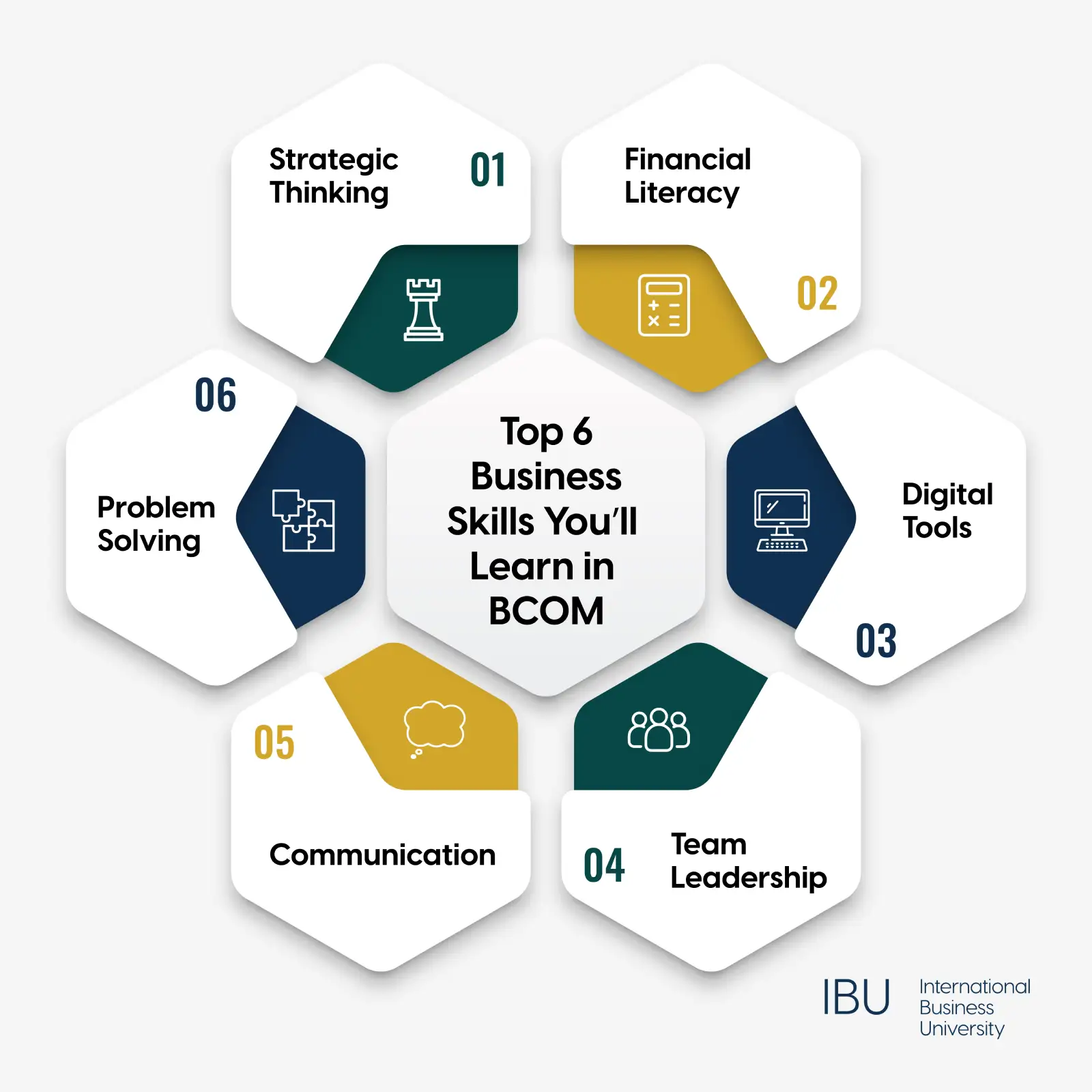
The Bachelor of Commerce Degree develops a transferable skill set that applies across industries. Through simulations, case studies, and collaborative projects, students build analytical reasoning, financial judgment, and the communication skills that employers across Canada consistently rank as priorities.
The realistic business challenges presented in class help students transition smoothly into the workplace. It’s the ideal setting to build financial literacy, cross-functional collaboration, and digital agility. These capabilities are key in today’s rapidly evolving economy, especially for those considering global business roles.
Graduates of the program gain a well-rounded set of realistic business skills, including:
- Strategic Decision-Making: Assessing risk, identifying opportunity, and applying business forecasting in fast-paced environments.
- Analytical Thinking: Interpreting financial reports, market data, and consumer trends to make informed
- Digital Competency: Applying business technology tools, Excel, CRM platforms, ERP systems, to operational and financial workflows.
- Financial Literacy: Budgeting, investment planning, cost analysis, and profitability forecasting.
- Leadership and Team Collaboration: Leading cross-functional teams, resolving conflict, and driving shared outcomes.
- Communication Mastery: Delivering presentations, writing reports, and articulating strategies to stakeholders.
Through hands-on projects, students apply these skills in simulated business environments that reflect real industry scenarios. If working on a supply chain optimization case or building a go-to-market strategy, students gain meaningful exposure to the complexities of modern commerce.
IBU enhances this experience by embedding career coaching, peer collaboration, and faculty mentorship into the program, creating a feedback-rich, supportive environment where students grow both professionally and personally.
See the BCOM Curriculum
Find out what skills IBU builds from year one.
Why Do Companies Go International? The Global Mindset Advantage
In today’s interconnected economy, understanding why do companies go international is critical for aspiring business leaders. Businesses seek growth by accessing new markets, reducing operational costs, and diversifying their revenue streams. They also enter global markets to capitalize on competitive advantages, such as lower production costs, specialized talent, or emerging consumer demand.
Students in the Bachelor of Commerce Degree program explore these global drivers through practical learning and scenario-based simulations. By analyzing realistic cases, students develop insights into how international expansion fuels innovation, reduces risk, and strengthens a company’s strategic position.
Common reasons why companies engage in international business include:
- Market Expansion: Accessing untapped customer bases in international regions.
- Cost Efficiency: Taking advantage of lower production or labor costs abroad.
- Global Talent: Recruiting skilled professionals from diverse cultural and educational backgrounds.
- Risk Mitigation: Diversifying geographic risk during economic or political instability.
- Innovation Exchange: Tapping into new technologies and creative business models.
The International Business specialization at IBU gives students a front-row seat to these strategies. It explores trade policies, global logistics, intercultural communication, and foreign investment practices. By developing cultural fluency and strategic thinking, students build a global mindset that prepares them for the complexities of multinational business.
In a world where businesses are no longer confined by borders, understanding why do companies go global is more than theoretical; it’s a career asset. Graduates with this knowledge can confidently pursue roles in global trade, international marketing, logistics, and consulting.
BCOM Specializations: Customizing Your Career Path
Your Bachelor of Commerce Degree journey can be tailored to match your specific interests and professional goals. IBU’s program offers focused specializations that let you deepen your expertise while maintaining the broad business acumen employers value, and our side-by-side look at the three BCOM specializations can help you compare each track.
Each specialization features hands-on industry projects, personalized mentorship, and skill-based training to position students for high-impact careers. If you’re interested in analytics, management, finance, or global business, there’s a path that fits.
Examples of popular specializations include:
- Finance & Accounting: Master financial planning, auditing, and investment strategies.
- Marketing & Digital Strategy: Learn to build brand narratives, manage campaigns, and analyze consumer behavior.
- International Business: Explore trade agreements, foreign market entry strategies, and global leadership.
Every path is designed to deliver practical skills, a relevant portfolio, and realistic readiness. These options also align with top Bachelor of Commerce degree jobs, ensuring your academic focus translates into career opportunities.
What Can You Do With a Bachelor of Commerce Degree?
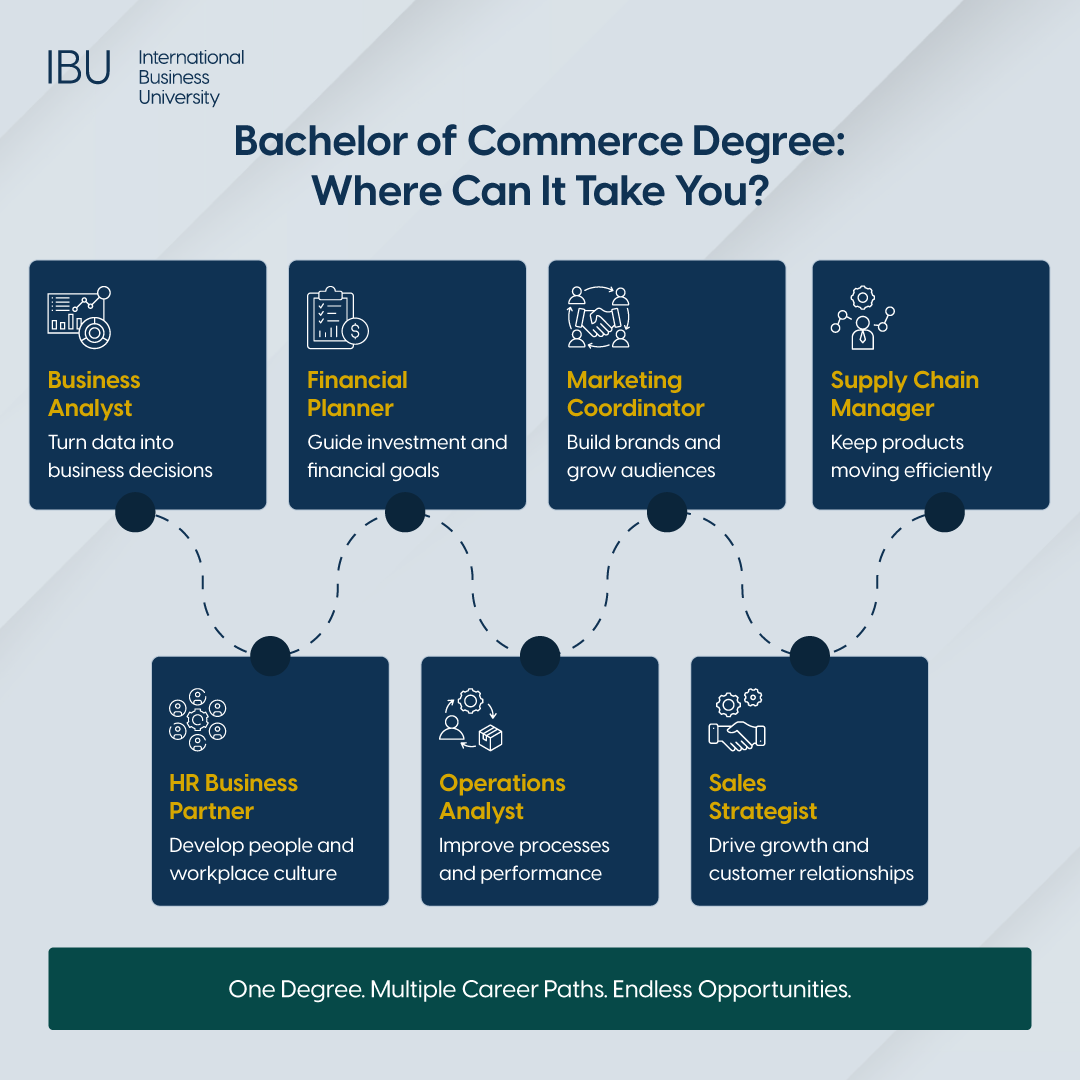
Graduates of the Bachelor of Commerce Degree program enter the workforce with strong business acumen, industry exposure, and confidence. The degree equips students with the tools to succeed in fast-paced environments, giving them a competitive advantage from day one. From financial services to consulting firms, BCOM graduates are seen as versatile professionals ready to solve real business problems.
Popular Bachelor of Commerce degree jobs include:
- Business Analyst: Identify trends, interpret data, and guide strategic decisions in organizations.
- Financial Planner: Help individuals and businesses achieve financial goals through budgeting and investment planning.
- Marketing Coordinator: Execute branding strategies, market campaigns, and customer engagement initiatives.
- Supply Chain Manager: Oversee procurement, logistics, and inventory to ensure efficient business operations.
- HR Business Partner: Develop talent strategies, resolve workplace challenges, and support organizational culture.
- Operations Analyst: Improve internal processes by optimizing systems, resources, and workflows.
- Sales Strategist: Generate revenue growth through client relations, sales forecasting, and market analysis.
Many students wonder, what to do with a Bachelor of Commerce degree? The path is broad:
- Some pursue corporate leadership tracks through management training programs.
- Others apply their knowledge to fast-paced startups and emerging tech ventures.
- Many use their degree to launch consulting careers, where adaptability and insight are critical.
- Others transition to entrepreneurship or go on to graduate school to deepen their expertise.
Graduates of IBU’s BCOM program consistently exhibit strategic thinking, leadership, and resilience, traits highly valued by employers across industries. The program helps students build a career narrative that is both agile and focused.
Ready to Start?
Apply to IBU’s BCOM and build your career track.
The MBA Path: Building on a Strong BCOM Foundation
A Bachelor of Commerce Degree lays the groundwork for graduate-level business education, especially MBAs. The skills acquired, including collaboration, research, leadership, and effective communication, make the transition to advanced studies seamless.
At IBU, BCOM graduates have the opportunity to join our Global Business Management MBA, further expanding their leadership capacity. Students who pursue an MBA after completing their undergraduate degree build on their foundational knowledge while sharpening their focus on innovation, strategy, and global business leadership.
This clear academic pathway reinforces the idea that BCOM is the Smart Choice for your career.
Entrepreneurship and Innovation: Start Something of Your Own
If you’re passionate about building something from the ground up, a Bachelor of Commerce Degree offers the structure and skills needed to become a successful entrepreneur. From understanding financial modeling to building strong customer value propositions, the program helps turn ideas into scalable ventures.
You’ll learn how to:
- Analyze markets and identify customer needs
- Develop a sound business plan
- Design go-to-market strategies that drive traction
- Secure financing and manage risk
- Leverage innovation to solve real problems
IBU supports budding entrepreneurs with mentorship, networking events, and access to incubators. To get inspired, check out these international business ideas that can shape your future path.
Entrepreneurship isn’t just about independence; it’s about building value, creating jobs, and shaping industries. The BCOM gives you the strategic and operational mindset to lead that change.
Bachelor of Commerce Degree Salary: What Can You Expect?
A frequently asked question is: What is the Bachelor of Commerce degree salary outlook? While compensation varies depending on industry, location, and experience, BCOM graduates consistently enter the workforce with strong earning potential.
Based on Canadian industry benchmarks:
- Entry-level roles: $50,000–$65,000/year
- Mid-career professionals: $70,000–$90,000/year
- Senior managers or MBA holders: $100,000+/year
Roles in international business, finance, and consulting tend to offer the highest salaries, especially for graduates who bring cross-cultural skills, bilingual capabilities, or global work experience. Your earning power also improves with continued education, specialization, and certifications.
IBU’s focus on realistic learning, networking, and specialization allows BCOM students to not only meet but often exceed these salary benchmarks. The program doesn’t just prepare you for your first job; it prepares you for long-term growth.
Want a degree with high ROI and strong job prospects?
- Discover career paths with excellent earning potential
- Learn what BCOM grads are making in today’s market
- See how the degree sets you up for salary growth
Meeting the Bachelor of Commerce Degree Requirements
To begin your BCOM journey, it’s important to understand the Bachelor of Commerce Degree requirements. Admission typically includes:
- Completion of secondary education (Ontario Grade 12 or equivalent)
- Proficiency in English
- Strong academic standing in math and business subjects
At IBU, we look beyond grades. We value ambition, curiosity, and a desire to create impact. Learn more about the admissions process on our website and take the first step toward a rewarding business career.
Why Choose IBU for Your Bachelor of Commerce Degree?
At International Business University, our BCOM program is built for students who want more than a traditional business degree.
You’ll learn in a flexible, supportive environment with small classes, personalized guidance, and opportunities to connect with industry professionals. We keep things practical and up to date, so you’re gaining more than just theory; you’re building hands-on experience, learning how to think critically and make smart decisions, and respond effectively to challenges.
At IBU, your degree is just the beginning. It’s where you start building the future you want.
Key Takeaways

A Bachelor of Commerce Degree builds transferable skills in finance, strategy, and analytics that qualify graduates for roles across Canada’s major industries.
Graduates move into corporate, consulting, entrepreneurial, or graduate education pathways with the same credential as a foundation.
Specializations in business management, digital marketing, and international technology allow students to align their training with specific career targets.
Frequently Asked Questions
What is a Bachelor of Commerce degree?
A Bachelor of Commerce degree (BCOM) is a four-year undergraduate program covering finance, accounting, marketing, management, and economics. It prepares graduates for careers in banking, consulting, marketing, operations, and government administration, and serves as a direct pathway to graduate programs including an MBA.
Is a Bachelor of Commerce a good degree in Canada?
Statistics Canada confirms undergraduate degree holders earn higher median employment income than diploma or certificate graduates over a career. BCOM graduates in Canada access mid-career salaries of $70,000–$90,000 across finance, consulting, and operations roles, with senior and MBA-credentialed professionals exceeding $100,000. The degree also qualifies graduates for professional designations including CPA, CFA, and CMA.
What can you do with a Bachelor of Commerce degree?
BCOM graduates work as financial analysts, business consultants, operations managers, marketing strategists, HR analysts, supply chain managers, and data analysts. The degree also supports entrepreneurship, public sector roles, and graduate education pathways. Career outcomes depend on specialization, province, and if the graduate pursues additional credentials or designations.
What are the top commerce degree jobs in Canada?
Top commerce degree jobs in Canada include Financial Analyst, Business Consultant, Operations Manager, Product Manager, Marketing Strategist, HR Business Partner, and Compliance Officer. Roles in financial services, technology, and consulting consistently rank among the highest compensated for BCOM graduates in the Canadian market.
What is the average Bachelor of Commerce degree salary in Canada?
Based on Government of Canada Job Bank data and Statistics Canada earnings tables, BCOM graduates in Canada earn $50,000–$65,000 at entry level, $70,000–$90,000 at mid-career, and $100,000+ at the senior or MBA level. Salaries vary by province, industry, and specialization.
How long does a Bachelor of Commerce degree take in Canada?
A standard Bachelor of Commerce degree in Canada takes four years of full-time study. Part-time or flexible delivery formats can extend the timeline. IBU’s BCOM is structured to accommodate students who are working while enrolled.
Start Your Business Journey with Confidence
In closing, the Bachelor of Commerce Degree isn’t just a credential. It’s a strategic investment in your future. If you’re focused on career advancement, international opportunities, or launching your own company, this degree gives you the skills and network to succeed.
From practical learning to mentorship and career coaching, IBU’s BCOM program positions you for long-term growth. So, if you’re asking why companies go international or why companies engage in international business, start by equipping yourself with the right education. For students evaluating their options, if a BCOM degree is worth it in Canada provides a direct, evidence-based answer.
Start Your Business Journey at IBU
Apply to build practical business skills for your future career.