

Degrees open doors; skills keep them open. In today’s workplace, simply holding a diploma isn’t enough. Employers want confident communicators, data-literate decision-makers, and future leaders who can navigate uncertainty and drive performance. That’s why developing the right business skills early gives you an enormous career advantage.
Key Takeaways
- Business skills matter more than credentials alone. Employers value graduates who can think critically, communicate clearly, and make informed decisions under pressure, and understanding your negotiation styles is central to performing confidently in those high-pressure conversations. Developing these skills early gives aspiring leaders a lasting career advantage.
- Leadership readiness comes from practice, not theory. Skills like financial literacy, negotiation, teamwork, and adaptability grow through hands-on learning, real cases, and continuous feedback. Programs designed around skill development prepare students to lead from day one.
- Investing in skill-building accelerates career growth. Students who strengthen core business skills stand out faster in competitive job markets. These capabilities support long-term success across industries, roles, and changing economic conditions.
12 Powerful Business Skills for Business Students
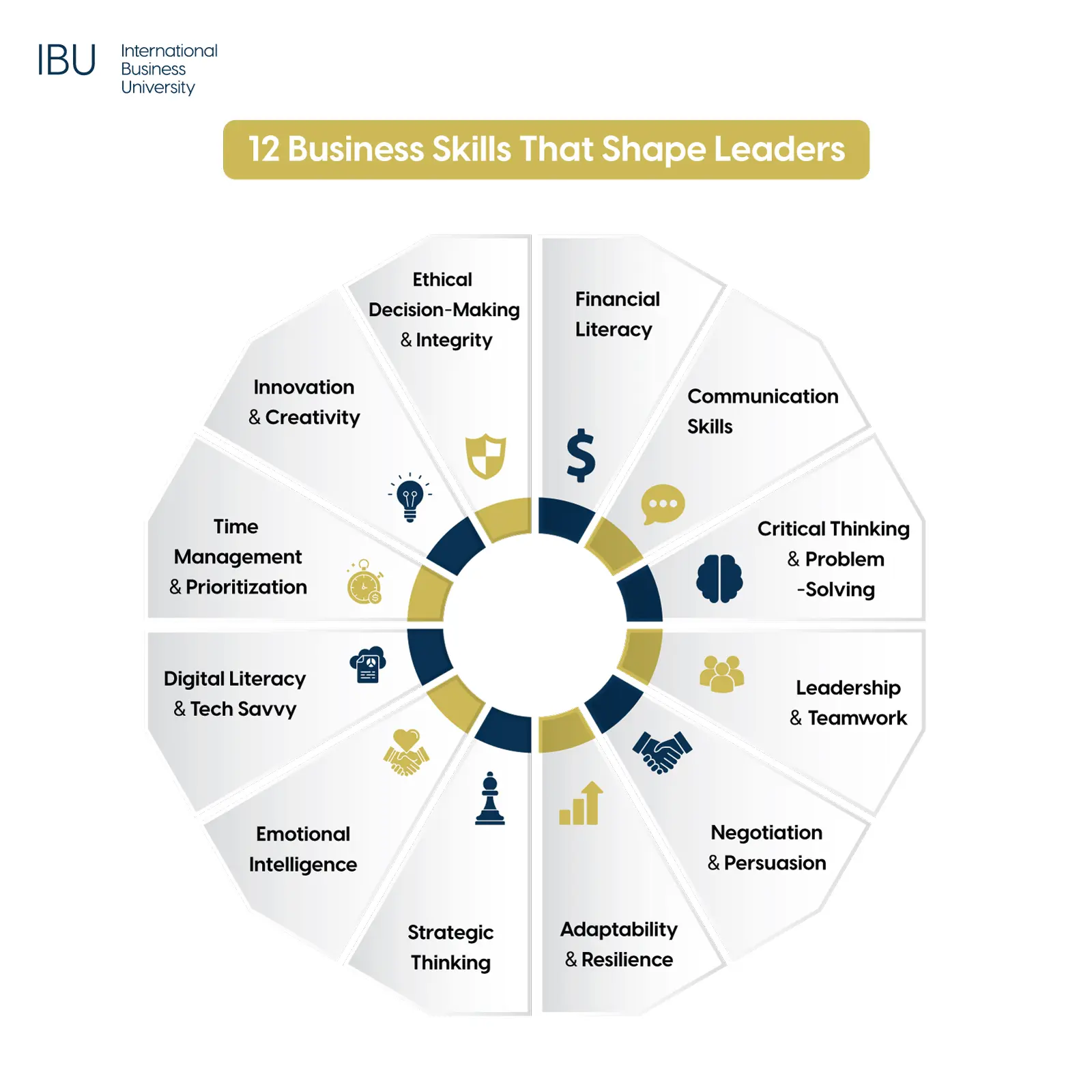
Here are six must-have business student skills that every aspiring leader in Canada should focus on – all of which can be sharpened through a results-driven program like the BCOM at the International Business University (IBU) in Toronto.
1. Financial Literacy
It’s no longer acceptable for aspiring business leaders to shrug off the numbers. Financial understanding should shape every decision! And yet, nearly half (43%) of small business owners in Canada still face financial challenges due to gaps in money management skills.
That’s why financial literacy tops the list of essential business skills. Business students must get comfortable with budgeting, forecasting, interpreting balance sheets, and understanding the bottom line.
2. Communication Skills
The ability to articulate ideas clearly and build trust is one of the most irreplaceable skills a business student should have. It revolves around more than presentations and writing reports – communication includes listening, reading a room, and knowing when to speak up or step back.
Modern business education (like that offered at IBU) places communication at the heart of every course.
3. Critical Thinking & Problem-Solving
AI, global competition, and constant disruption are the new normal, and that means reactive thinking just won’t cut it. Critical thinking and problem-solving are absolutely essential business skills for students who want to lead under pressure.
These skills help you evaluate options, analyze risks, and find innovative solutions even when there’s no obvious roadmap. Courses that challenge students to think independently and solve complex case studies are where these capabilities go from theory to instinct.
4. Leadership & Teamwork
Effective leadership can’t be faked – and in Canada, businesses are still underinvesting in this critical area. Canada lags behind in leadership development spending compared to the U.S. and Australia. Canadian companies spend an average of just $507 per employee annually, while U.S. companies invest $1,057 and Australia averages over $2,500 per employee.
That means business students who invest in developing leadership and collaboration early will stand out fast. Remember, true leadership isn’t about being the loudest in the room; it’s about inspiring trust, navigating conflict, and driving group success without micromanaging.
5. Negotiation & Persuasion
Textbook smarts are great, but can you influence decisions and advocate for yourself (or your company) in high-stakes situations? Negotiation and persuasion are vital business student skills that many overlook, and so is the ability to pitch like a venture capitalist: structuring a clear argument, anticipating objections, and earning belief through logic rather than enthusiasm.
You’ll need these skills whether you’re closing sales, proposing budgets, or interviewing for your first job. Good negotiators listen actively, stand firm, and build win-win outcomes. Great negotiators? They change minds: ethically, persuasively, and with confidence. Find your negotiation style here.
6. Adaptability & Resilience
If the past few years have taught us anything, it’s this: change is constant, and adaptability is important. Students today must be prepared to shift focus quickly, learn from failure, and stay grounded when plans fall apart, since this trait now shows up directly in how employers decide who gets promoted.
Business success hinges on evolution – and resilience is what carries you through delayed projects, missed targets, or uncertain job markets with your energy (and optimism) still intact.
Prepare to lead across global markets
Build strategic thinking, cross-border business insight, and leadership skills designed for today’s interconnected global economy.
7. Strategic Thinking
In a competitive Canadian market, aspiring leaders must look beyond day-to-day tasks to shape the big picture. Strategic thinking involves anticipating market shifts, identifying growth opportunities, and aligning resources with long-term goals – skills honed through IBU’s forward-focused curriculum.
This essential business skill empowers students to craft actionable plans that drive sustainable success, whether launching a startup or scaling operations in Toronto’s dynamic economy.
8. Emotional Intelligence
Beyond IQ, Emotional Intelligence (EQ) determines how well leaders connect with teams and stakeholders. It’s about self-awareness, empathy, and regulating emotions to foster positive workplace cultures – a gap in many traditional business programs.
Canadian students mastering EQ excel in diverse teams, handle stress gracefully, and build loyalty, turning potential conflicts into collaborative wins.
9. Digital Literacy & Tech Savvy
Today’s business world runs on data and digital tools – from AI analytics to ERP systems like those in public sector payments. Business students need fluency in cloud platforms, cybersecurity basics, and emerging tech to stay ahead.
IBU integrates digital literacy across courses, preparing graduates to leverage technology for efficiency and innovation in Canada’s tech-driven industries.
10. Time Management & Prioritization
Juggling deadlines, projects, and priorities is a rite of passage for business students, but poor time management derails even the brightest talents. Effective leaders master calendars, delegate smartly, and focus on high-impact tasks.
This skill ensures productivity without burnout, using techniques like Eisenhower matrices to thrive in fast-paced environments like Toronto’s entrepreneurial scene.
11. Innovation & Creativity
Stagnation kills businesses; innovation fuels them. Aspiring leaders must cultivate creativity to disrupt markets, ideate solutions, and pivot during uncertainty – think of Canada’s top entrepreneurs who turned ideas into empires.
IBU encourages creative problem-solving through real-world projects, helping students generate breakthroughs that set them apart in competitive job markets.
12. Ethical Decision-Making & Integrity
Trust is the currency of leadership, especially in regulated sectors like finance and healthcare. Ethical decision-making means navigating grey areas with principles, transparency, and accountability amid pressures for quick wins.
Canadian business students prioritizing integrity build lasting reputations, comply with standards like PCI DSS, and lead organizations that endure scandals and economic shifts.
FAQs
Why are business skills important for aspiring leaders?
Business skills shape how future leaders make decisions, communicate ideas, and guide teams through uncertainty. Employers expect graduates to contribute strategically, not just follow instructions. Strong skills help leaders earn trust and deliver consistent results.
Which business skills are most valuable for students in Canada?
Financial literacy, communication, critical thinking, leadership, negotiation, and adaptability rank among the most in-demand skills. These abilities help students succeed across industries and roles. Canadian employers especially value graduates who combine technical knowledge with strong people skills.
How can business students develop leadership skills while studying?
Leadership skills grow through practical learning, collaboration, and real-world application. Programs that emphasize projects, mentoring, and case-based learning accelerate skill development. Consistent practice builds confidence and prepares students for leadership responsibilities early in their careers.
How Business Students in Canada Can Develop These Skills
What is the most powerful way to develop these business skills? Enroll in a program designed to build them intentionally and consistently.
At the International Business University, every BCOM program is built around skill-building, not just memorization. Through small class sizes, hands-on projects, 1:1 mentoring, and real-case applications, IBU prepares students for leadership before and beyond graduation.
Turn business knowledge into career-ready confidence
Learn how communication, negotiation styles, and management thinking shape leadership success across industries