

Data engineering is one of the fastest-growing technical career paths in Canada right now. Every organization building an AI system, analytics platform, or cloud infrastructure needs engineers who can move, store, and prepare data reliably. If you are considering how to become a data engineer, this guide covers the skills, tools, credentials, and steps that take you from student to working professional. The path is specific and learnable, regardless of where you are starting from.
What Does a Data Engineer Do
A data engineer builds and maintains the infrastructure that moves data from source to destination. They write pipelines that extract data from databases, APIs, and streaming systems. They clean and structure that data so analysts and AI models can use it. They also manage the storage systems, monitoring tools, and orchestration platforms that keep everything running.
The data engineer career is often described as the plumbing of the data world. Without that infrastructure, data science and analytics have nothing to work with. An AI model needs clean, structured, current data to function accurately. A business intelligence dashboard needs reliable feeds from multiple systems to stay up to date. The data engineer is responsible for making both of those things possible.
How Data Engineering Differs from Data Science
Data engineers build the systems; data scientists use the output of those systems. A data scientist works with structured, cleaned data to produce models and insights. A data engineer works further back, building the processes that produce that structured data. Both roles require analytical thinking, but data engineering is more closely tied to software development. Students who enjoy systems design, code architecture, and reliability engineering tend to find data engineering more satisfying.
How Data Engineering Differs from Database Administration
A database administrator manages the operation and security of existing databases. A data engineer builds the pipelines that feed into, transform, and move data between systems. The scope of a data engineer role is broader and more focused on data flow than data storage. Modern data engineers work heavily with cloud platforms and distributed systems. Traditional database administration is more focused on SQL, access control, and backup management.
Why Data Engineering Is in Demand in Canada
Data engineering is in demand in Canada because every sector is expanding its data infrastructure. Financial services, healthcare, retail, and government all require reliable data pipelines. AI adoption has accelerated that demand because AI systems cannot function without quality data input. The result is a strong, sustained need for professionals who know how to build and operate these systems.
According to 365 Data Science’s 2025 data engineer job outlook report, the data engineering field employs over 150,000 professionals globally and added more than 20,000 new jobs in the past year alone. That reflects a growth rate of approximately 22.89%. Canada is part of that growth, with Toronto, Vancouver, and Montreal leading in job volume. Companies including RBC, Deloitte, Shopify, and major government departments are all actively hiring data engineers.
The talent gap adds to the opportunity for new entrants. Demand for data engineers has consistently outpaced the number of qualified graduates entering the market. This means candidates with the right combination of skills, tools, and credentials face less competition than in many other technical fields. For students planning a data engineer career now, the timing is favorable.
Skills and Tools You Need to Become a Data Engineer
Data engineer skills fall into three categories: programming, data tools, and cloud platforms. Most Canadian employers expect candidates to have practical experience across all three. The combination is what separates candidates who get interviews from those who do not.
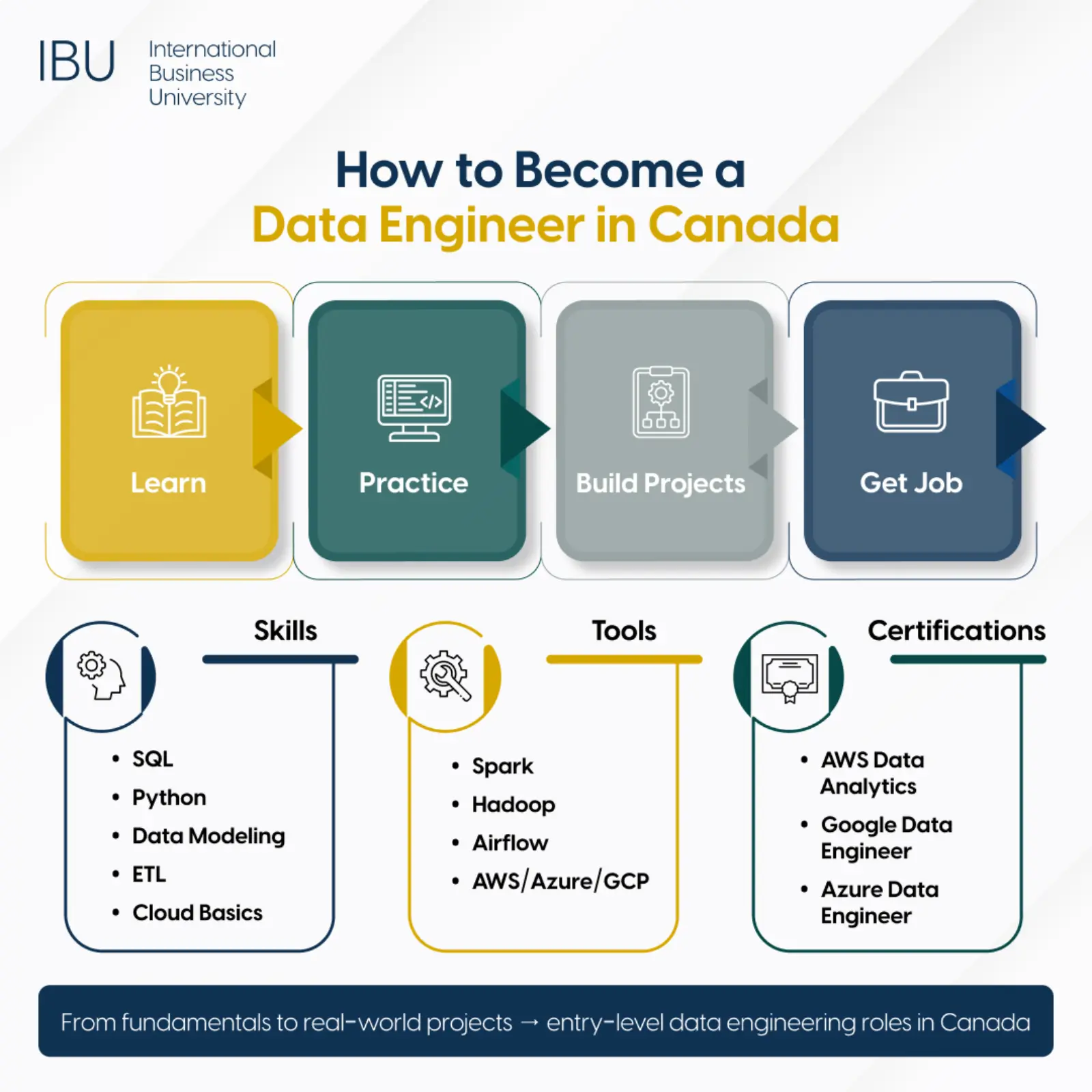
The IBU roadmap above organizes the path into four clear stages. You start by learning, then move into practice, then build projects, and finally get the job. Each stage depends on the one before it, and none can be skipped without a cost to your readiness.
Within those stages, the roadmap identifies the three pillars of your preparation. Skills cover SQL, Python, data modeling, ETL, and cloud basics. Tools cover the platforms you will use on the job: Spark, Hadoop, Airflow, and AWS, Azure, or GCP. Certifications validate your knowledge to employers in a format they can quickly assess.
The path moves from fundamentals to hands-on projects, then into entry-level data engineering roles in Canada. That progression is exactly what this section and the ones that follow are built around.
Core Data Engineer Skills
SQL is the most foundational data engineer skill and the first one to develop. Almost every data engineering role requires strong SQL for querying, transforming, and joining datasets. Python is the primary scripting language for building ETL pipelines and automating data workflows.
Data modeling covers how to structure databases and data warehouses for efficient querying. ETL, which stands for extract, transform, and load, describes the core process of moving data between systems. Cloud basics cover how major platforms like AWS, Azure, and GCP store and process data at scale.
Data Engineering Tools Employers Expect
Data engineering tools are the platforms that production pipelines run on in most organizations. Apache Spark is the dominant processing framework across large-scale data engineering environments. Hadoop remains relevant in legacy enterprise systems and is still referenced in many job postings.
Apache Airflow is the standard tool for orchestrating and scheduling data pipeline workflows. Cloud platforms, specifically AWS, Azure, and Google Cloud Platform, are where most modern pipelines are built and hosted. Familiarity with at least one cloud provider is now a baseline expectation for most entry-level data engineer roles in Canada.
Soft Skills That Support a Data Engineering Career
Data engineer requirements include communication skills alongside technical ones. Engineers regularly explain pipeline decisions to non-technical stakeholders and product managers. Problem-solving under production pressure is a daily part of the role.
Documentation habits matter because poorly documented pipelines become liabilities when engineers change roles. Collaboration with data scientists, analysts, and platform teams requires clear, consistent communication throughout a project.
Start Your Data Career
IBU’s MBA programs build skills data engineering employers seek.
Educational Requirements to Become a Data Engineer in Canada
Most data engineer roles in Canada require at a minimum a bachelor’s degree in a related field. Computer science, software engineering, mathematics, and information systems are the most common backgrounds. However, the field has a strong tradition of accepting candidates from adjacent disciplines. Business analytics, applied mathematics, and even economics graduates regularly enter data engineering with the right supplemental training.
Bachelor’s Degrees That Lead into Data Engineering
A bachelor’s in computer science or software engineering provides the strongest technical foundation. These programs cover algorithms, data structures, systems design, and database management in depth. Students who supplement this background with a data engineering course focused on pipelines and cloud tools are well-positioned for entry-level roles. Business and analytics graduates with strong SQL and Python skills also compete effectively. What matters most is demonstrable proficiency in the tools and techniques employers use, not just the degree title.
How an MBA Adds Value in Data Engineering
An MBA focused on technology and analytics prepares students to lead data engineering decisions. Technical skills get you the first role; management skills determine how far you progress. Data engineers who understand business context make better architectural decisions for the organizations they serve. IBU’s MBA in Technology, Innovation, and Entrepreneurship develops both technical and strategic thinking for students entering data-driven careers. It is particularly suited to professionals who want to move from technical contributor to team lead or architect.
Step-by-Step Path to Becoming a Data Engineer
The data engineering roadmap follows a sequence that builds competence at each stage before the next. Skipping stages is possible, but candidates who follow the full progression arrive more prepared. This path applies even if you are starting fresh or transitioning from another technical role.
| Step | Focus | Key Actions |
| 1. Learn Fundamentals | Core skills | Learn SQL and Python; understand AWS/Azure basics; study data modeling (relational + star schemas) |
| 2. Practice Tools | Hands-on experience | Use Apache Spark, build Airflow pipelines, and run cloud-based data workflows with Python |
| 3. Build Portfolio | Proof of skills | Create 2–3 projects (API → clean → warehouse → visualize); publish on GitHub with documentation |
| 4. Certify & Apply | Job readiness | Earn a cloud certification; tailor CVs; apply widely; connect with hiring managers on LinkedIn |
Step 1: Learn the Fundamentals
Start with SQL and Python before touching any data engineering tools. These two languages underpin almost every data pipeline job in Canada. Add basic cloud literacy, specifically how data is stored and accessed on AWS or Azure. Data modeling fundamentals, including relational schemas and star schemas for warehouses, complete this foundation. This stage can be covered through a formal program, a data engineering course, or structured self-study with projects.
Step 2: Practice on Practical Tools
Move into practicing with the tools that appear in job postings once fundamentals are solid. Set up a local Apache Spark environment and run distributed queries on public datasets. Build a simple Airflow DAG that schedules a multi-step data pipeline. Connect to a cloud storage bucket and write a Python script that loads, transforms, and exports data. Hands-on tool practice is what prepares you for technical interviews, not just theoretical knowledge.
Step 3: Build Portfolio Projects
Portfolio projects show employers that you can build something functional from start to finish. A strong portfolio project might ingest a public API, clean the data, store it in a warehouse, and visualize the output. Using GitHub to publish your code and document your architecture decisions is standard practice. Employers increasingly evaluate GitHub profiles alongside CVs for data engineering candidates. Two or three well-documented projects are more compelling than a list of completed courses without demonstrated work.
Step 4: Pursue Certifications and Apply
Data engineering certifications from major cloud providers carry weight with Canadian employers. Complete at least one cloud certification before submitting applications. Tailor your CV to the specific tools mentioned in each job posting. Apply to mid-sized companies alongside large ones; smaller teams often give junior engineers more ownership faster. Follow up applications with LinkedIn outreach to data team leads at target companies.
Certifications That Can Boost Your Career
Data engineering certifications signal competence on specific platforms to hiring managers quickly. They are particularly valuable for candidates entering the field from non-traditional academic backgrounds. Three certifications appear most consistently in Canadian data engineering job postings.
- AWS Certified Data Analytics: This certification validates your ability to collect, store, process, and visualize data using AWS services, including S3, Redshift, and Glue.
- Google Professional Data Engineer: This certification covers Google Cloud data infrastructure, BigQuery, and Dataflow, and is highly regarded by organizations running GCP-based pipelines.
- Microsoft Azure Data Engineer: The DP-203 certification validates skills in Azure data pipelines, Synapse Analytics, and data lake architecture for Microsoft cloud environments.
- Databricks Lakehouse Fundamentals: This platform-specific certification demonstrates knowledge of Delta Lake, Unity Catalog, and the Databricks ecosystem that many enterprise teams use.
- Snowflake SnowPro Core: This certification is increasingly valued as Snowflake becomes the storage layer of choice for analytics and AI workloads across Canadian enterprises.
Data Engineer Salary and Job Opportunities in Canada
A data engineer’s salary in Canada is consistently above the national professional average, and it climbs sharply once you look at the full breakdown by experience level. The combination of technical demand and talent shortage keeps compensation high. Salaries vary by province, industry, and experience level, but the floor is strong across the country.
Salary Ranges by Experience Level
According to Glassdoor’s 2024 Canada data engineer salary data, the average data engineer salary in Canada is CA$104,533 per year. The lowest range sits around CA$85,573 and top earners reach CA$129,817 annually. Ontario, British Columbia, and Saskatchewan pay the highest salaries across provinces. Banking and financial services consistently pay at the top of the range for data engineering roles. Entry-level candidates with one cloud certification and a portfolio typically land between CA$80,000 and CA$95,000.
Where the Jobs Are in Canada
The Greater Toronto Area has the highest concentration of data engineering job postings in Canada. Vancouver and Montreal are growing rapidly as tech hub investment increases. Over 5,000 active data engineer job postings appear on LinkedIn for Canada at any given time. Industries hiring most actively include financial services, e-commerce, healthcare technology, and federal government IT. Per Job Bank Canada (December 2024), data engineers in Canada earn between $29.74 and $64.90 per hour depending on experience and location.
Common Challenges and How to Overcome Them
Most students who want to become a data engineer face a similar set of early challenges. Knowing what they are in advance makes them easier to plan around. None of them are insurmountable with the right preparation and timeline.
The Experience Requirement on Entry-Level Postings
Many entry-level data engineering roles ask for one to two years of experience. Portfolio projects and internships are the standard way to address this gap. Candidates who can demonstrate pipeline work on GitHub close the experience gap more effectively than those who cannot. Applying to roles that do not specify experience requirements, or to smaller companies, is also a practical approach. The first role is the hardest to get; progression after that is typically faster.
Keeping Up with Rapidly Changing Tools
Data engineering technologies change faster than most fields. A tool that was standard three years ago may be less relevant today. The best way to stay current is to follow industry newsletters, attend virtual data engineering meetups, and work on projects that use newer tools. Databricks, dbt, and Apache Iceberg are examples of tools gaining significant traction in 2025 postings. Checking LinkedIn job postings monthly for what tools appear most often is a simple and effective signal to track.
- Imposter syndrome: Most data engineering professionals felt underprepared when starting; shipping a working project publicly addresses this faster than more study alone.
- Cloud costs during learning: AWS, Azure, and GCP all offer free tiers that cover the practical experiments needed for portfolio projects at no cost.
- Interview technical tests: Data engineering interviews typically involve SQL challenges and pipeline design questions; practicing both weekly in the months before applying makes a significant difference.
How IBU Helps You Start a Data Engineering Career
IBU prepares students for data engineering careers through programs that connect technical knowledge to business application. Understanding tools is necessary but not sufficient for career success. Employers consistently look for professionals who understand why a data system is built, not just how.
IBU’s MBA in Technology, Innovation, and Entrepreneurship covers the strategic and technical dimensions of data systems in organizations. Students develop skills in data infrastructure decision-making, technology management, and applied analytics. The program is structured for students who want to manage, lead, or evaluate data systems alongside technical contributors.
IBU’s MBA in Financial and Management Analytics develops quantitative methods and analytical infrastructure skills for finance and operations contexts. Students learn how data pipelines connect to financial reporting, performance analytics, and strategic decisions. Both programs use small class settings that allow direct faculty feedback on analytical work. That feedback accelerates skill development in ways that large lecture programs do not support.
Key Takeaways
- The data engineering roadmap follows four stages: Learning fundamentals, practicing tools, building projects, and applying for roles is the sequence produces job-ready engineers.
- Core skills and certifications work together: SQL, Python, cloud platforms, and recognized certifications are the baseline that most Canadian employers expect from entry-level candidates.
- Demand in Canada is strong and growing: Data engineer roles are available across Toronto, Vancouver, and Montreal, with salaries well above the national professional average.
Frequently Asked Questions
Do I need a computer science degree to become a data engineer in Canada?
A computer science degree is common but not the only path into data engineering. Candidates from business analytics, mathematics, and information systems backgrounds enter the field regularly by building proficiency in SQL, Python, and cloud tools through formal programs or structured self-study. What Canadian employers consistently prioritize is demonstrable technical skill and hands-on project work, which is why portfolio projects and certifications carry as much weight as the degree field on a CV.
How long does it take to become a data engineer in Canada?
Most candidates complete the full learning-to-hired data engineering roadmap in 12 to 24 months. The timeline depends on your starting skill level, the pace of your program or self-study, and how early you start building and publishing projects. Students who combine a formal program, such as an MBA in technology management, with parallel tool practice and certification preparation often reduce this timeline significantly because structured coursework and portfolio development occur simultaneously.
Which data engineering certification is most valuable for getting hired in Canada?
AWS Certified Data Analytics and the Google Professional Data Engineer are the two certifications that appear most often in Canadian job postings. The right choice depends on which cloud platform your target employers use most. Checking job postings at your top target companies for tool mentions takes 5 minutes and gives you a clear signal. Pairing a cloud certification with a strong portfolio project that uses that cloud platform is more effective than holding multiple certifications without demonstrated applied work.
The Path to Data Engineering in Canada Is Clear – Start Where You Are
Knowing how to become a data engineer in Canada comes down to four things: building the right skills, learning the right tools, earning a credential that employers recognize, and demonstrating your ability through projects that anyone can see. The demand is strong, the salaries are competitive, and the talent gap means qualified candidates have options. IBU’s programs in Technology, Innovation, and Entrepreneurship, and Financial and Management Analytics give you both the technical context and the strategic foundation to enter this field ready to contribute from day one.
Launch Your Data Career
IBU’s MBA builds the skills and context data employers value.