
A BCOM degree is more versatile than most graduates realize when they are standing at the edge of convocation.
The instinct is to apply for the obvious roles: marketing coordinator, junior accountant, sales rep, because those are the ones listed in campus job boards and career fair brochures. The result is a crowded applicant pool chasing a narrow set of titles.
Key Takeaways
- 93% employment within 6 months: Smith BCom 2024 data shows the majority of graduates secure roles quickly when they approach the job search strategically.
- 62% of offers came through internships: Early work experience is the single most reliable path to a strong first offer, not the application portal after graduation.
- The highest-demand roles reward analytical skills: Business analyst, operations coordinator, and project coordinator roles are growing faster than traditional accounting and marketing placements.
- Specialization clarity wins interviews: Graduates who can speak specifically about their concentration and connect it to a role get further than those presenting a generic BCOM background.
- The first year is about visibility, not just performance: Getting noticed inside an organization early accelerates every promotion that follows.
What Employers Actually Look for in a Commerce Degree Graduate
The degree is table stakes. What moves a BCOM grad from the screening pile to the interview is what they demonstrate on top of it.
Analytical Thinking Applied to Real Situations
Employers in financial services, consulting, and operations want graduates who can break a problem down, structure an answer, and communicate it clearly. That skill transfers across roles and is exactly what business programs train for, if you take it seriously.
Internship or Placement Experience
Canadian employers consistently weigh placement experience heavily at the entry level. A student who completed a co-op in operations or a summer role in a finance department has demonstrated that they can function in a professional environment. That proof point matters more than GPA for most hiring managers in their first screening pass.
Specialization Clarity
Graduates who can articulate exactly what they studied, what skills they built in that specialization, and why that maps to the role they are applying for stand out. Generic applications from BCOM graduates rarely get past the first screen. Specific ones do.
Six Commerce Degree Jobs Most Students Never Consider
These roles are actively posted across Canadian job boards and match BCOM skills directly, but most graduates do not think of them until later in their careers.
Business Analyst
Business analyst roles sit at the intersection of operations, technology, and finance. They involve documenting processes, identifying inefficiencies, and translating business needs into actionable improvements. BCOM graduates with even a basic understanding of data tools, Excel, SQL at an introductory level, or Tableau, are highly competitive for junior BA roles. Firms from RBC to Shopify to Deloitte post these continuously.
Operations Coordinator
Supply chain disruptions, logistics complexity, and the growth of e-commerce have made operations coordination one of the highest-demand graduate roles in Canada. BCOM graduates who studied operations, logistics, or even general management are well-positioned. These roles pay well and often promote quickly.
Human Resources Associate
HR has become significantly more strategic over the last decade. BCOM graduates with coursework in organizational behaviour, management, or labour relations have a genuine advantage in entry-level HR roles, particularly at technology companies and professional services firms that are growing quickly and need people who understand business, not just compliance.
Financial Services Representative
Banks, credit unions, and insurance companies hire BCOM graduates steadily into client-facing financial services roles. These positions build foundational understanding of financial products, client relationship management, and compliance, and they lead directly into wealth management, commercial banking, or corporate finance roles within three to five years.
Project Coordinator
Project coordination is one of the fastest-growing entry-level categories in Canadian employment. BCOM graduates are natural candidates because the role requires exactly the skills a business degree builds: planning, communication, stakeholder management, and the ability to track multiple workstreams simultaneously. A PMP certification added within the first two years significantly accelerates the trajectory.
Account Manager
Sales-adjacent account management roles at B2B software companies, staffing firms, and professional services organizations are continuously hiring BCOM graduates. The compensation structures include strong base salaries and performance bonuses that can push total first-year income well above the median.
The Business Management Jobs Hiring BCOM Grads Right Now
The University Canada West BCOM careers guide identifies the top hiring sectors for BCOM graduates in Canada as financial services, government, technology, consulting, and retail management. Average starting salaries typically begin at $66,000, with roles in financial services and consulting trending higher.
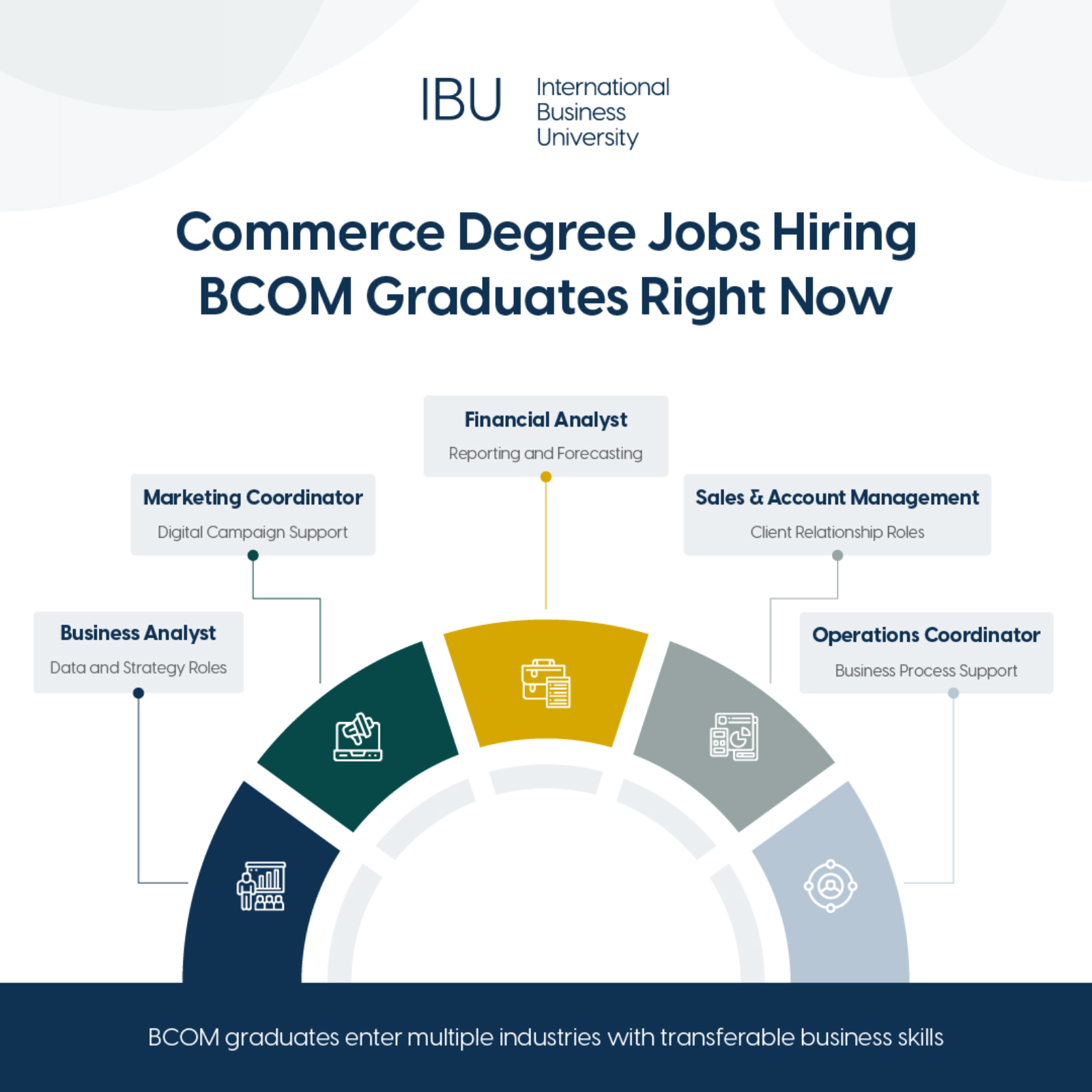
The roles growing fastest in Canadian hiring for BCOM graduates currently include data-adjacent analyst roles (business analyst, data analyst, financial analyst), operations and supply chain coordination, and project management, all of which reward the analytical and organizational skills at the core of any well-designed business program.
How Your BCOM Specialization Changes Which Doors Open First
Not all BCOM degrees are equal in the eyes of a hiring manager, and specialization matters more than the general degree label, whether that means a BCOM in International Management and Technology focus or another track in the first year after graduation.
Business Management
This is the most broadly applicable specialization. It opens doors across general management, operations, HR, consulting, and project-based roles. The trade-off is that it requires candidates to articulate their specific strengths clearly, since the degree title alone does not signal a technical focus.
Finance
A finance concentration accelerates entry into banking, financial analysis, and corporate treasury roles. Canadian banks and professional services firms actively recruit BCOM finance graduates into analyst programs with defined training and promotion tracks.
Marketing
Digital marketing, product management, and brand roles increasingly require analytical capability alongside creative skills. BCOM graduates with a digital marketing or sales management concentration can compete directly with communications graduates and often outperform them on the analytics side.
What Hiring Managers in Canada Say About Commerce Graduates
Hiring managers who regularly recruit BCOM graduates consistently identify the same differentiators between candidates who get offers and candidates who do not.
- They did something practical during school: Internships, co-ops, case competitions, and consulting projects are all proxies for real-world capability. Graduates with any of these can speak concretely about what they produced.
- They know their specialization: Generic applications listing broad BCOM skills do not advance. Graduates who can say specifically what they built in their concentration and how it applies to this role get callbacks.
- They researched the company: This is obvious advice that most candidates do not follow in enough depth. Hiring managers test this in the first five minutes. Graduates who know the company’s revenue model, recent initiatives, and competitive position signal preparation that stands out immediately.
- They communicate clearly: Business writing, structured verbal communication, and the ability to get to the point without hedging are skills that distinguish BCOM graduates who have practiced them from those who have not.
Explore BCOM Career Paths
See how IBU’s BCOM programs prepare you for the roles employers are hiring for right now.
The First Three Moves After Graduation That Shape Your Career
The first job is less important than what you do in the first job. Three moves in the first 12 months determine more about your career trajectory than the role title on your first offer.
Get Visible Inside the Organization
Volunteer for cross-functional projects. Ask to attend meetings above your pay grade. Get exposure to the decisions being made at the level above yours. Career advancement in any organization favors people who are visible, not just competent.
Build Your Credentials While You Work
The CPA, CFA Level 1, PMP, or a data analytics certificate all become significantly more valuable when you have a real work context to attach them to. Starting a credential program in your first year, not as a full-time student but while employed, signals ambition and produces faster promotion consideration.
Stay Connected to Your Classmates
Your BCOM cohort will become one of your most valuable professional networks within five years of graduation. The classmate who goes into consulting, the one who joins a bank, and the one who starts a company are all potential collaborators, referral sources, and job leads. Staying connected to that network deliberately, not just on LinkedIn but through actual conversations, pays compounding dividends.
Frequently Asked Questions
What is the average starting salary for a BCOM graduate in Canada?
Starting salaries for BCOM graduates in Canada typically range from $55,000 to $80,000, depending on specialization, institution, and industry. Graduates entering financial services and consulting roles at large firms tend toward the higher end of that range. Roles in retail management, government, and non-profit tend to start lower but offer structured progression.
The Smith School of Business reported an average starting salary of $79,226 for the 2024 graduating class, though this reflects a cohort with strong internship completion rates and a concentration in financial services placements.
Does a BCOM from a smaller institution like IBU compete with degrees from larger universities?
What employers evaluate at the entry level is a combination of degree credentials, practical experience, and how a candidate performs in the interview. A BCOM from an accredited institution, combined with relevant internship experience and a clear specialization story, is competitive with degrees from larger universities in most non-prestige-driven hiring processes.
The exceptions are large bank analyst programs and top-tier consulting firms, which recruit primarily from a narrow set of target schools. For the majority of BCOM graduate opportunities in Canada, the quality of your practical experience and your ability to perform in the interview matter more than the name on the degree.
Should I get an MBA after my BCOM?
An MBA is most valuable when you have several years of work experience and a specific career gap it addresses, if that is a shift into management, a move between industries, or a credential required for a promotion. Getting an MBA immediately after a BCOM is less common and less strategically valuable than spending three to five years building real-world experience first.
IBU offers both on-campus and online MBA options designed for working professionals who are ready to build on their BCOM foundation at the point where that investment makes strategic sense.
Commerce Degree Jobs Reward Graduates Who Position Themselves Deliberately
The range of commerce degree jobs available to BCOM graduates in Canada is significantly broader than most students appreciate before they graduate. Financial services, consulting, operations, project management, technology, and government all hire BCOM graduates consistently.
What separates the graduates who secure strong first roles from those who settle is how clearly they articulate their specialization, how relevant their practical experience is, and how deliberately they pursued the right opportunities rather than the most visible ones.
IBU’s BCOM programs are built around exactly this kind of deliberate preparation, connecting academic foundations to the career outcomes graduates are actually targeting.

Start Building Your Career Edge
IBU’s BCOM programs connect your degree to the roles employers are actually hiring for.