
If you’re walking into a negotiation without knowing your best alternative to a negotiated agreement (BATNA), you’re stepping in without a compass or a map. You may have ideas, hopes, or expectations, although none of that replaces a concrete backup plan. BATNA in negotiation, or Best Alternative to a Negotiated Agreement, is more than a buzzword; it’s the most practical tool you can bring to the table. It provides clear direction when choices feel uncertain.
You’ll know exactly when to walk away because you’ve already identified a better alternative, and when to lean in because the deal in front of you is stronger than anything else available. It reduces stress, improves your timing, and helps you think with logic instead of emotion.
Every confident negotiator relies on their BATNA to stay steady, especially when talks get tough. You can rely on it too. Build it before the conversation begins, and you’ll walk in prepared to make smart, firm decisions that support your goals.
Key Takeaways

Your BATNA in negotiation helps you avoid poor deals and recognize strong ones.
Building a solid BATNA involves planning, comparison, and evaluation.
Smart negotiators use their BATNA as a foundation, not a fallback.
What Is BATNA and Why Does It Matter in Negotiation
BATNA stands for Best Alternative to a Negotiated Agreement. It gives you a clear sense of your lowest acceptable value in a deal. Knowing you BATNA protects you from pressure, poor offers, and decisions made from urgency rather than preparation.
Every skilled negotiator needs a BATNA because it serves as a decision-making guide. If the current proposal falls short of your BATNA, you have a better path elsewhere. Rather than feeling stuck or settling too quickly, you can stand firm with confidence. That kind of clarity makes negotiations more strategic and less emotional.

Developing a strong BATNA in negotiation involves thoughtful and deliberate preparation. It’s about taking control before the conversation even begins.
First, you need to get clear on what you want from the negotiation; this gives you a solid target to aim for. Be specific with your goals, even if you’re seeking better pay, fairer terms, or more flexibility. Then, take time to explore all your available options and seriously think through what you would do if this current deal falls through. Imagine different paths forward and write them down. By doing this, you’re not just reacting in the moment; you’re preparing in advance and giving yourself room to choose wisely.
Evaluating your backup plans helps you spot which options are practical, realistic, and worth pursuing. It also lets you identify areas where you can improve your alternatives before you ever sit down to negotiate.
These steps remove doubt, reduce stress, and give you a clearer path so you can negotiate with calm focus and confidence rather than from a place of fear or pressure.
Define Your Negotiation Goal
- Pinpoint what you want from the negotiation with as much specificity as possible.
- Is it a higher salary, a better timeline, or more flexible terms?
- Your goal sets the benchmark against which all other options are measured.
List All Possible Alternatives
- Brainstorm every path you could take if this deal falls apart.
- Do not filter at this stage, quantity matters before evaluation.
- Aim for at least three concrete alternatives to compare.
Evaluate and Strengthen Your Options
- Which alternative is the most practical, desirable, and immediately available?
- What would it take to make this backup plan stronger before you negotiate?
- Investing time to develop your best option changes the power dynamic before the conversation starts.
BATNA in Negotiation: Examples Across Career Stages
Understanding BATNA in negotiation is more useful when grounded in decisions you are likely to face. It is not a concept reserved for senior executives or high-value contracts, it applies at every career stage, in every negotiation where your floor matters. It grounds your response in preparation rather than improvisation.
Salary Negotiation: Accept, Reject, or Walk Away?
You have a job offer on the table that, on the surface, appears competitive. But knowing that another company has offered you a higher salary and better conditions changes your position entirely. That second offer becomes your BATNA, it tells you that you do not need to accept the current terms. This gives you the standing to negotiate confidently, ask for more, or walk away if the offer does not align with what you have already been offered elsewhere. You are not guessing at your value; you are comparing confirmed options and choosing the one that serves your goals.
Business Deal: When the Client Says “Take It or Leave It”
You are negotiating with a client who insists on rigid terms with no room to adjust. If you have already lined up another client with a similar scope and a higher rate, your BATNA gives you a defensible position. You can push back without operating from a position of need, because you already have a viable alternative in place. That shift, from negotiating out of necessity to negotiating from choice, changes both the dynamic and the likely outcome of the conversation.
Everyday Use
BATNA applies in negotiations you might not initially recognize as negotiations. If you are buying a used laptop and the seller will not adjust the price, and you have found an equivalent option with another seller for less, that second offer is your BATNA. You do not have to settle. Knowing your alternative, even in a low-stakes transaction, prevents pressure from driving your decision.
Renting an Apartment or Choosing a Vendor
If a landlord is offering limited amenities at a high cost, and you have already toured another apartment with better features at a comparable price, that second option becomes your alternative. The same logic applies to vendor selection. If one provider quotes a restrictive package and another offers more value with more flexibility, your BATNA gives you the standing to walk away without hesitation. That clarity is not about aggression, it is about knowing what you have before you decide what to take.
Build Your Negotiation Foundation
IBU prepares students to apply BATNA, WATNA, and ZOPA frameworks before entering any high-stakes business conversation.
BATNA vs. WATNA: Confidence vs. Fear
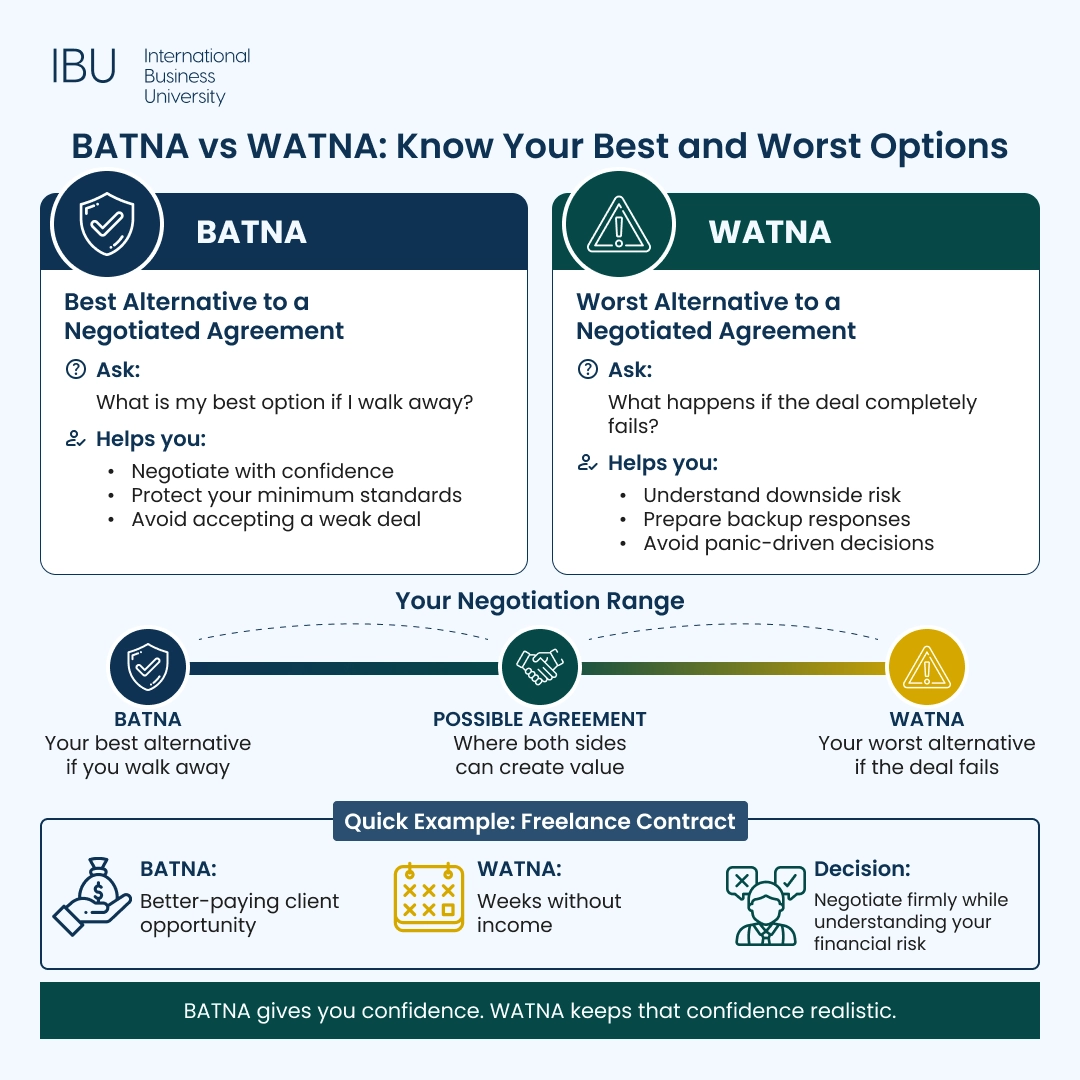
BATNA isn’t the only tool in your negotiation tactics. You also need to understand the worst alternative to a negotiated agreement (WATNA), which stands for Worst Alternative to a Negotiated Agreement. While BATNA helps you know your best way forward, WATNA prepares you for the worst-case scenario. Knowing both gives you a complete picture of the range within which any agreement makes sense. Understanding both also positions you to map your ZOPA in negotiation, the zone where agreement between the two alternatives is actually possible.
- What Is WATNA (Worst Alternative)? It represents your worst-case scenario if the deal falls apart. Knowing it helps you manage risk without overreacting.
- Why Knowing Both Prevents Regret or Panic: Understanding your full range, from best to worst, grounds your decisions in realistic analysis rather than optimism or fear.
- Quick Example, Freelance Contract With No Backup Plan: If you decline a low-paying contract without a backup or sufficient reserves, your WATNA may mean weeks without income. That risk shapes how assertively you negotiate the current terms.
Common BATNA Mistakes to Avoid
Even a well-constructed BATNA fails when it is misused. The most common errors, overestimating alternatives, revealing your BATNA prematurely, or entering without one at all, consistently reduce the quality of outcomes for negotiators who have done most of the other preparation right.
- Overestimating Your Alternatives: Believing an option is stronger than it is produces false confidence. The other party may call a bluff built on an inflated assessment, which eliminates the protection a BATNA is supposed to provide.
- Revealing Your BATNA Too Early: Once your fallback is known, the other party may anchor their offer just above it. Timing when and whether to disclose is a strategic decision, not a default.
- Having No BATNA at All: Entering a negotiation without one puts you in a position of pure reaction. It is better to acknowledge that you are still developing your alternatives than to fabricate a fallback that will not hold under scrutiny.
How IBU Teaches Strategic Negotiation Thinking
At IBU, negotiation is not just something you read about in textbooks. It’s an active learning experience that helps you connect theory to real decisions. Students don’t just study BATNA in a lecture; they practice it in their hands, on scenarios that mirror actual situations. This approach helps you understand not only what BATNA means, but also how it feels to use it when the pressure is on. By applying what you learn in a safe, structured environment, you build both skill and confidence.
- BATNA in Simulations: Role-play exercises help you test and build your BATNA strength in high-pressure settings.
- Case Work and Peer Practice: You study what worked and what failed in real cases. Then, you practice those skills with classmates.
- Learning When to Hold and When to Walk: Through guided feedback, you develop judgment on when to push forward and when to walk away.
See BATNA Applied in Context
IBU’s MBA and BCom programs develop negotiation skills through applied business scenarios and structured preparation.
Frequently Asked Questions
What does BATNA mean in negotiation?
BATNA in negotiation stands for Best Alternative to a Negotiated Agreement, your best available option if the current deal does not work out. It gives you a clear benchmark for evaluating every offer on the table and the confidence to walk away when a deal falls below the value of what you already have waiting.
Can I negotiate well without a BATNA?
Negotiating without a BATNA is possible but puts you at a structural disadvantage. Without one, you have no reliable floor, no point at which you know the current offer is worse than what you could get elsewhere. That uncertainty often produces rushed decisions, unnecessary concessions, and outcomes you would not have accepted with better preparation.
Is it okay to share my BATNA during negotiation?
Only if doing so strengthens your position and moves the conversation toward better terms. A strong, credible BATNA can shift the dynamic when disclosed strategically. If your BATNA in negotiation is weak or still developing, revealing it early eliminates the analytical protection it is meant to provide. Default to keeping it private unless a specific moment makes disclosure genuinely advantageous.
What makes a BATNA example strong in practice?
A strong BATNA example in negotiation is specific, immediately actionable, and genuinely more valuable than settling for a poor deal, a second job offer at a higher salary, a competing vendor quote, or a confirmed alternative client relationship all qualify. Each works because it removes dependence on the current negotiation entirely.
What is the relationship between BATNA and ZOPA in negotiation?
Your BATNA sets the floor for what you will accept, while ZOPA in negotiation identifies where both parties’ acceptable ranges overlap enough for a deal to be structurally possible. A stronger BATNA shifts your position within that zone, it reduces your pressure to accept terms at the lower end and gives you more room to negotiate toward the upper end.
What is the key difference when comparing BATNA vs WATNA?
BATNA in negotiation defines your best alternative if the deal fails, the option you are prepared and willing to take. WATNA maps the worst-case outcome of a complete breakdown, giving you the full risk picture on the other end of the spectrum. Using both prevents overconfidence and eliminates unnecessary panic when a negotiation reaches a difficult point.
How does improving your BATNA change your negotiation position?
A stronger BATNA in negotiation reduces your dependence on reaching any specific deal, which directly shifts the balance at the table. The more credible and developed your alternative, the more clearly you can hold your position, make strategic concessions without eroding your floor, and walk away when the terms do not meet your minimum acceptable outcome.
Negotiation Starts Before You Speak
Your BATNA in negotiation isn’t a trick or a secret weapon. It’s a foundation that supports every decision you make at the table. While you can’t predict every question or response from the other side, you can prepare in advance with clear goals and strong alternatives. This preparation gives you a safety net and a sense of control, no matter how the conversation unfolds. Know your floor, the minimum you’re willing to accept, and understand the value you bring to the table. Know your leverage so you can use it wisely. When you’ve done the work, you won’t need to guess your next move. You’ll walk in ready, clear-headed, and equipped to negotiate with purpose.
Take the First Step
IBU’s business programs develop the strategic planning and negotiation skills that graduates carry into every career stage.