
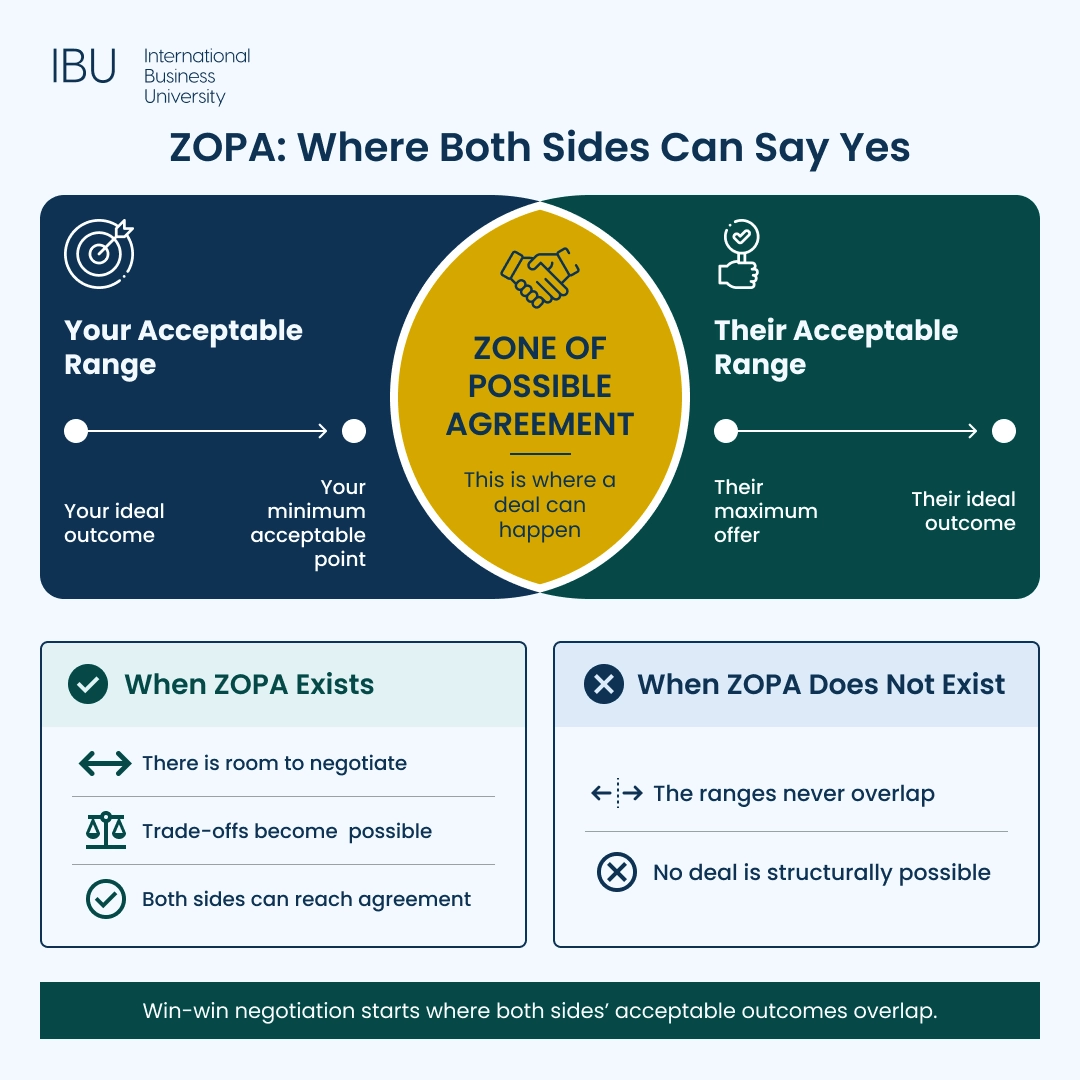
The Zone of Possible Agreement (ZOPA) is the space where your minimum acceptable outcome and the other side’s maximum offer overlap. ZOPA is the single most important factor that tells you if a deal is possible. It is where a real, workable agreement can live. If you step into a negotiation without knowing where this zone sits, you are relying on hope, not strategy. You risk spending hours trying to build something on ground that doesn’t exist. If you enter a negotiation without knowing where this zone sits, you are relying on preparation that stops halfway. The most effective negotiators do not just look for ZOPA. They map it before the first word is spoken.
Key Takeaways

ZOPA defines the range where both sides’ needs align and meaningful agreement can happen.
Negotiating without knowing the ZOPA leads to missed opportunities, strained talks, or dead-end deals.
Clear preparation and analysis are essential to finding or creating ZOPA and reaching sustainable agreements.
What Is ZOPA in Negotiation?
ZOPA stands for the Zone of Possible Agreement. Think of it as the shared space on a negotiation map, the stretch of road where both parties’ interests not only meet, they briefly run parallel. It’s the space where your minimum needs and their maximum limits align just enough to open the door to a practical, mutually beneficial deal.
This overlap isn’t always obvious; it’s the hidden engine behind meaningful agreements. When your bottom line sits below their ceiling, you’re no longer in a standoff; you’re in a space where solutions live. And once you’re in the zone, the conversation shifts from defending positions to discovering pathways, making negotiation less about winning and more about co-creating value.
The Zone of Possible Agreement Defined
As defined in negotiation theory, ZOPA exists when your minimum acceptable outcome overlaps with the other party’s maximum offer. That overlap isn’t just mathematical; it’s the oxygen a deal needs to breathe, expand, and come to life. It creates a space where flexibility can be rewarded, trade-offs can be explored, and agreement feels like a shared victory, not a reluctant compromise.
Without this overlap, you’re trying to build a bridge with no land on the other side. No matter how polished your pitch is, if the fundamentals don’t align, the deal collapses under its own weight, slowly or suddenly. Recognizing the absence or presence of ZOPA early can save you time, stress, and even your reputation by helping you focus only on negotiations with genuine potential.
Why It’s the Key to Win-Win Outcomes
ZOPA is where durable agreements are made. When both parties land inside the zone, the outcome reflects actual alignment rather than pressure or concession. Agreements reached within ZOPA tend to hold because they are grounded in what both sides can reasonably accept, not in what one side was forced to give up.
When your floor and their ceiling overlap, the conversation shifts from defending positions to identifying shared pathways. That shift, from positional negotiation to structured problem-solving, is what ZOPA enables in practice.
Why ZOPA Matters More Than You Think
In theory, ZOPA sounds straightforward: find where your goals align and structure a deal. In practice, it is one of the most misunderstood and underestimated factors in negotiation. Negotiators misread it not from carelessness but because they rush to the offer stage without doing the preparation that ZOPA requires, knowing their own floor, estimating the other side’s ceiling, and comparing the two before the conversation begins.
Why Most Negotiators Ignore ZOPA Before Talks Begin
Most negotiators go directly to offers without defining their walkaway point or estimating what the other side is likely to accept. The result is a conversation built on assumptions. If the ZOPA does not exist and neither party realizes it, both sides invest time in a deal that had no structural basis from the start.
That’s like playing darts blindfolded in a moving room with the lights off and no idea where the board is. You might hit the target, it’s mostly luck, and if you miss, you won’t know why or how to correct it, leaving you stuck in a cycle of trial and error while opportunities quietly slip away.
What Happens When Negotiators Guess the Zone
Guessing the ZOPA in negotiation leads to mismatched expectations that quietly sabotage even promising negotiations. One side might walk away thinking a deal was impossible when, in reality, it was well within reach, hidden by poor preparation or a lack of open dialogue. Others may settle for far less than they could have achieved simply because they didn’t realize the zone was wider or underestimated their value in the negotiation.
Visualizing ZOPA: The Overlap That Seals the Deal
ZOPA becomes clearer when anchored in concrete examples. Mapping the overlap turns an abstract concept into a practical planning tool, one you can use before any negotiation to set your range, estimate the other side’s, and identify where agreement is structurally possible.
Buyer Max vs. Seller Min: The Classic Example
A buyer is willing to pay up to $1,200 for a piece of equipment, and the seller will not go below $1,000. The ZOPA, $1,000 to $1,200, is where both sides can realistically come to the table. Within that zone, each dollar negotiated reflects something more than price: the buyer’s pursuit of value and the seller’s need to protect margin. It becomes more than a simple transaction; it’s a balancing act where both sides can feel they’ve gained something worthwhile.
Charting the Zone in Salary and Pricing Discussions
When negotiating a salary, your ZOPA might be $60k–$70k while the company is offering $65k–$75k. That overlap, $65k–$70k, is where the deal can happen, and within that zone lies your opportunity to secure a fair outcome. Knowing this ahead of time doesn’t just help you stay confident; it gives you leverage. You’re no longer walking in with guesswork; you’re prepared to advocate for your worth and negotiate with precision.
How to Find the ZOPA in Any Negotiation
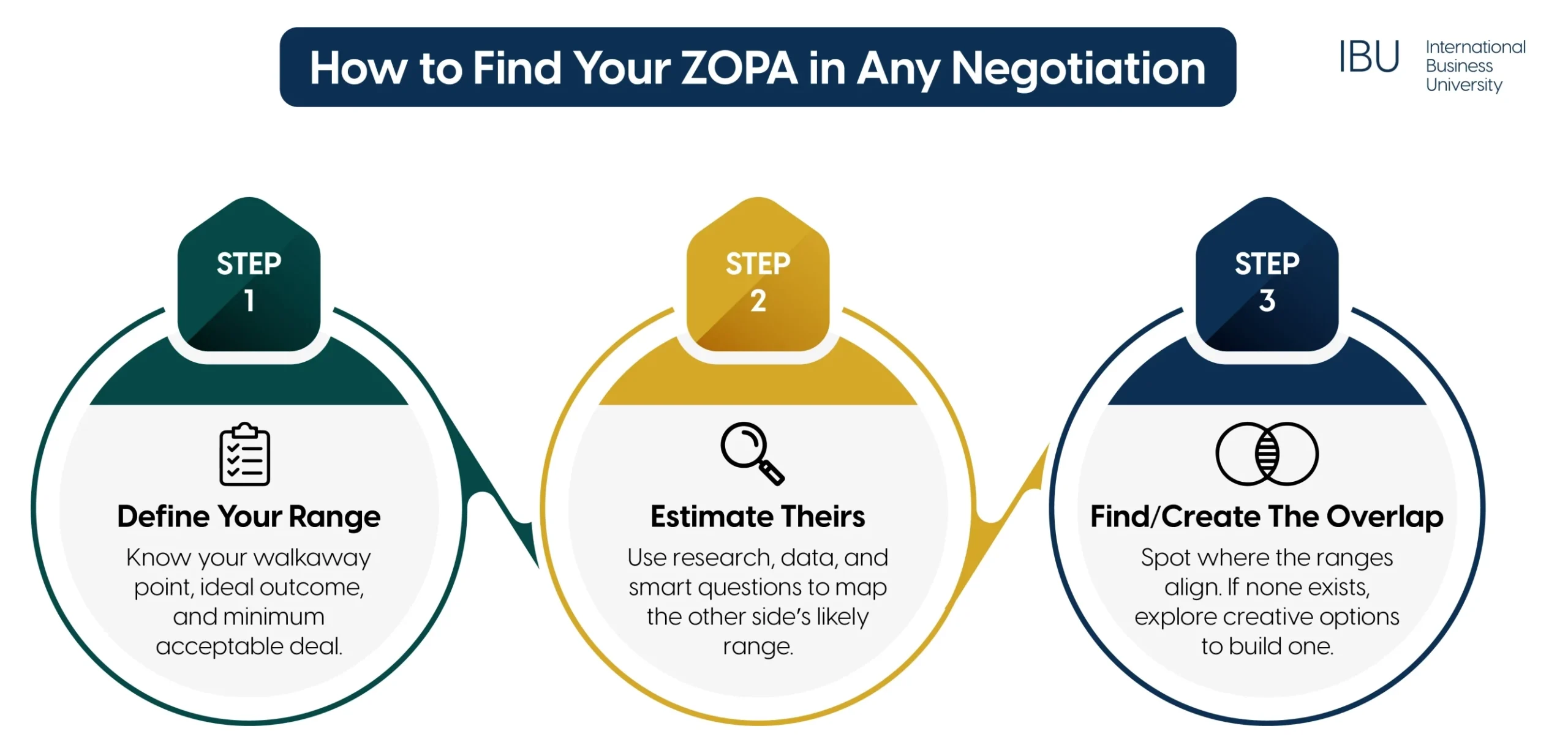
You can’t guess your way into the ZOPA. Effective negotiation requires more than intuition; it demands a deliberate process rooted in clarity, curiosity, and preparation. You need a clear roadmap that blends self-awareness with solid research, so your choices are guided by insight, not improvisation.
Step 1: Define your range: Start with your BATNA, your Best Alternative to a Negotiated Agreement. Know your walkaway point, then define your ideal and minimum acceptable outcome.
Step 2: Estimate theirs: Based on available data or experience, estimate the other party’s likely range. Use market trends, past deals, or even direct questions to help.
Step 3: Identify or expand the zone: Compare both ranges. If there’s overlap, you’ve found your ZOPA. If not, look for ways to add value (like extended timelines, bundled offers, or perks) to create one.
ZOPA Is Part of a Bigger Preparation Framework
Finding the ZOPA is one part of a broader preparation framework that effective negotiators build before any significant conversation. It’s not just about identifying a number; it’s about understanding the full negotiation landscape, from motivations and goals to fallback options and long-term consequences. Before you negotiate, you need a full map of interests, options, and potential trade-offs so you can navigate with confidence instead of reacting on the fly.
A Quick Look at NOPA: Options and Preferences
NOPA stands for Needs, Options, Preferences, and Alternatives. It’s more than just a checklist; it’s a snapshot of your deeper interests, your backup paths, and where you’re most open to compromise. Mapping this out gives you clarity, not just on what you want, but on what you’re prepared to trade or adjust to move closer to a deal. It’s the mental groundwork that makes ZOPA easier to identify because it reveals the full terrain before you even step into the room.
How ZOPA Fits Into Structured Planning Before the Ask
ZOPA is the intersection of preparation and possibility. By defining what you must have, what you prefer, and what you can offer, you’re not just hoping for a deal; you’re engineering it. Preparation makes your offer realistic and persuasive.
What If There’s No ZOPA?
Not every negotiation ends in agreement, and that’s not a failure; it’s a strategic choice. The goal isn’t to force a deal just to check a box; it’s to recognize when alignment is genuinely missing and have the clarity to walk away with confidence. Knowing when to stop is just as powerful as knowing how to push forward.
Recognizing No-Deal Zones
If your minimum is above their maximum, there’s no ZOPA, no overlap, no deal, and that is exactly when it pays to weigh your WATNA, no matter how compelling your pitch may be. Instead of wasting energy trying to “sell harder,” recognize that the numbers, and likely the interests, simply don’t align. Accepting this truth isn’t giving up; it’s strategic restraint. Respecting this reality not only protects your time and resources, it frees you to focus on opportunities that do have potential, rather than chasing agreements that were never possible to begin with.
Expanding ZOPA with Creative Value Trades
Sometimes you can create a ZOPA by shifting the terms, not by changing the core value, but rather by reframing how that value is delivered. Extending a timeline to ease cash flow pressure, bundling in additional deliverables, or dividing an agreement into phases can shift the acceptable ranges on one or both sides. These moves do not paper over a gap, they address the underlying constraints that created it.
ZOPA vs. BATNA: What’s the Difference?
It’s easy to confuse ZOPA and BATNA; they both help you make smarter decisions, yet they serve very different purposes. ZOPA is about the shared space between you and the other party where agreement is possible. BATNA, on the other hand, is your personal safety net, the best outcome you can fall back on if no deal is reached. Understanding your WATNA gives you a full picture: ZOPA shows where you can meet, and BATNA tells you when to walk away.
- ZOPA = shared zone: the overlap between what you will accept and what they can offer. It identifies where agreement is structurally possible.
- BATNA = personal benchmark: your best alternative if the negotiation reaches no agreement. It tells you when to walk away.
- WATNA = worst-case floor: the outcome you are working to avoid. It grounds your risk assessment and prepares you for the full range of outcomes.
Using all three together, you operate within a defined range, knowing where deals are possible, when to pursue them, and what the cost of failure actually looks like.
Frequently Asked Questions
What if I don't know the other party's range?
You can estimate based on market data, industry benchmarks, past interactions, or exploratory questions that reveal what the other party values and where their constraints lie. Even a rough estimate is more useful than entering without one, it gives you a starting framework and tells you which early signals to pay attention to.
Can the ZOPA change during a negotiation?
Yes. As new information surfaces or conditions shift, budget changes, competitive pressure, evolving priorities, the acceptable ranges on both sides can move. Staying alert to these shifts and adjusting your analysis in real time is what keeps your preparation relevant rather than static.
Is ZOPA only for business deals?
ZOPA applies wherever there is a give-and-take between two parties with different starting positions. Whether you are negotiating a freelance rate, discussing responsibilities in a shared project, or setting terms with a supplier, the zone of possible agreement is the same structural concept, a range where both sides can realistically accept the outcome.
What is the ZOPA meaning in negotiation?
ZOPA stands for Zone of Possible Agreement, the range where your minimum acceptable outcome and the other party’s maximum offer overlap, creating the space where a deal can realistically happen. Outside of that zone, no amount of persuasion changes the underlying arithmetic of the negotiation.
How does ZOPA support conflict resolution?
ZOPA makes conflict resolution more structured by identifying where both parties have practical room to agree, rather than focusing on fixed positions or stated demands. When both sides know a zone exists, the conversation shifts from defending claims to finding specific terms that fit within it.
Which negotiation tactics work best once you have identified the ZOPA?
Anchoring within the zone, making concessions strategically from the edges inward, and using targeted open-ended questions all perform more effectively once you have mapped your ZOPA in negotiation. These tactics produce better outcomes when both parties have a realistic picture of where agreement is actually possible.
What is zopa negotiation and how does it differ from standard negotiation preparation?
Zopa negotiation refers to preparation that explicitly identifies the overlap between both parties’ acceptable ranges before talks begin, as opposed to entering with only a target number or a single walkaway point. Standard preparation often stops at knowing what you want; ZOPA preparation adds the other party’s probable range to the picture.
Finding and Using Your ZOPA
ZOPA in negotiation is not a theoretical construct, it is your practical deal filter. It separates the conversations worth having from the ones that were never going to close. With solid preparation, you are not walking in blind. You are stepping into the room with a clear picture of where agreement is possible, how wide the zone is, and what it would take to reach it.
Understanding your ZOPA turns vague conversations into structured outcomes. It grounds your expectations in what is structurally achievable rather than what you hope is on the table. In the end, the goal is not just to close a deal, it is to close the right one, on terms that reflect the actual zone of alignment between both parties.
Take the First Step
IBU’s business programs develop the negotiation and deal-structuring skills that graduates carry into every career stage.