
WATNA stands for Worst Alternative to a Negotiated Agreement; it defines the most unfavourable, realistic outcome you could face if a deal collapses entirely. While most negotiators focus on best alternatives through BATNA, understanding WATNA requires accounting for failure before it arrives. It’s not about expecting doom, but about preparing for it with clear, practical strategies. Identifying your worst-case scenario reduces uncertainty, sharpens risk assessment, and gives you the foundation to set firm boundaries when the stakes are high.
Key Takeaways

WATNA in negotiation forces you to confront and plan for the worst-case scenario so you can stay steady under pressure.
Identifying your WATNA strengthens decision-making by turning vague fear into specific, manageable risks.
Knowing both WATNA and BATNA gives you the full picture, helping you negotiate with clarity, confidence, and resilience.
What Is WATNA in Negotiation?
WATNA stands for Worst Alternative to a Negotiated Agreement. While BATNA in negotiation stands for Best Alternative to a Negotiated Agreement and focuses on your best-case backup plan, WATNA in negotiation identifies the harshest outcome if a negotiation breaks down. It functions as an analytical tool that requires you to examine outcomes you would prefer to avoid, so you can prepare for them with a structured response rather than an improvised one. Avoiding this analysis does not offer protection; it leaves you without a framework when the situation deteriorates.
Understanding your WATNA in negotiation builds practical readiness across three dimensions: risk clarity, decision-making under pressure, and the ability to hold a position without emotional drift. It forces a precise question: what is the actual cost if this deal collapses, and am I prepared for that outcome? Answering that question before the negotiation begins means fear becomes a data point you have already accounted for, not a variable that surfaces mid-conversation.
How to Identify Your WATNA Step by Step

Recognizing your WATNA requires structured analysis and a willingness to examine outcomes you would prefer to avoid. Instead of letting worst-case scenarios remain vague, this process names them, evaluates their probability, and builds a response plan around them. The result is a clearer sense of what is actually at stake and a more grounded position from which to negotiate.
With a well-defined WATNA, your planning sharpens, your confidence grows deeper, and your negotiation strategy becomes not only smarter but also more resilient. It’s like putting on armour before a battle. You may never have to raise your shield, yet just knowing it’s there gives you the courage to step forward with clarity and control. That quiet confidence changes how you move, how you speak, and how much you’re willing to risk, because you’re protected, even if you never need to prove it.
Step 1: Ask What Happens If the Deal Fails
- Picture the negotiation ending without an agreement, no handshake, no deal, just silence.
- Identify what you might lose (money, opportunity, time) and what you still retain (networks, skills, backup offers).
- Write down the most realistic negative outcomes so they’re not swirling in your mind; they’re in front of you, where you can evaluate them.
Step 2: Map Out All Potential Consequences
- Don’t stop at surface-level problems, ask what happens next and how that creates a ripple effect.
- Look for financial consequences, time delays, trust erosion, or reputation damage.
- Make a full list so you can see the interconnected risks, not just isolated ones.
Step 3: Assess the Real Impact, Not Just the Fear
- Review each item on your list and separate what’s probable from what’s purely emotional.
- Ask: Is this a one-time setback, or does it lead to a larger issue?
- Focus on the real-world likelihood of each consequence to clarify which risks need action.
Step 4: Create a Cushion Plan You Can Live With
- Build a practical plan that cushions the blow; this reduces anxiety and increases control.
- That might include saving money, arranging a backup project, reaching out to mentors, or even rehearsing a “graceful exit.”
- Even a simple fallback strategy gives you confidence, keeps your tone steady in tough talks, and shows you’re not negotiating out of desperation.
See WATNA Used in Practice
IBU’s programs cover negotiation frameworks through case-based scenarios, not theory alone.
WATNA in Action: Negotiation Scenarios That Cost the Most
WATNA becomes more useful when applied to specific decisions rather than discussed in the abstract. In practice, understanding your worst-case scenario changes how you prepare, what you are willing to concede, and how long you hold a position under pressure. The scenarios below reflect situations that recent graduates and early-career professionals are likely to encounter.
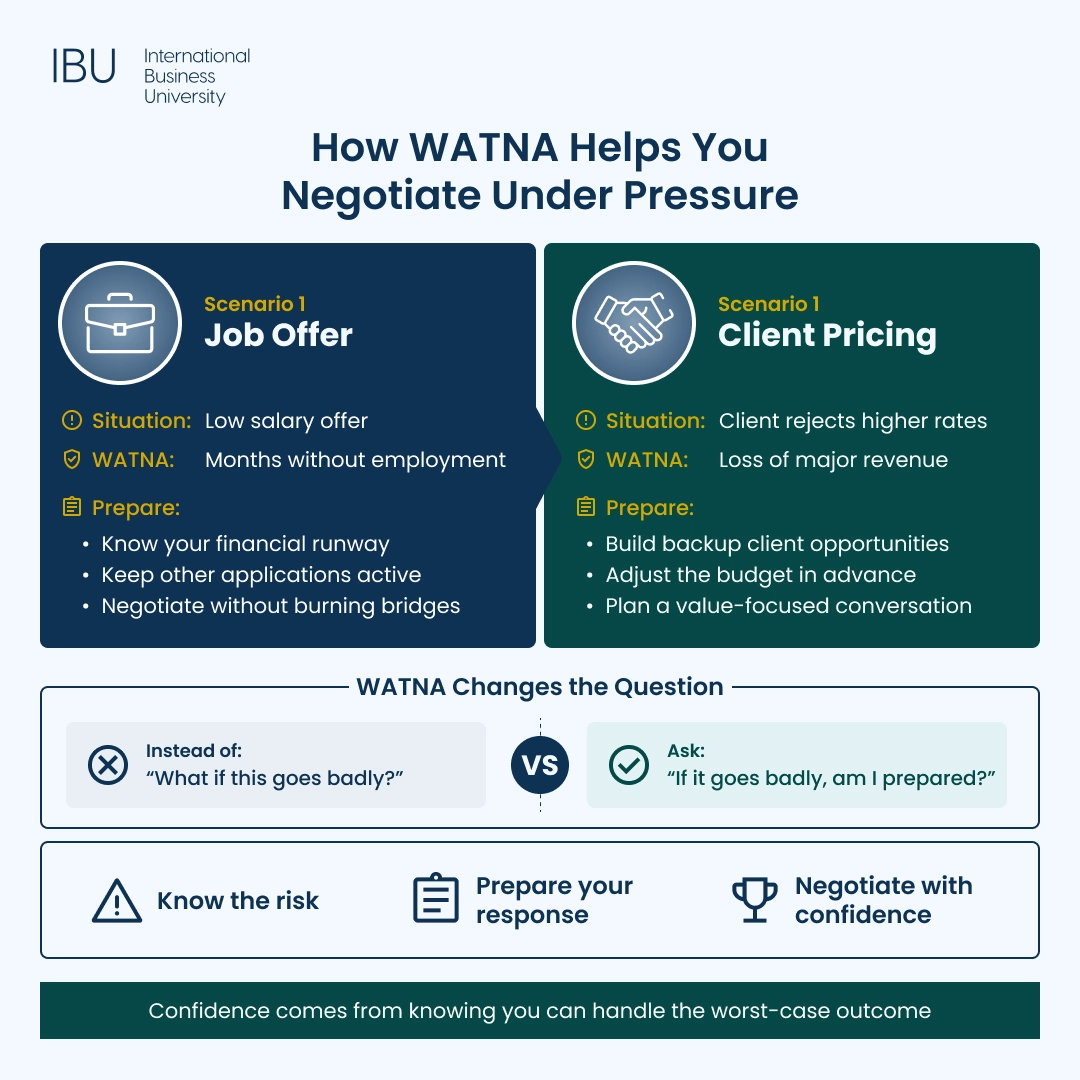
Scenario 1: Walking Away from a Job Offer
- You receive a low-paying offer and hesitate to accept it because it undervalues your skills and experience.
- Your WATNA might be staying unemployed for months, leading to financial strain, emotional stress, and delayed career momentum.
- Knowing this forces you to consider how long you can reasonably hold out, what resources you need to sustain yourself, or negotiating now could lead to better terms without burning bridges.
Scenario 2: Losing a Major Client Over Pricing
- You decide to raise your rates after months of providing high-value work, yet a major client threatens to walk away.
- Your WATNA could mean losing a significant portion of your income, stalling other investments, or missing payroll if you’re running a team.
- If you’ve mapped this out in advance, you can prepare backup clients, redesign your budget, or create a communication strategy that preserves the relationship without compromising your value.
How WATNA Framing Changes Decision-Making
- When you know the worst-case scenario, you stop making emotional guesses and start asking smart, grounded questions.
- You develop practical responses in advance, which helps you stay calm and in control when the conversation gets tense or unpredictable.
- Confidence doesn’t come from hoping things go well. It comes from knowing you’re equipped to handle whatever doesn’t. That shift influences every part of how you show up, in your tone, your posture, and your decisions.
WATNA vs. BATNA: Two Sides of the Same Coin
WATNA and BATNA are not competing frameworks. They address different parts of the same risk landscape. BATNA, as defined in negotiation theory, identifies the best course of action available if talks fail, giving you a clear and actionable benchmark for when to proceed and when to walk. WATNA in negotiation identifies the worst-case outcome of a complete breakdown, grounding your strategy in what you cannot afford to accept.
Together, they work like a GPS for decision-making: BATNA guides you toward the best route to your destination, while WATNA in negotiation alerts you to the cliffs and roadblocks, and the ZOPA in negotiation shows you where that route and the other side’s actually meet.
Understanding both doesn’t just make you smarter, it gives you more control. You stop reacting to pressure and start shaping outcomes. You know when to push forward, hold your ground, and walk away, not out of fear, but because you’ve already studied the terrain, weighed the risks, and prepared for every fork in the road. That’s the power of strategic clarity: it replaces guesswork with intention and turns hesitation into informed choice.
BATNA = Your Best Exit Strategy
BATNA is the most favourable, realistic alternative you can pursue if the current negotiation fails to reach an agreement. This option allows you to walk away without losing value, time, or momentum, and possibly even gaining by choosing a smarter path. A well-researched BATNA gives you the confidence to negotiate assertively because you’re grounded in real options, not guesses.
You’re not just protected; you’re empowered. It becomes your leverage, your fallback that’s not just “good enough.” It is potentially stronger, more sustainable, and better aligned with your long-term goals. With a clear BATNA, you approach negotiations with a calm mind, steady posture, and the ability to say no without hesitation.
WATNA = Your Worst-Case Outcome Map
It helps you visualize the consequences if the negotiation completely breaks down and no agreement is reached. This could involve financial loss, missed deadlines, damaged relationships, or other meaningful setbacks that ripple across your personal and professional life. By identifying these potential outcomes in advance, you stop letting fear dictate your response and start designing smart, practical strategies that prepare you for even the roughest scenarios.
Understanding your WATNA in negotiation allows you to develop contingency plans, calibrate expectations, and maintain composure when decisions carry real consequences. For further context on how worst-case analysis functions as a structured planning tool, see Wikipedia’s entry on worst-case scenario planning.
Build Your Negotiation Foundation
IBU prepares students to apply WATNA, BATNA, and ZOPA before entering any high-stakes business conversation.
Why Understanding Both Gives You True Leverage
When you know your best and worst scenarios, you enter the negotiation with both a safety net and a compass. Your BATNA shows you where to go if the deal falls through, while your WATNA shows you what happens if everything breaks down. Together, they shape the boundaries of what you can realistically accept and prepare for.
You’re no longer reacting, you’re leading with intention, because you understand the full playing field and the consequences of each move. That kind of insight helps you avoid emotional traps, stay strategic under pressure, and push for better outcomes with a grounded mindset. In short, knowing your BATNA and WATNA allows you to negotiate from a place of clarity, control, and confident decision-making, not confusion or wishful thinking.
How WATNA Shapes Your Negotiation Tactics
Most effective negotiators think about tactics primarily in terms of what they want to gain. WATNA shifts that analysis by requiring you to account for what you stand to lose, and that shift changes how every tactic is applied.
When you know your worst-case outcome before a negotiation begins, several decisions become clearer. You know which terms require a firm position and which carry acceptable risk if conceded. You know when extending the conversation is to your advantage and when the cost of delay begins to exceed the potential benefit of a better deal. You know at what point walking away produces less damage than accepting the current offer.
The negotiation tactics that benefit most from WATNA clarity include anchoring to realistic terms rather than aspirational ones, using silence strategically when the other party faces greater time pressure, making targeted concessions that do not compromise your floor, and framing your position around outcomes rather than fixed positions. Each of these tactics performs differently when a negotiator has a defined worst-case floor compared to one who is estimating in real time.
Frequently Asked Questions
Why should I care about WATNA if I already have a BATNA?
BATNA tells you when to walk away with strength, WATNA in negotiation reveals what it might cost you if everything falls apart, and the Zone of Possible Agreement shows you where a workable deal could still exist between those two extremes. One defines your best exit, the other clarifies the full cost of no agreement. Knowing both is what gives you a complete picture of the negotiation landscape before you enter it.
Is WATNA just negative thinking?
WATNA in negotiation is not about expecting failure, it is about preparing for it as a structured analytical exercise. It gives you the clarity to stay composed and make grounded decisions when a negotiation moves in an unfavorable direction.
Can WATNA change over time?
Your WATNA is not fixed, it shifts with your financial position, professional goals, and external conditions. A consequence that once seemed severe may become manageable as circumstances improve, while a previously minor risk may grow if it goes unaddressed. Revisiting your WATNA before each significant negotiation keeps your planning accurate.
How does WATNA relate to conflict resolution?
WATNA in negotiation is a practical conflict resolution tool because it clarifies the consequences of reaching no agreement. When both parties have mapped their worst-case scenarios, the motivation to find workable common ground increases and the conversation becomes less positional.
What negotiation skills does WATNA help develop?
Preparing your WATNA builds three core negotiation skills: risk assessment, boundary-setting under pressure, and composure during unpredictable conversations. These compound over time and apply across professional contexts, from salary discussions to vendor contracts to business partnerships.
What negotiation tactics work best alongside WATNA?
Anchoring, interest-based questioning, and strategic use of silence all perform more effectively when you have defined your WATNA in advance. Because you have already mapped the worst-case outcome, you can hold a position longer and make deliberate concessions without compromising your floor.
How do negotiating styles affect how you use WATNA?
Competitive negotiators may use WATNA to justify holding firm on critical terms, while accommodating negotiators may need it as a check against conceding too quickly. Knowing your WATNA recalibrates how you apply your natural negotiating style, it introduces a defined floor that functions independently of personality or disposition.
Allowing WATNA to Strengthen Your Negotiation Strategy
Planning your WATNA in negotiation isn’t about fearing failure; it’s about preparing for it so you can stay grounded, focused, and in control when negotiations get tough. By clearly understanding the worst-case scenario, you create mental clarity, emotional stability, and a strategic framework that keeps you steady even when circumstances shift unexpectedly. Like BATNA provides a confident exit plan, WATNA acts as your safety net, helping you protect your time, energy, and decisions by accounting for potential setbacks before they arise. Together, they empower you to navigate negotiations with resilience and precision.
Take the First Step
IBU’s business programs develop the negotiation and risk-planning skills that professionals carry into every career stage.