
Your study environment shapes how much you retain and how long you last. Most students focus on time management but overlook the physical and social conditions around them. Small adjustments to your setup, noise level, and routine can produce significant gains. This article covers the factors that actually move the needle.
Key Takeaways
- Natural light improves student productivity by up to 21%: A study cited in Indoor Air (2025) found that students in classrooms with the most natural light were 21% more productive than those in classrooms with the least. Lighting is one of the most underestimated factors affecting the study environment.
- A single nearby conversation can cut productivity by 66%: Research reviewed by Loop Earplugs’ noise and concentration analysis found that exposure to a nearby conversation can reduce productivity by up to 66%. Noise is one of the most damaging and most controllable factors in any study environment.
- Your setup, not just your schedule, determines your focus: A well-controlled study environment that addresses distractions, physical setup, and routine leads to better focus, stronger retention, and higher academic performance.
What Is a Study Environment and Why It Matters
A study environment is the full set of conditions in which you do your academic work. It includes lighting, noise, seating, temperature, and the people around you. It also includes less visible factors like routine, digital habits, and how your space is organized. All of these influence student focus and productivity, often without students realizing it.
Most students associate poor academic performance with effort or ability. Research consistently shows that the study environment plays a significant independent role. A student studying in a poorly controlled environment uses more cognitive energy just to concentrate. That energy comes directly from what would otherwise go toward understanding and retaining material. Improving the learning environment for students does not require more hours; it requires better conditions.
What Makes a Good Study Environment for Students
A good study environment for students controls the factors most likely to interrupt concentration. The goal is not a perfect or elaborate space. It is a consistent, predictable setup where the brain knows work is the only activity happening.
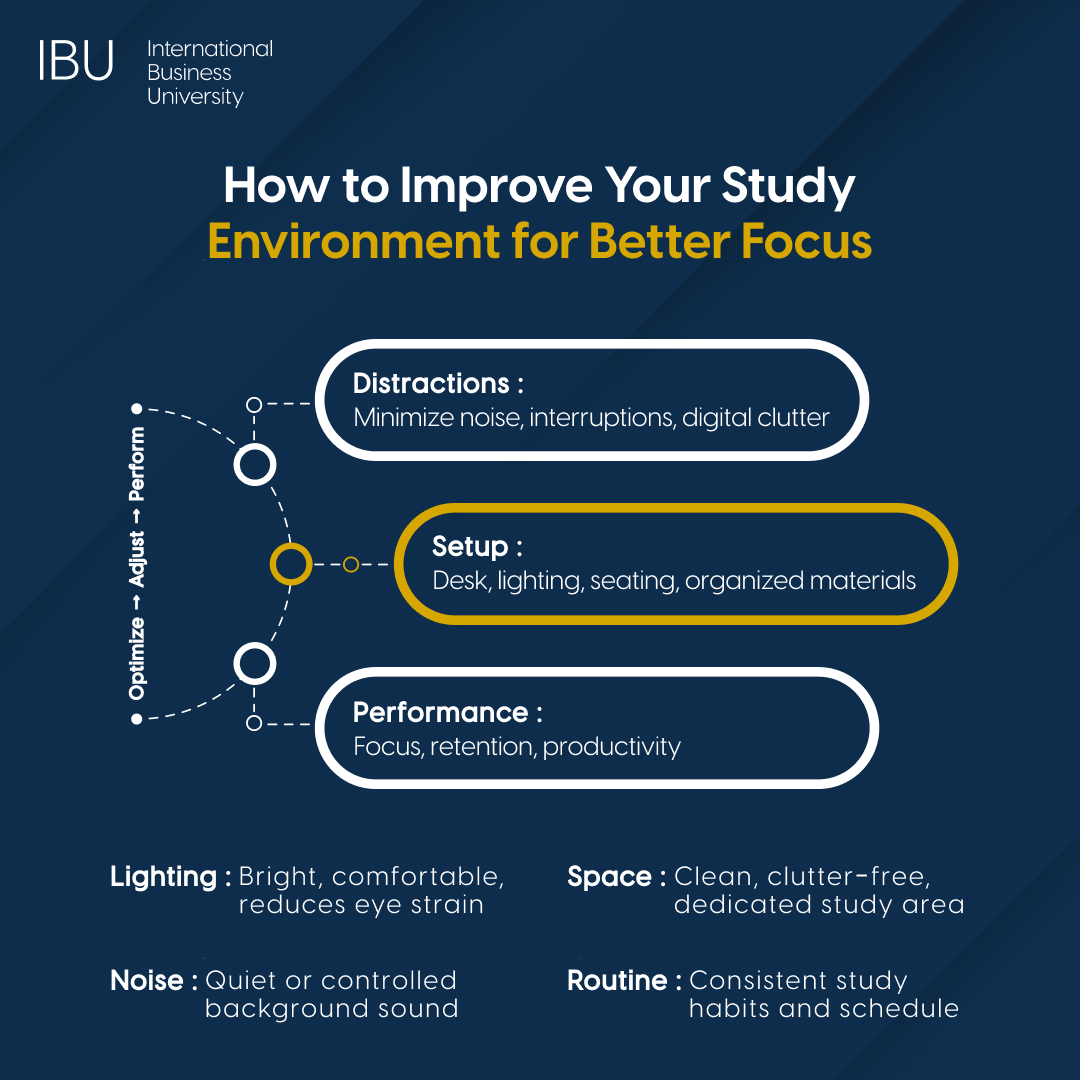
The IBU framework above captures this clearly. It breaks the study environment into three connected layers. The second is setup: your desk, lighting, seating, and how materials are organized.
1. The first is distractions: minimizing noise, interruptions, and digital clutter.
2. The third is performance: the focus, retention, and productivity that result when the first two are controlled.
3. The process follows a simple cycle: optimize, adjust, and then perform.
Below the cycle, four specific factors are identified as the most impactful: lighting, noise, space, and routine. Each one contributes differently to student focus and productivity. A well-controlled environment addresses all four, not just the most obvious one.
Lighting
Lighting directly affects how alert and focused a student feels during study sessions. Bright, comfortable light reduces eye strain and signals the brain to stay awake. Poor lighting causes fatigue faster, which shortens effective study time. Natural light is the most effective option when available. When it is not, LED lighting that mimics daylight performs significantly better than fluorescent alternatives.
Noise
Noise is the most disruptive factor in any study environment for students. A quiet or controlled background is not about silence for everyone. Some students concentrate better with consistent low-level sound, like ambient or instrumental music. What damages focus is unpredictable noise, especially speech, because the brain involuntarily tries to process it. Identifying your noise tolerance and choosing your space accordingly is one of the easiest improvements available.
Space
A clean, clutter-free, dedicated study area reduces the mental load before work begins. When a space serves multiple purposes, the brain does not associate it strongly with focused work. Students who study in the same organized location each session build a mental cue that activates concentration. This consistency is a small change with a disproportionate effect on how quickly you settle into studying.
Routine
Consistent study habits and a regular schedule reduce the effort required to start. Students who study at the same time each day spend less mental energy on deciding when to begin. Routine removes friction from the transition into focused work. Over a semester, that saved friction adds up to significantly more productive hours.
Hidden Factors That Affect Your Study Environment
Several factors affecting the study environment are invisible until you notice they are missing. These are not about buying equipment or finding the perfect space. They are about awareness: knowing what your brain needs to sustain concentration and providing it.
Temperature and Air Quality
Room temperature affects alertness more than most students expect. A room that is too warm accelerates fatigue and reduces processing speed. A room that is too cold directs attention toward physical discomfort. A slightly cool, well-ventilated space keeps the brain alert and comfortable during long sessions. This is one of the simplest factors to adjust and one of the most frequently overlooked.
Digital Clutter and Phone Proximity
A phone sitting face-up on a desk reduces focus even when it does not ring. Research consistently shows that the mere presence of a device captures cognitive resources. Moving the phone to another room during study sessions improves concentration without any additional effort. Digital clutter on a computer screen, open tabs and notification banners, has the same effect. A cleaner digital workspace is as important as a clean physical one.
- Body posture: Uncomfortable seating causes physical distraction that shortens attention spans during long study sessions.
- Hunger and hydration: Cognitive performance drops noticeably when students study while hungry or dehydrated.
- Time-of-day alignment: Studying during hours when your natural alertness peaks produces better retention with the same amount of time.
- Social pressure: Studying near students who are also focused creates a productive social norm that reinforces concentration.
Study Environment in Small vs Large Campuses
The university study environment differs significantly between small and large campuses. Large campuses offer more space and resource variety, but can also feel impersonal and overwhelming. Small campuses create more consistent access to quiet, faculty, and community. Neither is automatically better; what matters is if the campus supports the conditions you need to work.
At a smaller institution, students often have easier access to quiet study spaces. They are less likely to compete for seats in the library or workrooms. Relationships with faculty are typically more direct, which helps students get support faster.
These factors all contribute to a more controlled and less stressful university study environment. For students who already know that noise and crowding reduce their focus, a smaller campus removes those variables by default.
Study Better at IBU
IBU’s small campus supports focused, distraction-free student learning.
How Campus Spaces Influence Focus and Productivity
Campus spaces directly shape student focus and productivity through physical conditions. A library with natural light, proper acoustics, and organized seating supports deep work. A crowded, noisy common area with poor lighting does the opposite. Students who choose their study spaces strategically, rather than by habit, see consistent performance differences.
The type of work matters when choosing a space. Writing and analysis require more quiet than reviewing notes or reading. Group work sessions need a different environment than solo problem-solving. Students who match their space to their task reduce mental effort and work more efficiently. This is a practical application of what improving your study environment actually means in daily practice.
Common Problems That Ruin a Study Environment
The most common study environment problems are predictable and preventable. Most students are aware of them but underestimate how much they cost in focus and time. Addressing even two or three of these consistently produces noticeable academic gains.
- Studying in bed: The bedroom is a sleep cue, not a work cue, and mixing the two weakens both focus and sleep quality.
- Background television: TV audio is specifically engineered to capture attention, making it one of the worst background options for studying.
- Group chat notifications: Even brief notification glances break concentration cycles that take time to rebuild.
- Inconsistent locations: Switching study spots daily prevents the brain from building a strong cue for focused work.
- Multitasking across tabs: Switching between study content and social media dramatically reduces retention for both.
How to Improve Your Study Environment at University
Improving your study environment does not require a new setup or a new space. It requires small, deliberate changes applied consistently. The improvements that produce the most impact address lighting, noise, space organization, and routine. These four factors, addressed together, build a better study environment within a week.
Start by identifying where your current sessions lose momentum. If you regularly lose focus after 30 minutes, noise or discomfort is likely the cause. If you struggle to start, your routine and location cues probably need adjustment. If you finish sessions feeling more tired than the work warrants, lighting and posture are worth examining. Each of these is a specific problem with a specific solution, not a general discipline issue.
How IBU Creates a Better Study Environment for Students
IBU supports a better study environment for students through its campus structure and program model. As a smaller institution, IBU gives students consistent access to quiet, organized spaces. Students are not competing for resources or navigating a sprawling, impersonal campus. The learning environment for students at IBU is built around the conditions research identifies as most effective.
Small class sizes mean students interact with faculty directly, not through a large lecture system. That access removes delays in getting support and reduces the anxiety that disrupts focus. IBU’s MBA program and BCOM in Business Management are both structured with a student-focused learning environment as a core part of the academic experience. Students who need a university study environment that supports concentration rather than competes with it consistently find that smaller institutions serve them better.
Find Your Focus at IBU
IBU’s program model supports student focus and academic success.
Frequently Asked Questions
What is the most important factor in a study environment?
Noise control is the single most impactful factor in most students’ study environment. Unpredictable audio, especially speech, involuntarily pulls attention and is the most common reason students cannot sustain focus. After noise, lighting, and physical setup are the next highest-impact adjustments, and both can be improved quickly without high cost.
Is studying with music good or bad for focus?
It depends on both the type of music and the type of task. Instrumental music and ambient sound tend to support focus for reading and repetitive tasks. Music with lyrics competes with language processing and has been shown to reduce performance on complex tasks like writing and analysis, so the benefit depends heavily on what you are studying and what your own concentration patterns are.
Does IBU provide dedicated study spaces for students?
Yes, IBU’s campus includes organized, quiet spaces that support focused academic work. As a smaller institution, IBU students have consistent access to these areas without competing with large student populations. Students in IBU’s MBA and BCOM programs also benefit from direct faculty access, which reduces the uncertainty and stress that often disrupts a productive university study environment.
Build the Study Environment That Works for You
A better study environment is not about finding a perfect space; it is about controlling the factors that undermine concentration. Lighting, noise, space organization, and routine are the four variables that most directly affect how long and how well students can focus. Students at IBU benefit from a university study environment built around exactly these conditions, giving them a consistent foundation for academic performance from day one.