
Small class sizes change how students experience learning at every level. When fewer students share a room with one instructor, the dynamic shifts completely. Students get more time, more feedback, and more opportunities to participate. That difference is not cosmetic; it has direct consequences for how much students retain and how prepared they are after graduation.
Key Takeaways
- Participation increases significantly: Students in small classes ask more questions and engage more deeply with the material.
- Feedback is faster and more specific: Instructors in small class environments can address individual student needs in ways that large lectures cannot support.
- Academic outcomes are consistently higher: Research across multiple studies supports a strong positive link between small class sizes and improved student performance.
Small vs Large Class Sizes: What’s the Difference
The gap between small and large class sizes is not just about the number of seats in a room. It is about how much time a faculty member can give each student. For example, in a lecture of 200 students, the participation time is zero. While in a seminar of 20, the same instructor can track every student’s progress and adjust how they teach accordingly.
Small class and big class learning environments produce different habits in students. Students in large lectures often adopt a passive role: they take notes and hope the content sticks. Students in smaller settings tend to prepare more, ask more, and contribute more consistently. These habits develop because the environment makes participation both possible and expected, not optional.
- Instructor awareness: In a small class, faculty notice when a student is falling behind and can act before the gap widens.
- Discussion quality: Fewer students in a room means each voice gets more space, which produces richer conversations.
- Assignment feedback: Individual attention in classroom settings allows instructors to give specific, actionable comments on student work.
- Accountability: Students who know their absence or non-participation will be noticed and tend to show up and engage consistently.
Why Small Class Sizes Lead to Better Learning Outcomes
Small class size learning benefits are well-documented across decades of educational research. The evidence points in one direction: when class sizes decrease, student outcomes improve. The reasons are not complicated, but they matter significantly when choosing where to study.
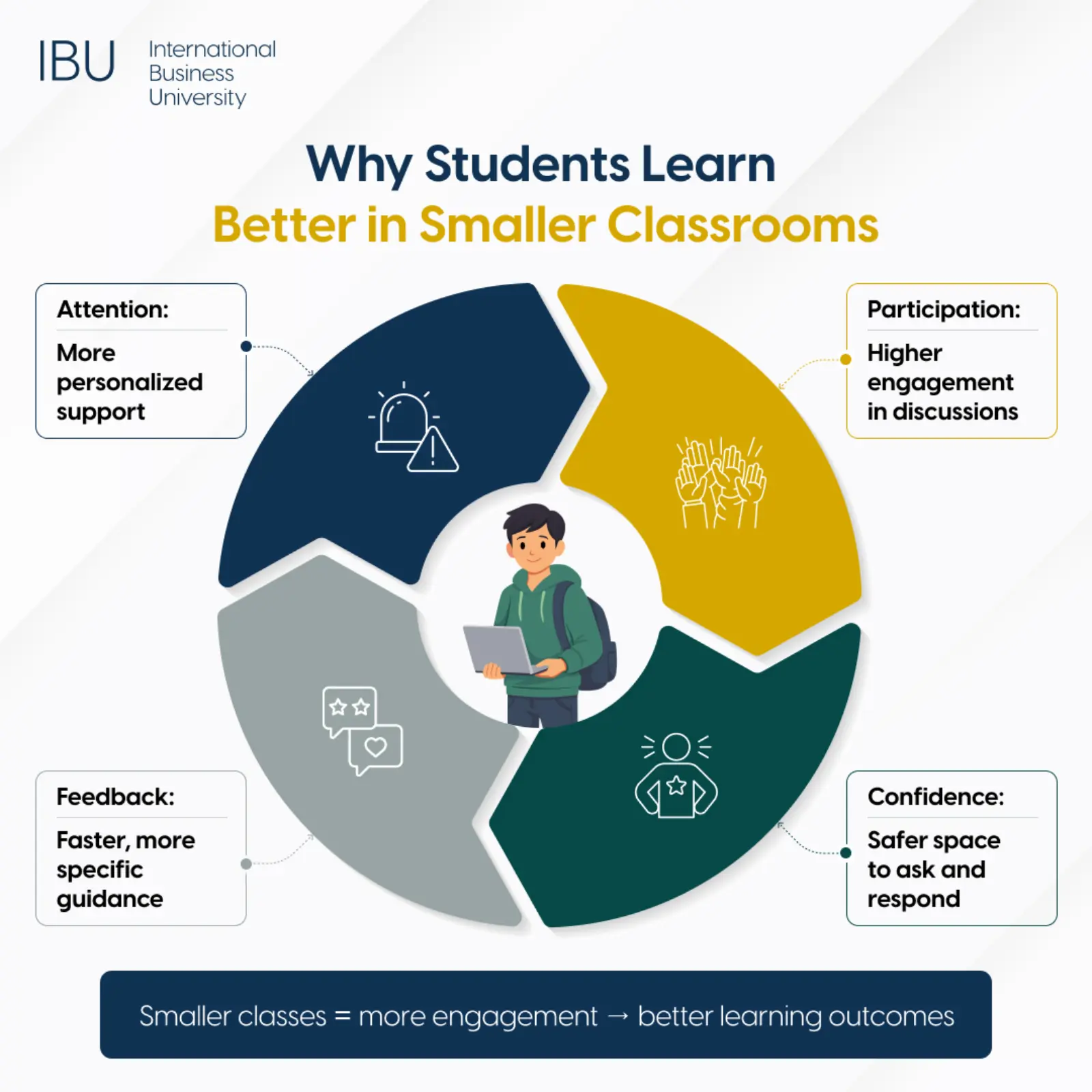
The IBU diagram above shows exactly why this happens. It maps three outcomes that small class sizes consistently produce for students. Participation increases because students have higher engagement in discussions when the group is small. Confidence grows because the smaller setting creates a safer space to ask questions and respond.
Feedback improves because instructors can offer faster and more specific guidance to each individual. Surrounding all three is a fourth outcome: Attention, meaning more personalized support for every student.
Participation: Why Engagement Goes Up
Interactive classroom learning happens naturally when fewer students are present. Students are more likely to contribute when they feel their voice carries weight. In a large lecture, raising a hand is an act of courage; in a small seminar, it is a normal part of class.
This shift in classroom culture changes how actively students process the material during each session. Active processing during class leads to stronger retention compared to passive note-taking in a lecture.
Confidence: The Value of a Safer Space
Confidence in academic settings develops from repeated low-stakes interactions with instructors and peers. Small class sizes create more of these interactions per student per semester. A student who presents an idea in a seminar group of 15 builds a different confidence than one who never speaks in class.
That confidence transfers directly into presentations, group projects, and eventually job interviews. It is one of the benefits of small class sizes that students often do not expect but consistently report after graduation.
Feedback: Faster, More Specific Guidance
Individual attention in classroom settings is the most direct advantage of small class sizes. Instructors who teach fewer students can review work more carefully and return feedback faster. That specificity matters because generic feedback does not tell a student how to improve.
Students in small class environments receive guidance that is tied to their specific thinking, not a rubric applied to 200 papers. Over a full degree program, the cumulative effect of that feedback gap is significant.
The Hidden Downsides of Large Classrooms
Large classroom disadvantages go beyond less individual attention. A better learning environment for students requires more than good facilities and a qualified instructor. The structure of the class itself shapes how students behave and how much they absorb.
Research from CEPR’s analysis of university class size and performance found that going from an average class of 56 to 89 students decreases marks by 9% of the observed variation within a given student. That effect is nearly four times larger for students in the top 10% academically. High-performing students, the ones most likely to be considering competitive university programs, are also the most affected by oversized classrooms.
- Anonymity reduces effort: Students who feel invisible in a large class often reduce their preparation because no one will notice.
- Questions go unasked: Many students avoid asking for clarification in large groups because they fear judgment from peers.
- Feedback is generic: Large class marking schemes rely on standardized rubrics that rarely address a student’s specific reasoning.
- Disengagement grows: Students who sit passively through 200-person lectures develop habits that carry into their university careers.
Do Students Perform Better in Smaller Classes
Yes, the research on if students perform better in smaller classes is consistent. Multiple large-scale studies show a positive link between reduced class size and improved academic outcomes. The benefits of small class sizes are especially clear when students have access to them throughout a degree, not just in one course.
The Tennessee STAR project, one of the most cited studies on this topic, followed over 7,000 students across 79 schools. Students in small classes of 13 to 17 outperformed those in regular classes of 22 to 25 in both reading and mathematics. According to the STAR project data published by Princeton’s Data and Statistical Services, the improvement was statistically significant at 99.9% confidence. This is one of the strongest findings in educational research on class size.
A review by Zyngier (2014), cited by Class Size Matters, analyzed 112 peer-reviewed studies on class size reduction. The overwhelming majority found that smaller classes have a significant positive impact on student achievement. Only three of the 112 studies concluded that smaller class sizes did not produce better outcomes.
Study in Smaller Classes
IBU keeps class sizes small so every student gets attention.
How Small Classes Improve Student Confidence and Participation
Small classroom advantages show up most clearly in how students carry themselves outside the classroom. Students who regularly participate in seminars and discussions develop communication skills that passive learners do not. These are skills that employers notice and that graduate school admissions reviewers look for specifically.
Student-teacher ratio benefits are most visible in how often students receive direct feedback on their thinking. In a small class, an instructor can challenge a student’s argument directly and constructively. That kind of exchange does not happen in a large lecture.
It builds analytical habits that stay with students long after the course ends. Graduates who experienced small class environments consistently report stronger preparation for professional settings.
Small Class Sizes vs Large Lectures: Which One Prepares You Better
Small class sizes vs large lectures is not simply a preference question. It is a question about what kind of preparation you want from your degree. Large lectures can cover content efficiently, but they do not develop professional communication or critical thinking the same way. The advantages of small class sizes are most pronounced in how students learn to think, not just what they learn.
Personalized learning in university happens when instructors can respond to individual student reasoning. This only works when class sizes are small enough for instructors to know their students by name. A business program that trains students in strategy, finance, or management needs this dynamic.
The skills those programs build through discussion and application cannot be developed from a seat in a lecture hall. IBU’s BCOM in Business Management and MBA programs are structured around exactly this type of learning environment.
What Most Universities Get Wrong About Class Size
Most large universities treat class size as an operational variable, not an academic one. They increase enrolment because it generates revenue and fills seats. The academic cost of that decision falls on students who sit in progressively larger classes each year.
The argument that large classes can be offset by teaching assistants is not well supported. TAs provide supplementary support; they do not replace the relationship between a faculty member and a student. Students who consistently receive individual attention from their actual instructors perform and retain better.
The student teacher ratio benefits that drive stronger outcomes come from faculty contact, not TA availability. Institutions that keep class sizes genuinely small are making a different kind of commitment to student outcomes.
How IBU Uses Small Class Sizes to Improve Student Experience
IBU keeps class sizes intentionally small to give every student direct access to faculty. This is not a marketing feature; it is a structural commitment built into how programs are delivered. Students in IBU classes participate more, receive more specific feedback, and develop stronger professional communication skills.
IBU’s MBA in Healthcare Management and MBA in Financial and Management Analytics both operate in small class settings. Discussions in these programs are substantive because every student is expected to contribute. Faculty know each student’s thinking, progress, and areas for development throughout the semester. That level of individual attention in classroom settings is not incidental; it is the point.
Is a Smaller Class the Right Choice for You
A smaller class is a better fit for students who want more than content delivery from their degree. If you want feedback that helps you improve, not just a grade, smaller settings serve you better. If you want to practice communication, reasoning, and professional thinking alongside academic content, the small class model is the right environment.
Students who struggle in large lecture settings often find that the problem is not their ability. It is the environment. A student who is disengaged in a 200-person lecture may thrive in a seminar of 20. Smaller classes remove the anonymity that lets passive habits develop. For students considering graduate programs or professional careers in business, that engagement difference is worth taking seriously.
Frequently Asked Questions
How small is considered a small class size at the university level?
Most research defines small university classes as 20 or fewer students per instructor. Some institutions use 25 as the upper limit, particularly for seminar-style or discussion-based courses. At IBU, class sizes are kept small enough that faculty can track each student individually, which is the standard that actually produces the interactive classroom learning and feedback benefits students are looking for.
Do small class sizes matter more in graduate programs than in undergraduate?
Small class sizes matter at both levels, but the impact is especially strong in graduate programs. MBA and master ‘s-level courses rely heavily on case discussions, group analysis, and direct feedback on strategic thinking. These activities require genuine interaction between faculty and students, and small class sizes are what make that interaction consistent and substantive throughout the program.
How do I know if a university actually keeps class sizes small?
Ask for the average class size for the specific program you are considering, not the institutional average. University-wide averages often include large introductory lectures that inflate the numbers and obscure what your experience will actually be. IBU’s program pages are a good starting point, and speaking directly with admissions staff gives you the clearest picture of what the classroom experience looks like in practice.
Small Class Sizes Are a Feature, Not a Coincidence
The advantages of small class sizes are not minor conveniences; they shape how well students learn, how confidently they communicate, and how prepared they are when they graduate. Institutions that keep class sizes genuinely small are making a deliberate choice about what student outcomes should look like. IBU’s commitment to small class sizes across its MBA and BCOM programs reflects exactly that commitment, and students feel the difference from the first week of class.
Learn at IBU’s Scale
IBU’s small classes give every student direct faculty access.