
Pursuing an MBA while maintaining a full-time job is one of the toughest challenges a professional can take on. Between long work hours, deadlines, and personal responsibilities, finding time for academic growth might feel impossible. Yet, learning how to balance work and study effectively is the defining skill that separates those who thrive in online MBA programs from those who struggle.
When you commit to an Online MBA Program, you’re also committing to personal transformation. At International Business University (IBU), we teach students to develop time management skills, use digital tools strategically, and sustain long-term motivation. These are the habits that make working professionals succeed in education without sacrificing performance or well-being.
MBA for Working Professionals: What the Commitment Really Looks Like
An MBA for working professionals is a different commitment than a full-time, on-campus program, and understanding that difference before enrolling is the first step in learning how to balance work and study before the program even starts. A traditional full-time MBA typically takes two years. Part-time and flexible formats, including IBU’s Online MBA, are structured specifically around the schedule of someone who is not stepping away from their job.
What Is an Online MBA Program and How Is It Structured?
An Online MBA program delivers the same core business curriculum as an on-campus degree through asynchronous coursework, scheduled video sessions, and digital collaboration tools, allowing students to complete coursework around a full-time job rather than around a fixed class schedule. IBU’s Online MBA is structured to be completed in about 16 months, shorter than the traditional two-year timeline, while still covering the core business curriculum in finance, strategy, operations, and leadership.
Specializations available within the program include Online MBA in Global Business Management, Online MBA in Healthcare Management, and Online MBA in Technology Innovation and Entrepreneurship, each built around the same flexible delivery model.
For a closer comparison of how this format differs from a traditional program, and how it changes the practical answer to how to balance work and study, see IBU’s breakdown of online MBA vs. regular MBA, and for financing options, see IBU’s guide on how to pay for your MBA.
How Many Hours Do MBA Students Study Each Week?
Before starting your degree, it’s essential to understand what you’re signing up for. Learning how to balance work and study begins with understanding time commitment, workload, and realistic pacing.
A full-time MBA typically takes two years, but part-time and flexible formats, like IBU’s, are designed for working professionals. The IBU Online MBA degree programs are structured to be completed in about 16 months, giving students the advantage of earning their credentials faster than traditional models.
When comparing online MBA programs in Canada, it’s vital to know how many hours you’ll spend on classes and self-study each week. Review your current schedule and see where study time fits best. Then, build a plan that aligns with both your work hours and personal life. The key is realism; overcommitting will quickly lead to exhaustion, while undercommitting can slow progress.
How many hours do MBA students study each week depends on the program format, but most accredited part-time and online MBA programs are built around 15 to 20 combined hours of coursework, reading, and assignments per week. For IBU’s 16-month Online MBA, that typically breaks down into two to three hours on weekday evenings plus a longer weekend block, a pace built specifically to fit around a full-time work schedule rather than compete with it.
Course load is not constant across the program. Some weeks carry a heavier reading or project load, particularly around case study submissions and group assignments, while others are lighter. Planning around that variation, instead of assuming every week demands the same number of hours, is what makes balancing work and study sustainable across all 16 months, not just the first few weeks.
Balancing Work Life and Your MBA Degree Without Burning Out
The most successful professionals treat their study hours like client meetings, non-negotiable and clearly scheduled. They block the time on their calendar weeks in advance, protect it from last-minute meeting requests, and treat a missed session with the same urgency as a missed appointment with a client. This consistency is what separates those who finish strong from those who let coursework slide whenever work gets busy.
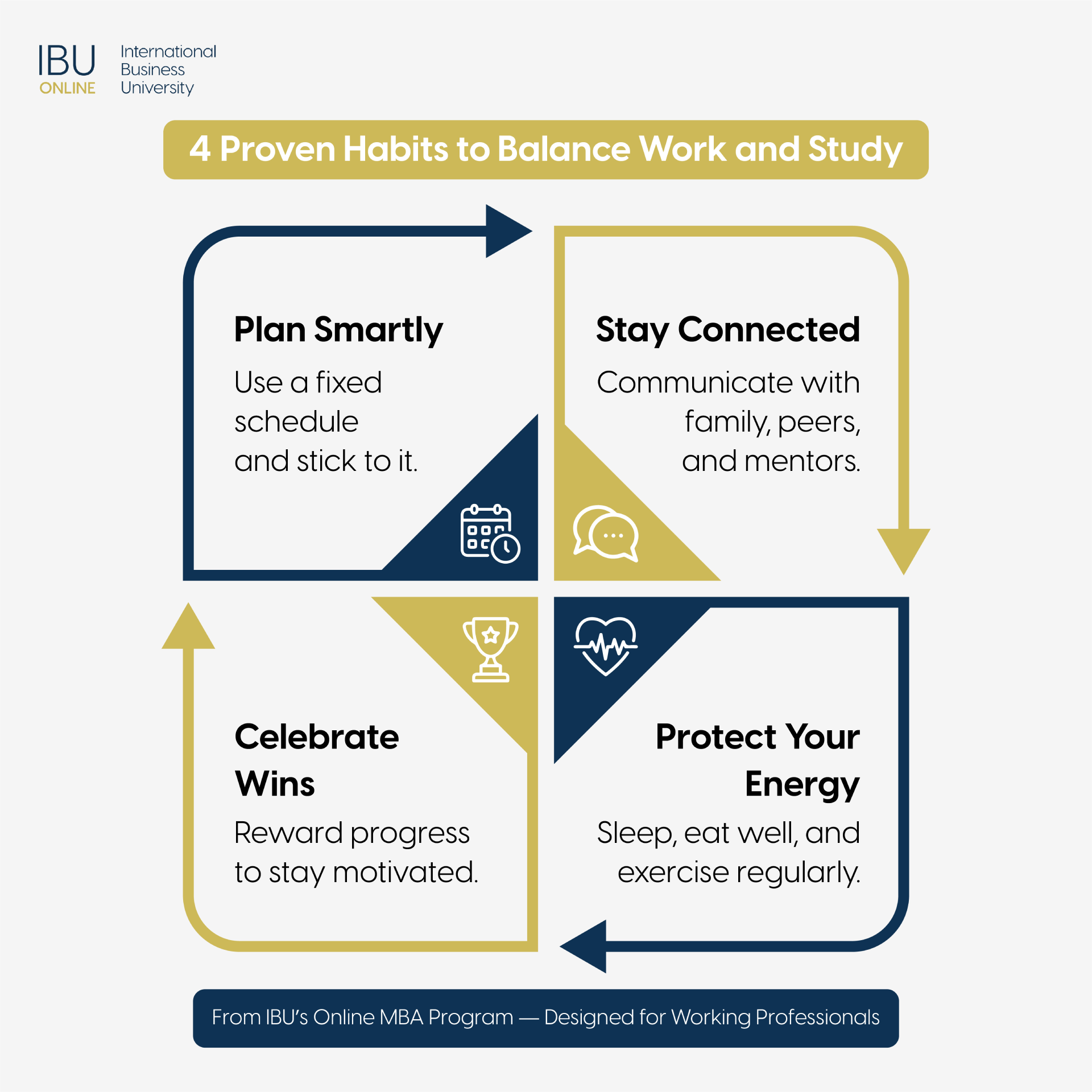
- Set a schedule: If you work 9–5, consider blocking an hour early in the morning or during quiet evening hours for coursework. Short, consistent sessions are more effective than irregular marathon study days.
- Prioritize tasks: Keep one master list for all work and study deadlines. This helps you track what’s urgent and what can wait. Integrating both sides of your life into one calendar ensures you never double-book yourself.
- Plan for flexibility: Include open time blocks in your week. Unplanned work meetings or family responsibilities are inevitable, and having “buffer time” helps you stay on track even when life intervenes.
The top online MBA programs emphasize planning and adaptability. Developing these habits early not only helps you complete your degree but also strengthens your leadership and organizational skills in the workplace.
Main Text: Build the Habits Through an Online MBA
Apply now and start building a study schedule around your job, not against it.
Virtual Study Tools That Actually Save Professionals Time
Technology is your strongest ally in learning how to balance work and study effectively. Modern students have access to countless digital tools that simplify time management and improve productivity.
Apps like Notion, ClickUp, or Shift help organize coursework and reminders. Cloud-based storage tools ensure your assignments are accessible from anywhere, while video conferencing platforms make collaboration easier for group projects.
Through IBU’s Online MBA, students gain access to digital libraries, writing guides, and peer discussion forums where knowledge exchange happens daily. These tools create a flexible and connected environment ideal for professionals.
If you’re evaluating top online MBA programs, make sure the platform supports your learning preferences, flexibility, accessibility, and interaction are important for your success.
Master Work-Study Balance with Healthy Habits
True mastery of how to balance work and study goes beyond scheduling; it’s about sustaining your mental and physical health. Without good habits, even the best time management system will fail.
- Maintain physical energy: Eat nutritious meals, stay hydrated, and schedule short exercise sessions. Movement sharpens focus and improves mood.
- Protect your rest: Sleep fuels learning. Avoid late-night cramming sessions by setting a study cut-off time and keeping a consistent sleep routine.
- Reduce stress: Build small breaks into your day. Short walks, meditation, or even social time with family can restore balance.
Managing stress also means knowing when to say no. Be realistic with your commitments and set boundaries to protect your study and rest time. When you maintain balance, your productivity and quality of learning stay high.
Building a Support System During Your Online MBA
No one succeeds alone. A strong support network is an underrated but vital part of successfully balancing work and study.
Tell your family and close friends about your schedule and study plans so they understand your time constraints. When people around you know what you’re working toward, they’re more likely to offer patience and encouragement during demanding periods.
At work, communicate openly with your employer or manager. Many organizations support continuing education and may offer flexible arrangements or professional development funding.
Your classmates are another powerful resource. Virtual cohorts in IBU’s online MBA programs in Canada form close connections through study groups and discussion boards. Sharing challenges and strategies with peers helps you stay grounded and motivated.
If you’re considering joining an Online MBA Program, read more about the IBU Online MBA in Technology Innovation & Entrepreneurship, Global Business Management, or Healthcare Management to see how collaborative learning works in practice.
Staying Motivated and Avoiding Burnout
Even the most disciplined professionals hit motivational walls. Understanding how to balance work and study long-term requires strategies to stay focused and prevent burnout.
Start by defining your “why.” Why did you choose this degree? Even if it’s career growth, leadership advancement, or entrepreneurship, keep that purpose visible, write it down or post it where you study.
- Set achievable milestones: Celebrate small wins, like completing a course or submitting an assignment early. Rewarding progress keeps your drive alive.
- Manage burnout proactively: Recognize the signs early, fatigue, irritability, loss of focus, and take action. Rotate between study and leisure to reset your energy.
- Seek accountability: Regular check-ins with peers or mentors help sustain consistency. They remind you that progress, not perfection, defines success.
Many professionals find that studying with IBU’s Online MBA degree programs helps maintain motivation because of the flexibility, community, and ongoing academic support built into the curriculum.
Challenges Balancing Work and an Online MBA Nobody Talks About
Challenges balancing work and an online MBA go beyond the obvious time crunch, and understanding how to balance work and study through these specific friction points is what most program overviews leave out. Several of the harder problems only show up a few months into the program, after the initial motivation has worn off.
- Motivation dips mid-program: the first few weeks run on enthusiasm, but motivation typically drops around the midpoint of a term. Defining a clear reason for pursuing the degree, and keeping it visible, helps carry students through that stretch.
- Group project coordination across time zones and schedules: asynchronous formats make this easier than a fixed class schedule, but coordinating a group assignment with classmates who also work full-time still requires deliberate planning well ahead of deadlines.
- Underestimating workload variability: students who plan for a flat number of hours every week are consistently caught off guard by heavier weeks around major assignments. Building buffer time into the schedule in advance prevents this from becoming a crisis.
- Reluctance to set boundaries at work: many professionals hesitate to tell a manager about their study schedule, then end up sacrificing study time to unplanned work demands. Most organizations are more supportive of continuing education than students expect, and an early conversation tends to head off this conflict, a small step that makes how to balance work and study far easier for the rest of the program.
IBU’s guide to the challenges of online learning for an MBA covers the technical and learning-format side of this list in more detail, and IBU’s breakdown of the advantages of an online MBA in Canada covers the upside that tends to offset these challenges once a student is a few months in.
Study Without Pausing Your Career
Explore flexible Online MBA options built for working professionals.
Key Takeaways

Structure beats motivation: a fixed weekly schedule, not willpower, is what actually answers how to balance work and study for most professionals.
Tools and support systems matter as much as time management: digital planning tools and a clear support network at home and at work reduce the friction that causes most students to fall behind.
Burnout is predictable and preventable: recognizing early signs and building rest into the schedule keeps performance steady across the full length of the program.
Frequently Asked Questions
How do you balance work and study during an online MBA?
How to balance work and study during an online MBA comes down to a fixed weekly schedule, strategic use of digital planning tools, and a support system at home and at work that knows about the time commitment in advance. Students who treat study blocks as non-negotiable appointments are consistently the ones who finish on schedule.
How many hours do MBA students study each week?
Most part-time and online MBA students spend 15 to 20 combined hours per week on coursework, reading, and assignments. For IBU’s 16-month Online MBA, that typically means two to three weekday evenings plus a longer weekend session, with some weeks running heavier around major assignments.
What are the biggest challenges balancing work and an online MBA?
The biggest challenges include a motivation dip around the midpoint of each term, coordinating group projects with classmates who also work full-time, underestimating how much workload varies week to week, and hesitating to set boundaries with an employer about study time.
Is an online MBA worth it for working professionals?
An online MBA is worth it for most working professionals who complete it, given that Statistics Canada data shows a 27 to 28 percent earnings advantage for business master’s degree holders over bachelor’s degree holders in the same field. IBU’s article on the advantages of an online MBA in Canada covers the return on investment question in more detail.
What is an online MBA program and how does it work?
An online MBA program delivers the same core business curriculum as an on-campus degree through asynchronous coursework, scheduled video sessions, and digital collaboration tools, structured around a working professional’s schedule rather than a fixed campus timetable.
How long does IBU's online MBA take to complete?
IBU’s Online MBA is structured to be completed in about 16 months, faster than the traditional two-year, full-time MBA timeline, while still covering the core business curriculum across finance, strategy, operations, and leadership.
The Smart Way Forward: Mastering How to Balance Work and Study
Learning how to balance work and study is more than an academic exercise. The structure, discipline, and resilience built over the course of an MBA carry directly into how a graduate manages a team, a budget, or a project once the degree is finished.
With IBU’s Online MBA, students get a 16-month format, flexible scheduling, and a support network built specifically for people who are not pausing their careers to study. Across the Global Business Management, Healthcare Management, and Technology Innovation and Entrepreneurship streams, the underlying answer to how to balance work and study stays the same: build the structure early, protect it consistently, and let the support system around you carry some of the weight.
Start Your Online MBA With IBU
Build your schedule, support system, and leadership skills.