
A university credit transfer lets you continue your education at International Business University (IBU) without losing the coursework you’ve already completed. Many students begin their studies elsewhere before realizing they can apply that prior coursework to a new program in Canada more efficiently.
At IBU, you can apply for transfer credits toward our Bachelor of Commerce (BCOM), including the BCOM in Business Management specialization, or Master of Business Administration (MBA) programs, saving both time and tuition. Here’s how the transfer credit process works and what you should know before applying.
Key Takeaways
- The university credit transfer process allows students to carry previously earned credits to a new institution, helping them save time and costs.
- IBU’s BCOM and MBA programs accept eligible transfer credits after an academic assessment of equivalency and recency.
- Understanding how to transfer credit from one university to another makes the transition into your next academic phase clearer.
What Are Transfer Credits and How Do They Work?
A university credit transfer recognizes academic achievements earned at another post-secondary institution. When you move to a new program or transfer university, approved credits from your previous studies are applied toward your new degree requirements. That means you don’t have to repeat equivalent courses, shortening the time to graduation and aligning your learning experience with your career goals.
Transfer credits are often categorized as vertical or horizontal:
- Vertical transfer: credits move from a lower qualification (e.g., diploma) to a higher one (e.g., bachelor’s or master’s).
- Horizontal transfer: credits move between programs at the same academic level, such as from one bachelor’s program to another.
Once you understand how credit transfer works at university, you can plan your next steps around a degree that builds on what you’ve already achieved.
Eligibility Criteria for the University Credit Transfer Process
Each institution sets its own rules for credit transfer. At IBU, the process involves reviewing your previous coursework to confirm it meets academic standards and program relevance.
If you’re transferring to the MBA program, your previous credits must show:
- A minimum grade of “B” (73%) or higher.
- A strong match in course content, learning outcomes, and academic depth.
- Recency of completion (credits older than five years may not qualify).
IBU’s BCOM program follows a similar review process, requiring that your prior courses align closely with the learning objectives of the program.
Transfer limits apply:
- Up to 60 credits can be transferred toward the 120-credit BCOM.
- Up to 21 credits can be transferred toward the 42-credit MBA.
These policies protect academic consistency while rewarding your prior achievements.
How to Transfer Credits to IBU’s BCOM and MBA Programs
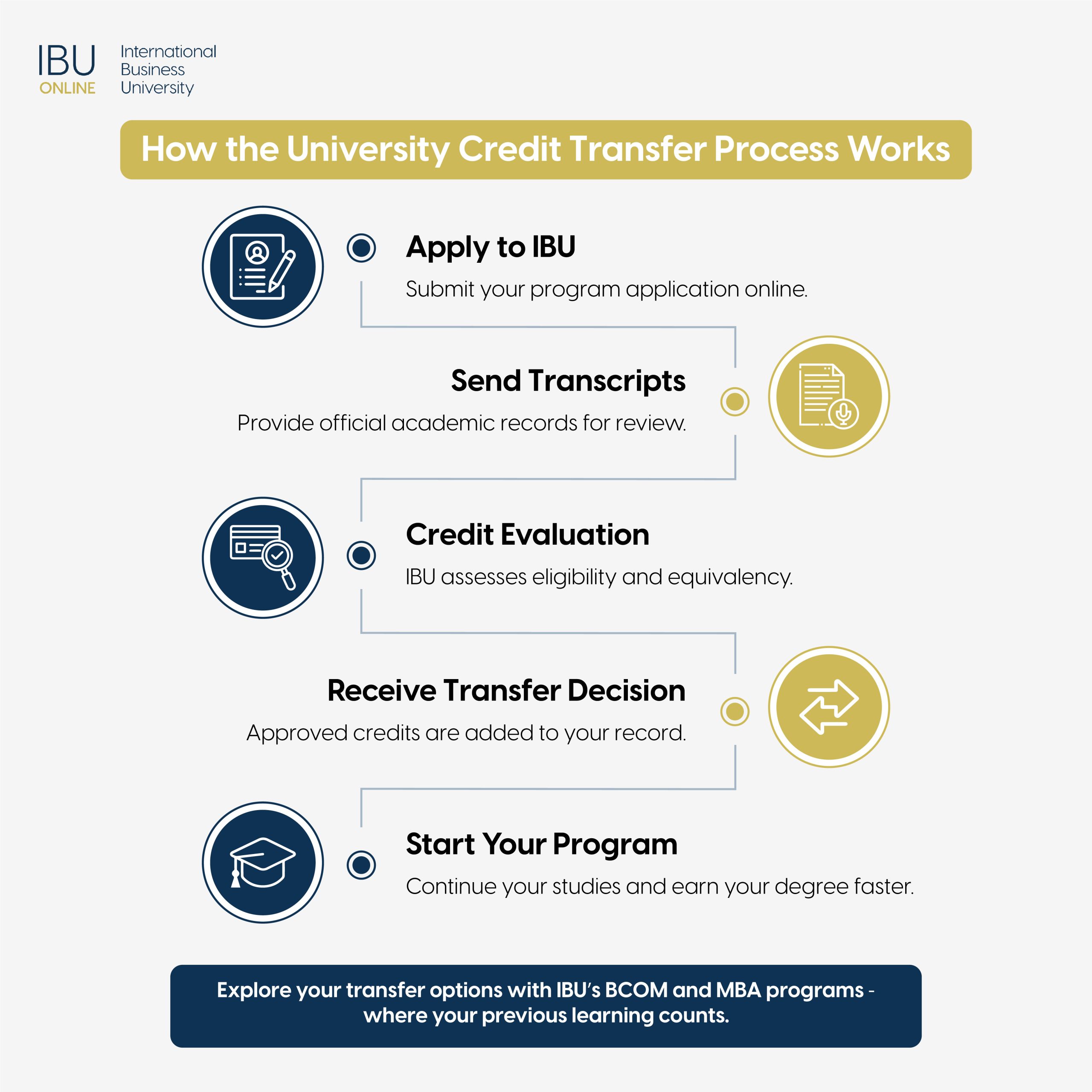
If you’re wondering how to transfer to a university like IBU, the process begins with a simple step: contacting the Admissions Department. You’ll be guided through eligibility checks, documentation, and next steps.
Here’s a quick overview of how to apply for a transfer credit in a Canadian university:
- Apply for your chosen IBU program (BCOM or MBA).
- Provide transcripts showing previously completed courses.
- Fill out the Credit Transfer Request Form provided by the Admissions team.
- Await course evaluation, where equivalency and grade requirements are assessed.
- Receive a transfer decision confirming approved credits.
Once your transfer credits are approved, you’ll receive an updated program outline showing the remaining courses required for graduation.
You can find answers to common transfer-related questions in IBU’s Credit Transfer FAQ.
How Does Credit Transfer Work Between Universities in Canada?
Understanding how to transfer credit from one university to another shows you what to expect before you apply. When moving between institutions, the receiving university assesses your transcripts to confirm academic equivalence.
Factors that affect transfer approval include:
- The level and accreditation of your previous institution.
- Similarity of course learning outcomes.
- Recency and grades earned.
- Program capacity and available credit transfer limits.
In Canada, credit evaluation is guided by institutional autonomy, meaning universities determine their own acceptance standards while aligning with national academic quality frameworks.
This flexibility allows IBU to recognize international, domestic, and inter-provincial learning experiences under fair and transparent standards.
Benefits of a University Credit Transfer
A university transfer provides multiple advantages for students aiming to complete a degree efficiently. With recognized transfer credits, you can:
- Reduce costs by avoiding repetition of completed courses.
- Graduate faster, shortening your study duration.
- Customize your education, taking advanced electives that match your career goals.
- Broaden your experience by combining learning across different institutions and disciplines.
Many students use university credit transfer pathways in Canada to move from a diploma to a bachelor’s, or to switch into a program that better fits their career interests.
Apply Your Existing Coursework
Apply now instead of retaking courses you’ve already passed.
Understanding the Difference Between Course Transfers and Program Transfers
When considering a university transfer, it’s useful to distinguish between course-level and program-level transfers.
- Course Transfers: Occur when individual subjects from your previous studies are matched and counted toward equivalent IBU courses.
- Program Transfers: Apply when an entire academic credential (such as a diploma or partial degree) is recognized toward a new qualification.
Both paths require careful academic assessment to confirm your prior learning aligns with IBU’s academic framework.
IBU’s credit transfer system maintains fairness through the academic integrity of every program while rewarding prior effort and knowledge.
Preparing Your Application for a Smooth Credit Transfer
Before starting your transfer, prepare all required documentation to streamline the process. Most universities, including IBU, request:
- Official academic transcripts.
- Course outlines or syllabi for previously completed subjects.
- Proof of grades and dates of completion.
If your credits were earned internationally, translations and verification documents may be required. IBU’s Admissions team helps students understand each step so their application meets the eligibility criteria efficiently.
Proper preparation gives your credits an accurate review and moves your transition into the new program along more smoothly.
Exploring Transfer Credit Opportunities for MBA Students
Prior master’s-level coursework can transfer into IBU’s MBA program when it matches the curriculum’s learning objectives.
For example, previous graduate courses in accounting, finance, or leadership may qualify for up to 21 transferable credits. IBU’s MBA Transfer Credit Policy outlines the details of eligibility, documentation, and approval timeframes.
Navigating the Path to Your Next Degree
Pursuing a university credit transfer means building on your past success rather than starting from scratch. IBU runs a fair and supportive process for students transitioning from local or international institutions.
Students transferring into the BCOM or MBA programs gain access to modern business education that emphasizes strategy, innovation, and leadership. Every transfer credit approved at IBU reflects a step closer to your professional goals and a stronger academic foundation.
Start Your Transfer
Apply now so your prior coursework counts toward your degree instead of starting over.
Frequently Asked Questions
Can you transfer credits into an MBA program?
Yes. IBU accepts up to 21 transferable credits toward its 42-credit MBA, provided prior graduate coursework matches the program’s learning outcomes and meets a minimum grade of B.
Which MBA programs recognize previous business education or transfer credits?
IBU’s MBA program recognizes prior graduate-level coursework in areas like accounting, finance, and leadership, evaluated individually for equivalency and recency.
What are transfer credits?
Transfer credits are academic credits earned at one institution that are recognized and applied toward a new degree at another institution, reducing the number of courses you need to repeat.
Do MBA programs accept transfer credits from other universities?
Many do, including IBU, though each program sets its own eligibility rules around grade minimums, course equivalency, and how recently the credits were earned.
Build a Career Trajectory, Not a Single Starting Number
Evaluating data engineer income by starting salary alone misses the larger financial picture, since the credential and skill choices made early in a career shape the trajectory over the following decade far more than the first offer does. Focus on building the specific technical skills that correlate with senior compensation: cloud infrastructure, machine learning pipelines, and real-time processing, rather than optimizing only for the first job title. Consider how a graduate credential fits into that longer trajectory before evaluating it purely against entry-level salary data.
Build a career trajectory, not just an entry-level job.
Explore IBU’s MSc in Applied AI, Data Engineering specialization.