
If you want to know how to become a data analyst, a business degree can give you a stronger starting point than you might expect. The data analyst career path is one of the most consistently in-demand in Canadian employment, and the candidates who move into it most quickly are not always the ones who studied data science or statistics.
Business graduates, BCOM and MBA holders, bring something that pure technical candidates frequently lack: the organizational context, financial literacy, and communication skills that make analysis genuinely useful to the people who need to act on it.
What Data Analysts Actually Do Inside Canadian Organizations Today
The data analyst role has expanded significantly in scope over the past decade. The stereotype, someone who runs reports and builds spreadsheets, persists in some organizations but increasingly understates what strong analysts actually do.
Descriptive Analysis and Reporting
The foundational function: what happened? Data analysts build the dashboards, reports, and metrics that answer this question consistently and reliably across an organization. Revenue trends, customer acquisition metrics, operational performance indicators, and financial reporting are all examples of descriptive analysis work that most data analyst roles include in some proportion.
Diagnostic Analysis
Why did it happen? Diagnostic analysis goes beyond reporting to identify the factors driving observed outcomes, why customer churn increased this quarter, why a particular campaign underperformed, and why operational costs spike in a specific region. This is where analytical reasoning and business context intersect, and where business graduates have a distinct advantage over analysts with purely technical backgrounds.
Predictive and Prescriptive Analysis
What will happen and what should we do about it? At the advanced end of the data analyst function, analysts use statistical models and machine learning to forecast future outcomes and recommend courses of action. This dimension of the role is increasingly expected even at mid-level analyst positions in technology-forward organizations, and it is the dimension that most clearly benefits from graduate-level education in data analytics.
How to Become a Data Analyst Using a Business Degree as Your Foundation
The transition from a BCOM or MBA into a data analyst role is well-documented and well-traveled. The specific path varies by background, but the key components are consistent across successful transitions.
Identify the Right Entry Point
A data analyst is not a single job level, it spans from junior business intelligence report builders to senior statistical modelers. The right entry point for a BCOM graduate is typically a junior or associate data analyst role or a business analyst role with a data emphasis. MBA graduates can often enter at the mid-level analyst or senior analyst tier, depending on their existing quantitative background and the domain expertise they bring.
Build the Core Technical Toolkit
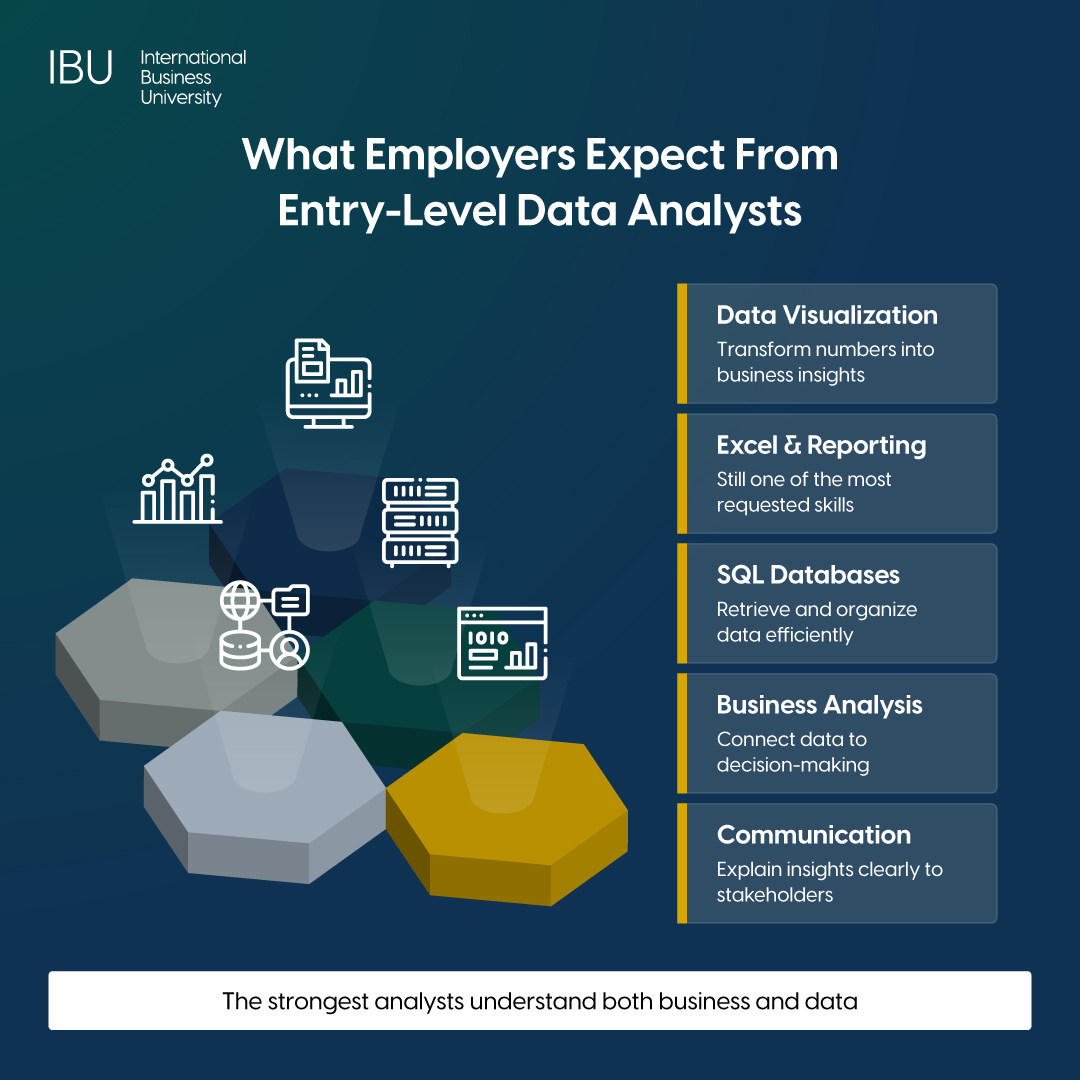
Business graduates entering data analytics typically need to build specific technical skills that business programs cover lightly or not at all. The core toolkit for entry-level data analyst roles in Canada currently includes:
- SQL, the most universally required data skill; learn to write queries, joins, aggregations, and window functions
- Excel, beyond basic formulas; pivot tables, VLOOKUP, and basic statistical functions at a minimum
- Tableau or Power BI, data visualization tools used by most Canadian corporate analytics teams
- Python or R, for analysts targeting more technical roles; Python with pandas is the most common starting point
These skills are learnable through systematic online courses in 100 to 200 hours of focused effort. The combination of business foundation and these technical skills positions BCOM and MBA graduates well above the entry-level technical candidates who have the tool skills but lack the business context.
Build Your Data Analytics Career at IBU
IBU’s BCOM and MBA programs include analytics specializations with applied data skill development.
Why BCom and MBA Graduates Have a Head Start in the Data Analyst Career Path
The data analyst career path rewards a specific combination: technical capability to work with data and the business understanding to translate analysis into recommendations that decision-makers can act on.
Pure technical candidates, data science graduates, statistics majors, often have excellent tool skills and quantitative foundations. Many struggle with the business communication, stakeholder management, and organizational context dimensions that make analysis genuinely impactful.
Business graduates who build the technical toolkit are genuinely differentiated because they already have the other side. They know how financial statements work, they understand organizational decision-making, they can write and present clearly, and they have spent years in programs that required them to translate complex information for non-expert audiences.
Domain Expertise Accelerates Career Trajectory
Data analysis is more valuable when the analyst understands the domain they are analyzing. A BCOM graduate with a finance concentration who builds SQL and Python skills is an exceptionally strong candidate for financial data analyst roles, not just because of the technical skills but because they can build models that reflect financial reality accurately and can communicate findings to finance teams in terms they immediately understand.
This domain expertise advantage compounds over time. Analysts who combine data skills with deep domain knowledge in healthcare, financial services, retail, or technology consistently advance faster and command higher compensation than generalist data analysts at equivalent technical skill levels.
Business Analyst Career Path vs Data Analyst Career Path: Know the Difference
Business analyst and data analyst roles are related but distinct, and confusing them leads to job applications that do not align with what the role actually requires.
Business Analyst
Business analysts work at the intersection of business operations and technology or process improvement. They gather requirements, document processes, identify inefficiencies, and translate business needs into actionable initiatives. Their outputs are primarily process improvements, requirements documents, and solution recommendations. Strong business analysts are excellent at stakeholder management, systematic problem-solving, and communication, data skills are a supplement to these capabilities, not the primary value.
Data Analyst
Data analysts work primarily with data, collecting, cleaning, analyzing, and visualizing data to answer specific business questions. Their outputs are analyze, visualizations, dashboards, and data-driven recommendations. Strong data analysts are excellent at SQL, visualization tools, statistical reasoning, and translating analytical findings into business terms, business skills complement these capabilities.
The practical distinction: if you are drawn to understanding how organizations work and improving processes, business analyst is typically a better fit. If you are drawn to working with data directly, querying databases, building visualizations, building models, data analyst is the right path. Many professionals work across both roles, but understanding which your primary orientation is produces more focused career development.
Tools Every Entry-Level Data Analyst in Canada Is Expected to Know
Based on current Canadian job postings for entry-level and junior data analyst roles, the following tools appear most frequently as requirements.
- SQL: Present in over 80% of entry-level data analyst postings. Learn PostgreSQL or MySQL syntax, the concepts transfer across platforms.
- Excel: Present in virtually every data analyst posting that involves any corporate or non-technology environment. Master pivot tables, XLOOKUP, and basic statistical functions at a minimum.
- Tableau or Power BI: Data visualization tools required for dashboarding and reporting functions. Power BI is dominant in Microsoft ecosystem organizations; Tableau is more common in technology companies. Learn one to a strong level rather than both superficially.
- Python with pandas: Increasingly required for roles with data manipulation, automation, or modeling components. The pandas library for data manipulation and matplotlib or seaborn for visualization are the most relevant starting points.
- Google Analytics or equivalent: Required for digital marketing and e-commerce adjacent analyst roles. Foundational web analytics concepts transfer across platforms.
Finance Careers Canada: The Sector Hiring the Most Data Analysts Right Now
Financial services is the single largest employer of data analysts in Canada, driven by regulatory reporting requirements, risk management complexity, customer analytics, and the ongoing shift from intuition-based to data-driven financial decisions.
Banks, insurance companies, asset managers, and fintech firms all maintain large analytics teams. BCOM and MBA graduates with finance backgrounds are genuinely competitive for these roles, the combination of financial literacy and data tool skills is rare and highly valued.
Healthcare is the second-largest and fastest-growing sector for data analyst hiring in Canada, driven by the digital health investment cycle, electronic health record implementations, and population health management priorities. Business graduates with an interest in healthcare who build data skills are in an especially strong position for this sector.
IBU’s blog on healthcare data analytics for students covers the specific analytics tools and career pathways in healthcare data in more detail for students evaluating this direction.
How to Build a Portfolio Before You Graduate That Gets You Shortlisted
A data analyst portfolio demonstrates that you can do the work, not just that you studied the tools. Hiring managers reviewing applications from BCOM and MBA graduates will give significantly more weight to two or three completed analysis projects than to a list of courses completed.
Personal Projects That Demonstrate Applied Skill
The most effective portfolio projects answer a specific question using publicly available data, Canadian labor market data from Statistics Canada, sports performance data, financial market data, and healthcare utilization data, with a clear methodology, a meaningful finding, and a visualization that communicates the result clearly.
A project that asks ‘which Canadian cities show the strongest correlation between post-secondary education levels and median income, and has this relationship changed over the past decade?’ and answers it with a well-systematic analysis in Python and a Tableau dashboard demonstrates more capability than a list of 10 online course certificates.
Kaggle Competitions and Public Datasets
Kaggle is the most widely recognized platform for public data science competitions and datasets. Completing even one Kaggle competition, even without placing, and including the methodology and results in a portfolio demonstrates applied data analysis capability in a format that technical hiring managers recognize immediately.
Making Your Portfolio Visible
A GitHub repository with well-documented analysis projects is the standard format for data analyst portfolios. A personal website with a brief write-up and visualizations for each project makes the work accessible to hiring managers who are not comfortable navigating GitHub. Both together are ideal.
What IBU Programs Give You That Pure Tech Bootcamps Do Not
Data analytics bootcamps and online technical programs produce SQL and Python skills efficiently. They typically do not produce business communication skills, financial literacy, organizational context, or the professional judgment that determines how analysis is framed, who it is presented to, and what recommendation follows from it.
IBU’s BCOM and MBA programs build a combination: analytical foundations alongside the business and interpersonal competencies that make analysis useful in organizations.
MBA graduates from IBU’s Financial and Management Analytics specialization are specifically positioned for data analyst roles in corporate finance, financial services, and healthcare, the three sectors with the strongest Canadian demand, because the program builds domain expertise alongside analytical capability.
Key Takeaways

Business context is what pure technical candidates lack: BCOM and MBA graduates who build data skills are competitive precisely because they bring the organizational understanding that makes analysis actionable.
SQL and visualization tools are the non-negotiable starting point: SQL and one visualization platform (Tableau or Power BI) are required for the vast majority of entry-level data analyst roles in Canada.
Domain expertise compounds the advantage: Finance-focused BCOM graduates entering financial data analysis, or healthcare-focused MBA graduates entering health analytics, build careers faster than generalist analysts at equivalent technical skill levels.
Portfolio work outweighs course certificates: Two or three well-documented analysis projects demonstrating applied skill outperform a list of completed courses in most hiring decisions.
Finance and healthcare are the largest hiring sectors: Financial services and healthcare are the two sectors with the strongest and most consistent data analyst hiring in Canada, both heavily reward business domain expertise alongside data skills.
Frequently Asked Questions
How long does it take to transition into a data analyst role from a BCOM or MBA?
For a BCOM or MBA graduate who actively builds the technical toolkit, SQL, Excel, and one visualization platform, while in their final year or immediately after graduation, a transition into a junior or entry-level data analyst role typically takes three to six months of job searching after the skills are developed.
The timeline is significantly shorter for graduates who develop some analytical work experience during school, through capstone projects, internships with data components, or case competitions involving data analysis, because the portfolio of demonstrated capability is already partially built before the job search begins.
Do I need a statistics degree to become a data analyst?
No. Most entry-level and mid-level data analyst roles in Canadian corporate environments require practical analytical reasoning and tool proficiency, not graduate-level statistical theory. Understanding of descriptive statistics, basic hypothesis testing, and the ability to interpret regression outputs are sufficient for the vast majority of data analyst roles outside of specialized statistical modeling or research functions.
What differentiates strong analysts from average ones is not the depth of their statistical theory but the quality of their analytical judgment, knowing which question to ask, how to frame the analysis to answer it, and how to communicate the finding so decision-makers can act on it. Business graduates typically develop this judgment through their programs.
What is the average salary for a data analyst in Canada?
Entry-level data analyst salaries in Canada typically range from $55,000 to $75,000 depending on industry, location, and the technical depth of the role. Senior data analyst roles command $85,000 to $120,000. Business intelligence and analytics manager roles that data analysts advance into typically range from $100,000 to $150,000 in financial services, technology, and healthcare.
Toronto remains the highest-compensation market for data analyst roles in Canada, followed by Vancouver and Calgary. Remote-eligible positions have somewhat compressed geographic salary differentials over the past three years.
The Data Analyst Career Starts With the Right Foundation
How to become a data analyst with a business degree is not a complicated question. The answer is: build the technical toolkit, leverage your business foundation as a differentiator, create portfolio work that demonstrates applied capability, and target the sectors where business domain expertise adds the most value.
The business degree is not a disadvantage in this transition. For candidates who approach it deliberately, it is one of the strongest starting positions available in the Canadian data analyst market.
Check Your Eligibility for an Analytics-Focused MBA
A business degree can become a stronger data analytics credential when it is paired with graduate study in finance, management, and applied analytics.