

Hospitals run on data now, not just instinct. Every diagnosis, discharge, and drug order creates a record. Someone must turn that record into a decision. That someone is a healthcare data analytics professional. Canada’s health system is short on people with these skills. Students who build them early will not wait long for their first offer.
Key Takeaways
- The healthcare analytics market is expanding at scale: According to Grand View Research’s 2024 healthcare analytics market report, the global healthcare analytics market reached USD 52.98 billion in 2024. It is projected to grow to USD 198.79 billion by 2033 at a 14.85% CAGR.
- Healthcare data analytics jobs pay well in Canada: Average health data analyst salaries in Canada reach $98,502 annually. Top earners in Ontario regularly exceed $110,000 per year.
- Students need healthcare data analytics training now, not later: Employers across hospitals and public health agencies actively seek analytics-ready graduates. Starting your healthcare analytics education before you graduate gives you a distinct hiring advantage.
What Is Healthcare Data Analytics
Healthcare data analytics is the structured analysis of health-related data. It changes basic clinical and operational data into useful information. That information helps guide decisions across the entire healthcare system. IBU’s MBA in Healthcare Management trains students to apply data analytics in healthcare industry contexts.
How Healthcare Data Analytics Differs From General Analytics
General analytics applies across any industry with usable data. Healthcare data analytics operates under strict privacy and clinical rules. Analysts must understand PHIPA, HIPAA, and health data governance standards. The stakes are higher because the data directly affects patient safety. A billing error in retail is inconvenient; a clinical error costs lives. This distinction shapes everything about how healthcare analysts are trained.
The Four Core Types of Healthcare Analytics
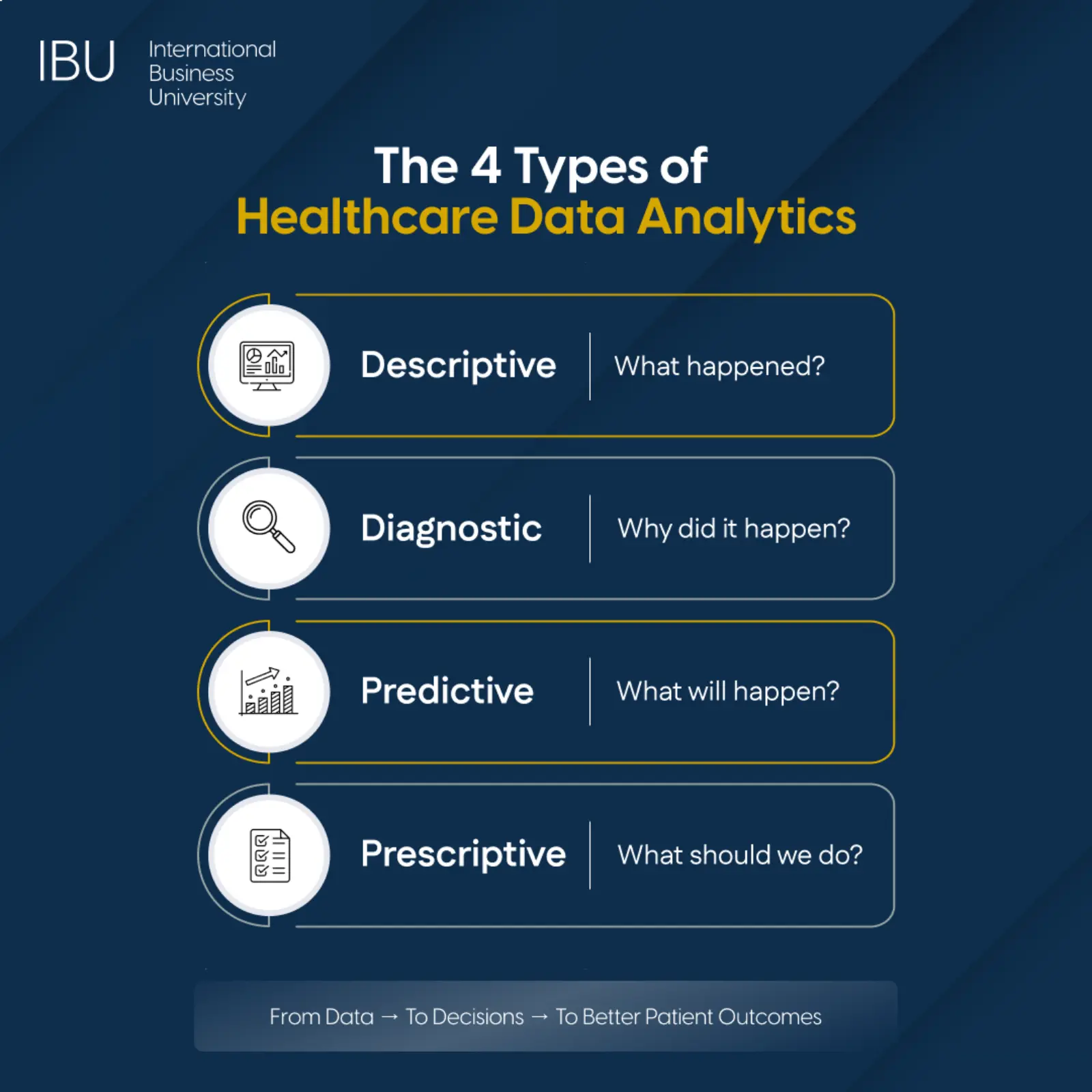
Healthcare analytics is categorized into four types by function. Each type serves a different purpose in the healthcare decision cycle. Most organizations use all four, often in combination.
- Descriptive analytics: This type summarizes what happened in patient care and operations.
- Diagnostic analytics: This type identifies why a particular health outcome occurred.
- Predictive analytics: This type forecasts which patients face future health risks.
- Prescriptive analytics: This type recommends a specific clinical or operational action.
Why Healthcare Data Analytics Matters for Students Entering Healthcare
Healthcare analytics affects every role in the sector now. Nurses use dashboards to track patient deterioration in real-time. Hospital administrators use analytics to cut costs without cutting care. Policymakers use population data to allocate public health resources. Students who arrive analytics-ready step into these conversations immediately. Those without that background spend their first years catching up.
How Healthcare Analytics Improves Patient Outcomes
Predictive models identify sepsis risk before symptoms become critical. Readmission risk scores allow discharge teams to plan better follow-up. Medication error tracking systems catch dangerous combinations automatically. These are concrete healthcare analytics examples already saving lives in Canada. Every one of them depends on trained professionals to build and maintain. That is where students entering healthcare today have a legitimate opportunity.
Why the Demand for Healthcare Analytics Professionals Is Growing
Canada’s aging population generates more health data every year. Electronic health records now exist in nearly every major hospital. Value-based care models require evidence to prove outcomes, not just effort. Insurers and governments demand more transparency in spending and results. Each of these pressures creates a new need for trained analysts. Healthcare analytics education has not kept pace with that demand yet.
- Better patient outcomes: Analytics helps clinicians identify risk and intervene earlier in care.
- Lower operational costs: Hospitals use data to reduce waste without compromising patient safety.
- Faster clinical decisions: Real-time dashboards support quicker and more accurate treatment choices.
- Stronger career readiness: Graduates with analytics skills are sought across every sector role.
Types of Healthcare Data Students Should Understand
Healthcare data comes from dozens of sources with different structures. Each type requires a different approach to clean, manage, and interpret. Students entering healthcare analytics need a working knowledge of all seven.
1. Electronic Health Records
Electronic health records are the backbone of clinical data analytics. They contain diagnoses, prescriptions, lab results, and treatment histories. Most Canadian hospitals use Epic or Cerner as their primary EHR platform. Analysts extract EHR data to identify patterns across patient populations. Poor EHR data quality is one of the most common analytics challenges. Students who understand EHR structure arrive more prepared than most graduates.
2. Administrative and Claims Data
Administrative data covers billing, insurance claims, and service records. It reveals how often services are used and what they cost. This is one of the most commonly used data types in healthcare analytics examples. Financial and operations analysts rely on it for cost modeling. Government agencies use claims data to evaluate program efficiency. Analysts must understand billing codes like ICD-10 and OHIP categories.
3. Clinical Trial Data
Clinical trial data come from carefully conducted medical studies. It helps doctors and researchers make informed decisions about treatments and patient care. Healthcare data analytics professionals help clean and interpret these datasets. This data is heavily regulated under the Health Canada and FDA frameworks. Working with it requires both statistical rigor and ethics training. Pharmaceutical and biotech companies hire specifically for this specialization.
4. Genomic and Precision Medicine Data
Genomic data links genetic profiles to disease risk and treatment response. It powers personalized medicine and targeted cancer therapies. Analyzing genomic data requires advanced bioinformatics tools and training. Cancer centers and research hospitals are the primary employers in this area. This is the fastest-growing specialization within healthcare data analytics. Graduate-level education is typically required for these roles.
5. Wearable and Remote Monitoring Data
Wearable devices now track heart rate, glucose, sleep, and activity levels. Remote patient monitoring connects home-based patients to care teams digitally. This data arrives continuously and at high volume, requiring real-time systems. Healthcare analytics teams process these streams to flag deterioration early. Telehealth expansion in Canada has made this a high-growth data category. Students with IoT and streaming data skills will be highly competitive here.
6. Population Health Data
Population health data captures health trends across communities and regions. Public health agencies use it to track outbreaks and distribute resources. Provincial and federal governments fund large population health data programs. Analysts in this space work directly with Statistics Canada datasets. This is a core area of data analytics in the healthcare industry nationally. Students interested in public health policy often start here.
7. Survey and Patient-Reported Outcomes Data
Patients report their own experiences through structured health surveys. This data captures quality-of-life, treatment satisfaction, and symptom burden. Healthcare analytics professionals use it to evaluate patient-centered care. It is harder to validate than clinical data but equally important. Survey instruments like PROMIS and EQ-5D are standard in this category. Combining patient-reported data with clinical records produces richer analysis.
Analyze Healthcare. Lead Change.
IBU’s Healthcare MBA builds real analytics management skills.
Skills Students Need for Healthcare Data Analytics
Healthcare data analytics requires both technical and domain-specific skills. Technical skills without a healthcare context produce incomplete analysis. A healthcare context without technical skills leaves insights inaccessible. The strongest healthcare analytics professionals develop both simultaneously. Healthcare data analytics training at the graduate level builds both. The skills below appear consistently across healthcare analytics job postings.
- Statistical analysis: Interpret patterns and test hypotheses using quantitative modeling methods.
- SQL and database management: Query and manage large healthcare databases accurately and efficiently.
- Data visualization: Present insights clearly through dashboards, charts, and executive reports.
- Health informatics knowledge: Understand EHR structures, HL7, FHIR, and SNOMED data standards.
- Python or R programming: Automate data cleaning, modeling, and reporting across large datasets.
- Critical thinking: Evaluate data quality and draw valid conclusions from incomplete records.
- Communication skills: Translate findings into recommendations non-technical teams can act on.
- Privacy and regulatory knowledge: Apply PHIPA, PIPEDA, and healthcare data governance rules correctly.
- Project management: Coordinate analytics projects across clinical, IT, and administrative teams.
Tools Used in Healthcare Data Analytics
Healthcare data analytics professionals use a defined set of core tools. Each tool serves a distinct stage in the analytics and reporting workflow. Learning these tools is central to any healthcare data analytics training program.
Data Management and Query Tools
SQL is the most widely used data language in healthcare analytics. It allows analysts to extract specific records from massive patient databases. Python and R handle data cleaning, transformation, and pipeline automation. Epic and Cerner provide built-in reporting modules for clinical analysts. Microsoft Azure and Google Cloud are growing platforms for health data storage. Proficiency in at least two of these tools is expected in most job postings.
Statistical and Analytical Software
SAS is the standard statistical platform in pharmaceutical research. SPSS remains widely used for population health and survey-based analyze. Python libraries like Pandas, NumPy, and Scikit-learn support machine learning. R is the preferred tool in academic health research and biostatistics. Most healthcare analytics education programs teach at least two of these. Knowing which tool your employer uses before you apply is a practical advantage.
Data Visualization Platforms
Tableau is the most recognized visualization tool across healthcare organizations. Power BI integrates directly with Microsoft-based hospital IT environments. Qlik and Looker are alternatives used in larger enterprise health systems. Strong visualization separates analysts who report from those who influence. Executives and clinicians act on dashboards, not spreadsheets. Tableau and Power BI skills appear in most healthcare analytics job descriptions.
AI and Predictive Analytics Platforms
AI platforms are now embedded directly in healthcare analytics operations. Oracle Analytics Intelligence supports life sciences and clinical research. Machine learning models detect readmission risk and sepsis probability scores. Natural language processing extracts insights from unstructured clinical notes. IBM Watson Health and Google Cloud Healthcare API are major enterprise tools. Students who understand AI concepts will lead, not just support, these systems.
Career Paths for Students in Healthcare Data Analytics
Healthcare analytics jobs span clinical, administrative, and policy roles. The data analytics career path in healthcare is not a single corridor. It branches depending on your background, training, and interests. Salaries are strong at every level and grow consistently with experience. The bullets below cover the primary paths available after graduation. Each leads to a distinct role with different day-to-day responsibilities.
- Healthcare data analyst: Average salary in Canada reaches $69,922 per Glassdoor’s 2025 healthcare data analyst salary report; top earners exceed $110,000.
- Clinical informatics specialist: This role manages EHR systems and supports clinical decision workflows.
- Population health analyst: This role analyzes community-level data to guide public health programs.
- Health economist: This role evaluates the cost-effectiveness of treatments and care models.
- Biostatistician: This role applies statistical methods to clinical trials and research datasets.
- Healthcare operations analyst: This role uses data to improve hospital scheduling and resource efficiency.
- Health data scientist: This role builds predictive models and machine learning tools for care.
- Quality improvement analyst: This role tracks patient safety indicators and drives clinical process improvement.
- Chief data officer (healthcare): This senior role leads enterprise-wide health data strategy and governance.
The Future of Healthcare Data Analytics in Healthcare Careers
The future of healthcare data analytics is already visible in hospitals today. Predictive analytics is expected to grow at a 26.5% CAGR through 2030. According to MarketsandMarkets’ healthcare analytics market report, the global market will reach USD 166.65 billion by 2030. Canada is directly positioned to benefit from this global growth. The country’s strong public health infrastructure generates enormous data volumes. Students entering healthcare analytics now will spend decades in a growing field.
Artificial Intelligence and Machine Learning in Healthcare
AI is not replacing clinical judgment; it is supplementing it with data. Machine learning models now predict patient deterioration hours in advance. Natural language processing reads physician notes to flag documentation gaps. AI-assisted radiology reduces missed diagnoses in imaging analysis. Healthcare analytics professionals who understand AI will lead these projects. Those who do not will execute tasks defined by someone who does.
Open Banking and Health Data Interoperability
Canada is moving toward open banking and open health data frameworks. The federal government released its consumer-led banking framework in December 2024. Similar interoperability principles are being applied to health data systems. When health data flows more freely between providers, analysts gain richer datasets. Students who understand data governance will be critical in this transition. Privacy-compliant data sharing is one of the most valued skills in the sector.
Value-Based Care and Outcomes Measurement
Canada’s health system is shifting from volume-based to value-based models. Payers now fund outcomes, not just procedures. Proving outcomes requires analytics infrastructure at every stage of care. Quality improvement analysts, health economists, and data scientists power this shift. Students trained in outcomes measurement will have immediate roles to fill. This is where healthcare data analytics intersects with health policy directly.
Precision Medicine and Genomics
Genomic sequencing is becoming faster, cheaper, and more routine. Linking genomic data with clinical records requires advanced analytics capability. Cancer care and rare disease programs are leading this integration in Canada. Healthcare analytics professionals who understand bioinformatics are in short supply. Students with a combined biology and data background hold a rare advantage. Precision medicine analytics is one of the highest-paying specializations available.
- AI-powered diagnostics: Machine learning detects diseases earlier and with greater consistency.
- Real-time health monitoring: Wearables and IoT generate continuous patient streams requiring live analytics.
- Open data interoperability: Health data sharing frameworks will expand the analytical datasets available.
- Precision medicine expansion: Genomic and biomarker data will drive analytics demand for decades ahead.
- Value-based care reporting: Payers and providers will require proof of outcomes at every level of care.
Master Health Analytics
IBU’s Financial Analytics MBA develops data-driven healthcare leaders.
Frequently Asked Questions
What education do I need to work in healthcare data analytics?
Healthcare data analytics education typically starts with a relevant undergraduate degree. Degrees in health informatics, statistics, computer science, or business provide strong foundations. Graduate programs like IBU’s MBA in Healthcare Management or the MBA in Financial and Management Analytics combine analytics training with healthcare management applications, preparing graduates directly for available healthcare analytics jobs.
Are there healthcare analytics jobs available for new graduates right now?
Yes, healthcare analytics is one of the most actively hiring fields in Canada. Entry-level roles include junior data analyst, health informatics coordinator, and quality analyst. Graduates who have SQL proficiency, EHR familiarity, and Tableau experience are particularly sought after across hospitals, insurers, and public health agencies, making early healthcare data analytics training a direct competitive advantage on any resume.
Is healthcare data analytics training available online in Canada?
Yes, multiple Canadian institutions offer online healthcare data analytics training. IBU’s online MBA programs integrate analytics directly into their curriculum structure. IBU’s MBA in Healthcare Management provides structured online delivery that works for working professionals and recent graduates alike, offering healthcare analytics education without requiring a full-time, on-campus commitment.
Make Data Your Competitive Advantage in Healthcare
Healthcare data analytics is not one path; it is the foundation of many. Every major healthcare role now intersects with data in a direct way. Students who invest in healthcare analytics education early will lead faster. The sector is short on trained people, and demand will not slow down. This is one of the clearest signals any healthcare student will receive. The time to build these skills is before you need them, not after.
IBU prepares students for the place where data and healthcare management meet. Its programs build analytical depth alongside healthcare leadership capability. Explore the IBU MBA in Healthcare Management or the MBA in Financial and Management Analytics to start your healthcare data analytics career path with the right academic foundation.