
International business management prepares graduates to lead operations, negotiations, and strategy across more than one country at once, a scope most single-market MBAs do not attempt. A single-market MBA covers general management theory that applies inside one regulatory and cultural environment.
The specialization adds the layer that single-market training leaves out entirely: trade regulation across jurisdictions, cross-cultural negotiation, and currency exposure tied to more than one economy.
What International Business Management Actually Means in a Canadian Context
The discipline concentrates coursework in three areas a general MBA touches only briefly.
- Cross-border strategy: Covers market entry decisions, trade regulation, and supply chain structure across multiple countries.
- Cultural negotiation: Builds practiced skill in how negotiation norms and business etiquette shift by region.
- Currency and regulatory exposure: Covers how currency fluctuation and differing regulatory environments affect strategic decisions.
Canadian companies with export operations, multinational employers, and organizations expanding into new markets all draw on this specific skill set.
How This Differs From General International Trade Coursework
A single elective on international trade introduces concepts without repeated applied practice. International business management repeats and layers these skills across a full academic sequence, which builds working competence rather than surface familiarity.
Employers hiring for cross-border roles can generally tell the difference between the two during an interview.
Who the Specialization Is Built For
Professionals with two or more years of experience in export operations, trade compliance, or multinational corporate roles typically enter this specialization already familiar with the terrain and its regulatory demands. Founders planning cross-border expansion also benefit directly from the applied coursework.
Career changers from domestic-only roles enter with less immediate context but gain the same applied skills by the end of the full program sequence.
Six Core Skills This Degree Builds That Single-Market MBAs Do Not
Six skill areas separate graduates of this specialization from general MBA graduates, each tied to a different part of operating across borders rather than inside one market.
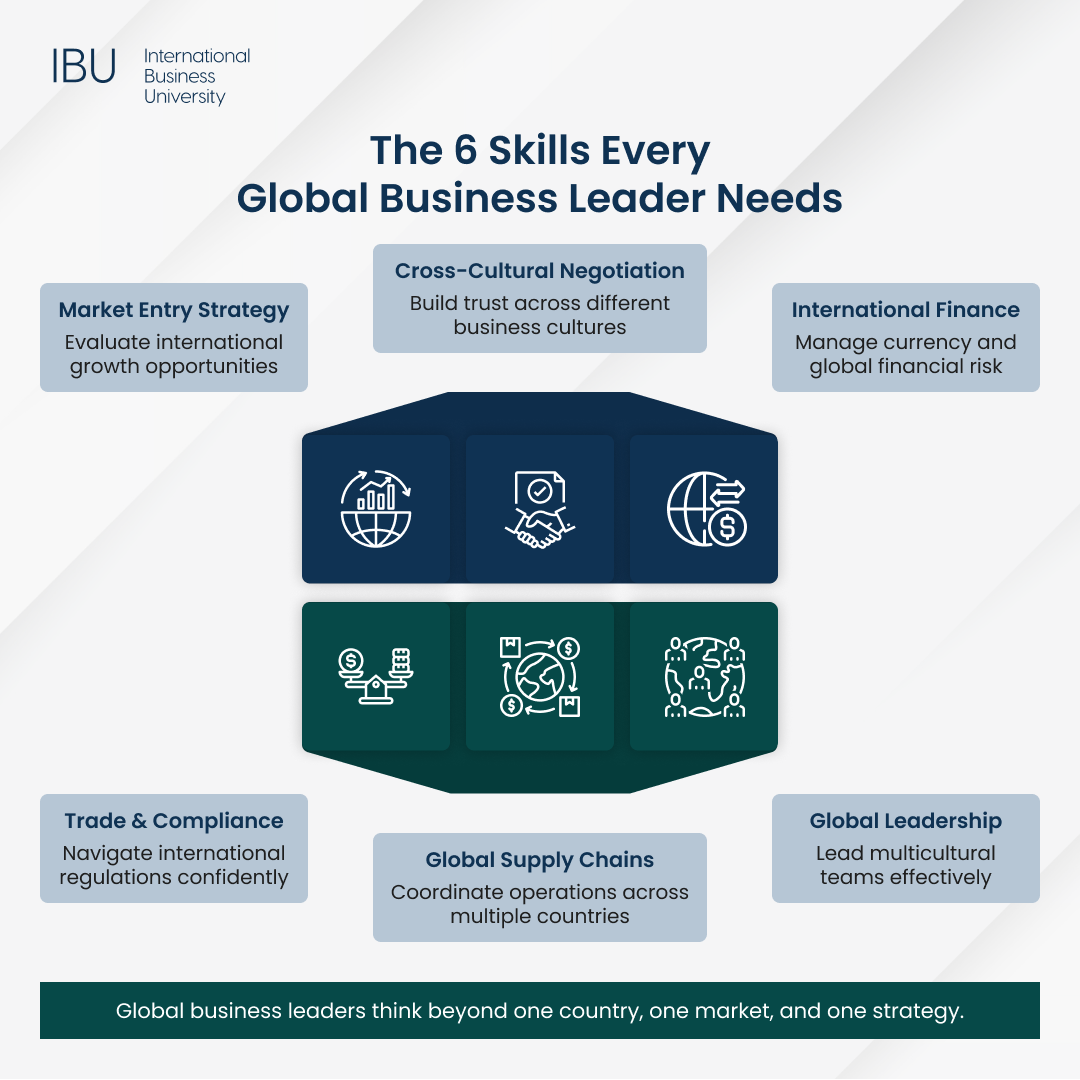
A general MBA introduces some of these topics briefly as electives, while this specialization builds all six into a full sequence of applied coursework across multiple terms.
- Market entry strategy: Evaluating international growth opportunities and if a specific market justifies the investment and regulatory complexity of entry.
- Cross-cultural negotiation: Building trust and closing deals across business cultures that do not share the same norms or communication style.
- International finance: Managing currency exposure and financial risk across the markets a company operates in.
- Trade and compliance: Navigating international trade regulations and shifting compliance requirements with confidence instead of reacting after the fact.
- Global supply chains: Coordinating sourcing, logistics, and operations across multiple countries and regulatory environments at once.
- Global leadership: Leading multicultural teams effectively without defaulting to a single management or communication style that only works in one culture.
Graduates who can speak to a specific example under each of these six areas, not just the specialization title, stand out clearly in interviews for cross-border roles.
How Employers Evaluate These Skills in Interviews
Hiring managers for cross-border roles typically ask candidates to walk through a specific market entry or negotiation scenario rather than accept a specialization title at face value. Candidates who can describe an actual decision process from coursework or a capstone project stand out clearly.
That gap is why the applied capstone project carries more interview weight than a list of completed courses.
Build the Skills That Cross Borders
IBU’s MBA in Global Business Management prepares graduates for cross-border strategy and negotiation roles.
How IBU’s MBA in Global Business Management Is Created
The curriculum moves from framework to applied practice across a defined sequence of core courses.
- International business strategy: Covers market entry models and competitive positioning across multiple regulatory environments.
- Global negotiation: Builds cross-cultural negotiation skills through applied exercises and simulated cross-border deal scenarios.
- International finance: Covers currency exposure, cross-border capital decisions, and financial risk management.
- Applied capstone: Requires students to build a market entry or expansion recommendation for a live business scenario.
The capstone project gives graduates a concrete example of applied cross-border strategy to reference directly in interviews.
How the BCOM Feeds Into This MBA
Students entering from IBU’s BCOM in International Management and Technology arrive with foundational cross-border coursework already completed, which shortens the adjustment period into MBA-level material.
Students entering from other undergraduate backgrounds complete the same core sequence without penalty, though some may benefit from an additional foundational elective.
Program Format and Duration
The program runs on a formatted academic calendar combining core coursework with applied project work across each term. Most students complete the degree in 18 to 24 months, depending on enrollment status and course load per term.
Students who begin in a fall intake typically align their capstone project timeline with spring guest lecture scheduling, though exact sequencing varies by cohort. Part-time enrollment options extend the overall timeline for students balancing full-time work alongside the degree.
Admission Requirements for This MBA Specialization
Admission standards for this specialization generally mirror standard MBA requirements, with some added weight on international exposure.
- Academic background: A completed undergraduate degree, with some programs accepting significant professional experience in place of specific prerequisites.
- Work experience: Most programs expect two or more years of professional experience, since coursework draws directly on workplace context.
- International exposure: Prior exposure to cross-border work, study abroad, or multinational employment strengthens an application, though it is not always required.
Candidates without direct international exposure are not disqualified from applying, but should be prepared to demonstrate interest through other application materials.
What a Strong Application Includes
Statements of purpose that name a specific cross-border career goal read more strongly than statements describing general interest in international business. Referencing a specific target industry, market, or role gives an admissions committee a clearer picture of fit.
Letters of reference from supervisors familiar with any cross-border or multinational work also strengthen an application directly. Work samples demonstrating prior cross-border project involvement, where available, further support a competitive application.
International Business Administration: The Career Paths That Follow This Degree
Graduates move into roles that specifically require cross-border judgment rather than general management skill alone.
- International business development: Leading market entry and partnership decisions in new regions.
- Global supply chain management: Coordinating sourcing and logistics decisions across multiple countries and regulatory environments.
- Trade compliance and policy roles: Advising organizations on regulatory navigation across the jurisdictions they operate in.
- Cross-border strategy consulting: Advising companies on international expansion and market entry decisions.
Each of these roles rewards the specific cross-cultural and regulatory fluency this specialization is built around.
Career Progression in These Roles
Graduates typically enter at a coordinator or analyst level within an international business function, then progress toward manager and director roles as they demonstrate cross-border judgment on the job. Progression speed depends more on demonstrated results than on tenure alone.
Some graduates move directly into consulting roles advising multiple client organizations rather than following a single-company progression path. Others move internally within a multinational employer into a regional or global rotation program tied to the same cross-border skill set.
What Canadian and Multinational Employers Look for in This Credential
Hiring managers for international roles screen for specific evidence beyond the degree title itself.
- Language exposure: Working proficiency in a second language strengthens a candidate profile for most cross-border roles.
- Cross-cultural project experience: Any project involving international teams or markets, academic or professional, demonstrates applied readiness.
- Regulatory literacy: Familiarity with how trade regulation and compliance differ across the regions where a company operates.
Candidates who can describe a specific cross-border project stand out clearly from candidates who only list the specialization on a resume.
Industries Where This Credential Carries the Most Weight
Manufacturing and logistics companies with multi-country supply chains value candidates who understand cross-border regulatory complexity directly. Financial services firms with international operations need managers fluent in cross-border capital and currency decisions.
Consulting firms advising on international expansion hire specifically for the market entry and negotiation skills this specialization builds. Technology companies expanding into new regional markets increasingly hire for this same combination of business judgment and regulatory awareness.
Prepare for Leadership Roles That Cross Borders
Learn how IBU’s MBA in Global Business Management builds cross-border strategy directly into coursework.
Why Toronto and Ottawa Make IBU Uniquely Placed for This MBA
Both cities carry a concentration of multinational headquarters, trade offices, and cross-border business activity relevant to this specialization.
- Toronto’s financial and trade sector: Home to a concentration of multinational corporate offices and financial institutions with cross-border operations.
- Ottawa’s trade policy proximity: Proximity to federal trade and international policy institutions supports coursework tied to regulatory and trade context.
- Networking access: Both cities offer direct access to guest faculty and mentors working inside multinational and trade-focused organizations.
Both cities support coursework and mentor access grounded in current cross-border business activity.
What This Means for International Students
International students studying this specialization gain direct exposure to a Canadian trade and business environment while building the cross-border skill set the program centers on throughout the full sequence. This dual exposure, Canadian regulatory context alongside international coursework, strengthens applications for roles both inside Canada and abroad.
Graduates frequently reference this specific combination directly when applying to multinational employers with an established Canadian presence.
Cost and Funding Considerations for This MBA
Tuition for this specialization generally aligns with standard MBA program costs, with some variation tied to specific electives or international components.
- Base tuition: Covers core coursework, applied projects, and academic support across the length of the program.
- Optional components: Some programs offer international immersion trips or additional certifications at added cost beyond base tuition.
- Funding options: Scholarships, employer sponsorship, and government student loan programs apply to this specialization the same way they apply to other MBA streams.
Prospective students should request a full cost breakdown directly from admissions before comparing programs, since bundled fees vary between institutions.
Return on Investment Considerations
Graduates entering cross-border roles in finance, consulting, or supply chain management typically see compensation that reflects the specialized nature of the credential. The specific return depends heavily on the target role and industry rather than the degree alone.
Candidates evaluating cost against expected return benefit from researching typical compensation for their specific target role and industry before enrolling in this or any comparable specialization.
Who Should Choose International Business Management and Who Should Not
The specialization fits a specific career direction rather than serving as a general default choice.
- Strong fit: Professionals targeting international assignments, multinational employers, or founders planning cross-border expansion.
- Weaker fit: Candidates planning to stay within a single domestic market see less direct return compared to a general management or finance-focused MBA.
Candidates unsure which path fits benefit most from speaking directly with an admissions advisor about their specific career direction and long-term goals.
A Simple Test for Fit
Candidates considering this specialization can ask a direct question: does the target role involve decisions that cross a border, a market, a currency, or a regulatory system, on a regular basis. A yes points toward this specialization, while a no points toward a general management or finance-focused MBA.
That quick test does not replace a full conversation with an admissions advisor, but it narrows the decision quickly.
Faculty and Mentorship Behind This Specialization
Coursework in this specialization draws on faculty and guest instructors with direct professional experience in cross-border business, not exclusively academic backgrounds.
- Practitioner faculty: Several instructors bring direct experience in trade compliance, international finance, or multinational operations.
- Guest lecture series: Regular sessions feature professionals working inside multinational companies and trade policy organizations based in Toronto and Ottawa.
- Mentor matching: Students are paired with a mentor working in a field aligned with their target career direction and specific industry preference.
That structure gives students exposure to how cross-border decisions actually get made, beyond what a textbook case study can convey.
How Mentorship Shapes the Capstone Project
Mentors often provide direct feedback on capstone project assumptions before students present their final recommendation. That step mirrors how a market entry proposal would be reviewed inside an actual organization before moving forward.
Students who engage actively with mentor feedback tend to produce capstone projects that hold up better under interview scrutiny later.
How IBU’s International Business Management MBA Compares to Other Programs
Program structures for this specialization vary across Canadian institutions in scope and applied practice.
- Elective vs full specialization: Some programs offer international business as a single elective rather than a full sequence of applied coursework.
- Applied capstone requirement: IBU requires a market entry or expansion project, while some programs rely on written exams alone.
- Mentor access: IBU pairs students with mentors working inside multinational and trade-focused organizations throughout the program.
Prospective students comparing programs should ask directly how much applied practice, rather than lecture-based theory, each program includes.
Questions Worth Asking Any Program Before Enrolling
Prospective students benefit from asking a program directly how many courses focus specifically on cross-border content versus general management theory taught without an international lens. A second useful question covers how the capstone project is created, and if it involves an actual business scenario rather than a hypothetical case study.
Programs willing to answer these questions in detail typically reflect the same transparency in how they deliver the coursework itself.
Key Takeaways

Built for cross-border work: the specialization concentrates coursework in trade regulation, negotiation, and currency exposure that a general MBA only touches briefly.
Career paths are specific: international business development, global supply chain management, and trade compliance roles reward this training directly.
Applied practice matters: a capstone project gives graduates a concrete cross-border case to reference in interviews.
Location adds context: Toronto and Ottawa provide direct proximity to multinational and trade policy institutions relevant to this specialization.
Fit depends on goals: professionals targeting international or multinational roles benefit most, more than those planning to stay in a single domestic market.
Frequently Asked Questions
What is the difference between international business management and a general MBA?
International business management concentrates coursework in cross-border strategy, cultural negotiation, and currency exposure. A general MBA covers management theory that applies broadly without this international focus.
What is the difference between international business management and international business administration?
The two terms largely overlap in practice, with administration sometimes used for undergraduate coursework and management for graduate-level strategic training. IBU’s MBA uses the management framing to reflect its strategic, not administrative, focus.
Who should consider international business management as an MBA specialization?
Professionals targeting international assignments, cross-border roles, or multinational employers benefit most directly. Founders planning international expansion also gain direct value from this specialization.
What careers can I pursue with an MBA in global business management?
Common paths include international business development, global supply chain management, trade compliance, and cross-border strategy consulting. Each role rewards the specific cross-cultural and regulatory fluency this specialization builds.
Why do Toronto and Ottawa matter for this MBA specialization?
Toronto carries a concentration of multinational corporate and financial offices, while Ottawa sits close to federal trade policy institutions. Both cities support coursework and mentor access grounded in current cross-border business activity.
Does this specialization require fluency in another language?
A second language is not required, but working proficiency strengthens a candidate profile for most cross-border roles. Employers view language exposure as one signal of cross-cultural readiness among several.
How is IBU's program different from other international business MBAs in Canada?
IBU requires an applied capstone project built around a live market entry or expansion scenario, rather than relying on written exams alone. Students also gain direct mentor access through Toronto and Ottawa’s concentration of multinational and trade organizations.
What are the admission requirements for this MBA specialization?
Most candidates need a completed undergraduate degree and two or more years of professional experience. Prior international exposure strengthens an application but is not always required for admission.
What does this MBA specialization typically cost?
Tuition generally aligns with standard MBA program costs, with some variation tied to optional international components. Prospective students should request a full cost breakdown directly from admissions before comparing programs.
Does IBU offer mentorship as part of this specialization?
Students are paired with a mentor working in a field aligned with their target career direction. Mentors also provide direct feedback on capstone project assumptions before the final presentation.
Can international students apply to this MBA specialization?
International students are welcome and often bring valuable cross-cultural context directly relevant to the coursework. Standard admission requirements apply, along with any additional documentation required for study permits.
Where International Business Management Leads Next
International business management adds a specific cross-border layer that a general MBA does not cover in depth. Graduates who pair this specialization with a concrete cross-border project enter the job market with evidence employers in international roles are actively looking for.
Toronto and Ottawa’s concentration of multinational and trade organizations gives IBU students direct access to mentors and guest faculty working in this exact field, strengthening the applied practice this specialization depends on. That combination of location, faculty, and applied coursework is what distinguishes this specialization from a general international business elective offered elsewhere.
IBU’s guide on international business versus business administration and its companion piece on mastering the art of conducting international business cover related distinctions in more depth.
See If International Business Management Fits Your Goals
Speak with an admissions advisor about IBU’s MBA in Global Business Management.