
An MBA in finance prepares graduates to manage financial strategy, not only record financial results. Employers hiring for finance leadership roles want candidates who can interpret data, build financial models, and advise on company decisions at a strategic level.
A bachelor’s degree in accounting or finance covers technical reporting, while the graduate credential adds the strategic and analytical layer Canadian employers now expect from anyone moving into finance leadership. That difference is the gap an MBA in finance is built to close.
What MBA in Finance Actually Means as a Specialization
The specialization differs from both a general MBA and an undergraduate finance degree in scope and depth.
- Specialization focus: An MBA in finance narrows graduate coursework into financial strategy, capital allocation, and risk assessment.
- a general MBA: A general MBA spreads coursework evenly across marketing, operations, and management, while the finance stream concentrates study in one function.
- an undergraduate degree: An undergraduate finance degree focuses on technical accuracy in reporting and compliance, not strategic recommendations.
- Core coursework: Programs typically include corporate finance, financial analytics, investment analysis, and case work drawn from current Canadian business scenarios.
Graduates leave the specialization prepared to sit at the table where budget, investment, and growth decisions get made.
Who the Specialization Is Built For
Most students bring two to five years of experience in accounting, banking, or corporate operations before starting the program. Coursework moves them from understanding finance mechanics to leading the finance function directly.
Career changers from fields such as engineering or operations also enroll to formalize financial literacy before a move into general management. That mix of professional backgrounds carries through the program structure itself.
How the Specialization Fits Inside a Broader MBA
Coursework follows a set sequence that builds general management skills before narrowing into finance.
- Core first: Students complete a shared set of business fundamentals before choosing a concentration.
- Finance electives: The finance stream then adds a heavier course load in corporate finance, valuation, and analytics.
- Sequencing: The core-then-specialization order matches how Canadian employers structure promotion paths into finance leadership.
That same order, general training first and finance specialization second, is what separates an MBA in finance from an undergraduate finance degree.
Accreditation and Recognition
A recognized MBA in finance carries accreditation that Canadian employers verify during background checks on senior hires. Graduates can reference the specialization on professional designation applications, including CPA prior learning assessments.
Accreditation status is one of the first details a recruiter checks before moving a finance leadership candidate forward.
The Difference Between an MBA in Finance and an Undergraduate Finance Degree
The two credentials differ in both scope and the type of work graduates are prepared to do.
- Undergraduate scope: Coverage centers on financial statement analysis, accounting principles, and introductory valuation for entry-level roles.
- Graduate scope: An MBA in finance adds strategic frameworks, cross-functional business context, and leadership training.
- Practical shift: An undergraduate program asks a student to calculate a company’s debt ratio, while an MBA program asks the student to recommend what the company should do about it.
That shift in expectation is what employers are screening for once a candidate applies for a finance leadership role.
Why This Distinction Matters for Employers
Canadian hiring data reflects this gap directly.
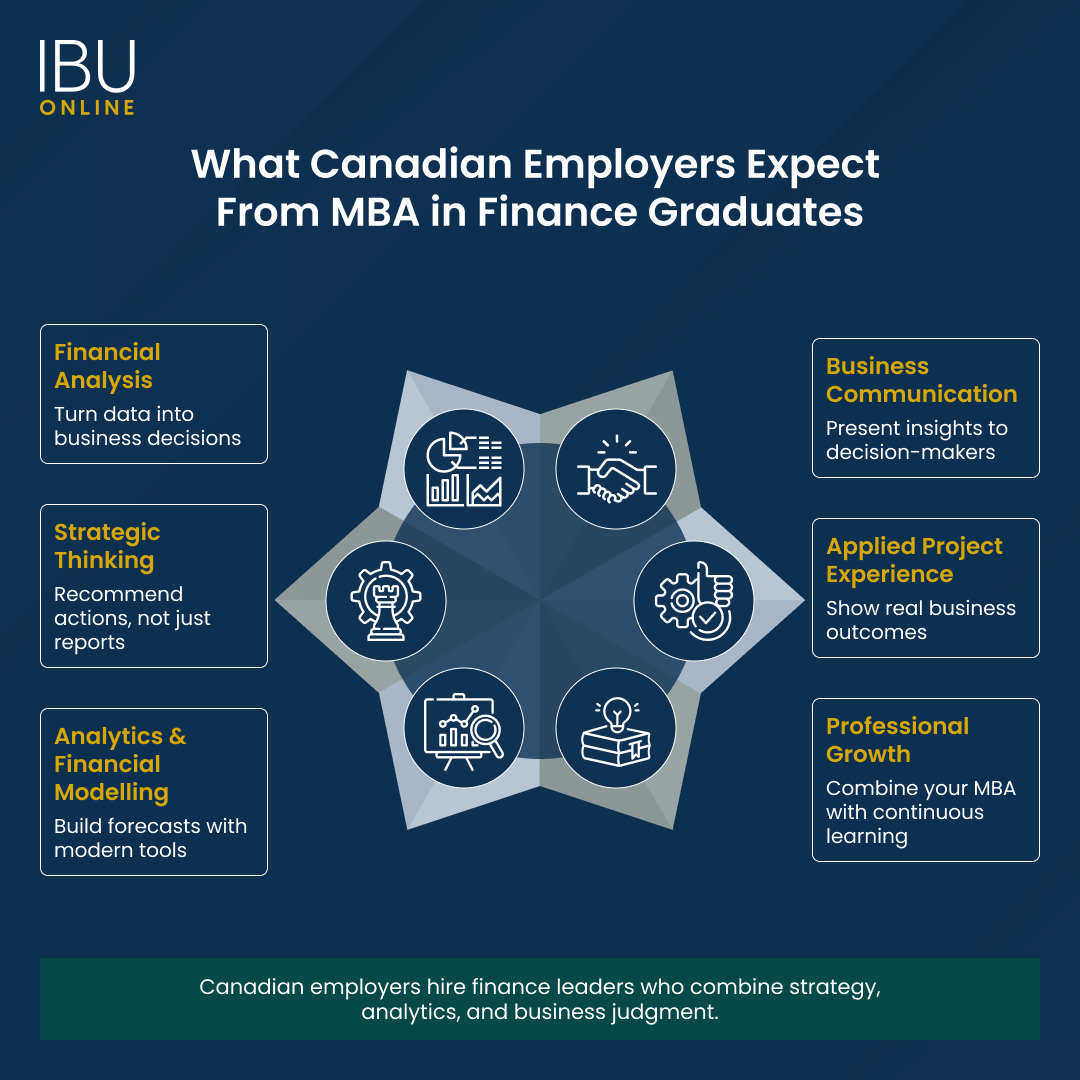
- Employer priorities: Canadian employers hiring financial managers or finance directors consistently list strategic thinking and stakeholder communication alongside technical accuracy.
- Credential data: Job Bank reports 45 percent of financial managers in Ontario hold a bachelor’s degree, well above the 24 percent average across all occupations.
A graduate credential signals to hiring managers that a candidate can move between technical detail and strategy without a learning curve.
What Employers Screen For Beyond the Degree Title
Job postings pair a graduate degree requirement with proof of applied work, such as a completed forecasting model or a capital project brought through approval. Capstone projects and applied coursework carry more weight on a resume than a list of course titles.
A finance MBA that produces a portfolio of applied work gives graduates something concrete to reference in an interview.
What IBU’s MBA in Finance and Management Analytics Covers
The program structure pairs finance fundamentals with applied analytics training.
- Core structure: The program pairs core finance coursework with applied analytics training across corporate finance, financial modeling, and investment analysis.
- Capstone project: Students complete a capstone project built around a live business problem instead of a written exam.
- Analytics edge: The analytics component sets the program apart from a traditional finance MBA by teaching students to build forecasting models with the tools used by Canadian corporate finance teams.
That applied structure carries into how the program handles related credentials, including the CFA designation.
How the Program Structures Applied Learning
Students who are also considering a CFA designation alongside their MBA often ask how the two credentials fit together. IBU addresses this directly in its guide on combining an MBA with a CFA, which outlines where the coursework overlaps.
The program also pairs students with mentors working inside Canadian corporate and financial institutions.
Core Courses Inside the Program
Four core courses anchor the curriculum.
- Corporate Finance: covers capital structure, valuation, and funding decisions at the company level.
- Financial Analytics: trains students on forecasting models and the data tools used in Canadian finance teams.
- Investment Analysis: builds skill in evaluating projects, acquisitions, and portfolio decisions.
- Applied Capstone: requires students to solve a live business problem for a partner organization or simulated case.
Electives let students lean further into strategic finance or applied analytics depending on their target role.
Program Format and Duration
The program runs on a blended format that combines structured coursework with applied project work. Most students complete it in 12 to 24 months, depending on enrollment status.
That format serves working professionals who need structured flexibility while completing a full graduate credential.
The Roles That Specifically Ask for an MBA in Finance Background in Canada
Several finance leadership roles in Canada now list a graduate credential directly in the posting.
- Leadership postings: Financial manager and finance director postings increasingly name a graduate business degree as a preferred qualification, not a bonus.
- National outlook: Job Bank projects a moderate employment outlook for financial managers nationally through 2027, with growth from new positions and retirements.
- Analyst demand: Financial and investment analyst hiring was constrained by weak growth through 2025 but is expected to improve through 2026 and 2027.
That improving demand puts pressure on employers to hire analysts who can contribute to strategy immediately.
Positions Where the Credential Carries the Most Weight
Four roles in particular draw on this credential most consistently.
- Financial manager: oversees budgeting, forecasting, and reporting for a business unit or company, and typically requires several years of experience plus a graduate credential.
- Finance director: sets financial strategy across departments and reports directly to executive leadership.
- Corporate finance manager: leads capital planning, M&A analysis, and investment decisions within a company.
- Financial and investment analyst: builds models and forecasts that inform executive and client decisions.
Each role draws from a different corner of the finance function, but all four now expect graduate-level training.
Industries Hiring Most Actively
Sector data from Job Bank shows where this demand concentrates.
- Top sector: Financial managers in Canada work most heavily in finance, insurance, and real estate.
- Secondary sectors: Professional and technical services and public administration follow, according to Job Bank sector data.
- Analyst concentration: Financial and investment analysts show a similar concentration in the finance and insurance sector.
- Regional demand: Ontario, British Columbia, and Alberta post the highest volume of finance leadership openings nationally, according to Job Bank regional data.
Graduates targeting a specific industry can use this concentration to prioritize where to apply first.
What the Credential Pays in Canada
Wage data adds another layer to this picture.
- Finance director range: Finance directors in Canada earn between $38.50 and $91.76 an hour, according to Job Bank wage data.
- Financial analyst median: Financial analysts earn a median wage of $43.27 an hour nationally.
- Credential premium: The wage spread across these roles reflects how strongly experience and graduate credentials affect earning potential inside finance.
That wage range is one reason Canadian professionals treat the MBA in finance as a career investment rather than a line on a resume.
Build the Finance Credential Canadian Employers Are Asking For
IBU’s MBA in Finance and Management Analytics pairs corporate finance training with applied analytics.
MBA in Finance vs MBA in Financial Analytics: Understanding the Distinction
The two credentials overlap but are not interchangeable.
- MBA in finance: concentrates on financial strategy, corporate valuation, and capital decisions across a business.
- MBA in financial analytics: narrows the focus to forecasting, data modeling, and the tools used to turn financial data into a recommendation.
- Combined programs: Some Canadian graduate programs, including IBU’s, teach both under a single stream.
Finance leaders today are expected to build the models themselves rather than hand that work to a separate analytics team.
Which Path Fits Which Career Goal
Candidates aiming for controller, treasury, or finance director roles benefit most from the strategic depth of a finance-focused MBA. Candidates aiming for financial planning and analysis, business intelligence, or corporate analytics roles benefit more from a program weighted toward modelling.
A combined program removes the need to choose between the two.
Why Employers No Longer Separate the Two Skill Sets
Companies once employed a separate analyst team to build financial models and a separate finance manager to act on them. Canadian finance teams have consolidated that work, and hiring managers now expect one candidate to do both.
A combined MBA in finance and management analytics credential reads as more current to employers than a finance-only degree on its own.
What Canadian Employers List in MBA in Finance Job Postings
Postings for finance leadership roles tend to repeat the same set of requirements.
- Technical tools: Postings frequently name Excel, Power BI, and enterprise financial systems such as SAP or Oracle.
- Professional designations: CPA appears most often, followed by progress toward a CFA for investment-focused roles.
- Experience range: Most finance director and senior analyst postings ask for five or more years of relevant experience.
- Soft skills: Stakeholder communication and cross-functional collaboration appear almost as often as technical requirements.
Matching a resume against this list before applying narrows the gap between a qualified candidate and an interview.
Reading a Posting Before You Apply
A posting titled Finance Director expects strategic ownership, while Senior Financial Analyst expects deep modeling work under direction. Required qualifications act as a hard filter, while preferred qualifications are areas to address in a cover letter.
Reading postings this way helps candidates decide where to spend limited application time.
How to Position Your MBA in Finance Credential in a Canadian Job Application
Positioning starts with how the credential appears on the resume itself.
- Beyond the title: Canadian employers screening resumes for finance roles look for evidence of applied experience, not just a degree title.
- Name the specialization: Candidates should list ‘MBA, Finance and Management Analytics’ directly and connect it to a specific outcome, such as a forecasting model built or a capital allocation recommendation delivered.
That level of detail is what separates an application that gets an interview from one that gets filtered out.
Framing the Degree for a Recruiter
A few details determine how strongly the credential reads to a recruiter.
- Pair with a designation: A finance MBA from a recognized Canadian program carries more weight when paired with a CPA or progress toward a CFA.
- State the target function: Cover letters and LinkedIn summaries should reference the specific function, such as financial planning and analysis or corporate finance.
- Match posting language: Resumes should mirror exact phrasing from the job posting, since applicant tracking systems scan for exact terms rather than synonyms.
Recruiters searching for a finance MBA Canada candidate typically filter for both the credential and a designation together.
Common Application Mistakes to Avoid
Most weak applications share the same two or three gaps.
- Listing coursework: A course title tells a recruiter what was studied, not what a candidate can do.
- Applying too broadly: Posting language should match the specialization named in the job ad, such as corporate finance, financial planning and analysis, or treasury.
- Weak quantification: Statements without numbers, such as improved reporting, carry less weight than statements with numbers, such as cut month end close by three days.
Matching language between the resume and the posting is a small step most applicants skip.
Turn Your MBA Into a Finance Leadership Track
Learn how IBU graduates position their MBA in Finance and Management Analytics credential for Canadian employers.
How IBU’s MBA in Finance Connects to Strategic Business Decisions
The capstone project inside IBU’s MBA in Finance and Management Analytics requires students to work through an active business problem, such as a capital allocation decision or a financial restructuring scenario.
Students use the same analytical process a finance director would use on the job, and graduates leave with a portfolio of applied work to reference in interviews rather than a transcript of course titles.
IBU’s blog on how corporate finance shapes business growth extends this same applied approach, breaking down how financial strategy decisions affect a company’s ability to expand.
From Classroom Model to Business Case
The capstone format is deliberately close to how finance decisions get made on the job.
- Grading standard: Capstone recommendations are graded on how well they hold up under scrutiny from a panel that includes working finance professionals.
- Live defence: Students defend their assumptions the way they would in front of an executive team.
Preparing and defending a financial case this way is often the part of finance leadership that classroom coursework alone does not cover.
Key Takeaways

Consectetur adipisicing elit, sed do eiusmod tempor incididunt ut labore et dolore.
In tempor aliquam velit, quis ultrices ante placerat in. Nam at urna placerat, interdum.
Sed vel massa eget justo pharetra auctor. Nunc vel metus nulla. Nulla id leo velit.
Frequently Asked Questions
What is an MBA in finance?
An MBA in finance is a graduate business degree that concentrates on financial strategy, corporate valuation, and capital decisions. It builds on undergraduate finance training with leadership and strategic decision coursework.
Is an MBA in finance the same as an MBA in financial analytics?
An MBA in finance and an MBA in financial analytics differ in scope. Finance concentrates on strategy and capital decisions, while financial analytics focuses on forecasting and data modelling, and some programs, including IBU’s, combine both.
What jobs can I get with an MBA in finance in Canada?
Common roles include financial manager, finance director, corporate finance manager, and financial and investment analyst. Job Bank projects moderate to improving demand across these occupations through 2027.
Do I need a CFA in addition to an MBA in finance?
A CFA is not required, but pairing the two strengthens a resume for investment-focused roles. IBU outlines how the credentials overlap in its guide on combining an MBA with a CFA.
How long does an MBA in finance take to complete in Canada?
Most Canadian MBA in finance programs run 12 to 24 months. Program length depends on full-time or part-time enrollment alongside work.
Does IBU's MBA in finance include analytics training?
IBU’s MBA in Finance and Management Analytics pairs corporate finance coursework with applied analytics and forecasting. The training runs through a capstone project based on a live business problem.
What does an MBA in finance in Canada typically pay in salary terms?
Wages vary by role and experience level, but authoritative Canadian data sources show strong earning potential for MBA‑level finance careers. The Government of Canada’s Job Bank reports that finance directors usually earn between $38.50/hour and $91.76/hour nationally, while financial and investment analysts have a median wage of $43.27/hour across Canada.
Can I complete an MBA in finance part time in Canada?
Most Canadian MBA in finance programs offer part-time options alongside full-time study. Part-time students typically extend the 12 to 24 month timeline to accommodate work schedules.
Is IBU's MBA in Finance and Management Analytics accredited?
The program carries institutional accreditation that Canadian employers verify during hiring for finance leadership roles. Graduates can reference this status directly on resumes and designation applications.
What an MBA in Finance Opens Up Next
An MBA in finance is the credential Canadian employers now expect from candidates moving into finance leadership, not a bonus line on a resume. The programs that combine strategy with applied analytics, such as IBU’s Financial Analytics stream, match most closely with where finance roles in Canada are already headed.
Graduates who pair the degree with a clear specialization and a professional designation enter the job market with both the credential and the evidence employers are asking to see.
Canadian finance leadership roles increasingly filter for both the credential and the applied experience behind it, and programs that provide both give graduates a clear advantage in a competitive hiring market.
Advance Your Finance Career with IBU
Speak with an admissions advisor about the Financial Analytics stream and how it applies to your background.