
Leadership communication is the mechanism that turns a decision into action across a team. A leader can make the right call, but if that decision is communicated poorly, the team executes on a version that never matches the original intent.
Most professionals learn to communicate adequately long before they learn to communicate as a leader, and communication is only one of the management skills that fast-track a career. That gap between adequate and effective is the specific skill this article addresses.
What Leadership Communication Actually Means Beyond Presenting Well
Presenting clearly is a component of leadership communication, but it is far from the whole skill. The deeper competency involves shaping how people interpret, trust, and act on what a leader says, not just how polished the delivery sounds.
- Framing: Presenting information in a way that gives it context and weight, so the audience understands why it matters, not just what it says.
- Calibration: Adjusting tone and detail level based on who is listening, an executive audience needs different framing than a frontline team.
- Follow-through: Reinforcing a message consistently after the initial delivery, since a single announcement rarely changes behavior on its own.
Leaders who master presentation but skip these three elements often find their messages technically correct but practically ignored.
The Gap Between Management Communication and Leadership Communication
Management communication focuses on directing tasks: what needs to happen, by when, and by whom. Leadership communication operates one level above that, shaping why the work matters and how people should think about it going forward.
- Management communication: Task-focused, transactional, and often one-directional, moving information from manager to team.
- Leadership communication: Purpose-focused, relational, and often two-directional, inviting questions and adjusting based on how a message lands.
Professionals moving into senior roles frequently continue relying on management-style communication, which explains why some technically strong managers struggle to gain broader organizational trust.
Build Leadership Communication Before Your Next Promotion
IBU builds this skill directly into coursework from BCom through MBA.
Leadership Communication: The Four Patterns of Every Executive Worth Following
Executives who earn consistent trust across an organization tend to repeat a small set of communication patterns. These patterns are learnable and do not depend on natural charisma.
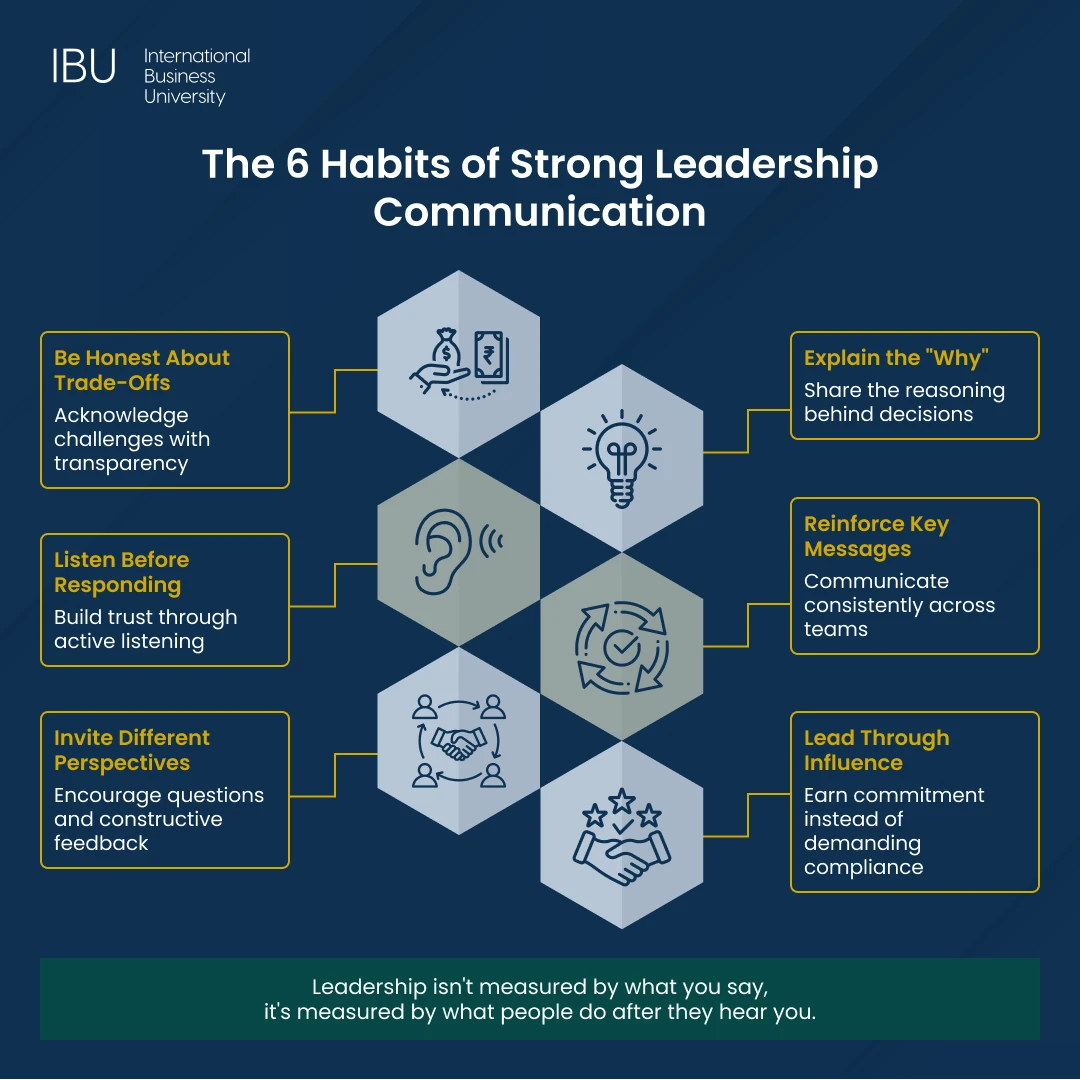
- They explain the reasoning: Sharing the logic behind a decision, not just the decision itself, which helps a team apply the same thinking to future situations.
- They acknowledge tradeoffs: Naming what a decision costs alongside what it gains, rather than presenting every choice as purely positive.
- They invite pushback: Creating space for questions or disagreement before a decision is finalized, which increases buy-in once it is.
- They repeat the message: Communicating important points multiple times through different channels, since a single mention rarely sticks organization-wide.
Executives who skip these patterns often find themselves repeatedly explaining the same decision without ever building lasting understanding.
How Interpersonal Communication Shapes Every Leadership Relationship
Interpersonal communication, the one-on-one dynamic between a leader and an individual, forms the foundation that broader organizational trust is built on. A leader who communicates well in group settings but poorly one-on-one still struggles to build genuine trust.
- Active listening: Demonstrating that a concern has been heard and understood before responding, rather than jumping straight to a solution.
- Direct feedback: Addressing a performance or behavior issue clearly and early, rather than allowing it to become a larger unspoken tension.
- Consistency across relationships: Treating similar situations with similar responses across different individuals, which builds a reputation for fairness.
Leaders who invest in these one-on-one habits build a reserve of trust that carries them through harder group communication moments later.
Why Influence Beats Authority in Every Modern Canadian Workplace
Formal authority can direct a task, but it rarely builds lasting commitment on its own. Influence, the ability to shape thinking and behavior without relying on hierarchy, increasingly determines who succeeds in flatter, more collaborative Canadian workplaces.
- Authority gets compliance: People follow an instruction because a title requires it, often with minimal discretionary effort beyond the minimum.
- Influence gets commitment: People act because they understand and agree with the reasoning, often contributing more than the instruction technically required.
Leaders who rely solely on authority tend to see performance drop the moment direct oversight is removed, while leaders who build influence see performance hold steady.
Communication Skills for Managers: What IBU Builds Into Every Stream
IBU treats communication as a core competency across both BCom and MBA coursework, not as a single standalone course. The training is created to build skill progressively as students take on more responsibility.
- Applied practice: Students work through simulated feedback conversations, stakeholder presentations, and team communication scenarios.
- Peer and instructor review: Communication exercises are reviewed for clarity, tone, and framing, not just content accuracy.
- Progressive complexity: BCom coursework builds foundational skills, while MBA coursework adds higher-stakes scenarios, including managing former peers and communicating through organizational change.
Graduates leave with practiced experience across a range of leadership communication scenarios, not just theoretical familiarity with the concepts.
How to Develop Leadership Communication Before Your First Senior Role
Waiting for a senior title to start practicing leadership communication puts a new leader at a disadvantage during the exact period when trust is hardest to build. A few deliberate habits accelerate this development well before a formal promotion.
- Practice explaining reasoning: In any group setting, get in the habit of sharing why a recommendation makes sense, not just what the recommendation is.
- Seek feedback on delivery: Ask a trusted colleague how a message landed, not only if the content itself was correct.
- Study strong communicators directly: Pay attention to how respected leaders in an organization frame decisions and handle pushback, and adapt those patterns deliberately.
Professionals who build these habits early tend to step into formal leadership roles with communication skills already in place, rather than developing it under pressure.
IBU’s guide on ways to improve your communication skills at work and its companion piece on speaking with purpose cover related communication techniques in more depth.
Key Takeaways

Framing matters more than delivery: explaining why a decision matters builds more lasting understanding than polished presentation alone.
Interpersonal habits build the foundation: one-on-one trust built through listening and direct feedback carries into harder group communication moments.
Influence outperforms authority: commitment built through understanding holds up better than compliance built through hierarchy alone.
The skill is trainable early: practicing reasoning, seeking feedback, and studying strong communicators before a formal promotion builds a genuine advantage.
Frequently Asked Questions
What is the difference between leadership communication and management communication?
Management communication directs tasks: what needs to happen, by when, and by whom. Leadership communication shapes why the work matters and how people should think about it going forward.
Can leadership communication be learned, or is it a natural trait?
The core patterns, explaining reasoning, acknowledging tradeoffs, inviting pushback, are learnable through deliberate practice. Executives who communicate well typically develop these habits over time rather than starting with them naturally.
Why does influence matter more than authority in modern workplaces?
Authority produces compliance, while influence produces genuine commitment and discretionary effort. Flatter, more collaborative Canadian workplaces increasingly reward leaders who can influence without relying on hierarchy.
How does IBU build leadership communication into its programs?
IBU uses simulated feedback conversations, stakeholder presentations, and team communication scenarios reviewed for clarity and framing. Training progresses from foundational BCom coursework into higher stakes MBA-level scenarios.
How can I start developing leadership communication before a senior role?
Practice explaining the reasoning behind recommendations, not just the recommendations themselves, in any group setting. Seeking direct feedback on how a message landed and studying respected communicators in an organization also build this skill early.
Building Leadership Communication Before It Is Required
Leadership communication separates leaders who build lasting organizational trust from leaders who technically make correct decisions that never quite land. Professionals who practice this skill before a formal promotion step into senior roles with an advantage that pure technical competence does not provide.
Develop Interpersonal Communication Skills That Last
IBU’s programs pair communication theory with applied practice across BCom and MBA coursework.