

Delegation sounds simple on paper. Assign work. Set a deadline. Move on. In practice, delegation often creates friction instead of freedom. Tasks return incomplete. Expectations drift. Teams hesitate. Leaders step back in and redo the work themselves.
This cycle drains time and trust.
The solution rarely involves working harder. It involves delegating better. The 5 steps of delegation provide a clear system for transferring responsibility without losing quality, accountability, or momentum. When applied consistently, this framework changes how teams operate and how leaders lead.
In high-performing organizations, delegation drives execution the same way a strong funnel drives conversion. Clear inputs produce predictable outcomes. Clear ownership strengthens performance. Clear authority speeds decisions.
This guide answers what the 5 steps of delegation are, explains how they connect to the 5 rights of delegation, and shows how to apply both through practical workplace examples. If your goal involves scaling output without scaling stress, this framework belongs in your leadership toolkit.
Key Takeaways
- The 5 steps of delegation create clarity, accountability, and execution speed
- The five rights of delegation prevent common delegation breakdowns
- Strong delegation builds future leaders while protecting current performance
Practical Tips for Delegating Tasks Successfully
Delegation improves results when leaders treat it as a system rather than an occasional action. Strong delegation relies on repeatable habits that protect quality, develop people, and preserve momentum. These practices separate leaders who stay involved from leaders who scale.
Start with Low-Risk, High-Frequency Work
Delegation works best when confidence builds early.
Recurring tasks provide structure. Weekly reporting. CRM updates. Meeting coordination. Quality checks. These activities follow predictable patterns, which reduces ambiguity and speeds learning.
Early wins matter. When team members complete delegated tasks successfully, trust grows quickly. Trust lowers resistance. Ownership increases naturally.
Leaders who start delegation with complex or time-sensitive work often feel pressure to intervene. Leaders who begin with predictable tasks see consistency develop without disruption.
This approach protects performance while expanding capacity.
Break Tasks into Transferable Components
Many delegation issues come from task size rather than task difficulty.
Large responsibilities overwhelm when transferred as a whole. Breaking work into components allows gradual ownership. Preparation. Execution. Review. Optimization.
Consider a campaign launch. One person handles research. Another manages the setup. A third tracks performance. Each component carries a clear responsibility.
This structure supports learning without overload. It also allows leaders to identify strengths and development gaps more precisely.
Delegation becomes modular. Scale becomes manageable.
Document Processes with Outcome-Focused Clarity
Documentation succeeds when it explains outcomes, not just steps.
Teams need to understand what success looks like. Format. Accuracy. Timelines. Decision boundaries. Examples help anchor expectations.
Strong documentation answers:
- What problem does this task solve
- What should the finished work accomplish
- How quality will be evaluated
This clarity reduces dependency. Team members act without waiting. Consistency improves across repetitions.
Documentation also protects continuity. When roles change, knowledge remains accessible. Execution continues without interruption.
Establish Feedback Cadence Before Work Begins
Feedback works best when it feels expected.
Leaders clarify how feedback will happen before delegation begins. Checkpoints. Written comments. Review meetings. This transparency removes anxiety and improves receptiveness.
Feedback cadence matters more than feedback volume. Regular guidance keeps performance aligned. Small adjustments early prevent rework later.
Two-way feedback strengthens outcomes. Teams share obstacles sooner. Leaders adjust support levels accordingly.
When feedback becomes routine, improvement accelerates.
Coach Through Questions Instead of Corrections
Growth develops through thinking, not rescue.
Leaders often step in when results differ from expectations. A better approach involves guided problem-solving. Ask what the team member sees. Ask how they would adjust. Ask what support would help.
This method preserves ownership while strengthening judgment. Team members learn how to approach challenges independently.
Mistakes handled through coaching build confidence. Repeated corrections without explanation create hesitation.
Delegation works when leaders guide reasoning rather than replacing effort.
Gradually Expand Authority Alongside Responsibility
Responsibility without authority slows execution.
As competence increases, decision rights expand. Approval thresholds rise. Autonomy grows.
Leaders communicate authority boundaries clearly. Budget limits. Escalation points. Quality controls. This clarity supports speed without risk.
Authority growth signals trust. Trust drives engagement.
Delegation evolves from task assignment into leadership development.
Redefine Your Role Through Consistent Delegation
Delegation reshapes leadership identity.
As you delegate tasks consistently, your focus shifts. Less execution. More planning. More coaching. More systems thinking.
You gain visibility into patterns rather than details. You anticipate issues earlier. You influence outcomes through structure rather than intervention.
This shift creates space for strategic work. Leadership influence expands as execution spreads.
Understanding the 5 Steps of Delegation
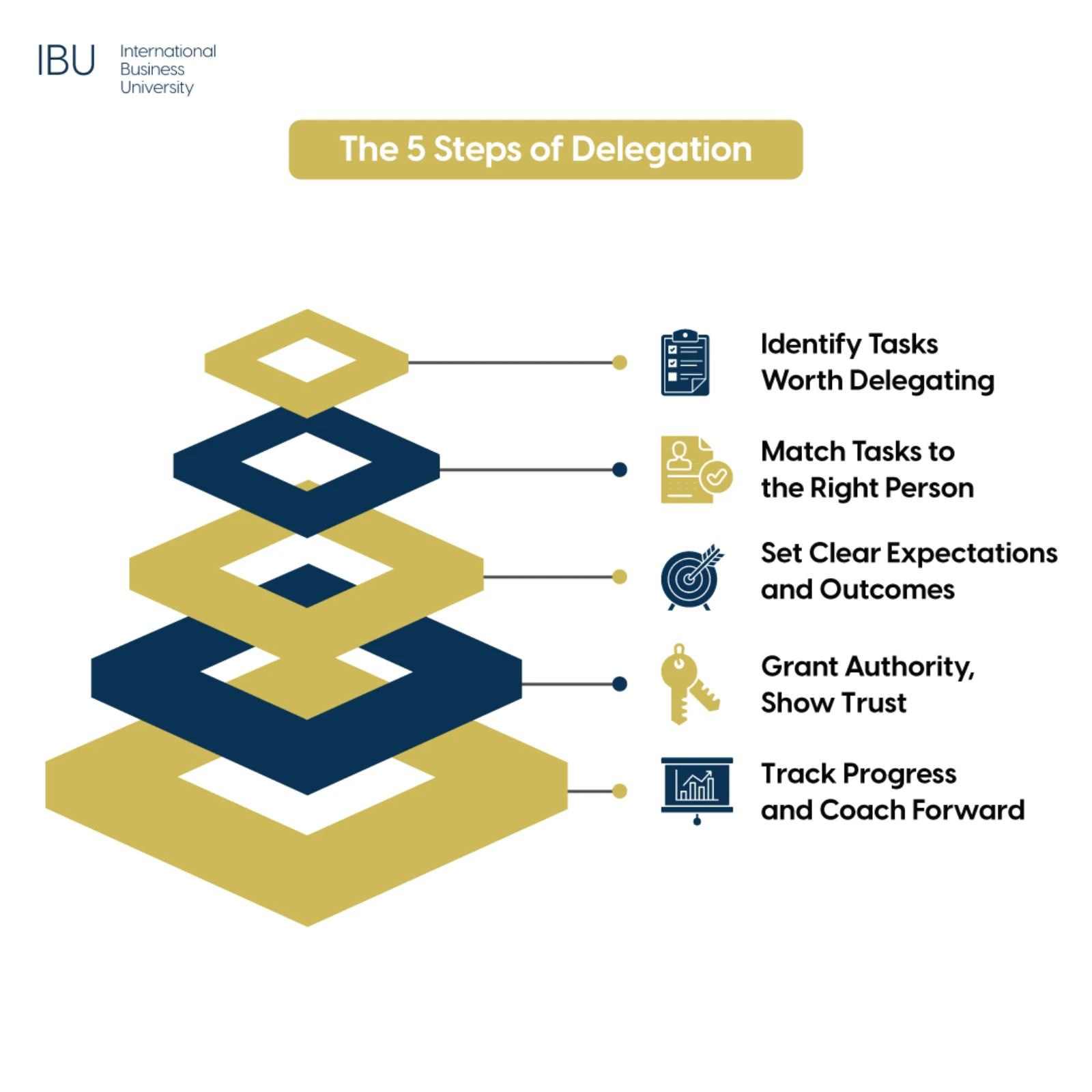
Delegation fails most often when leaders treat it as a one-step action rather than a process. Assigning work without context leaves teams guessing. Holding authority while expecting ownership creates hesitation. Skipping follow-up allows problems to grow quietly.
The 5 steps of delegation solve these issues by introducing structure at every stage. Each step addresses a specific risk. Together, they form a repeatable system that works across roles, departments, and company sizes.
Step 1: Assess and Prioritize Tasks
Delegation begins with discernment. Leadership starts by deciding what requires judgment and what benefits from execution by others. This decision shapes trust, efficiency, and long-term team capability.
When the workload increases, many managers react by pushing work outward too quickly. Teams feel flooded. Priorities blur. Confidence drops. Effective leaders pause and evaluate tasks through two lenses: impact on outcomes and opportunity for development.
High-leverage responsibilities often remain with leadership because they require judgment shaped by experience. Strategic direction, performance conversations, sensitive negotiations, vision setting, and final accountability typically stay centralized. These decisions influence long-term direction and carry reputational risk.
Execution-focused work transfers well when structure exists. Reporting, coordination, documentation, research, data preparation, scheduling, and process management thrive under delegation. These tasks build skill while protecting momentum.
Consider a sales director overseeing quarterly pipeline health. Reviewing forecast accuracy, adjusting strategy, and aligning revenue targets remain leadership responsibilities. Preparing pipeline reports, updating CRM data, tracking deal stages, and scheduling follow-ups transfer smoothly to the team. The director protects decision quality while expanding team ownership.
This assessment preserves focus. Leaders spend time where judgment creates value. Teams gain responsibility where execution creates momentum. Over time, capacity grows across the organization.
Step 2: Choose the Right Person for the Task
Delegation strengthens teams when assignments align with capability, confidence, and growth potential. Matching work to people requires intention rather than convenience.
This step connects directly to the 5 rights of delegation, beginning with the right person. Leaders evaluate skill level, prior experience, decision confidence, learning readiness, and current workload before assigning responsibility.
Placing complex responsibilities on underprepared team members increases stress and hesitation. Assigning routine work to senior contributors limits engagement and development. Balance matters. The goal involves stretching capability without overwhelming capacity.
Picture a marketing manager assigning campaign performance analysis. A junior analyst handles data extraction, spreadsheet organization, and dashboard updates. A senior strategist interprets trends, identifies insights, and recommends adjustments. Both contribute meaningfully while operating within readiness levels.
Over time, leaders expand scope intentionally. Junior contributors receive deeper responsibility as competence grows. Senior contributors receive broader authority as trust strengthens. Delegation evolves into a leadership development system rather than simple task distribution.
Step 3: Provide Clear Instructions and Expectations
Clarity replaces guesswork. This step determines quality, speed, and confidence.
Clear delegation begins with purpose. Teams understand why the task matters before learning how to complete it. Leaders define outcomes, deadlines, quality standards, decision boundaries, and review checkpoints.
Imagine delegating customer onboarding documentation. Clear expectations specify audience type, tone, format, completion date, approval process, and update cadence. Team members know exactly what success looks like before starting.
Strong delegation mirrors strong lead generation planning. You would never expect conversion without mapping the buyer journey. Teams deserve the same level of clarity when executing work.
Written follow-ups reinforce understanding. Documentation provides reference points. Alignment stays intact as complexity increases and team size grows.
Step 4: Delegate Authority and Empower Your Team
Responsibility without authority slows execution. Empowerment completes delegation.
This step grants decision rights aligned with the task scope. Teams move forward without waiting for constant approval. Momentum improves. Confidence grows.
Empowerment also shows through behavior. Leaders support decisions publicly. Adjustments happen privately through coaching rather than correction. Trust becomes visible through action.
Consider a project lead managing external vendors. Responsibility includes delivery timelines and coordination. Authority must include approval rights within defined cost and schedule limits. Without that authority, progress pauses at every decision point.
This step reinforces the five rights of delegation, especially the authority and supervision balance. Teams feel ownership when trust shows through consistent empowerment.
Step 5: Monitor Progress and Provide Constructive Feedback
Delegation continues well beyond assignment. Monitoring keeps alignment strong while preserving autonomy.
Effective leaders establish checkpoints rather than hovering. They track milestones, review interim outputs, and address misalignment early. Oversight remains structured rather than intrusive.
Feedback focuses on improvement rather than control. Recognition reinforces confidence. Adjustments refine execution before issues compound.
For example, a manager delegating monthly reporting schedules a midpoint review. Early feedback improves accuracy. Final review reinforces strengths. The team member leaves with greater confidence and clearer judgment.
This step transforms delegation into a learning system. Each cycle strengthens skill, trust, and performance. Over time, delegation builds leaders rather than task completers.
Examples of Using the 5 Rights of Delegation in Action
The 5 rights of delegation protect delegation quality across environments. They answer practical leadership questions that arise daily.
The five rights include:
- Right Task: Assign work that can be completed independently without compromising quality or strategic oversight.
- Right Person: Match responsibility to capability, experience, and growth potential to ensure confident execution.
- Right Authority: Grant decision-making power that aligns with responsibility so progress continues without delay.
- Right Time: Delegate when capacity, urgency, and readiness align to support successful delivery.
- Right Supervision: Provide the appropriate level of guidance and follow-up to maintain accountability without micromanagement.
Let’s explore 5 rights of delegation examples in real settings.
A finance manager delegates the monthly expense reconciliation. The task fits routine execution. The person understands reporting tools. Authority includes system access. Timing aligns with month-end cycles. Supervision involves review before submission.
A product leader delegates feature testing coordination. The person selected already works cross-functionally. Authority includes scheduling resources. Supervision involves milestone updates.
These five rights of delegation examples show how alignment prevents friction. Delegation works when rights match reality.
Lead teams with clarity in digital-first environments
Build delegation, communication, and performance-tracking skills through a BCOM designed for digital sales and marketing leadership
Delegation creates impact across performance, culture, and sustainability when applied systematically. The 5 steps of delegation, reinforced by the five rights of delegation, produce results that compound over time.
Faster Execution Through Clear Accountability
Clear ownership accelerates action.
When teams know who owns each task, work moves without hesitation. Decisions occur closer to execution. Bottlenecks dissolve.
Accountability replaces follow-up. Momentum replaces waiting.
Execution speed increases without sacrificing quality.
Stronger Decision-Making Across the Organization
Delegation distributes thinking.
As authority spreads appropriately, teams solve problems independently. Leaders focus on direction rather than detail.
Decision quality improves through proximity to information. Responses become faster and more relevant.
Organizations gain agility through trust and clarity.
Reduced Burnout and Improved Leadership Sustainability
Delegation protects energy.
Leaders regain time for strategy, innovation, and people development. Workload is redistributed realistically.
Burnout declines when responsibility matches capacity. Leadership remains effective over time.
Sustainable leadership supports sustainable growth.
Higher Engagement Through Meaningful Ownership
Delegation signals confidence in people.
Teams feel valued when responsibility increases. Skills develop through application. Engagement rises as work carries purpose.
Ownership builds pride. Pride strengthens performance.
Culture improves through shared responsibility.
Scalable Growth for Entrepreneurs and Business Leaders
The benefits of being an entrepreneur multiply when delegation functions well.
Growth becomes repeatable rather than reactive. Systems replace heroics. Results compound steadily.
Delegation supports expansion without chaos. That balance defines mature leadership and resilient organizations.
FAQ
What are the 5 steps of delegation
Assess tasks, choose the right person, clarify expectations, empower authority, monitor progress
How do the five rights of delegation support performance
They align responsibility, authority, timing, and supervision
Can delegation work in small teams
Yes. Structure matters more than size
Unlock Team Success by Following the 5 Essential Delegation Steps
Leadership scales through systems. Delegation remains one of the most powerful systems available.
The 5 steps of delegation transform delegation from risk into an advantage. Combined with the 5 rights of delegation, leaders gain clarity, teams gain ownership, and execution accelerates.
Strong teamwork grows from daily habits. Delegation stands among the most influential.
Apply this framework consistently. Watch confidence rise. Watch the performance follow.
Strengthen delegation through data-driven leadership
Develop the analytical insight needed to assign work, measure outcomes, and guide teams with confidence through an MBA focused on financial and management analytics