
Your ability to solve problems defines how quickly you adapt, decide, and move forward when pressure shows up. In business, academics, and leadership, progress rarely comes from perfect conditions. It comes from clear thinking under constraint. This article breaks down smart problem solving techniques that sharpen your ability to solve problems faster through practical methods, mental discipline, and repeatable habits you can apply immediately. You’ll learn how top performers reduce friction, think clearly, and convert uncertainty into action.
Key Takeaways
- Your ability to solve problems improves fastest through structure, repetition, and calm decision-making.
- Speed comes from reducing mental noise, not rushing to conclusions.
- Strong problem solvers rely on systems, not instinct alone.
Understanding the Importance of Your Ability to Solve Problems
Your ability to solve problems determines how often you move forward instead of getting stuck. Every role, from student to executive, rewards people who can evaluate situations quickly and respond with clarity. Decisions shape outcomes. Delayed decisions drain momentum. Poor decisions create rework.
Problem-solving speed matters because complexity keeps increasing, and U.S. Bureau of Labor Statistics research shows faster employment growth across occupations. You face more information, tighter timelines, and higher expectations. Without a reliable way to process challenges, even smart people stall. Strong problem solvers stay effective because they know how to think when things feel unclear.
This skill also compounds over time. Each solved problem builds confidence and pattern awareness. That confidence reduces hesitation in future situations. Over time, your ability to solve problems becomes a competitive advantage across academics, careers, and leadership roles.
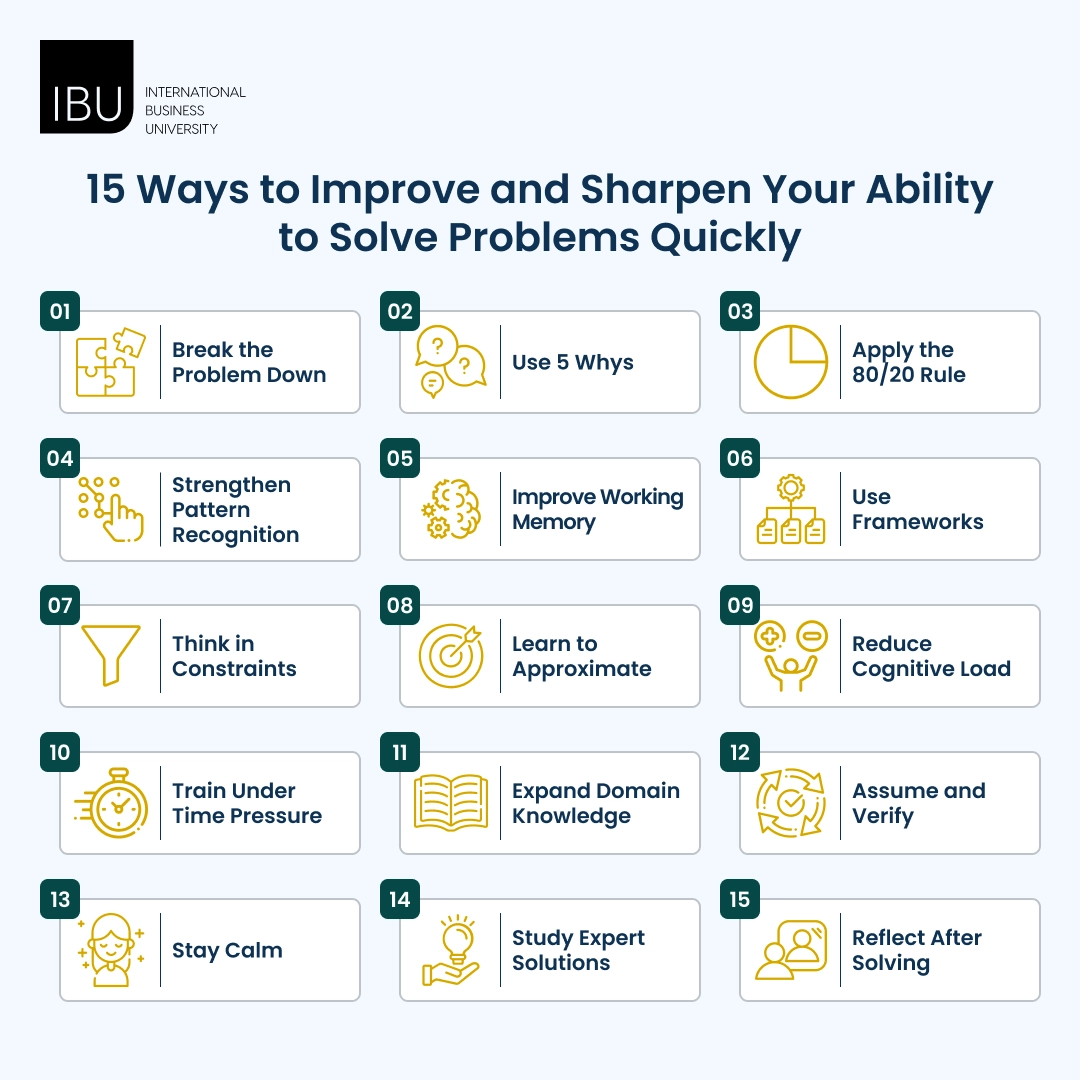
15 Ways to Improve and Sharpen Your Ability to Solve Problems Quickly
Speed in problem-solving is often misunderstood. It’s not about rushing decisions or skipping steps. It’s about removing friction from thinking. People who solve problems quickly rely on mental structure, disciplined reasoning, and repeatable habits that keep them moving when others hesitate. These fifteen methods show how to improve problem-solving skills because they simplify complexity, reduce cognitive strain, and protect momentum. When practiced consistently, they strengthen your ability to solve problems under time pressure, uncertainty, and competing priorities.
1. Break the problem down
Complex problems overwhelm because they arrive bundled. Inputs, constraints, risks, and outcomes all appear at once. When your brain tries to process everything simultaneously, clarity collapses. Breaking the problem down introduces order where chaos exists.
This method forces separation. You isolate variables, identify dependencies, and sequence actions. Instead of asking how to solve the entire problem, you ask what must be understood first, then second, then third. Each answer reduces uncertainty.
Strong problem solvers use decomposition to regain control and solve the problem in front of them before tackling what comes next. As each smaller component becomes clear, confidence rises and progress follows. Solutions emerge faster because the mind no longer fights complexity.
2. Use 5 Whys
Most problems repeat because people solve symptoms instead of causes. The first explanation feels convincing, yet it rarely explains why the issue keeps returning. The 5 Whys technique slows thinking just enough to prevent superficial fixes.
Each “why” challenges the previous assumption. You move past blame, habit, and convenience toward underlying structure. By the fourth or fifth layer, patterns appear. Constraints surface. True causes reveal themselves.
Solving the root cause saves time long after the initial effort. You eliminate recurring friction instead of managing it repeatedly. Speed improves because future problems shrink or disappear entirely.
3. Apply the 80/20 rule
Not all problems deserve equal attention. Some issues create disproportionate impact, while others consume time without meaningful return. The 80/20 rule sharpens focus by identifying the few factors driving most results.
This approach forces prioritization. You stop asking what can be solved and start asking what must be solved. High-impact actions move forward. Low-impact distractions fade.
Problem-solving speed increases because effort aligns with outcomes. You spend less time managing noise and more time addressing leverage points that actually change results.
4. Strengthen pattern recognition
Fast problem solvers recognize familiar structures beneath new situations. While details differ, underlying mechanics often repeat. Pattern recognition allows you to reuse thinking instead of inventing solutions from scratch.
This skill develops through reflection and exposure. Reviewing past challenges helps you notice similarities in constraints, trade-offs, and failure points. Over time, your mind builds a reference library.
With strong pattern recognition, decisions feel faster because they feel familiar. You’ve seen versions of the problem before. That familiarity reduces hesitation and increases confidence.
5. Improve working memory
Working memory acts as your mental workspace. It holds information while you analyze relationships and make decisions. When overloaded, reasoning slows, and errors increase.
Improving working memory isn’t about memorizing more. It’s about managing inputs better. Writing ideas down, grouping related concepts, and focusing on one variable at a time protect mental capacity.
A stronger working memory supports clearer comparisons and faster judgment. You track fewer loose ends, which allows decisions to form with less strain.
6. Use frameworks
Frameworks remove uncertainty about how to think. When pressure rises, improvisation becomes unreliable. Structured frameworks provide a stable path forward.
Decision trees guide complex choices. Priority matrices clarify urgency. Cost-benefit grids evaluate trade-offs logically. Each framework reduces mental friction by narrowing options systematically.
Using frameworks increases speed because thinking follows a familiar route. You stop reinventing the process and focus on content. Accuracy improves alongside pace.
7. Think in constraints
Unlimited options slow decisions. Constraints accelerate them. When boundaries are defined, weak options disappear automatically.
Constraints include time, resources, rules, and objectives. By acknowledging these early, you eliminate unrealistic solutions. Focus sharpens.
Strong problem solvers define constraints intentionally. They use limits to guide creativity rather than restrict it. Within clear boundaries, solutions surface faster and with greater precision.
8. Learn to approximate
Waiting for certainty delays action. Approximation allows progress without perfection. You estimate direction, magnitude, or impact well enough to move forward.
Approximation doesn’t reject accuracy. It postpones it. Early estimates create momentum and feedback. Feedback refines precision.
Problem solvers who approximate act sooner, learn faster, and adjust intelligently. Speed improves through iteration rather than hesitation.
9. Reduce cognitive load
Cognitive load refers to how much information your mind holds at once. When overloaded, clarity collapses. Reducing cognitive load restores focus and reasoning capacity.
High performers externalize complexity. They use notes, diagrams, and checklists to move information out of their head and onto paper. This frees mental space for analysis.
Lower cognitive load helps you solve problems with cleaner, faster decisions You think faster because your mind isn’t juggling unnecessary details.
10. Train under time pressure
Time pressure reveals decision habits. Training under deadlines builds confidence before the stakes rise. Simulated urgency strengthens prioritization skills.
Timed exercises force clarity. You learn to identify critical variables quickly and ignore noise. Over time, speed becomes controlled rather than rushed.
When real pressure arrives, it feels familiar. Familiarity protects judgment and prevents panic.
11. Expand domain knowledge
Knowledge reduces uncertainty. Familiarity shortens explanation time and improves intuition. The more you understand a domain, the fewer questions slow you down.
You don’t need mastery everywhere. Broad exposure across related areas builds context. Context allows faster inference and fewer assumptions.
Domain knowledge accelerates pattern recognition and improves decision confidence, building the management skills that fast-track your career and shape long-term growth.
12. Assume and verify
Perfect information rarely arrives on schedule. Assuming a likely scenario allows movement. Verification adjusts the course if needed.
This approach protects momentum. You avoid paralysis while still respecting accuracy. Each assumption becomes a test, not a commitment.
Iteration sharpens judgment. Speed improves because learning happens in motion.
13. Stay calm
Stress narrows thinking. Calm restores access to logic, memory, and judgment. Emotional regulation protects problem-solving speed.
Pauses, breathing, and reframing interrupt reactive patterns. Control returns quickly. Decisions improve.
Calm minds process complexity without distortion. Speed follows clarity.
14. Study expert solutions
Experts solve problems faster because they recognize structure and apply tested reasoning. Studying their decisions accelerates learning.
Focus on how they think, not just what they decide. Reasoning transfers across contexts. Outcomes alone do not.
Adopting expert patterns reduces trial and error, saving time and effort.
15. Reflect after solving
Reflection transforms action into insight. Reviewing decisions reveals what improved speed and what slowed progress.
Fast problem solvers analyze process, not just results. They identify habits worth repeating and errors worth correcting.
Reflection compounds improvement. Each solved problem sharpens the next.
How to Develop a Problem-Solving Mindset for Faster Solutions
Your mindset determines how fast you move before you ever choose a method. Speed in problem-solving starts upstream, in how your brain interprets uncertainty. People who solve problems quickly do not wait for clarity to appear. They train their thinking to stay functional when clarity is incomplete. This mindset reduces hesitation, limits emotional drag, and keeps momentum intact even under pressure.
A strong problem-solving mindset operates on one principle: movement creates information. Instead of pausing to eliminate risk, fast thinkers move forward in controlled steps, using feedback to guide their next decision.
See obstacles as information, not interruptions
Obstacles are signals, not setbacks. Fast problem solvers treat resistance as a diagnostic tool. When something breaks, stalls, or pushes back, it reveals a flaw in assumptions, design, or sequencing. This reframing prevents emotional reactions that slow thinking.
Instead of asking why this is happening to me, they ask:
- What variable is exposed here?
- What assumption just failed?
- What does this tell me about the system?
This habit keeps attention on learning and forward adjustment rather than frustration.
Expect friction as part of the process
Friction is inevitable in complex thinking. Missing data, delays, misalignment, and competing priorities are not exceptions. They are the environment. When friction is expected, it no longer triggers panic or indecision.
Prepared minds recover faster because resistance feels familiar. They adjust without dramatizing difficulty. This emotional neutrality preserves cognitive energy and shortens decision cycles.
Stay focused on progress rather than perfection
Waiting for perfect clarity is one of the most expensive delays in problem-solving. Fast thinkers value direction over precision in early stages. They aim to move the problem forward enough to generate feedback.
Progress produces information. Information sharpens the next step. This loop replaces hesitation with momentum and prevents analysis paralysis.
Use curiosity to replace frustration
Frustration narrows thinking. Curiosity expands it. When outcomes are uncertain, curiosity keeps the mind flexible and investigative.
Instead of reacting emotionally, curious problem solvers ask:
- What changed?
- What pattern is forming?
- What matters most right now?
This mental posture leads to stronger questions, clearer insight, and better-quality decisions.
Treat every challenge as practice
Speed is trained through repetition. Every problem becomes a rehearsal for the next one. Fast problem solvers review outcomes intentionally:
- What slowed me down?
- What helped me move faster?
- Where did I hesitate unnecessarily?
Over time, familiarity replaces fear. Familiarity accelerates action. What once felt complex becomes routine.
Solve complex business problems with confidence and clarity
Learn how structured thinking, decision-making, and execution shape effective managers in business environments.
Using Critical Thinking to Boost Your Ability to Solve Problems
Critical thinking protects your ability to solve problems by filtering noise before it drains energy. It prevents emotional shortcuts, weak assumptions, and wasted effort. Strong critical thinkers slow down briefly to speed up execution later.
Their advantage comes from clarity. They identify what matters before committing time and attention.
Separate facts from assumptions
Fast decisions depend on clean inputs. Critical thinkers clearly label what is known versus what is assumed. This distinction prevents conclusions built on unstable foundations.
They ask:
- What evidence do we actually have?
- What am I inferring without proof?
- What would change if this assumption were wrong?
This habit sharpens judgment and reduces rework.
Question the source of information
Not all information deserves equal trust. Strong problem solvers evaluate credibility before acting. They consider:
- Who provided this information?
- What incentive or bias may exist?
- How current and relevant is it?
This filtering prevents decisions driven by outdated, incomplete, or distorted data.
Identify what is missing before acting
Missing information creates hidden risk. Critical thinkers scan for gaps before committing fully. Even partial awareness improves planning.
They ask:
- What do I still need to know?
- What could surprise me later?
- Which unknown carries the most risk?
This awareness allows smarter sequencing and contingency planning.
Test ideas before committing fully
Fast thinkers pressure-test assumptions early. They run small mental simulations and ask what breaks if an idea fails. This practice reduces costly errors and increases confidence in execution. Weak ideas are exposed quickly; strong ones move forward with conviction.
Structure reasoning for clear communication
Clear thinking leads to clear explanations. When logic is structured, decisions are easier to understand and execute.
Structured reasoning:
- Reduces confusion
- Prevents repeated clarification
- Improves alignment across teams
Execution speeds up when everyone understands the why behind the what.
Building a Toolkit to Improve Your Ability to Solve Problems
When pressure rises, thinking from scratch becomes inefficient. A personal problem-solving toolkit gives you a reliable starting point. It replaces hesitation with structure and preserves mental energy for judgment rather than recall. The goal of a toolkit is not creativity. It is consistency under pressure.
Use decision trees for complex choices
Decision trees break complexity into visible paths. They help you evaluate consequences step by step instead of juggling options mentally.
This visual structure:
- Clarifies trade-offs
- Reduces overwhelm
- Speeds up commitment
Complex problems become manageable when choices are externalized.
Apply prioritization grids for urgency
Not all problems deserve equal attention. Prioritization tools force clarity around impact and urgency.
They help you:
- Focus on high-leverage actions
- Defer low-impact distractions
- Protect attention during overload
Speed improves when effort is allocated intentionally.
Create checklists for recurring problems
Repeated challenges should not require repeated thinking. Checklists capture proven steps and prevent oversight.
They:
- Reduce cognitive load
- Improve consistency
- Eliminate preventable mistakes
High performers rely on systems, not memory.
Personalize tools to your role
Effective toolkits reflect the demands you will meet, if you’re managing coursework in a BCOM in Business Management program or leading a team on the job. Students benefit from exam breakdown frameworks and research structures. Professionals rely on risk analysis, trade-off evaluation, and decision mapping. Relevance increases usability. Usability increases speed.
Use the same tools consistently
Consistency matters more than variety. Repeated use builds familiarity. Familiarity reduces hesitation. Over time, your toolkit becomes instinctive. You stop thinking about how to start and move directly into action.
Rely on your toolkit under pressure
Confidence comes from knowing where to begin. When uncertainty appears, your toolkit provides immediate direction. That certainty stabilizes thinking, preserves momentum, and keeps decision-making steady when the stakes are high.
FAQ
Why is the ability to solve problems important today?
Modern environments change faster than plans can adapt. Strong problem solvers navigate uncertainty, maintain clarity under pressure, and make confident decisions with incomplete data. This ability directly drives leadership, academic success, and career advancement by making you a reliable anchor when unexpected challenges arise.
Can problem-solving speed be learned?
Yes. Speed is a trained skill built on structured frameworks, pattern recognition, and deliberate practice; not natural talent. As you apply repeatable problem-solving models and reflect on outcomes, cognitive load decreases, hesitation drops, and fast, high-quality decision-making becomes second nature.
Does faster problem-solving reduce quality?
Speed does not reduce quality when it is driven by clarity and preparation. In fact, structured thinking often improves accuracy by preventing emotional reactions, weak assumptions, and scattered effort. Faster decisions come from understanding the problem sooner, separating facts from assumptions, and identifying constraints early. High-quality problem solvers move quickly because their thinking is disciplined and intentional, allowing them to generate useful feedback and adjust effectively rather than rushing to conclusions.
How to get better at problem-solving as a business student?
You get better at problem-solving by practicing the same structured steps on small, low-stakes decisions before applying them under pressure. Reviewing past decisions and noting what worked builds pattern recognition faster than reading theory alone.
How to develop problem-solving skills that hold up under pressure?
You develop problem-solving skills that hold up under pressure by training with real-time constraints, not just studying frameworks. Practicing decisions on a clock builds the composure needed when deadlines are real.
How to improve problem-solving skills without burning out?
You improve problem-solving skills without burning out by reducing the number of things you hold in your head at once. Writing decisions down, using checklists, and applying one framework consistently protects mental energy over time.
How to solve problems that keep repeating?
Running a short cause check before reacting is a quick way to solve problems that seem to repeat. Addressing the root cause instead of the symptom is also a quick way to resolve problems permanently instead of managing them over and over.
Applying Your Ability to Solve Problems in Academic and Career Settings
In academics, learning how to solve problems determines how you manage exams, projects, and research challenges. Clear thinking improves performance under deadlines. Structured reasoning supports higher confidence and consistency.
In careers, problem-solving defines leadership potential. Employers value people who move situations forward. Fast, thoughtful decisions improve trust and results.
Your ability to solve problems compounds with experience. Each challenge strengthens future performance. Build the habit now, and momentum follows.
Solve complex business problems with confidence and clarity.
Advance your ability to solve problems under pressure through data-driven decision-making and strategic leadership training.