

The 5 rights of delegation give managers a practical system for assigning work without losing control, clarity, or trust. When delegation fails, teams stall, managers overwork, and results slip. When delegation works, execution accelerates, confidence rises, and leaders regain focus. The difference rarely comes down to effort. It comes down to structure.
You do not delegate to offload work. You delegate to multiply output. That only happens when the right task reaches the right person under the right conditions with the right direction and the right level of follow-up. Miss one element, and delegation turns into frustration.
Learning how to apply the 5 rights of delegation in real management settings. You will learn why the framework works, where managers commonly slip, and how to use delegation as a performance engine rather than a risk.
Key Takeaways
- The 5 rights of delegation create clarity, accountability, and execution speed
- Strong delegation reduces manager overload while improving team performance
- Applying the framework consistently builds confidence, trust, and long-term growth
The Origin and Importance of the 5 Rights Framework
The 5 rights of delegation emerged from healthcare management, a field where delegation mistakes create immediate risk. In clinical environments, assigning the wrong task to the wrong person under the wrong conditions can lead to serious outcomes. Managers in healthcare needed a repeatable way to protect quality while distributing workload. The result was a structured delegation framework built on clarity rather than assumption.
Over time, leaders outside healthcare recognized the same challenges in corporate, academic, and operational settings. Teams struggled with unclear ownership. Managers overextended themselves. Accountability broke down under pressure. The framework proved transferable because it addressed human and organizational realities rather than industry-specific tasks.
The power of the framework comes from structure. Each right forces a deliberate pause before delegation happens. Managers stop guessing. Teams stop filling gaps. Expectations become visible. Consistency replaces improvisation. Confidence grows on both sides of the delegation exchange.
When applied consistently, the framework shifts delegation from an informal habit into a repeatable management system. That system scales across teams, projects, and growth stages.
What Are the 5 Rights of Delegation?
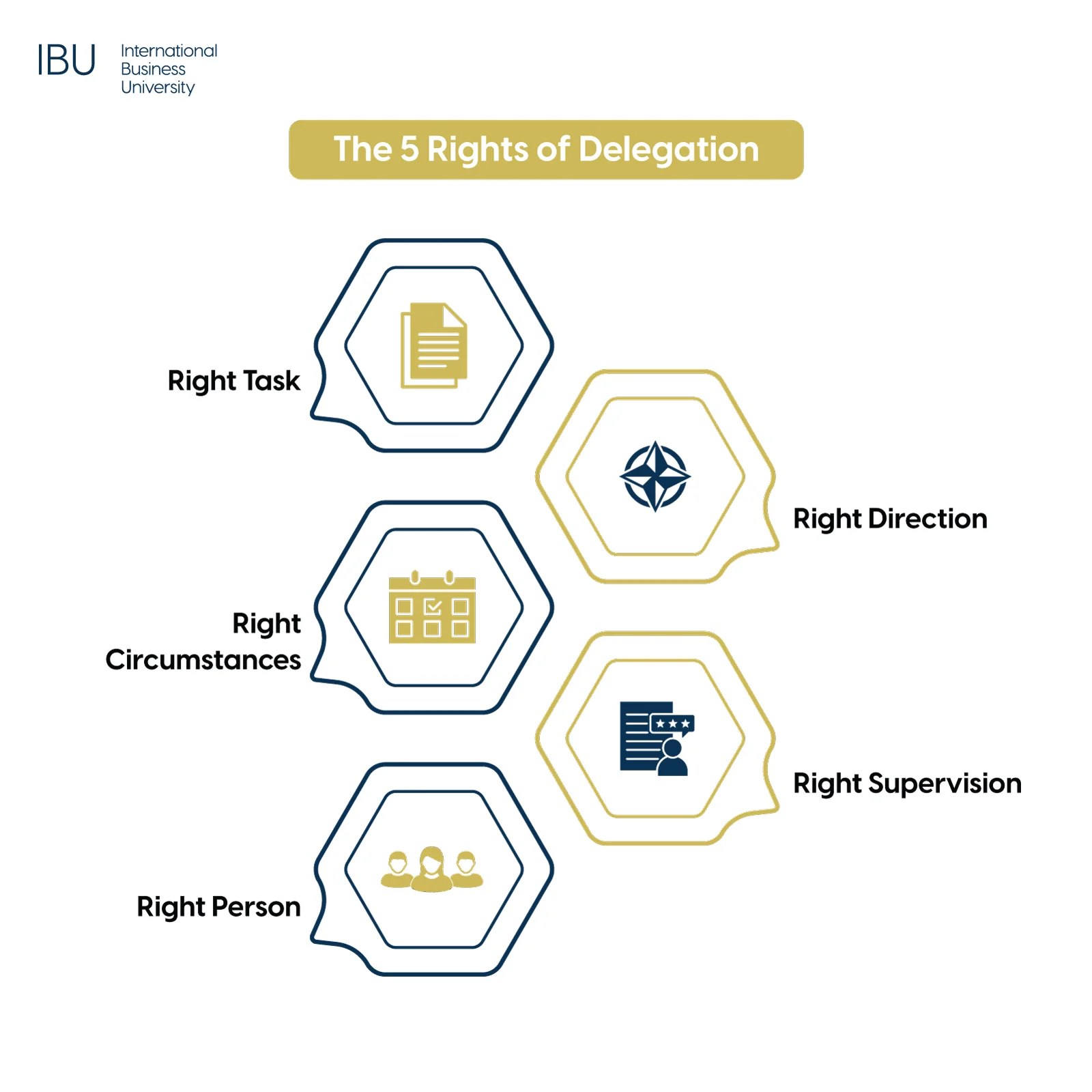
The 5 rights of delegation offer a structured way to assign responsibility while preserving quality and control. This framework ensures work moves forward with clarity instead of confusion. Each right addresses a common failure point in delegation.
When managers skip structure, delegation feels risky. When structure exists, delegation becomes repeatable and reliable.
Right Task
Not every task belongs in delegation. The right task matches the purpose of delegation and the readiness of the team. Strategic decisions, sensitive conversations, and high-risk approvals often remain with leadership. Operational execution, analysis, preparation, and coordination often transfer well.
Delegating the wrong task creates hesitation and rework. Delegating the right task frees time while maintaining standards. Ask one question before delegating: Does this task build capability without putting outcomes at risk?
Right Circumstances
Timing and context matter. The same task may work well under one set of conditions and fail under another. Tight deadlines, regulatory pressure, and limited resources change what delegation looks like.
The right circumstances mean the environment supports success. Tools must exist. Priorities must remain clear. Competing demands must stay visible. Delegation succeeds when the situation allows focus and follow-through.
Right Person
Delegation depends on capability and capacity. The right person has the skill, availability, and interest to execute effectively. This does not mean perfection. It means readiness with support.
Assigning work without considering workload leads to burnout. Assigning work without considering skill leads to rework. Effective managers balance development with delivery.
Right Direction and Communication
Clarity separates effective delegation from wishful thinking. Direction covers outcomes, constraints, timelines, and decision authority. Communication aligns expectations before work begins.
Strong direction answers four questions:
- What does success look like
- When is it due
- What constraints exist
- Where decision authority starts and stops
Without this clarity, delegation turns into guesswork.
Right Supervision and Feedback
Delegation never means disappearance. Right supervision matches task complexity and experience level. Feedback reinforces standards and builds confidence.
Too little follow-up invites drift. Too many follow-up signals of distrust. The right balance keeps work on track while encouraging independence.
Build stronger leadership skills through structured delegation through BCOM Business Management.
Learn how clear delegation improves execution and confidence.
Why Delegation Fails Without the 5 Rights
Delegation breaks down when structure disappears. A task may reach someone capable, yet expectations remain vague. Another task may have clear instructions, yet timing undermines success. In many cases, follow-up fades as priorities shift.
When one or more rights are missing, managers feel compelled to step back in. They correct errors, rewrite work, and chase updates. Teams interpret this as distrust. Managers interpret it as confirmation that delegation does not work. A negative loop forms.
Without the 5 rights, delegation increases workload rather than reducing it. Managers spend more time fixing outcomes than guiding direction. Teams hesitate to take initiative due to unclear boundaries. Confidence erodes quietly.
With the framework in place, delegation becomes predictable. Tasks land with purpose. Authority stays defined. Follow-up feels supportive rather than intrusive. Delegation starts producing leverage instead of friction.
Integrating the 5 Rights into Modern Workflows
Modern teams operate across platforms, schedules, and locations. Delegation now happens through project boards, shared documents, and digital messages rather than hallway conversations. The 5 rights adapt well to this environment because they emphasize clarity at the point of handoff.
Digital workflows succeed when ownership stays visible. A task card reflects the right task. Assigned ownership reflects the right person. Deadlines and dependencies signal the right circumstances. Written descriptions deliver the right direction. Scheduled check-ins support right supervision.
Project management tools, shared dashboards, and documented updates reinforce the framework naturally. Managers gain visibility without hovering. Teams gain autonomy without confusion. Structure replaces guesswork. Transparency replaces constant follow-up.
The framework works best when embedded into daily workflow habits rather than treated as a separate process.
Applying the 5 Rights to Enhance Team Efficiency
Efficiency improves when delegation supports execution rather than disrupting it. The 5 rights of delegation align responsibility with readiness, timing, and clarity. Work moves forward with fewer interruptions and less rework.
Managers who apply the framework consistently notice smoother handoffs, faster progress, and fewer escalation points. Teams spend more time executing and less time clarifying.
This section shows how managers translate the framework into daily practice.
Practical Examples of Each Right
Consider a manager delegating report preparation. The task involves analysis and formatting rather than final approval. That makes it the right task. The analyst assigned has strong data skills and available capacity, meeting the right person requirement. The deadline falls outside peak reporting season, supporting the right circumstances.
Clear guidance outlines the purpose, scope, and decision limits. That establishes the right direction. Weekly review points create right supervision without constant oversight.
In another scenario, a manager assigns client coordination to a team member during a period with fewer competing deadlines. Timing supports focus. Authority boundaries define escalation paths clearly. The team member executes confidently without unnecessary approvals.
Each right strengthens the others. Together, they create momentum rather than dependency.
Common Mistakes to Avoid
Delegation often fails due to predictable patterns. Managers delegate too late, delegate under pressure, and delegate based on convenience rather than capability.
Common mistakes include:
- Assigning work without defining outcomes
- Transferring responsibility without clarifying decision authority
- Reducing follow-up due to competing priorities
These missteps compound quickly. One unclear task leads to missed expectations. Missed expectations lead to rework. Rework leads to distrust.
Consistency prevents these cycles.
Step-by-Step Process for Successful Delegation
Effective delegation follows a deliberate sequence that managers can repeat across tasks and teams.
Start by selecting the task based on impact and acceptable risk. Confirm that circumstances allow focus, access to tools, and reasonable timelines. Choose the person based on readiness, workload, and development value.
Communicate outcomes, constraints, deadlines, and authority boundaries clearly. Agree on how progress will be reviewed and how feedback will be delivered.
This sequence reduces ambiguity and builds reliability over time.
Tools and Techniques for Monitoring Progress
Monitoring works best when visibility replaces interruption. Shared dashboards show status without constant messaging. Milestone reviews provide structured checkpoints. Written updates capture context clearly.
Brief scheduled check-ins maintain alignment without pressure. Documentation reduces misinterpretation. Tools support structure while preserving trust.
Effective monitoring feels supportive rather than controlling.
Cultivating Accountability and Ownership
Accountability grows when ownership stays explicit. Every delegated task needs a visible owner with defined authority. Shared responsibility often leads to diluted responsibility.
Managers reinforce ownership by acknowledging progress early and addressing gaps promptly. Recognition strengthens confidence. Course correction prevents drift.
Consistency matters more than intensity. When accountability stays predictable, teams respond with reliability and initiative.
Benefits of Following the 5 Rights in Delegation
Applying the 5 rights of delegation consistently reshapes how work moves through a team and how leadership shows up day to day. Improvements do not arrive all at once. They build through repetition. Each correctly delegated task reinforces trust, clarity, and momentum. Over time, these benefits compound into measurable performance gains.
This section breaks down what changes in practical terms when delegation follows structure rather than instinct.
Improved Task Completion
Clear delegation improves task completion by removing ambiguity at the start. When expectations remain visible, teams spend less time clarifying direction and more time executing. Rework declines because the success criteria stay defined from the outset.
Ownership plays a central role here. When one person owns a task with clear authority boundaries, progress remains steady. Follow-up feels expected rather than intrusive. Deadlines hold because accountability stays predictable.
Managers notice fewer last-minute escalations. Teams deliver work that meets standards without repeated adjustment. Completion becomes reliable rather than hopeful.
Increased Employee Confidence
Delegation builds confidence when responsibility comes with guidance. Team members grow when they understand what success looks like and know support exists if questions arise. Confidence develops through experience, not reassurance alone.
Structured delegation creates safe opportunities to stretch skills. Employees learn that responsibility does not mean isolation. They gain confidence through successful delivery rather than avoidance of risk.
As confidence grows, initiative follows naturally. Team members start anticipating needs, solving problems earlier, and contributing ideas without waiting for instruction. Performance strengthens because confidence fuels engagement.
Strengthened Team Dynamics and Collaboration
Clear roles reduce tension inside teams. When authority boundaries remain understood, collaboration feels focused rather than competitive. Team members know when to contribute, when to decide, and when to defer.
Consistency builds trust across the group. People rely on one another because responsibilities stay stable. Collaboration shifts from reactive coordination to intentional teamwork.
Purposeful collaboration replaces friction. Meetings become shorter. Decisions move faster. Energy stays directed toward outcomes rather than clarification.
Reduced Managerial Burnout
Managers experience burnout when they carry too much operational weight. Poor delegation forces leaders into constant problem-solving, review cycles, and last-minute corrections.
Effective delegation redistributes effort across the team. Managers regain time for planning, coaching, and decision-making. Mental load decreases as execution becomes more predictable.
Burnout declines because leadership shifts from constant oversight to strategic direction. Managers spend less time fixing work and more time shaping outcomes.
Long-Term Organizational Growth
Organizations scale through systems, not individual effort. The 5 rights of delegation create a repeatable system that supports growth without sacrificing quality.
As teams mature, leaders step back from daily execution and focus on direction, priorities, and development. New leaders emerge because delegation builds capability across the organization.
Growth becomes sustainable because responsibility spreads without confusion. Structure supports expansion. Leadership remains focused on progress rather than maintenance.
FAQ
What Are the Consequences of Ignoring the 5 Rights?
Ignoring the framework leads to confusion, rework, and frustration. Managers absorb more work. Teams disengage.
How Can New Managers Apply the 5 Rights Effectively?
New managers benefit from using the framework as a checklist. Structure reduces uncertainty while confidence grows.
Are the 5 Rights Applicable Outside of Healthcare or Management?
Yes. The framework applies to education, technology, operations, and creative teams. Delegation principles remain universal.
How Do the 5 Rights Support Leadership Development?
Delegation builds leadership by shifting focus from control to capability. Leaders grow by trusting structure rather than intuition alone.
Prepare for global leadership roles with real-world management skills with an MBA in Global Business Management.
Apply structured delegation techniques that employers value.
Implementing the 5 Rights for Delegation Success
Mastering the 5 rights of delegation changes how you lead, how your team performs, and how work moves forward. Delegation becomes intentional rather than reactive. Authority stays clear. Trust grows naturally.
You build momentum by applying the framework consistently. Each task reinforces structure. Each success strengthens confidence. Over time, delegation shifts from a risk into a competitive advantage.
The 5 rights of delegation offer more than a checklist. They provide a mindset for sustainable leadership, scalable execution, and long-term success.