
Conflict management is a process leaders use to identify, address, and resolve disagreements before they damage trust, communication, or performance. Understanding the principles of conflict management gives you the skill to guide people, maintain trust, and drive collaboration even when opinions clash. Leaders who master these principles create stability during uncertainty, encourage respect, and build cultures where performance rises instead of fractures. This article breaks down ten actionable principles that separate reactive managers from strategic leaders, those who turn tension into opportunity.
Why High-Performing Leaders Prioritize Conflict Management
High-performing teams rely on communication, shared purpose, and trust. When conflict goes unmanaged, it silently corrodes these foundations, reducing motivation, focus, and collaboration. Leaders who prioritize conflict management understand that disagreement itself isn’t the enemy; disconnection is. They recognize that, when handled strategically, tension can sharpen decision-making, clarify expectations, and strengthen resilience.
Instead of avoiding disagreements, strong leaders reframe them as opportunities to:
- Reveal Blind Spots: Uncover perspectives leadership might overlook.
- Spark Creativity: Push teams to evaluate assumptions and propose stronger ideas.
- Promote Accountability: Clarify ownership of tasks and expectations through discussion.
- Strengthen Culture: Demonstrate that honesty and respect can coexist with difference.
Why Unmanaged Conflict Damages Performance
Conflict that goes unaddressed behaves like slow rust. It weakens structure without immediate visibility. The consequences compound across departments:
- Productivity Loss: Research by CPP Inc. shows employees spend nearly 2.8 hours per week dealing with conflict, equating to $359 billion in lost productivity across the U.S. economy each year.
- Emotional Fatigue: Constant friction raises stress and burnout, lowering engagement scores and retention rates.
- Communication Breakdowns: Team members withdraw, share less information, and avoid collaboration, reducing innovation.
- Customer Impact: Internal misalignment eventually shows up externally, in missed deadlines, inconsistent service, and reduced client satisfaction.
Every unresolved dispute drains focus from strategic goals. Over time, that distraction costs more than any single disagreement ever would.
Why Skilled Leaders Treat Conflict as Strategic Data
The conflict management process is not about maintaining peace at all costs. It’s about using proper dialogue to align people toward shared solutions. Effective leaders treat conflict as a feedback mechanism, a real-time indicator of where clarity, role definition, or communication is breaking down.
Here’s how high-performing leaders use conflict to their advantage:
- Diagnose Systemic Issues: Identify recurring triggers such as unclear KPIs, workload imbalance, or cultural mismatches.
- Reinforce Standards: Use difficult conversations to remind teams of organizational values and behavioural
- Coach Communication Skills: Teach assertiveness, empathy, and accountability through lived examples rather than workshops alone.
- Document Learnings: Build institutional knowledge from past conflicts, strengthening future responses and leadership succession.
Conflict Management Strategies Leaders Use Proactively
Leaders who apply proven conflict management strategies never wait for tension to boil over. They anticipate it. Proactive frameworks allow them to channel friction into focus rather than frustration. These leaders:
- Establish Clear Communication Protocols so every team member knows how to raise issues constructively.
- Create Safe Dialogue Spaces where concerns can be voiced without fear of retaliation.
- Model Assertive Behavior by addressing issues directly and respectfully.
- Set Escalation Pathways, who mediates, how feedback loops close, and what follow-ups occur.
- Reinforce Fairness and Transparency by documenting outcomes and sharing lessons learned.
Through these systems, conflict becomes a structured process that builds capacity instead of chaos. When managed deliberately, disagreement transforms from a threat to an asset, fuelling innovation, strengthening trust, and improving team cohesion.
In high-performing environments, effective conflict management isn’t just a leadership competency; it’s a performance multiplier. Leaders who invest in it reduce turnover, elevate communication standards, and develop workplaces where respect drives results.
Understanding the 10 Principles of Conflict Management
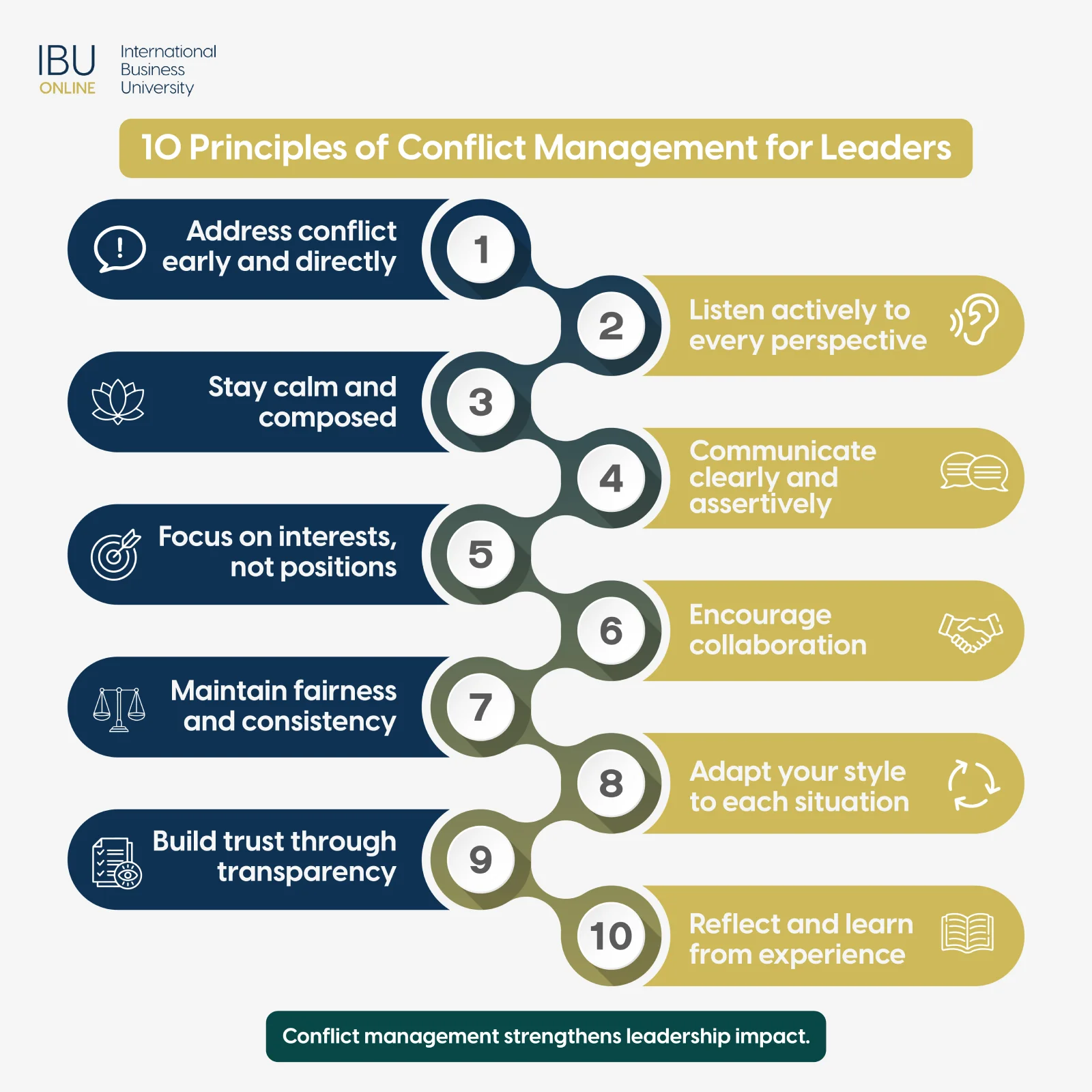
Each of the 10 principles of conflict management reinforces your ability to respond, not react. Strong leaders treat conflict as data, a signal revealing where communication or expectations have broken down. These principles help you identify early warning signs, communicate with empathy, and sustain performance even when tension rises. They are universal because they balance authority with humanity, structure with flexibility, and accountability with care.
Applied together, these principles become more than a checklist. They form a conflict management framework that equips leaders to guide teams through difficult conversations, align differences, and strengthen workplace relationships. Let’s explore each principle and how it shapes effective, confident leadership.
Principle 1: Address Conflict Early and Directly
Avoidance is the fastest way to let small problems become large ones.
When tension is left unattended, it spreads through small conversations, lost productivity, and emotional fatigue. Addressing conflict early signals to your team that you value resolution over discomfort. In leadership, silence often reads as indecision.
Early intervention protects relationships and preserves focus. The best leaders handle disputes before they calcify into resentment. Schedule private discussions, use neutral language, and clarify the facts before assumptions take root.
Principle 2: Listen Actively to Understand All Perspectives
Listening is the most underused leadership tool in conflict management. Many leaders think they’re listening when they’re simply waiting to speak. Active listening means you’re fully present, no mental rebuttals, no distractions, no preloaded answers.
Show genuine curiosity about each person’s experience. Paraphrase their words to confirm understanding, ask clarifying questions, and observe nonverbal cues that reveal emotional tone. When people feel heard, they soften defensiveness. That psychological safety creates space for cooperation.
Active listening also reduces misinterpretation. It surfaces the real issues behind surface-level complaints, budget pressures, unclear expectations, or emotional fatigue. This practice aligns perfectly with conflict resolution techniques, ensuring leaders focus on understanding before judgment.
Principle 3: Stay Calm and Composed Under Pressure
A leader’s composure determines the atmosphere of the room. When emotions spike, people instinctively watch the leader’s reaction. Calm behavior communicates control, and control fosters trust. The best leaders regulate their tone, pace, and body language even when frustration rises.
Composure doesn’t mean suppressing emotion; it means mastering it. Simple methods, controlled breathing, pausing before responding, or summarizing facts out loud, anchor discussions in logic. When you model emotional steadiness, others follow your lead. It’s like tuning a noisy room to your frequency.
Maintaining calm under pressure also prevents reactive decision-making. When your responses stay objective, you preserve credibility, protect morale, and promote a culture where disagreement doesn’t equal disrespect.
Principle 4: Communicate Clearly and Assertively
Clarity is leadership currency. Vague language confuses; assertive communication aligns. Assertiveness sits between aggression and avoidance, its confidence wrapped in respect. Leaders who communicate assertively build trust faster because their expectations, feedback, and reasoning are transparent.
Start with facts, stay specific, and keep your tone professional. Avoid judgmental language that assigns blame. For example: “Let’s clarify next steps so we stay aligned” carries more authority than “You always miss deadlines.”
Assertive communication also reinforces the conflict management process by minimizing misinterpretation. It sets mutual understanding as the standard and creates a feedback loop where people feel safe sharing concerns. Over time, this clarity becomes cultural, and your team learns that issues get solved through dialogue, not drama.
Principle 5: Focus on Interests, Not Positions
Every conflict has two layers: what people say they want and what they truly need. Skilled leaders recognize this difference. Positions are demands; interests are motivations. The goal is to uncover the reasoning behind those demands.
This principle stems from classic principles of negotiation, including the BATNA framework, the same methods used in business deals and diplomacy. This is also a direct answer to what is conflict resolution in management: it is the process of identifying the underlying interests behind stated positions so both sides reach a workable agreement. Instead of defending your stance, explore why it matters. For example, when a team member insists on a specific deadline, their underlying interest may be reducing workload anxiety or aligning with another project. Understanding that interest opens space for compromise.
Focusing on interests instead of positions turns win-lose battles into win-learn collaborations. You redirect the conversation toward outcomes that satisfy both productivity and morale.
Principle 6: Encourage Collaboration and Problem-Solving
Conflict often isolates people into “sides.” Collaborative leadership dissolves that separation. By inviting participation, you convert defensiveness into ownership. Encourage group brainstorming sessions where everyone contributes ideas, regardless of hierarchy.
Incorporate structured problem-solving models, such as identifying root causes, generating options, and evaluating pros and cons collectively. This approach builds shared accountability. When employees co-create solutions, they feel empowered rather than dictated to.
Embedding collaboration in the conflict management strategies of your organization produces long-term dividends, less turnover, stronger innovation, and higher engagement. People trust processes they help design.
Principle 7: Maintain Fairness and Consistency
Fairness is the moral backbone of leadership. It’s not about equal outcomes, it’s about equal treatment.
When people know the rules apply to everyone, they commit more willingly. Fairness shows up in how you distribute workload, recognize performance, and communicate feedback.
Consistency cements fairness. Teams quickly detect when leaders make exceptions without explanation. Once that happens, loyalty drops. Research from Deloitte shows that perceived unfair treatment is the number one driver of employee disengagement, exceeding even pay dissatisfaction.
Keep conflict policies transparent, document agreements, and ensure decisions align with previously communicated values. Consistent fairness turns leadership from authority into integrity.
Principle 8: Adapt Your Style to the Situation
Effective conflict management is not rigid; it’s responsive. Different situations call for different tones, methods, and involvement levels. A disagreement between peers might only need facilitation, while a performance-related dispute may require firm direction.
Evaluate three variables before choosing your approach: urgency, impact, and emotional intensity. When deadlines are tight, be directive. When relationships are strained, lean into mediation. When the stakes are strategic, blend firmness with empathy.
Adaptability connects directly to how to handle management conflicts in practice.Leaders who adjust style without losing fairness resolve disputes faster and strengthen their credibility. The ability to shift gears demonstrates emotional intelligence and situational awareness.
Principle 9: Build Trust Through Transparency
Trust is the invisible glue holding teams together. Without it, even small disagreements spiral into major disruptions. Transparency is the tool that keeps trust intact. Communicate openly about decisions, why they’re made, how they affect others, and what the next steps will be.
Avoid vague reassurances. Instead, share relevant facts. For example, if a schedule changes due to budget constraints, explain the reasoning. When employees understand the why, they’re more willing to support the how.
Transparency also supports conflict prevention strategies. When people believe they’ll be informed honestly, they stop speculating. Clear communication keeps rumor chains short, aligns expectations, and reinforces your credibility as a leader who leads with integrity.
Principle 10: Reflect and Learn from Each Conflict Experience
Experience without reflection is repetition. Reflection turns mistakes into progress. Every conflict you resolve carries lessons about communication, personality, and organizational culture. Ignoring those lessons guarantees you’ll face similar issues again.
Conduct brief post-conflict reviews with involved parties. Ask: What worked? What didn’t? What signals did we miss? Encourage team input so everyone learns together. Document these findings to strengthen future processes.
Reflection also connects to continuous improvement, a leadership mindset that values feedback over ego. This closing loop completes the conflict management framework, ensuring that every challenge enhances your capacity for effective conflict resolution in the future.
Conflict Management Skills That Separate Strong Leaders
The conflict management skills that distinguish strong leaders from reactive managers are consistent across industries and team sizes:
- Active listening: Hearing the full context behind a complaint before responding.
- Emotional regulation: Staying composed and objective when tension rises in the room.
- Clear, assertive communication: Stating expectations and feedback without ambiguity or blame.
- Fairness and consistency: Applying the same standards to every team member, every time.
- Situational adaptability: Adjusting approach based on urgency, stakes, and emotional intensity.
- Reflective practice: Reviewing each conflict for lessons that improve future responses.
Leaders who want to build these competencies formally can review powerful business skills for leaders for a broader skills framework that complements conflict management training.
Build Leadership Skills at IBU
Develop BCOM skills for workplace challenges.
Balancing Authority and Empathy in Leadership
Exceptional leaders understand that leadership balance is a skill, not a coincidence. Authority without empathy turns leadership into command; empathy without authority breeds uncertainty. True balance sits in the middle, firm guidance with genuine understanding. It’s the difference between being respected and being merely obeyed.
Authority gives direction while empathy gives connection. Together, they create a leadership style that earns both loyalty and accountability. The best leaders develop this balance intentionally, using awareness, communication, and feedback as their daily tools.
When you master this duality, you:
- Build trust faster by showing fairness and compassion in decision-making.
- Reduce resistance because people follow leaders who both listen and lead.
- Increase team resilience since employees feel supported even in challenging discussions.
- Protect organizational culture by setting emotional tone and professional expectations simultaneously.
Leaders who blend authority with empathy establish credibility that doesn’t fluctuate with mood or circumstance. They project confidence while keeping humanity at the centre of leadership.
Understanding Emotional Triggers
Recognizing emotional triggers separates reactive managers from self-aware leaders. Emotions silently shape how you deliver feedback, interpret tone, and react to pressure. Understanding what provokes you and what triggers others creates composure under stress.
Why this matters:
- Predict reactions before they happen. Knowing your triggers lets you prepare calm, rational responses.
- Avoid escalation. Recognizing when frustration or defensiveness is rising helps you shift to neutral ground.
- Model emotional intelligence. Teams mirror their leader’s behavior; your self-regulation sets the cultural standard.
Developing emotional intelligence (EI) strengthens your ability to de-escalate tension. It includes four components:
- Self-Awareness: Identifying personal emotions in real time.
- Self-Regulation: Managing impulses before they dictate behavior.
- Social Awareness: Reading the emotions of others accurately.
- Relationship Management: Guiding interactions toward positive outcomes.
When Emotional Intelligence becomes a habit, you lead conversations instead of reacting to them.
Setting Clear Boundaries
Empathy does not mean permissiveness. Boundaries define structure and protect mutual respect. Without them, accountability blurs, productivity falls, and frustration grows. Boundaries remind everyone, including you, what behaviors sustain collaboration.
Effective boundaries accomplish three things:
- Clarify Expectations: People understand acceptable conduct and professional limits.
- Preserve Objectivity: Decisions stay fact-based, reducing favoritism or emotional bias.
- Protect Focus: Clear limits prevent minor tensions from spreading across teams.
As a leader, communicate boundaries early and reinforce them consistently. For example:
- “I’m available for feedback during one-on-ones, not during team presentations.”
- “We discuss performance privately to protect professionalism.”
- “Respectful disagreement is welcome; personal criticism is not.”
Boundaries are not walls; they’re guardrails. They keep relationships safe while allowing trust to grow.
Coaching Through Conflict
Conflict is one of the most valuable teaching opportunities in leadership. When handled skillfully, it strengthens team capability and independence. Instead of resolving every issue for your employees, guide them through reasoning so they learn to think critically under pressure.
Turn conflict into coaching by:
- Encouraging Reflection: Ask, “What outcome do you think each side wanted?” to promote perspective-taking.
- Teaching Negotiation: Help employees identify common ground rather than compete for validation.
- Building Confidence: Support team members in owning their communication, even when uncomfortable.
- Modeling Process Thinking: Walk through your decision-making transparently so they learn structure and fairness.
By turning conflict into a learning experience, you develop future leaders who approach disagreements with maturity instead of avoidance. Over time, this coaching culture reduces dependency and improves team agility.
Measuring Emotional Impact
Every decision you make leaves an emotional trail. Leaders who ignore that impact risk silent disengagement. Teams may comply outwardly but disconnect internally. Measuring emotional impact ensures alignment between your intention and your team’s perception.
How to measure it effectively:
- Pulse surveys: Short, anonymous questionnaires capture how people feel about leadership communication.
- 360-Degree Feedback: Collect perspectives from peers, subordinates, and supervisors for a complete view.
- Reflection Meetings: Facilitate open sessions where teams can express concerns safely.
- Behavioural Observation: Notice changes in participation, energy, and cooperation following major decisions.
Use these insights to adjust communication, policies, and recognition systems. Leaders who act on emotional data create a transparent loop of listening and responding, a hallmark of effective conflict resolution and sustainable engagement.
Empathy without feedback becomes assumption; authority without feedback becomes rigidity. When you measure emotional outcomes, you turn leadership from instinct to strategy.
Key Takeaways

Strong conflict management starts with early action, active listening, and calm composure.
Transparency, fairness, and adaptability build trust during disagreement.
Leaders who apply these principles consistently strengthen relationships, morale, and productivity.
Frequently Asked Questions
What are the principles of conflict management?
The principles of conflict management are a set of leadership practices that include addressing disputes early, listening actively, staying composed, communicating assertively, and treating disagreement as a source of useful information rather than a threat. Applied together, they form a structured framework leaders use to resolve disputes while protecting trust and team performance.
What is conflict management in leadership?
Conflict management in leadership is the structured process of identifying, addressing, and resolving disagreement before it damages trust, communication, or performance. It focuses on aligning people toward shared solutions rather than simply avoiding tension.
What are the most effective conflict management strategies?
The most effective conflict management strategies include addressing issues early, focusing on interests rather than fixed positions, and adapting your approach based on urgency and emotional intensity. Leaders who apply these strategies consistently resolve disputes faster and maintain stronger team trust.
What conflict management skills do leaders need?
Leaders need active listening, emotional regulation, assertive communication, fairness, and situational adaptability to manage conflict effectively. These conflict management skills apply across team sizes and industries and form the basis of most leadership development programs.
What is the difference between conflict management and conflict resolution?
Conflict management is the ongoing process of identifying and addressing disagreement before and as it happens. Conflict resolution refers specifically to reaching a solution that ends a particular dispute. Management is continuous, while resolution is the outcome of one specific conflict.
Why is conflict management important in the workplace?
Conflict management is important because unresolved disputes reduce productivity, increase turnover, and damage team trust. Research from CPP Inc. found that employees spend nearly 2.8 hours per week dealing with workplace conflict, representing a significant cost in lost productivity across organizations.
Applying These Principles to Improve Workplace Dynamics
Mastering the principles of conflict management positions you as a stabilizing force in any team environment. The ability to communicate calmly, act fairly, and adapt strategically reflects maturity that employers value. As you refine these principles, through practice, reflection, and education, you prepare yourself to lead with authority and humanity. Strong conflict management is not only a leadership skill; it’s a career advantage that amplifies trust, influence, and results.
Lead Through Conflict With Confidence
Apply to IBU and build workplace leadership skills.