

Big Data in Healthcare is often misunderstood, and those misunderstandings slow progress across one of the world’s most critical industries. Many professionals still hesitate to integrate data-driven systems, fearing privacy risks, high costs, or complexity. The truth is that healthcare data analytics can streamline decisions, improve patient outcomes, and prepare the next generation of healthcare leaders for a future powered by information. The myths surrounding big data in healthcare keep innovation stagnant, and addressing them is how healthcare managers move toward smarter, more connected care.
Role of Big Data in Healthcare
Big Data in Healthcare refers to collecting, organizing, and analyzing vast amounts of patient and clinical data to improve decision-making. Hospitals, clinics, and research institutions use it to understand patterns, predict outcomes, and make treatment more accurate. This growing field combines digital tools with human judgment, helping healthcare professionals act faster and with better evidence.
Modern healthcare systems run on information. From medical imaging to wearable devices, every interaction produces data. When managed effectively, this data turns into insights that reduce human error and improve diagnostic accuracy. Predictive analytics in healthcare allows organizations to identify risks early, reducing hospital readmissions and cutting operational waste. It transforms data from a static record into a living source of improvement.
For students preparing for healthcare management careers, understanding data science in healthcare is no longer optional. You’ll need the ability to interpret analytics, manage systems, and align data strategy with patient care. As digital transformation in healthcare continues, professionals who can combine technical understanding with leadership will become the most valuable contributors to innovation.
Debunking Myths About Big Data in Healthcare
Many professionals and future leaders hesitate to adopt Big Data in Healthcare due to misconceptions that date back years.
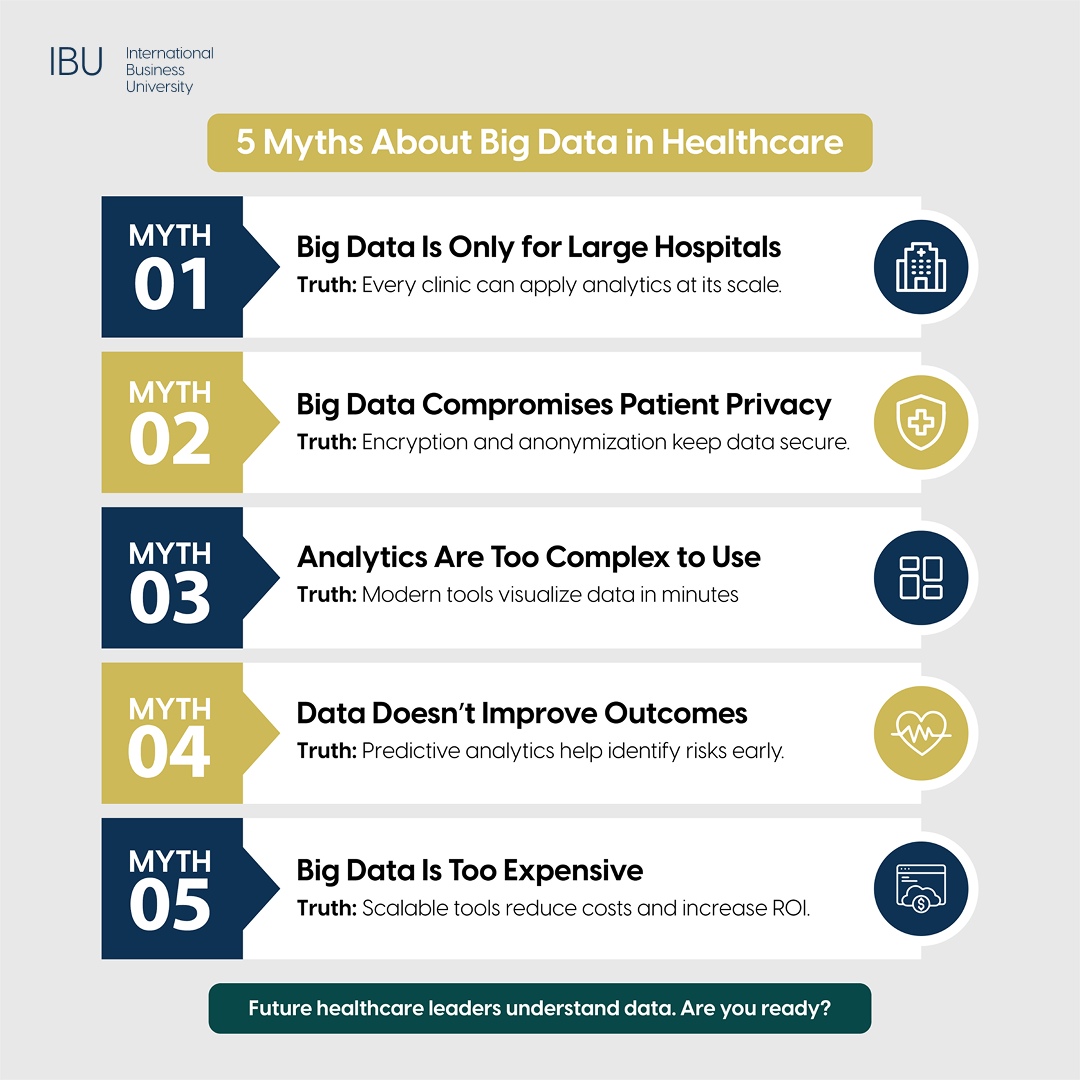
These myths often come from outdated assumptions, limited exposure to new technology, or fear of change. Let’s address five of the most common beliefs that prevent healthcare systems from embracing innovation.
Myth 1: Big Data Is Only for Large Institutions
Many assume only large hospitals and research centers have the resources to use Big Data effectively. The misconception stems from early examples where only top institutions could afford advanced analytics tools. Today, affordable cloud-based systems make medical data management accessible to clinics of every size.
Smaller healthcare providers can benefit just as much, using data to predict patient trends, manage supplies, and enhance care coordination. A family clinic can use healthcare data analytics to monitor chronic conditions, while regional hospitals can manage emergency response patterns using real-time dashboards. Scalability is the key; modern software adjusts to the size and needs of any organization.
Students entering the healthcare field should recognize that data literacy is a universal skill. Regardless of your workplace size, being able to analyze and interpret data strengthens your role as a professional capable of improving efficiency and patient satisfaction.
Myth 2: Big Data Compromises Patient Privacy
The fear of privacy breaches often keeps organizations from adopting healthcare technology trends. In reality, strict frameworks protect patient confidentiality through encryption, multi-level access control, and anonymization techniques. These systems make it possible to study patterns without exposing individual identities.
Digital transformation in healthcare depends on responsible data use. Ethical handling of sensitive information is built into every modern system. In most cases, data is aggregated, meaning that no single person’s details are visible. When healthcare organizations follow compliance guidelines, the risk of exposure drops dramatically.
As a future healthcare leader, understanding data protection principles is part of your role. You’ll be expected to guarantee that information remains secure while still accessible for research and care improvement. Privacy is not a barrier; it’s a foundation for trust and progress.
Myth 3: Data Analytics Are Too Complex to Implement
The assumption that healthcare data analytics require specialized programmers or mathematicians once made sense. Today’s tools are built for accessibility. Dashboards visualize data clearly, and automated reports highlight what matters most without needing complex code. The focus has shifted from computing to interpreting.
For healthcare professionals, that means you don’t need to be a data scientist to understand results. Instead, you should know how to apply insights to operations and patient care. Systems now use simple drag-and-drop interfaces, translating massive datasets into digestible summaries.
Students who study digital systems or healthcare management are already positioned to master this skill set. Learning how to interpret trends in patient flow, medication use, or recovery time will make you stand out in future hiring processes.
Myth 4: Big Data Does Not Lead to Better Outcomes
Skeptics sometimes claim that analytics have no measurable impact on treatment quality. In practice, data-driven healthcare continuously improves results. Predictive analytics in healthcare helps identify at-risk patients before conditions worsen. Hospitals use real-time monitoring to reduce emergency incidents and streamline care delivery.
Better outcomes also come from administrative decisions guided by data. By analyzing hospital workflow, management can identify resource bottlenecks, improve staff schedules, and shorten patient waiting times. Every data point becomes a clue to optimize performance.
When students study healthcare insights, they learn that success depends on both numbers and human judgment. Data doesn’t replace clinical expertise, it enhances it by providing context and precision.
Myth 5: Investing in Big Data Is Too Expensive
The cost concern is one of the strongest myths, especially among smaller institutions. Many believe that only wealthy hospitals can afford analytics tools. Yet modern software operates on scalable models, often through monthly subscriptions or shared platforms, making advanced analytics accessible to nearly every facility.
Over time, Big Data in Healthcare reduces operational costs. When systems identify unnecessary tests, repetitive procedures, or inefficient scheduling, organizations save resources. Investment in data platforms quickly turns into measurable returns through better patient care and reduced administrative waste.
For students, this mindset matters. Understanding ROI from technology investments prepares you for leadership roles where financial decision-making aligns with healthcare quality. Cost-efficiency is no longer about spending less; it’s about spending smarter.
Lead Data-Driven Healthcare
IBU’s MBA in Healthcare Management builds the analytical and strategic skills that health administrators need to apply data systems confidently.
How Myths About Big Data and Healthcare Hold Organizations Back
When healthcare professionals believe these myths, they limit the field’s ability to evolve. Hesitation to adopt data-driven tools slows down collaboration, research, and decision-making. Innovation requires confidence in new methods, and fear of change often prevents organizations from seeing potential improvements.
Myths about Big Data in Healthcare also affect education and workforce development. Students who underestimate the importance of healthcare data analytics may focus on traditional skills, leaving them unprepared for future expectations. The industry increasingly values analytical thinking, adaptability, and technological fluency, skills that drive progress.
Innovation thrives where experimentation is encouraged. By clinging to misconceptions, organizations miss opportunities to pilot new tools, test predictive models, and share insights. Breaking away from outdated thinking isn’t just beneficial, it’s necessary for a healthcare system ready to serve future generations.
Strategies for Moving Past Misconceptions Toward Data-Driven Care
Future healthcare leaders can overcome resistance by learning to apply technology with strategy and empathy. Digital systems are only as effective as the professionals who understand them. Developing skills in data science in healthcare gives you a competitive edge in a field moving quickly toward automation, analytics, and innovation.
When institutions promote a data-positive culture, they encourage collaboration between clinicians, IT experts, and administrators. This cross-functional teamwork finalizes every insight that contributes to better patient experiences. Embracing healthcare technology trends also means committing to continuous education, keeping pace with new tools, and evolving best practices.
1. Adopt a Learning Mindset
Data fluency grows through exposure. Enrolling in programs that blend business, management, and healthcare analytics helps you stay ahead. Courses that combine technology and strategy give students the language and confidence to apply data effectively. You don’t need to become a programmer; you need to know what questions to ask.
2. Encourage Ethical Data Use
Ethical frameworks guide how data is collected, stored, and analyzed. Future professionals should understand these boundaries and advocate for patient rights. Transparency creates trust, and when patients trust data systems, they engage more fully in their own care.
3. Integrate Analytics into Everyday Decisions
Whether managing a small clinic or a large hospital, data should inform daily choices. Analytics support everything from patient scheduling to supply inventory. Integrating these tools into regular operations reduces guesswork and increases accountability.
4. Collaborate Across Disciplines
Innovation often comes from diverse teams. Combining the expertise of healthcare professionals, administrators, and technologists guarantees balanced solutions. Collaborative environments make data interpretation more accurate and applicable to the operational needs of each department.
By adopting these strategies, students position themselves as future-ready professionals. The goal is not just understanding Big Data, it’s knowing how to use it to lead meaningful change in healthcare systems.
Advance Your Healthcare Career
IBU’s graduate programs in healthcare management combine data analytics, operations, and leadership skills for the modern health system.
Key Takeaways

Misconceptions about Big Data in Healthcare prevent hospitals and health organizations from fully realizing its potential for smarter patient care.
Misconceptions about Big Data in Healthcare prevent hospitals and health organizations from fully realizing its potential for smarter patient care.
Understanding how to manage and apply healthcare insights can prepare future professionals for leadership in modern medicine.
Frequently Asked Questions
What skills do I need to work in Big Data for Healthcare?
You’ll need analytical thinking, basic understanding of data visualization, and familiarity with medical data management tools. Many universities, including IBU, integrate these skills into healthcare and business programs to prepare students for future roles in digital health.
How does Big Data improve patient care?
By studying large sets of information, healthcare professionals can identify trends that help prevent disease, personalize treatments, and improve hospital operations. Data-driven healthcare allows medical teams to make faster, evidence-based decisions that support better outcomes.
Is Big Data relevant for students not majoring in technology?
Yes. Data understanding is a leadership skill across healthcare, business, and public policy. Even if your focus is management or operations, knowing how to interpret healthcare insights enhances your ability to make strategic decisions.
What role does health management play in implementing big data strategies?
Health management professionals are the primary drivers of big data adoption within healthcare organizations, responsible for aligning data strategy with operational goals, securing budget, and building cross-functional teams. Without strong management leadership, data systems remain underused regardless of their technical capability.
What are the main risks of big data in healthcare and how are they managed?
The risks of big data in healthcare include data privacy breaches, inaccurate analysis, algorithmic bias, and staff resistance to data-driven processes. Modern systems address most technical risks through encryption, access controls, and anonymization, while organizational risks require strong governance frameworks and ongoing professional development.
What are the 5 Vs of big data in healthcare?
The 5 Vs of big data in healthcare are Volume (the scale of health data generated), Velocity (the speed at which it must be collected and processed), Variety (the range of formats including EHRs, imaging, and device data), Veracity (the accuracy and reliability of the data), and Value (the actionable insight it produces for decision-makers). Healthcare organizations must address all five to use data effectively.
The Case for Big Data for Healthcare Leaders
Big Data in Healthcare represents more than technology; it’s a movement toward smarter, safer, and more patient-centred care. The myths surrounding it can only hold back progress if future leaders accept them as truth. You have the chance to shape a healthcare system driven by information, accuracy, and accountability. Learn the tools, question the fears, and prepare to lead with knowledge. The future of healthcare belongs to professionals ready to turn data into action.
Take the Next Step
IBU offers MBA programs in Healthcare Management and Digital Health that prepare professionals for data-driven leadership roles across Canada.