
An MBA in information systems management combines core business training, finance, strategy, operations, with a concentration in how organizations plan, govern, and get value from technology. It is built for people who want to lead digital transformation, not just execute it. Graduates leave able to sit in a room with a chief financial officer and a chief technology officer and translate between them.
This degree exists because most technology failures are not technical. They are the result of a system built without a clear business case, a rollout with no change management plan, or a budget that never accounted for the true cost of adoption. Leaders trained to close that gap are in short supply, which is exactly why this specialization has grown.
Key Takeaways
Here is what determines if this MBA specialization is the right move for a technology-facing career.

An MBA in information systems management is a business degree first, teaching students to govern and fund technology decisions rather than build the technology itself.
It fills a distinct gap between a pure IT degree and a general MBA, preparing graduates for roles that require both technical fluency and executive credibility.
Canadian employers hire this specialization for digital transformation leadership, IT strategy, and roles that connect technology investment directly to business outcomes.
What an MBA in Information Systems Management Actually Covers
The curriculum sits at the intersection of core MBA subjects and applied technology governance. Students study financial management, organizational strategy, and leadership alongside courses in enterprise systems, data governance, and technology project management.
The goal is not to produce a developer or a systems administrator. It is to produce a leader who can evaluate a vendor proposal, model the return on a technology investment, and manage the organizational change that comes with any major system rollout. Coursework typically includes case studies on documented digital transformation projects, so students practice the judgment calls before they make them professionally.
What a Case-Based Assignment in This MBA Looks Like
The learning model is built around a recurring challenge rather than a fixed lecture format, which is what separates this degree from a technical certificate.
A student is usually handed a scenario in which a technology investment has stalled or underdelivered: a platform rollout that went over budget, a system nobody adopted, or a vendor contract that no longer matches what the business needs. The assignment is not to fix the code. It is to diagnose which of the underlying business decisions went wrong, build a revised business case with a realistic budget and timeline, and present that case to a panel playing the role of an executive committee. Students then field questions about the assumptions behind their numbers, the same scrutiny an actual technology budget gets before it is approved.
That sequence, diagnose the business failure, rebuild the case, defend it under questioning, is what the degree is actually testing. A graduate who can do this once can generally repeat it with a different system, a different budget, and a different room of stakeholders, which is the actual skill employers are hiring for.
The Difference Between an IT Degree and an MBA in Information Systems
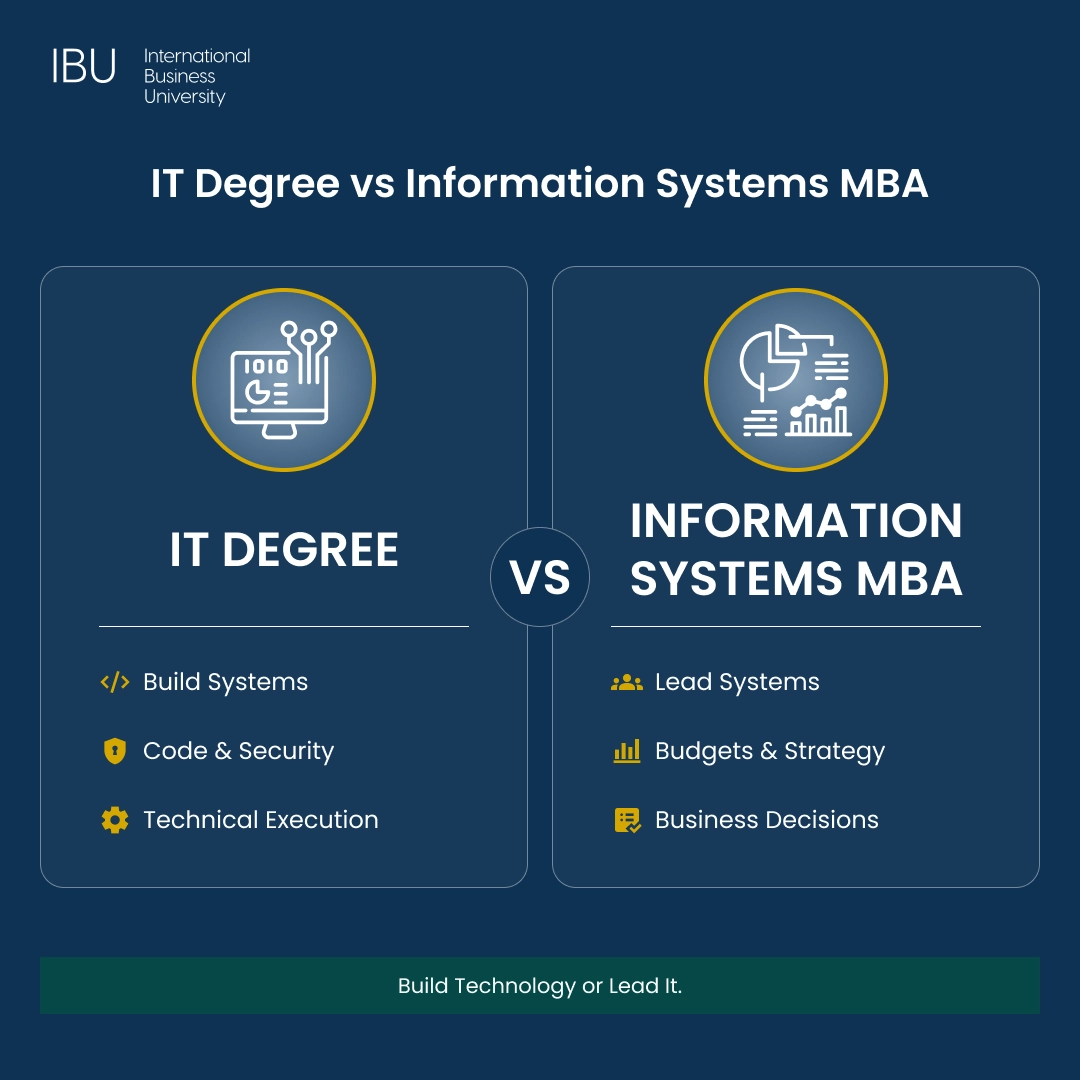
A computer science or information technology degree trains students to build, maintain, and secure systems. An MBA in information systems management trains students to decide which systems get built, why, and how their value will be measured. Put simply: one degree teaches you to write the code. The other teaches you to decide if the code should be written at all, and if it paid off.
- An IT degree focuses on technical depth: Coding, networks, systems architecture, and security implementation. A graduate leaves able to build a working system, troubleshoot it when it breaks, and harden it against threats. Success is measured by if the system runs correctly and stays secure.
- An MBA in information systems focuses on business depth: Budgeting, vendor negotiation, stakeholder alignment, and strategic planning around technology. A graduate leaves able to decide which of three competing software vendors is worth the contract, how to get a finance team and an engineering team to agree on a rollout timeline, and how to explain to a board why a six-figure system investment was worth it.
A simple way to picture the split: if a company decides to replace its customer database, an IT graduate is the person who migrates the data and makes sure nothing breaks during the switch. An MBA in information systems graduate is the person who decided the switch was worth the cost and disruption in the first place, chose which vendor to buy from, and will answer for the outcome a year later.
Neither path replaces the other, and this isn’t a question of which degree is “better.” Many students entering this MBA already hold a technical background and are making a deliberate move from execution into leadership, trading hands-on coding for budget ownership and decision-making authority.
Others enter from general business roles and want the technology fluency to manage teams that build and maintain systems, without needing to write the code themselves. Both groups end up in the same classroom because the skill they’re missing, if that’s business judgment or technical literacy, sits on the same side of this divide.
Lead Technology Decisions With Business Confidence
Build the strategy skills needed to manage IT-driven change.
The Roles Canadian Employers Fill With This Specialization
Canadian employers use this credential to fill roles that sit between the technology function and the executive team.
- IT project manager: Runs system implementations, coordinating timelines, vendors, and stakeholders, and is usually the first person accountable when a rollout slips its schedule.
- Digital transformation manager: Leads organization-wide shifts to new platforms, workflows, or operating models, balancing technical readiness against how much change staff can absorb at once.
- Business systems analyst: Bridges business requirements and technical teams during system design, translating what a department needs into specifications a development team can build against.
- Technology strategy consultant: Advises organizations on IT investment priorities and roadmaps, often brought in specifically because internal teams lack an outside view of where the budget should go.
- Chief information officer track: Long-term path toward executive technology leadership, where the job shifts from managing individual projects to managing an entire technology portfolio against the company’s strategy.
These roles consistently rank among the fastest-growing management categories in Canada as organizations continue to invest in digital infrastructure across sectors, from finance to healthcare to retail.
Digital Transformation Leadership: What This MBA Is Actually Training You For
Digital transformation leadership is the practical application of everything this MBA teaches. It means running a technology change initiative as a business project, with a budget, a timeline, a risk plan, and a specific outcome to measure, rather than treating it as a purely technical rollout.
Graduates learn to manage the three variables that determine if a transformation project succeeds: executive sponsorship, staff adoption, and realistic scope. A system that works perfectly in testing but fails during rollout usually failed on one of these three, not on the underlying technology. This is the gap the specialization is built to close, and it connects directly to the broader management skills every BCom and MBA graduate needs to lead a team through change.
Move From Systems Work to Strategy
Prepare for roles that connect technology, budgets, and business outcomes.
Who Should Choose This MBA Stream and Who Should Not
This specialization fits professionals who already work near technology decisions and want the authority to lead them. It fits IT managers ready to move into strategy, business analysts who want deeper financial training, and career changers moving from technical roles into management.
It is less suited to someone who wants to remain a hands-on technical specialist. Software developers who want to stay in deep technical work will get more value from a technical master’s degree than a business degree. This specialization is built for people whose next step is leading people and budgets, not writing more code. Statistics Canada tracks digital economic activity as a distinct and growing share of Canadian output, a trend that has expanded the number of management roles built specifically around overseeing technology investment rather than building it.1
Frequently Asked Questions
Is an MBA in information systems worth it compared to an MS in computer science?
The two degrees serve different goals. An MS in computer science builds deep technical expertise for engineering-track careers, while an MBA in information systems builds the business and leadership skills needed to manage technology strategy and teams. The right choice depends on if the target role sits in technical execution or business leadership.
What jobs can you get with an MBA in information systems management in Canada?
Common roles include IT project manager, digital transformation manager, business systems analyst, and technology strategy consultant. Many graduates also move into general management roles where technology oversight is one part of a broader mandate. Career progression typically leads toward director or chief information officer-track positions.
Do employers value an MBA in IT management or prefer pure tech degrees?
Most employers value both, but for different roles. Technical execution roles still prioritize technical degrees, while management and strategy roles increasingly prioritize candidates who can connect technology decisions to business outcomes. An MBA in information systems management is built specifically for the second category.
Can I get into a technology leadership role without a CS background using this MBA?
The specialization is built for professionals without a computer science background. Coursework builds the technology fluency needed to manage technical teams and vendors without requiring hands-on coding skills. Many successful graduates come from operations, finance, or general management backgrounds.
Positioning Yourself as the Leader Who Speaks Both Languages
An MBA in information systems management is most valuable to professionals who want to sit at the table where technology and business decisions collide, and be the person both sides trust. The degree does not make anyone a better coder or a better executive on its own. It builds the specific judgment required to prioritize technology investment, manage the change it creates, and measure if it worked. Start by identifying the technology decisions your current role already touches, then evaluate how a formal credential would strengthen your authority in those conversations.
Start Your Path to Technology Leadership
Apply to IBU and build business skills for IT strategy roles.