
Risk management in healthcare is the practice of identifying, evaluating, and reducing the events that can harm patients, staff, or the organization before those events happen. It sits above every other management function because a single unmanaged risk, a medication error, a data breach, a staffing gap during a surge, can undo years of operational progress in a single incident. Healthcare leaders who own this skill early build the judgment that every other responsibility depends on.
This is not a topic reserved for compliance officers or risk committees. Nurse managers, department directors, clinic administrators, and hospital executives all make risk decisions daily, no matter what they call it. The leaders who advance fastest are the ones who can name the risk, quantify it, and act on it before it becomes a headline.
Key Takeaways
Healthcare risk management touches every level of leadership, not just executive committees. Before reading further, here is what this article covers.

Risk management in healthcare spans four categories: clinical, operational, financial, and strategic risk, and leaders are expected to recognize all four.
Clinical risk management protects patients directly, while organizational risk management protects the institution, and the two require different frameworks and different owners.
Canadian accreditation and privacy law shape how healthcare risk is documented and reported, which means risk management strategies in healthcare rarely transfer directly from other industries or other countries.
An MBA in healthcare management builds the analytical and governance skills that turn risk awareness into a repeatable leadership practice, not a reactive one.
What Risk Management in Healthcare Actually Means as a Leadership Skill
Risk management in healthcare is the organized process of identifying what could go wrong, estimating how likely it is and how severe the consequences would be, and deciding what to do about it before it happens. It is a leadership skill because the decisions involved- what to escalate, what to accept, what to fix immediately- sit with the person accountable for the outcome, not just the person who spotted the issue.
The Judgment Behind the Framework
A frontline manager who sees a recurring near-miss and does nothing is practicing poor risk management, regardless of their job title. A senior leader who builds a system for staff to report near-misses without fear of blame is practicing it well. The skill is less about technical knowledge of risk frameworks and more about the judgment to prioritize, escalate, and follow through.
A Scenario That Shows the Difference
Consider a common scenario in an acute care unit: a nurse flags that a new medication administration process is prone to double-dosing during shift changes. A manager without risk training might log the incident and move on once the immediate case is resolved. A manager who understands risk management asks a different question: how many other shift-change handoffs share this same vulnerability, and what would it cost the unit if the next occurrence involved a higher-risk medication. That second question is what separates incident response from risk management.
How Canadian Healthcare Regulation Shapes Risk Management Practice
Risk management strategies in healthcare cannot be separated from the regulatory environment they operate in, and Canada’s environment has specific features that differ from other countries.
Accreditation Makes Risk Management a Documented Requirement
Accreditation Canada’s Qmentum program requires participating organizations to maintain documented risk management processes as a condition of accreditation, which means risk registers and incident review systems are not optional internal tools. They are part of what surveyors examine.
Federal and Provincial Reporting Obligations
The Canada Health Act sets the federal principles that provincial health systems operate under, while each province layers its own reporting requirements for serious reportable incidents on top of that foundation. Ontario, for example, requires public hospitals to report designated serious incidents under provincial regulation, which creates a direct link between a frontline risk event and a formal external reporting obligation.
Privacy as a Distinct Risk Category
Privacy adds a second layer that many new healthcare managers underestimate. Health information is subject to federal privacy law and, in several provinces, additional health-specific privacy legislation. A data breach involving patient records is treated as a distinct risk category in Canadian healthcare organizations, separate from clinical incident reporting, because the reporting obligations and the potential penalties differ. Leaders who move into Canadian healthcare management from another sector, or from another country’s health system, often need to relearn which incidents trigger which reporting pathway.
The Categories of Risk Every Healthcare Leader Is Responsible For
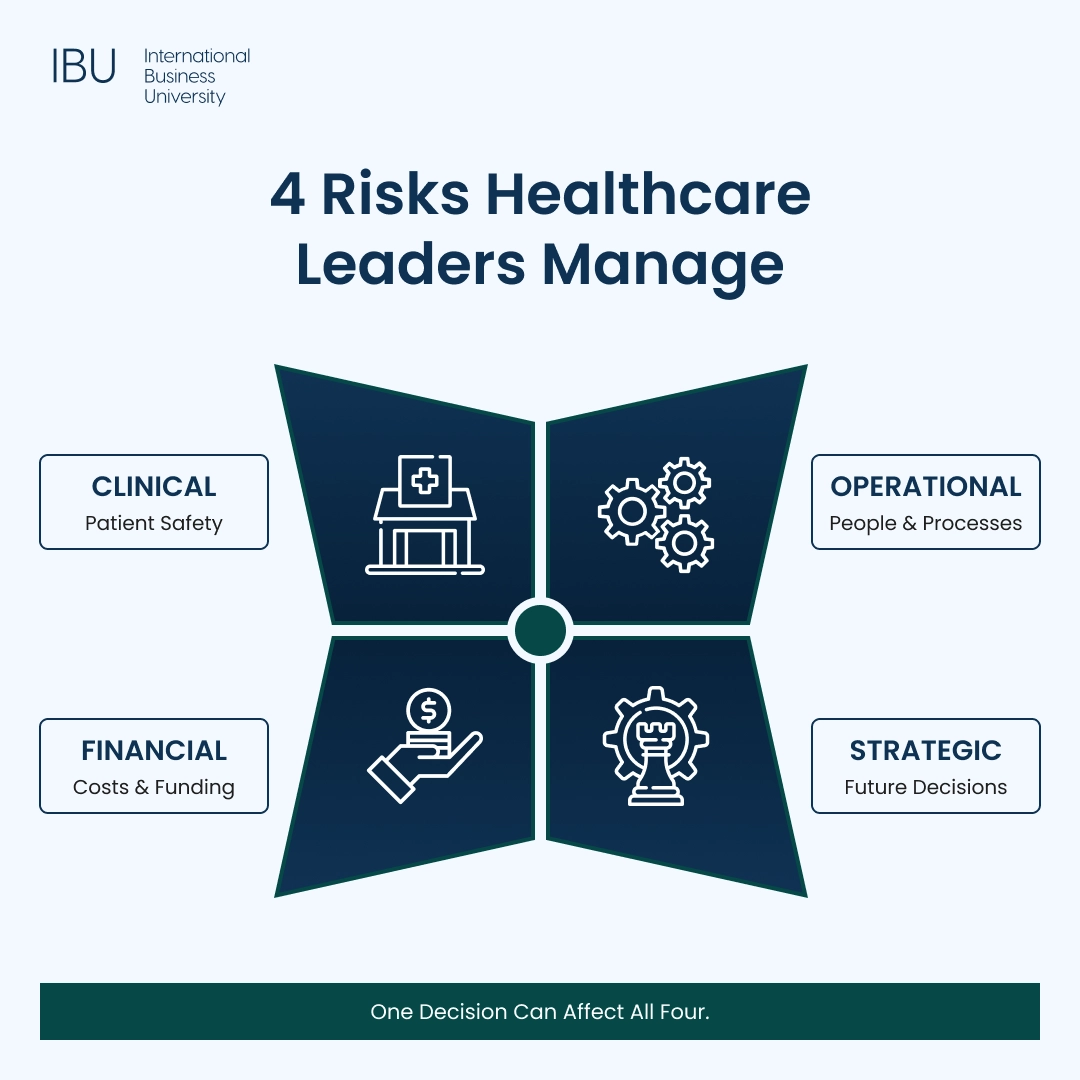
Healthcare risk breaks into four categories, and most leaders are only trained to see one or two of them clearly.
- Clinical risk: Errors, adverse events, and near-misses that affect patient safety directly, such as medication errors or diagnostic delays.
- Operational risk: Staffing shortages, equipment failures, and workflow breakdowns that reduce the organization’s ability to deliver care safely.
- Financial risk: Billing errors, funding shortfalls, and cost overruns that threaten the organization’s stability.
- Strategic risk: Poor decisions about partnerships, technology investments, or service expansion that carry long-term consequences.
A leader who only monitors clinical risk will miss the operational failure that caused it. A leader who only monitors financial risk will miss the compliance gap that created the liability. Effective healthcare leaders track all four categories at once, even if they are not personally responsible for solving each one.
These categories also interact more than most risk registers reflect. A staffing shortage, an operational risk, raises the likelihood of a medication error, a clinical risk, which in turn creates financial exposure through a potential claim and strategic exposure if it damages the organization’s reputation with referring physicians or partner institutions. Leaders who track categories in isolation tend to underestimate the true cost of any single failure, because they are only counting the cost inside their own column.
Clinical Risk Management vs Organizational Risk Management: Key Differences
Clinical risk management and organizational risk management overlap, but they answer different questions and often sit with different people.
Clinical Risk Management
Clinical risk management asks: did this patient receive safe, appropriate care, and what specific process failed if they did not? It is typically owned by clinical leaders, quality teams, and patient safety officers. It relies on incident reports, chart reviews, and direct clinical judgment.
Organizational Risk Management
Organizational risk management asks a broader question: what exposes this institution, financially, legally, reputationally, or operationally, to loss? It is typically owned by administrators, finance leaders, and executive teams. It relies on audits, insurance reviews, and enterprise risk registers.
Why the Two Functions Need Each Other
The two functions need to talk to each other constantly. A clinical near-miss is also an organizational liability. A staffing budget cut is also a clinical risk. Leaders who understand both languages can move between clinical and administrative conversations without losing credibility on either side. A useful test of this fluency is presenting the same incident twice, once to a clinical quality committee and once to a finance or audit committee, without changing the underlying facts, only the framing each audience needs.
Common Risk Management Mistakes Healthcare Leaders Make
Most healthcare risk failures trace back to a small set of recurring management errors rather than a single catastrophic decision.
- Treating incident reports as disciplinary tools: Staff stop reporting near-misses once they believe reporting leads to blame, which removes the early warning signal a manager depends on.
- Reviewing risk only after an audit or accreditation cycle: Risk registers that are updated once a year lag behind the actual pace of change in staffing, equipment, and process.
- Assigning risk ownership without authority: A risk owner who cannot approve budget or staffing changes cannot close the risks assigned to them, which leaves items open indefinitely.
- Separating financial and clinical risk conversations entirely: Committees that never meet jointly tend to duplicate effort on shared risks and miss the ones that fall between mandates.
Each of these mistakes is a structural problem rather than a personal failing, which is why they tend to persist even when individual staff act in good faith. Correcting them requires a leader with the authority and the analytical background to redesign the process, not just enforce it more strictly.
Move Into Healthcare Risk Leadership
Prepare for roles in patient safety, compliance, and operations.
How Risk Management in Healthcare Connects to Patient Safety Outcomes
Patient safety is the outcome that risk management exists to protect, and the evidence for that connection shows up at both the global and the Canadian hospital level.
- Unsafe care is a leading, largely preventable cause of harm. The World Health Organization identifies unsafe care as one of the leading causes of death and disability worldwide, and a large share of that harm is preventable through formated risk identification and process redesign.
- Canada tracks the same pattern at the hospital level. The Canadian Institute for Health Information tracks patient safety indicators across Canadian hospitals as part of its ongoing health system performance reporting, giving healthcare leaders a benchmark for how their own organization compares to national trends.
- The relationship runs in both directions. Strong risk management reduces adverse events, and every adverse event that does occur becomes data that strengthens future risk management. If risk stays visible, hospitals that treat incident reports as system information see reporting rates rise, which surfaces risk earlier and makes it cheaper to fix.
Risk Assessment in Healthcare: The Framework Every Manager Must Know
Most healthcare risk assessment follows a version of the same four-step framework, regardless of the specific tool used.
- Identify: Gather risks from incident reports, audits, staff feedback, and direct observation. Sources that go untapped, such as patient complaints or supply chain delays, often surface risks before formal reporting systems catch them.
- Analyze: Estimate the likelihood and severity of each risk using a standardized scoring matrix, so that a low-frequency but high-severity risk is not ranked below a frequent but minor one by accident.
- Prioritize: Rank risks so limited time and budget go to the highest-severity, highest-likelihood items first, and document why lower-ranked risks were deferred rather than simply dropping them from view.
- Mitigate and monitor: Implement a control, assign an owner, and set a review date to confirm the fix worked, rather than closing the item as soon as the control is put in place.
Managers who skip the analyze and prioritize steps tend to react to whichever risk feels most urgent that week, rather than the one with the highest actual consequence. Managers trained in the full framework build a defensible, repeatable process instead, one that produces a similar decision regardless of which manager is running the assessment that quarter.
Metrics and Reporting: How Leaders Track Risk Over Time
A risk assessment is only useful if it feeds a reporting structure that leadership actually reviews on a set schedule. Most healthcare organizations track a small set of recurring indicators.
- Incident volume: Tracked by severity level, since a rise can mean a worsening safety record or, just as often, a healthier reporting culture finally surfacing problems that used to go unrecorded.
- Time to close: How long it takes to close a corrective action once a risk has been identified and assigned an owner.
- Repeat incidents: Cases that share the same root cause, which show when a fix never actually addressed the underlying problem.
- Register review rate: The percentage of risk register items reviewed within their assigned timeframe, a signal if the register is a living document or a stale list.
None of these metrics is useful on its own. Leaders need enough context, and enough tenure with the data, to interpret a trend correctly rather than react to the raw number. Board and executive reporting on risk typically moves on a quarterly cycle, while operational reporting at the department level should move faster, often monthly, so a director can catch a developing pattern before it forces a board-level conversation. Leaders who only see risk data at the board cycle are, by definition, always looking at a problem that has already had a quarter to grow.
Build Risk Leadership Skills in Healthcare
Learn to connect patient safety, governance, and management decisions.
Healthcare Compliance: How Risk Management and Regulatory Accountability Overlap
Healthcare compliance and risk management share a border but are not the same discipline. Compliance asks if the organization is following the applicable laws, accreditation standards, and internal policies. Risk management asks what could go wrong even if every rule is technically being followed.
Passing an Audit Doesn’t Mean the Risk Is Gone
An organization can pass every regulatory audit and still carry serious operational risk, such as a single point of failure in its IT infrastructure or an aging workforce approaching retirement in a key department. Leaders who confuse compliance with risk management often stop looking once the audit is clean, missing the risks that live outside the checklist.
How Compliance Feeds Back Into Risk Management
The relationship also runs the other way. A pattern of unresolved risk items can itself become a compliance finding at the next accreditation cycle, since surveyors under programs such as Qmentum specifically look for evidence that identified risks were tracked to resolution rather than simply logged. Compliance, in that sense, is the audit that confirms risk management actually happened. It is not a substitute for it.
How an MBA Trains Healthcare Professionals to Lead Risk Management (bullets)
A general healthcare certificate can teach the vocabulary of risk management. An MBA is built to test something harder: can a professional use that vocabulary under pressure, given a specific incident pattern, size the exposure, and defend a recommendation to the people who control the budget. In an MBA in Healthcare Management, that challenge tends to follow the same shape regardless of which risk category it starts from.
- Incident pattern: Students are handed an operational or clinical problem drawn from a real risk category.
- Exposure estimate: They size the likelihood and cost of the risk before proposing a response.
- Budget trade-off: The recommendation has to be weighed against competing priorities, not made in isolation.
- Board defense: Students present the recommendation to a simulated board or committee, then answer questions about the assumptions behind it.
That sequence, from incident to business case to a defended recommendation, is the same sequence a working healthcare risk manager repeats throughout their career.
Read more about how leadership training connects to the skills that get healthcare leaders hired and how graduates apply this training in healthcare consulting roles after an MBA.
Building a Risk-Aware Culture: What This Looks Like in Practice
A risk framework only functions if the people closest to the work are willing to use it, which makes culture as much a part of risk management as any document or committee structure.
What a Strong Reporting Culture Looks Like
Organizations with a strong risk-reporting culture share a few observable habits. Frontline staff can describe how to report a near-miss without checking a policy manual first. Managers close the loop with the staff member who filed a report, even when no action is taken, so the person knows the report was read. Leadership reviews aggregated trends publicly within the organization rather than only in closed executive sessions, which signals that the data is used for improvement rather than performance management of individuals.
Why These Habits Matter More Than Budget
None of these habits require additional budget. They require a leader who understands that the reporting rate is a leading indicator of safety, not a scorecard of staff performance.
Career Roles Where Risk Management in Healthcare Is the Primary Requirement
Several healthcare careers are built almost entirely around this skill set.
- Patient safety officer: Owns incident review, root cause analysis, and safety culture programs.
- Healthcare risk manager: Manages the organization’s risk register, insurance exposure, and claims process.
- Compliance and quality director: Oversees regulatory adherence alongside clinical quality metrics.
- Healthcare operations manager: Applies risk thinking to staffing, scheduling, and workflow design.
- Clinical governance lead: Bridges clinical teams and executive leadership on safety and risk priorities.
- Privacy and health information officer: Manages the organization’s response to data-related risk under federal and provincial privacy legislation.
Each of these roles expects candidates to speak both the clinical and the financial language of risk, which is exactly the combination an MBA is built to develop.
Frequently Asked Questions
What does a risk manager do in a hospital in Canada day to day?
A hospital risk manager reviews incident reports, tracks the organization’s risk register, and coordinates responses to claims or safety events. They work across clinical, legal, and finance teams to close gaps before they escalate. Most of the role is process and follow-up rather than crisis response.
How is risk management in healthcare different from other industries?
Healthcare risk carries a direct patient safety dimension that most other industries do not face at the same scale. A single process failure can have an immediate and severe human cost, not just a financial one. This raises the stakes on speed, documentation, and follow-through compared to a typical corporate risk function.
Do I need a specific certification for healthcare risk management in Canada?
There is no single mandatory certification, though professional designations in healthcare risk management exist and can strengthen a resume. Most employers weigh a combination of clinical or operational experience, formal business education, and demonstrated results more heavily than a single credential. An MBA in healthcare management covers the governance and analytical foundation these roles require.
Can nurses or allied health professionals move into healthcare risk management?
Clinical experience is a strong foundation for this career path because it builds credibility with frontline staff. The transition typically requires adding formal training in governance, finance, and organizational risk frameworks. This is one of the most common career pivots supported by an MBA in healthcare management.
Is an MBA or a healthcare certificate better for risk management leadership?
A certificate can build technical vocabulary quickly, but an MBA builds the broader leadership and financial skill set that senior risk roles require. Leadership positions in this field usually involve budget ownership, board reporting, and cross-departmental influence, all of which extend beyond what a standalone certificate covers. Most healthcare risk executives hold a graduate business credential alongside their clinical or operational background.
How does accreditation affect a healthcare organization's approach to risk management?
Accreditation programs such as Qmentum require documented risk processes as a condition of ongoing accreditation status, which pushes risk management out of informal practice and into a proper, auditable system. Organizations preparing for a survey cycle typically review their risk register and incident closure rates well in advance. Leaders who understand accreditation standards can align day-to-day risk practice with what a survey will actually examine.
What is the difference between a risk register and an incident report?
An incident report documents a single event after it happens, while a risk register tracks ongoing exposures the organization has identified, including ones that have not caused harm yet. A well-run risk register often includes items that originated from incident reports but have been generalized into a broader category of exposure. Leaders who only maintain incident reports, without a register, tend to keep solving the same underlying problem each time it recurs under a new name.
Building the Habit of Owning Risk Before It Owns You
Risk management in healthcare is not a project with an end date. It is a habit built into how a leader reads a schedule, reviews an incident report, or evaluates a new partnership. Leaders who build this habit early spend less time reacting to crises and more time preventing them. The organizations that reward this skill promote from within, because a leader who has already learned to see risk clearly is the safest person to hand more authority to.
Start Building the Skills Healthcare Leaders Need
Apply to IBU and prepare for risk, compliance, and governance roles.