
A financial analyst evaluates financial data to guide business decisions, from budgeting and forecasting to investment analysis and reporting. Financial analyst Canada opportunities exist in nearly every industry, not just banking, which is why the role remains one of the most consistently available entry points into a business career.
How to become a financial analyst starts with the right foundation: a Bachelor of Commerce provides the core coursework this role requires in accounting, corporate finance, and quantitative analysis. From there, the path depends on how far a candidate wants to go: entry-level roles are accessible directly out of a BCOM, while senior positions typically require additional credentials.
Key Takeaways
Here is how to become a financial analyst in Canada, from a business degree to a full career path.

A BCOM degree covers the core skills financial analyst roles require: financial statement analysis, forecasting, and quantitative reasoning.
The career path runs from entry-level analyst to senior and specialized roles, with clear skill and credential requirements at each stage.
Additional credentials like the CFA or an MBA become more valuable as career goals shift toward senior or investment-focused roles, rather than being required for entry-level positions.
What Financial Analysts Actually Do Inside Canadian Organizations
Financial analysts spend most of their time building and maintaining financial models, analyzing variance between budgeted and actual performance, and preparing reports that inform decisions made by managers above them. The specific focus shifts by industry: a financial analyst at a retail company tracks sales and inventory costs, while one at an investment firm evaluates securities and market data.
Despite the variety, understanding how to become a financial analyst means recognizing the core skill consistent across every version of the role, such as translating raw financial data into a clear recommendation that a non-technical decision-maker can act on quickly.
How to Become a Financial Analyst Using a BCOM as Your Foundation
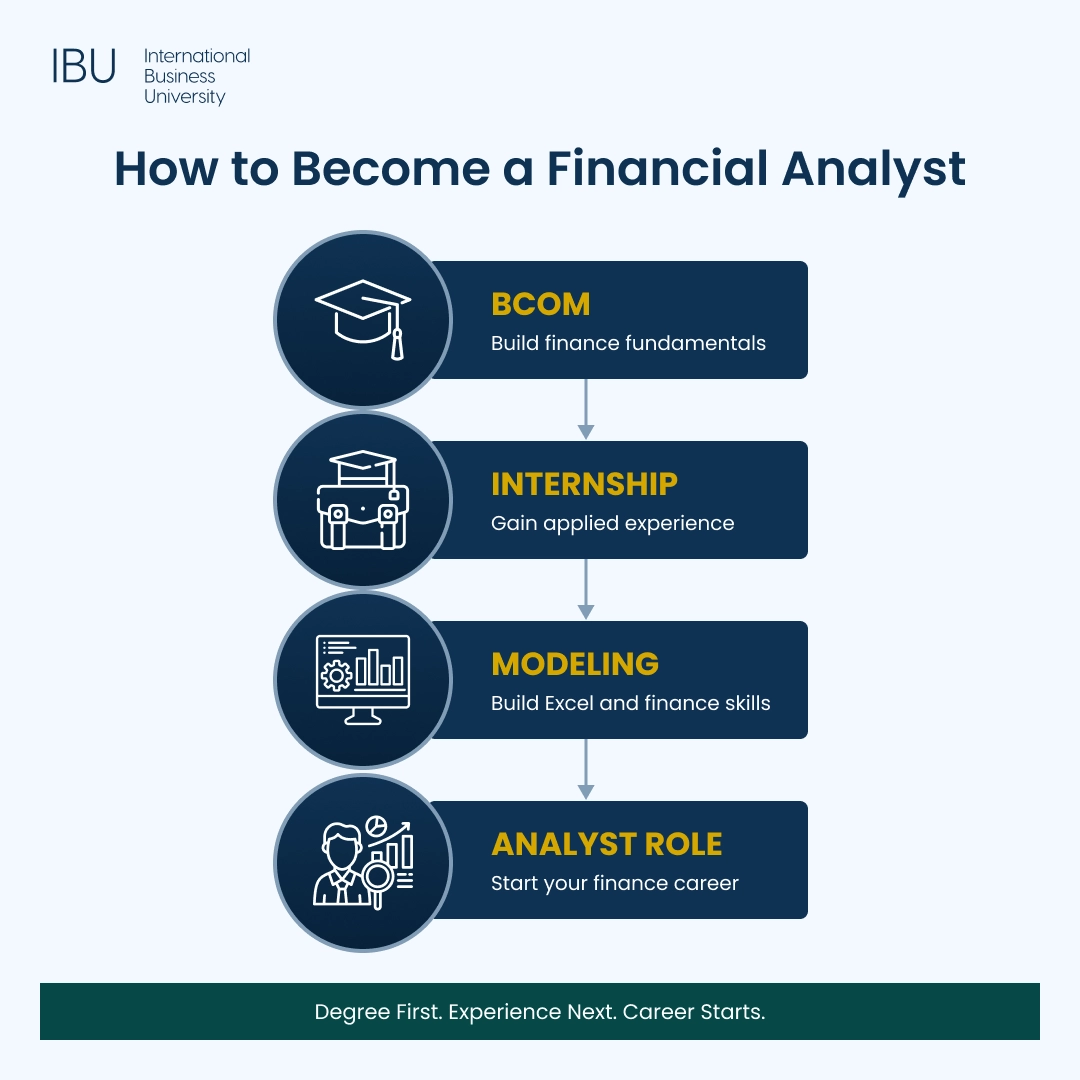
BCOM finance careers most often start with a business degree that includes strong accounting and finance coursework. A BCOM in Business Management covers the technical foundation, financial statements, valuation basics, and quantitative methods, that entry-level analyst roles require on day one.
- Complete core coursework in accounting, finance, and statistics to build the technical foundation employers expect.
- Pursue an internship or co-op placement during the degree to gain applied experience with real financial data.
- Build spreadsheet and forecasting proficiency beyond what coursework alone typically covers.
- Apply for entry-level financial analyst roles directly after graduation, since this position does not require a graduate degree to start.
Students who complete an internship before graduating consistently receive stronger entry-level offers, since employers can verify applied skill rather than relying on coursework alone. For a broader view of this transition, see how to start a career in finance after graduation.
The Financial Analyst Career Path From Entry Level to Senior in Canada
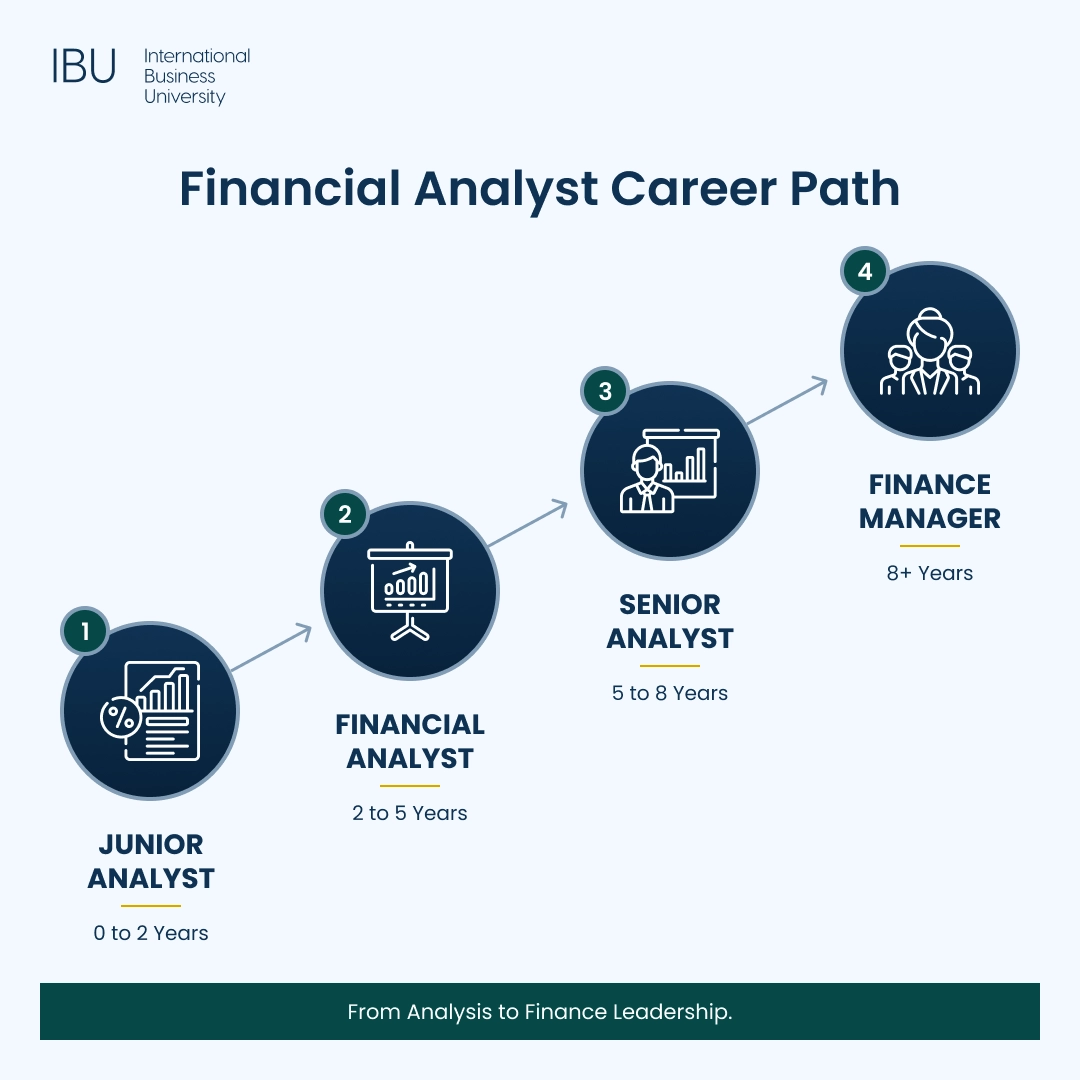
Once you know how to become a financial analyst, the role scales predictably with experience and additional credentials.
- Junior or entry-level analyst (0 to 2 years): Builds models, prepares reports, and supports senior analysts, typically working under close review while learning the specific reporting standards and systems a particular employer uses.
- Financial analyst (2 to 5 years): Owns specific reporting areas and begins presenting findings directly to management, taking on accountability for a defined portfolio of reports rather than supporting someone else’s work.
- Senior financial analyst (5 to 8 years): Leads forecasting cycles and mentors junior staff, often acting as the main point of contact between the finance function and the business units the forecasts serve.
- Finance manager or director (8 or more years): Oversees the analyst function and connects financial analysis to broader business strategy, a shift from producing analysis to deciding what gets analyzed and why.
Movement between these stages depends on demonstrated impact and, increasingly, additional credentials such as the CFA designation or an MBA once a candidate targets senior or specialized roles. A university degree is the baseline requirement listed for the occupation nationally, but it functions as an entry point rather than a differentiator: since every candidate at the junior level holds one, what separates a candidate who advances quickly from one who does not is typically the applied analysis they can point to directly, not the credential itself.
The pace of a financial analyst career path also depends on sector. A financial analyst in a bank’s risk division tends to move through structured, formally graded review cycles, while one at a smaller corporate finance team may take on senior-level scope earlier simply because the team is smaller and responsibilities shift faster. Either path still runs through the same four stages, but the timeline attached to each one is a range rather than a fixed number of years.
Financial Analyst Skills That Get BCOM Graduates Hired in Round One
Part of learning how to become a financial analyst is knowing employers screen candidates for a consistent set of skills during the interview process. Job Bank Canada’s Occupational and Skills Information System rates digital literacy and numeracy at the highest level for this occupation, alongside attention to detail and analytical thinking, both marked as extremely important to employers filling the role.
- Financial modeling: Building forecasts and scenarios in spreadsheet software with accuracy and speed, since a forecast an interviewer cannot follow or trust undermines every other qualification on the page.
- Attention to detail: Catching errors in large data sets that would otherwise distort a report, an attribute Job Bank identifies as one of the most heavily weighted employers screen for in this occupation.
- Business communication: Explaining financial findings clearly to non-financial stakeholders, since a correct analysis that a manager cannot act on delivers no value to the business commissioning it.
- Analytical reasoning: Drawing a defensible conclusion from incomplete or ambiguous data, the skill that separates a candidate who can run a spreadsheet from one who can advise a decision.
Candidates who can walk an interviewer through a specific forecast or spreadsheet they built, rather than describing coursework in general terms, consistently perform better in first-round interviews. That preference lines up with what the labour market data shows employers screening for: the financial analyst skills that matter most are applying that skill and analytical reasoning directly to data. This outweighs a list of courses completed, since coursework describes exposure while walking through real work demonstrates the skill itself.
Build the Foundation for Finance Roles
Develop accounting, analysis, and business decision-making skills.
Financial Analyst Salary: What Each Career Stage Pays Across Canada
Financial analyst compensation in Canada varies by city, industry, and experience level, with major financial centers such as Toronto typically paying at the higher end of the national range. Entry-level roles start lower and increase steadily with experience, and the jump from analyst to senior analyst or manager typically brings the largest single increase in a financial analyst’s career.
Financial analyst salary data in Canada should factor into that decision too: candidates evaluating if they should pursue additional credentials should weigh the salary increase against the time and cost involved. A CFA designation or MBA tends to pay off most clearly for candidates targeting senior, investment-focused, or leadership-track roles rather than staying in a general analyst position long term.
Frequently Asked Questions
Can you become a financial analyst without a dedicated finance degree in Canada?
A general business degree with strong accounting and finance coursework, such as a BCOM, is a common and accepted path into entry-level analyst roles. Employers generally care more about demonstrated financial structuring ability than the exact degree title. A dedicated finance degree can help, but it is not the only route in.
Is a BCOM enough to become a financial analyst or do I also need a CFA?
A BCOM is enough to enter the field at the analyst level. The CFA becomes more relevant when a candidate targets investment analysis, portfolio management, or senior finance roles later in their career. Many financial analysts work for years before deciding if the CFA fits their specific career direction.
How long does it take to become a senior financial analyst in Canada?
Most professionals reach a senior financial analyst title within five to eight years of consistent experience, though this varies by industry and individual performance. Progress accelerates for candidates who take on higher-visibility projects and pursue additional credentials along the way. Internal promotion timelines also vary significantly between organizations.
Is the CFA more valuable than an MBA for a financial analyst career?
The CFA is generally more valuable for candidates focused specifically on investment analysis and portfolio management. An MBA is generally more valuable for candidates aiming toward broader financial leadership or management roles that combine finance with strategy and people management. Some professionals pursue CFA and MBA credentials together at different career stages.
Mapping Your Path From Degree to Analyst Role
The fastest way to learn how to become a financial analyst starts with mastering the fundamentals a BCOM provides. After that, gain applied experience through an internship or entry-level role before deciding if a specialized credential fits your specific direction. Avoid pursuing the CFA or an MBA before clarifying if your goal is investment analysis, financial leadership, or a different specialization entirely, since the two credentials serve different long-term paths. Focus your first two years on building a track record of accurate, well-communicated financial analysis, since that record is what actually earns the next promotion.
Start Your Path Toward a Finance Career
Apply to IBU and build the business skills financial analyst roles require.