
Most BCOM and finance graduates apply to entry-level finance jobs the same way: find the posting, submit the resume, and wait for a response.
This approach works occasionally. It fails consistently for two reasons: it relies entirely on the automated screening processes of organizations that receive hundreds of applications per posting, and it casts the candidate as a passive applicant rather than a proactive professional.
Understanding how the finance hiring process actually works, what gets applications past the initial screen, what employers are testing for in first-round interviews, and which roles lead fastest to senior positions is the knowledge gap most finance graduates never close until they have already spent months in a frustrating job search.
Key Takeaways
- Finance hiring is process-driven: Understanding and preparing for each stage, ATS screening, technical interview, and fit interview produce better outcomes than applying reactively and hoping.
- Mid-market and non-bank finance employers are underutilized: Insurance companies, asset managers, fintech firms, and corporate treasury departments hire BCOM graduates consistently and receive fewer applications than large bank programs.
- CFA candidacy signals intent more powerfully than coursework: Registering for CFA Level 1 study while in your final year is a low-cost, high-signal career differentiator.
- Technical finance questions are learnable and predictable: The questions asked in 80% of entry-level finance interviews are well-known. Preparing 15 to 20 specific technical answers transforms the first-round interview from a gamble into a preparation exercise.
The Entry-Level Finance Jobs That Actually Exist in Canada Right Now
Entry-level finance is not a single job type. It is a cluster of distinct roles with different day-to-day responsibilities, different advancement trajectories, and different entry requirements. Treating them as interchangeable leads to applications that are too generic to win anything.
Financial Analyst
Financial analyst roles at banks, insurance companies, asset managers, and corporate treasury departments involve financial modelling, variance analysis, reporting, and support for business planning processes, and how to become a financial analyst in one of these settings is covered in a dedicated guide. These are the most competitive entry-level finance positions because demand is high and they are well-known. Competition is intense at large institutions. Smaller companies and mid-market firms are frequently overlooked and often more accessible.
Credit Analyst
Credit analysis roles at banks and alternative lenders assess the creditworthiness of businesses and individuals. They require strong analytical skills, comfort with financial statements, and attention to detail. These roles are less glamorous than investment banking adjacent positions but are excellent development grounds; credit analysts who perform well move into commercial banking, risk management, or lending roles that command strong compensation.
Accounting Associate
Accounting associate and junior accountant positions at public accounting firms, corporate finance departments, and government agencies are among the most consistently available entry-level finance roles in Canada. Many of these positions support CPA designation pathways, making them a structured investment rather than just a job.
Investment Operations Analyst
Operations roles at asset management firms and investment dealers, sometimes called back-office or middle-office roles, handle trade settlement, reconciliation, compliance reporting, and fund administration. These positions are less prominent in graduate conversations but pay competitively, offer high job security, and create strong pathways into investment management careers.
Treasury Analyst
Treasury analyst roles at corporations manage cash positions, banking relationships, debt monitoring, and foreign exchange exposure. They require comfort with financial data and banking systems. These roles exist outside of financial services firms, in retail companies, manufacturing firms, and technology companies, making them more geographically accessible and less competitive than bank-focused positions.

Build Your Finance Career Foundation
IBU’s BCOM and MBA programs include finance specializations that prepare you for analyst roles.
What a BCOM Gives You That Other Finance Candidates Do Not Have
The finance job market attracts candidates from multiple backgrounds: economics degrees, accounting programs, mathematics, and, more recently, data science and statistics. A BCOM graduate has specific advantages that others do not, but only if they articulate them clearly.
Business Context for Financial Analysis
A BCOM graduate understands how financial analysis fits into business decision-making, not just how to run the numbers. This business context is what separates analysts who produce useful insights from those who produce technically correct calculations with no practical relevance. Hiring managers in corporate finance value this combination.
Communication and Presentation Skills
Finance roles require communicating findings to non-finance stakeholders. BCOM programs consistently develop presentation skills, business writing, and the ability to translate complex information into accessible summaries. Pure quantitative candidates from economics or mathematics programs often lack this, and it shows in the screening process.
Organizational and Project Management Exposure
BCOM graduates have typically managed group projects, case competitions, and structured coursework that mirrors the multi-stakeholder, deadline-driven environment of professional finance roles. This exposure is directly relevant and should be articulated explicitly in applications and interviews.
How to Build a Finance Career Profile While Still in Your Final Year
The most effective time to build your finance career profile is before graduation, not after. Three specific actions taken in the final year of a BCOM program produce a dramatically stronger application than one assembled after graduation.
- Complete a finance internship or co-op: Direct finance work experience, even one semester, is the most significant differentiator between BCOM graduates who secure analyst roles immediately and those who spend six to twelve months in an unrelated position first.
- Start the CFA Level 1 study process: You do not need to pass CFA Level 1 before your first finance job. Appearing on your resume as a registered CFA candidate signals serious intent to finance hiring managers in a way that no coursework alone replicates.
- Build a basic Excel and financial modelling portfolio: Three to five financial models built for personal projects, case competitions, or coursework, uploaded to a personal website or GitHub, demonstrating applied skills that a transcript cannot.
What Canadian Finance Employers Test for in First-Round Interviews
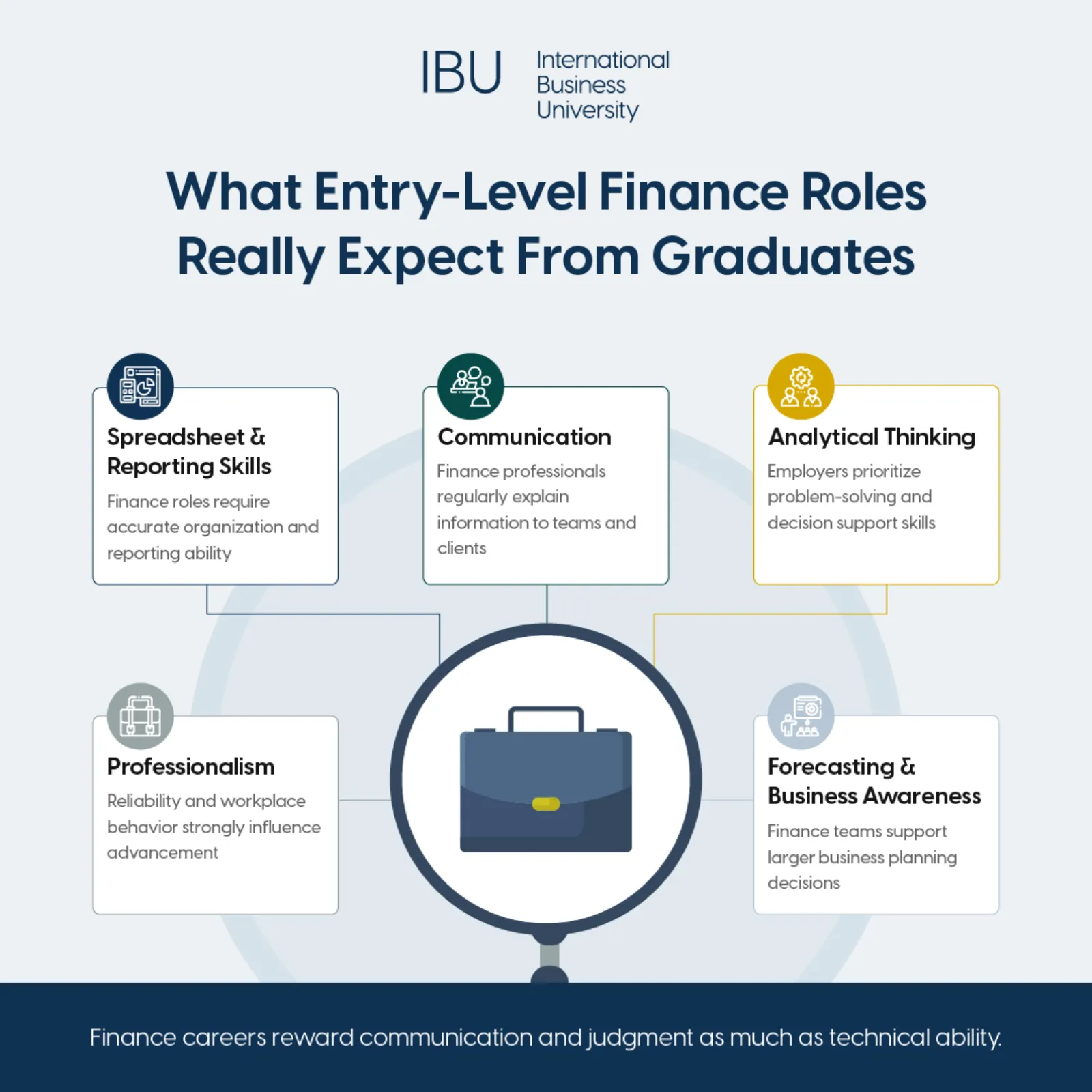
First-round interviews at Canadian banks, asset managers, and corporate finance departments typically test three areas. Candidates who prepare for all three move to the second round. Those who prepare for only the resume questions rarely do.
Technical Finance Knowledge
Expect questions on financial statement analysis, basic valuation concepts, and accounting mechanics. Common first-round questions include: walk me through the three financial statements and how they connect, how does a $10 increase in depreciation affect the financial statements, and what is the difference between enterprise value and equity value. These are not trick questions; they test whether you can apply the fundamentals you should know from a finance-focused BCOM.
Structured Analytical Reasoning
Case-style questions test how you approach a problem, not just whether you can calculate the answer. Practice structuring your answers: state your approach first, then work through it systematically. Finance interviewers value structured thinking over arriving at the right number.
Motivation and Career Clarity
‘Why finance’ and ‘why this firm’ are tested in almost every first-round finance interview. Generic answers, ‘I enjoy working with numbers’ and ‘your firm has a great reputation’, fail. Specific answers that connect your academic background to a particular area of finance and demonstrate knowledge of what this specific firm does win. Prepare these answers in the same way as you would prepare a technical question.
The Application Mistakes That Eliminate Most Candidates Before the Interview
- Applying with a generic resume not tailored to the role: Finance job descriptions include specific skills and responsibilities. A resume that does not mirror those specifics is eliminated by ATS screening systems before a human ever reads it.
- No cover letter or a generic one: Most finance candidates skip cover letters or use templates. A specific, well-written cover letter that connects your background to the role and demonstrates knowledge of the firm is an immediate differentiator in a competitive application pool.
- Applying only through the public posting: The majority of finance hires at mid-market firms and smaller financial institutions happen through referrals and direct outreach, not public postings. Identifying the hiring manager or team lead and reaching out directly, politely, and specifically supplements the formal application with a warm contact.
- Applying to only large institutions: Large bank analyst programs at RBC, TD, BMO, CIBC, and Scotiabank are excellent but intensely competitive. The majority of entry-level finance jobs in Canada are at insurance companies, asset managers, fintech firms, mid-market banks, credit unions, and corporate treasury departments, all of which hire BCOM graduates and receive far fewer applications per posting.
The Three Entry-Level Roles That Lead Fastest to Senior Finance Positions
Not all entry-level finance roles are created equal in terms of advancement trajectory. Three roles consistently produce faster pathways to senior positions.
- Financial analyst at a mid-market firm: Broader scope, faster responsibility accumulation, and more direct exposure to senior finance professionals than equivalent roles at large institutions.
- Credit analyst at a bank or alternative lender: Strong technical foundation, direct financial statement work, and a clear advancement path into commercial banking or risk management within three to five years.
- Accounting associate at a public accounting firm: Structured CPA pathway, broad exposure to different industries and business types, and alumni networks that place well into corporate finance roles at the manager and director level.
Frequently Asked Questions
What is the average salary for entry-level finance jobs in Canada?
Entry-level finance salaries in Canada typically range from $48,000 to $75,000, depending on the role, institution, and location. Financial analyst roles at banks start at the higher end of this range. Operations and accounting associate roles tend to start lower but progress quickly with performance. IBU’s blog on starting a career in finance after graduation provides additional context on salary ranges by role and pathway.
Do I need a CFA to get an entry-level finance job?
No. CFA Level 1 is not required for most entry-level finance roles. Being a registered CFA candidate, even without having passed Level 1, signals intent and commitment to finance hiring managers in a way that differentiates you from candidates with equivalent academic backgrounds who have not taken that step.
For investment management and portfolio-adjacent roles, CFA progression becomes increasingly important as you advance. For corporate finance, financial analysis, and accounting roles, it is a differentiator but not a requirement.
Can I get an entry-level finance job without an internship?
Yes, but it is significantly harder. Hiring managers evaluating entry-level finance candidates consistently rank internship experience as the most valuable differentiator on a new graduate’s resume. Candidates without internship experience can compensate partially with relevant certifications, a strong academic record in finance coursework, and evidence of applied financial work like modeling projects or case competition participation, but direct work experience remains the most powerful signal.
Finance Careers Reward Candidates Who Understand the Process
Entry-level finance jobs in Canada are available and accessible to BCOM graduates who approach the process deliberately. The gap between graduates who secure strong first roles and those who struggle for months is rarely academic; it is preparation, positioning, and process.
Understand what employers are screening for, prepare for technical questions with the same discipline you applied to coursework, and apply to the full range of finance employers, not just the most visible ones, and the market opens up significantly.

Prepare for Finance Roles That Move Your Career Forward
IBU’s finance-focused BCOM and MBA programs help you build analytical, business, and leadership skills for today’s finance industry.