

Corporate and asset finance is the study of how businesses access, allocate, and manage the money they need to operate and grow. Every company, from a small Canadian manufacturer to a publicly traded corporation, faces the same fundamental question: where does the money come from, and how should it be used? The answers to that question shape every major business decision, from hiring to expansion to equipment purchases. Understanding how corporate and asset finance work is one of the most practical competencies a business student can develop.
Key Takeaways
- Corporate finance and asset finance serve different but connected purposes: Corporate finance manages the overall capital structure and long-term investment decisions; asset finance uses specific assets to access funding or preserve cash.
- The choice between debt and equity has lasting consequences: Debt preserves ownership but creates repayment obligations; equity shares control but does not require repayment, and the right mix depends on the business stage and risk tolerance.
- Finance decisions connect to every other business function: How a company funds growth affects its operations, hiring, product development, and long-term competitive position in ways that extend well beyond the finance team.
What Is Corporate and Asset Finance
Corporate and asset finance covers two related but distinct areas of business financial management. Corporate finance focuses on how companies make capital structure decisions and fund long-term goals. Asset finance focuses on how specific physical or financial assets are used to access funding or generate value. Together, they form the foundation of how companies raise capital and deploy it.
Corporate Finance: The Bigger Picture
Corporate finance is concerned with the financial planning for businesses at the strategic level. It addresses questions like: how much debt should we carry, when should we raise equity, and which investments will generate the best return? Finance teams in corporations use tools like discounted cash flow analysis, weighted average cost of capital, and capital budgeting models.
These tools help leadership compare business funding options and allocate scarce capital to the highest-value uses. Decisions made at this level affect every department in the organization, not just the finance function.
Asset Finance: Using What You Own to Fund What You Need
Asset finance is a more specific category within the broader field. It refers to financing arrangements where assets, either existing ones or newly acquired ones, serve as the basis for funding. Equipment financing is one of the most common forms: a company acquires machinery or technology by financing it over time.
Asset-backed financing uses existing assets like inventory, receivables, or property as collateral to access loans or credit lines. For businesses that cannot or choose not to raise equity, asset finance provides a way to fund operations and growth without diluting ownership.
Why the Two Areas Overlap
Corporate and asset finance overlap when capital structure decisions involve asset-backed instruments. A company that finances its equipment fleet through leasing is making a capital structure decision. A manufacturer that uses accounts receivable as collateral for a working capital line is doing both.
Students who understand how these two areas interact develop a more complete picture of how businesses fund themselves. That integrated understanding is what separates strong finance graduates from those who only know individual concepts in isolation.
Why Businesses Need Funding to Grow
Businesses need external or structured funding because growth always costs more than current cash flow supports. Hiring new staff, opening new locations, buying equipment, and entering new markets all require capital up front.
Revenue from those investments arrives later, sometimes much later. The gap between when money goes out and when it comes back in is exactly what financing business growth is built to bridge.
According to Statistics Canada’s survey on SME financing and growth, nearly two in three Canadian SMEs (65.9%) reported average annual sales growth from 2021 to 2023. Yet almost half (49.3%) requested external financing in 2023 to support that growth.
Those two figures together tell the same story: even growing businesses regularly need outside capital to sustain and accelerate their trajectory.
Funding needs also differ significantly by business stage. Early-stage companies typically need working capital financing to cover operating costs before revenue stabilizes. Growth-stage companies need business expansion funding for facilities, talent, and market entry.
Mature companies use corporate finance tools to optimize their capital structure and return value to shareholders. Each stage calls for a different mix of instruments and a different approach to risk.
How Companies Raise Money for Expansion
Companies raise money for expansion through a combination of debt, equity, and asset-based instruments. The right mix depends on the company’s size, growth stage, industry, and risk tolerance. Understanding the full range of business funding options is central to financial planning for businesses at any level.
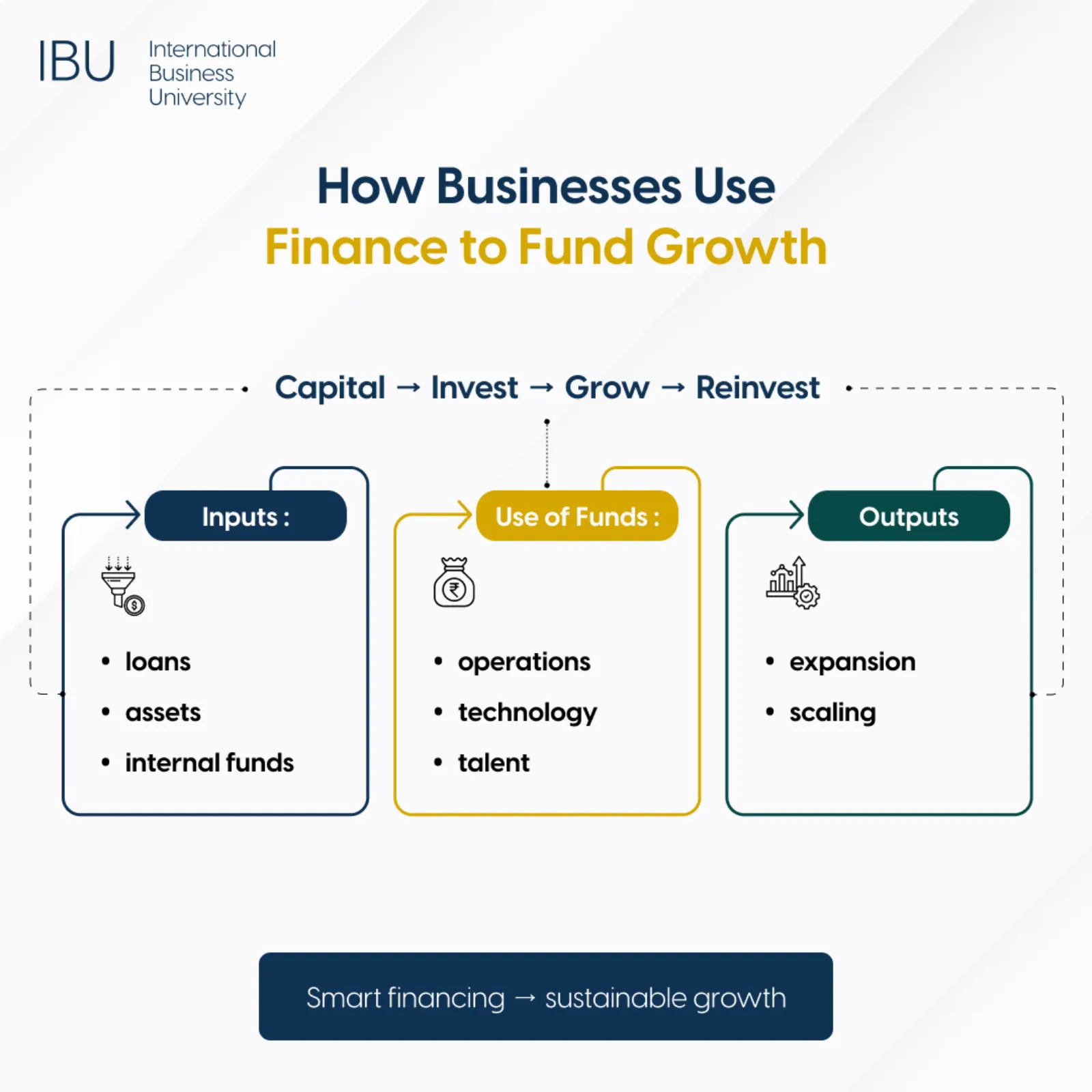
Capital enters the business through three primary inputs: loans, assets, and internal funds. That capital is then deployed across operations, technology, and talent, the three areas where spending produces the capacity to grow. The output of that spending is expansion and scaling, the outcomes of good financing decisions.
Capital, invest, grow, and reinvest is not incidental; it is the operating logic of every growing business. What makes financing smart is choosing the right input for the right use at the right time.
Debt Financing
Debt financing means borrowing money that must be repaid with interest over time. It includes bank loans, lines of credit, term loans, and bonds for larger corporations. The primary advantage of debt is that it does not dilute ownership. Founders and shareholders retain full control while accessing the capital they need.
The risk is that repayment obligations exist regardless of business performance. A company that borrows heavily and then misses revenue projections faces cash flow pressure that can threaten operations.
Equity Financing
Equity financing means raising capital by selling a share of the business. This includes venture capital, angel investment, private equity, and public share offerings. Debt vs equity financing involves a fundamental trade-off: equity does not require repayment.
There is no interest cost and no obligation to return funds on a fixed schedule. The cost, however, is ownership. Equity investors become partial owners of the business and often expect a voice in strategic decisions. For fast-growing companies that need large amounts of capital quickly, equity is often the most practical route.
Internal Funds and Retained Earnings
Internal funds come from profits that the business retains rather than distributes to owners. This is the least costly form of financing because there is no interest and no ownership dilution. The limitation is that it depends entirely on the business generating sufficient profit to fund its own growth.
Early-stage and high-growth companies often cannot rely on retained earnings alone. Mature businesses with stable cash flows frequently use retained earnings as the primary source of reinvestment capital.
Corporate Finance and Long-Term Growth Decisions
Corporate finance applies most directly when businesses make long-term capital allocation decisions. These are decisions about which projects to fund, how to structure the balance sheet, and how to return value to shareholders. Capital structure decisions at this level involve weighing cost, risk, flexibility, and strategic fit simultaneously.
Capital Budgeting
Capital budgeting is the process of evaluating which long-term investments are worth funding. A company might be considering a factory expansion, an acquisition, or a new product line. Capital budgeting tools like net present value and internal rate of return quantify even if the expected return justifies the cost.
Businesses that make these decisions without rigorous analysis frequently over-invest in low-return projects. Those that apply capital budgeting consistently allocate resources more efficiently and produce stronger shareholder returns over time.
Optimal Capital Structure
Capital structure refers to the proportion of debt and equity a company uses to finance itself. There is no single correct ratio; it depends on the industry, the business model, and the cost of each type of capital.
Highly capital-intensive businesses like manufacturing and real estate typically carry more debt. Asset-light businesses such as software companies often carry less because they have fewer tangible assets to use as collateral. Financial planning for businesses at the corporate level involves continuously optimizing this structure as conditions change.
Dividend and Reinvestment Decisions
A key corporate finance decision is how to distribute profits versus reinvesting them. Paying dividends returns value to shareholders but reduces the capital available for growth. Reinvesting profits keeps capital in the business but delays returns to shareholders.
The right balance depends on the growth stage, the availability of high-return investment opportunities, and shareholder expectations. Listed companies face particularly close scrutiny on this decision because it affects the stock price directly.
Asset Finance and How Businesses Use Assets
Asset finance gives businesses access to capital or equipment without large upfront cash outlays. It is particularly common in industries that rely heavily on physical infrastructure, vehicles, and machinery. Understanding how asset finance works connects directly to capital structure decisions, because the choice between owning and financing assets affects the balance sheet significantly.
Equipment Financing
Equipment financing allows businesses to acquire machinery, vehicles, or technology on a payment schedule. Rather than paying the full cost upfront, the business spreads the expense over the useful life of the asset. This preserves working capital for operations while still giving the business access to the assets it needs.
Lenders typically secure equipment financing against the asset itself, which reduces their risk and lowers borrowing costs for the business. For small and medium businesses in manufacturing, transportation, and construction, equipment financing is one of the most frequently used business funding options available.
Asset-Backed Financing
Asset-backed financing uses existing assets as collateral to access loans or revolving credit. A company with a large accounts receivable balance can borrow against those invoices before they are paid. A business with significant inventory can use that stock as collateral for a working capital line.
According to the Statistics Canada Survey on Financing and Growth of Small and Medium Enterprises (ISED, 2025), 47% of Canadian SME debt financing was secured by collateral in 2023, with business assets used by 71% of those borrowers. That figure demonstrates how central asset-backed financing is to everyday business funding across Canada.
Leasing as an Asset Finance Tool
Leasing is a form of asset finance that lets businesses use equipment or property without owning it outright. Operating leases keep assets off the balance sheet, which can improve certain financial ratios. Finance leases effectively transfer ownership over the lease term and appear on the balance sheet.
Airlines, logistics companies, and retail businesses use leasing extensively to manage large asset bases without tying up capital. The trade-off is that leasing typically costs more in total over time than outright purchase, but preserves flexibility and liquidity.
Study Finance at IBU
IBU’s MBA programs develop financial decision-making skills employers need.
Corporate and Asset Finance Compared
Corporate and asset finance serve different purposes but both contribute to how companies fund growth. Understanding where they differ helps students connect the right tool to the right business situation. They are not competing approaches; most companies use elements of both simultaneously.
- Scope: Corporate finance covers the entire capital structure and long-term investment strategy; asset finance focuses on specific assets and how they are financed or leveraged.
- Decision level: Corporate finance decisions are typically made by the CFO and executive team; asset finance decisions happen at the operational and departmental level.
- Time horizon: Corporate finance looks at multi-year strategic plans; asset finance often addresses immediate or medium-term funding needs for specific assets.
- Risk profile: Corporate finance decisions carry strategic and market risk; asset finance decisions carry asset-specific and collateral risk.
- Who uses each: Large corporations primarily use corporate finance frameworks; small and medium businesses more frequently rely on asset finance as their primary business funding option.
- Tools involved: Corporate finance uses DCF models, WACC calculations, and capital budgeting; asset finance uses loan-to-value ratios, lease structures, and receivables schedules.
Examples of Business Funding Decisions
Financing business growth looks different depending on the industry, size, and stage of the business. Concrete examples make abstract finance concepts easier to apply in case analysis and in professional practice. The scenarios below represent the kinds of decisions that appear regularly in MBA coursework and in the workplace.
A Manufacturer Expanding Production Capacity
A mid-sized Canadian manufacturer wants to add a second production line. The equipment costs $2 million. The company has $500,000 in retained earnings available, but does not want to deplete cash reserves. It approaches its bank for a term loan secured against the equipment itself.
This is a classic equipment financing scenario: the asset being acquired serves as its own collateral. The company maintains liquidity, spreads the cost over five years, and retains full ownership. The capital structure decision here is straightforward: debt financing is cheaper than equity for a profitable business with stable cash flows.
A Tech Startup Raising Equity
A software startup has a strong product but needs capital to hire and scale sales. It has no physical assets to use as collateral and its revenue is still early-stage. Debt financing is not accessible at reasonable rates without a revenue track record.
The founders raise a seed round from angel investors, exchanging 15% equity for $800,000 in capital. This is how companies raise capital when assets and revenue history are not yet sufficient to support debt. The cost is ownership dilution; the benefit is capital without repayment obligations during a period of high uncertainty.
A Retailer Using Working Capital Financing
A retail business has strong sales but faces a seasonal cash gap every spring. Inventory purchases for summer stock are due before spring revenue arrives. The company draws on a revolving line of credit secured against its inventory and receivables.
This is working capital financing in practice: short-term borrowing to bridge a timing gap in cash flow. It does not change the capital structure permanently; the line is drawn and repaid within the same operating cycle. Understanding this distinction is important in financial analysis: not all borrowing represents long-term leverage.
Common Mistakes Students Make in Finance
Finance mistakes in academic settings often reflect the same conceptual gaps that appear in professional practice. Identifying them early helps students develop more accurate financial reasoning before they are tested on it professionally. Most of these errors come from applying formulas without understanding the underlying logic they express.
- Confusing profit and cash flow: A business can report accounting profit while simultaneously running out of cash, which is why working capital financing exists.
- Treating all debt equally: Short-term and long-term debt carry different costs, risks, and uses; conflating them produces inaccurate capital structure analysis.
- Ignoring the cost of equity: Students often treat equity as free because there is no interest payment, but equity has a cost: the return shareholders expect.
- Overlooking asset intensity: The right financing mix for a manufacturing business looks very different from that of a consulting firm; ignoring this produces generic rather than contextual analysis.
- Applying DCF mechanically: Discounted cash flow models are only as good as their assumptions; students who input numbers without interrogating assumptions produce confident but unreliable valuations.
- Skipping the qualitative context: Finance decisions involve judgment about management quality, market conditions, and strategic fit that numbers alone cannot capture.
How Students Can Start Thinking Like Decision Makers
Thinking like a financial decision maker requires connecting theory to context before you are in the role. The gap between understanding concepts in class and applying them professionally closes faster with deliberate practice. Three habits accelerate this transition more than any others.
Read Financial News with Specific Questions
Financial news becomes a learning tool when you approach it with specific questions. When a company announces an acquisition, ask: how are they financing it, and what does that say about their capital structure strategy?
When a startup raises a funding round, ask: why equity rather than debt, what does the valuation imply about investor expectations, and how strong was the venture capitalist pitch that made it happen? This habit builds financial intuition faster than case studies alone because the decisions are current and consequential. Publications like the Financial Post, Globe and Mail Business, and BNN Bloomberg cover Canadian corporate finance decisions regularly.
Build Simple Financial Models
Building financial models, even simple ones, forces precision that reading does not. Take a public company’s annual report and build a basic three-statement model: income, balance sheet, and cash flow. Then test what happens to cash flow if revenue drops 10% while debt obligations remain fixed.
That scenario demonstrates the risk of leverage in a way that a textbook definition cannot. Students who can build and stress-test models in Excel or Google Sheets enter professional settings with a practical skill most peers lack.
Study Case Decisions in Your Industry of Interest
Finance decisions look different in healthcare than in technology or manufacturing. Studying how companies in your target industry have structured their capital gives you context-specific intuition.
How did Shopify fund its early expansion? How do Canadian hospital networks manage asset finance for medical equipment? These questions connect corporate and asset finance concepts to the industries where you will actually apply them.
Why Corporate and Asset Finance Matters for Your Career
Corporate and asset finance is relevant to every business career, not only finance roles. Operations managers who understand financing business growth make better investment proposals. Marketing leaders who understand capital constraints make more credible budget requests. Entrepreneurs who understand business funding options make better decisions about when and how to raise capital.
The same Statistics Canada survey on SME financing found that 72.6% of Canadian SMEs anticipate average yearly growth from 2024 to 2026. That anticipated growth will require financing decisions at every stage. The professionals who can evaluate those decisions accurately will be in demand across industries, company sizes, and roles. Finance literacy at the level of corporate and asset finance is not a niche specialization; it is a professional baseline.
IBU’s MBA in Financial and Management Analytics develops this kind of applied financial reasoning. Students work through capital structure decisions, financial modeling, and analytics in a curriculum built for professional application. IBU’s MBA in Technology, Innovation, and Entrepreneurship also addresses funding decisions in the context of entrepreneurial growth and venture strategy. Both programs cover corporate and asset finance as part of their broader business education, not as abstract theory.
Frequently Asked Questions
What is the difference between corporate finance and asset finance?
When should a business choose debt over equity financing??
Why should business students understand corporate and asset finance?
Understanding Finance Is What Separates Managers from Leaders
Corporate and asset finance is not only for accountants or investment bankers; it is the foundation of how every business decision gets funded and evaluated. Students who understand how companies raise capital, choose between debt and equity, and deploy assets strategically carry an advantage into every role they hold. IBU’s programs in Financial and Management Analytics and Technology, Innovation, and Entrepreneurship both develop this capability within a curriculum built for the decisions graduates will face from their first day in a professional role.
Build Financial Decision Skills
IBU’s MBA connects finance theory to applied career outcomes.